Space Physics
 Call Kai
 Learn
Learn Practice Test
 Spaced Repetition
 Match
Match Flashcards
 Knowt Play
1/43

There's no tags or description
Looks like no tags are added yet.
Name | Mastery | Learn | Test | Matching | Spaced | Call with Kai | Chat |
|---|
No analytics yet
Send a link to your students to track their progress
44 Terms
Give four types of object that form our solar system.
Sun
8 planets
Dwarf planets
Natural satellites
What name is given to objects that orbit a planet?
Natural satellites
What is the name of our galaxy?
Milky Way
What is a nebula?
Cloud of dust + gas
How was the Sun formed?
From nebula pulled together by gravitational attraction
At the start of a star’s life cycle, what does the dust and gas drawn together by gravity cause, and what do these lead to?
Fusion reactions
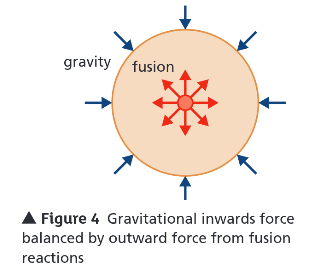
Equilibrium between gravitational collapse of star and expansion of star due to fusion energy
At the start of a star’s life cycle, what is the dust and gas drawn together by?
Gravity
Why is the Sun white?
Emits all wavelengths of visible light equally
What are the eight planets in the solar system in order?
Mercury → Venus → Earth → Mars → Jupiter → Saturn → Uranus → Neptune

Describe the process of star formation.
Particles in nebula pulled together by own gravitational attraction
Nebula merge together (becomes more concentrated) — forms protostar
Protostar becomes denser → its particles speed up more + collide more → temperature increases
process transfers energy from GPE → thermal energy
Protostar becomes hot enough? → nuclei of hydrogen atoms fuse together — forms helium nuclei
energy released in this fusion → star is ‘born’
Describe what is meant by a protostar.
First stage stars go through after forming from nebula
Star becomes hot enough for hydrogen nuclei to fuse
In star formation, objects can form that are too small to become stars.
What happens to these objects?
Attracted by protostar → becomes planets orbiting star
Why do stars like the sun radiate energy?
Hydrogen fusion in core
What are stars like the sun called, and why?
Main sequence stars
Main stage in life of star
Explain why main sequence stars are stable.
Forces within it are balanced
Gravity acts inwards trying to make star contract
Force f/ fusion reactions (radiation pressure) in core acts outwards trying to make star expand
Forces are in equilibrium — stay in equilibrium until most hydrogen nuclei in core fused together to form helium nuclei
What is the life cycle of a star the size of the Sun?
Nebula → Protostar → Main sequence star → Red giant → White dwarf → Black dwarf
What is the life cycle of a star which is more massive than the Sun?
Nebula → Protostar → Main sequence star → Red super giant → Supernova → Neutron star or Black hole
What is a red giant star?
Hydrogen used up and larger nuclei produced by fusion
stars of similar magnitude to Sun expand to form red giant
What produces all the naturally occurring elements?
Fusion processes in stars
Elements heavier than iron are produced in supernova
explosion of massive star (supernova) distributes elements throughout universe
What provides the force that allows planets and satellites to maintain their circular orbits?
Gravity
What is a satellite?
Object that orbits more massive object
What are artificial satellites?
Man-made satellites that have been sent into space
for satellite imaging + communications
For circular orbits, the force of gravity can lead to changing velocity but unchanged speed.
Explain this.
Gravity causes acceleration
Acceleration = change in velocity
Change in velocity = speed or direction changing
In circular orbit, direction constantly changing → changing velocity + unchanged speed
Define radiation pressure.
Outward force cause by energy release f/ fusion
What is meant by the word ‘massive’ in the context of space physics?
Object w/ more mass
What effect does a resultant force have on an object?
Causes object to accelerate — change in object’s speed or direction
What is the only force acting on an object that is in orbit around a larger object?
Gravity
Explain why red giants expand.
Main sequence star in equilibrium
Hydrogen decreases → force from fusion reactions reduces
initially causes star to collapse inwards
Inward collapse causes temp increase → allows helium nuclei to fuse together → makes heavier elements
outward force increases
Star expands → becomes red giant
Describe how a white dwarf is formed.
Red star becomes unstable
Outer layer ejected and remainder collapses (because of gravity)
Smaller v/ hot, dense solid core left behind (white dwarf)
What must an object do to maintain a stable orbit if it has a smaller orbit radius?
Travel at higher speed
![<p>Figure 1 shows the Hubble Space Telescope orbiting the Earth.</p><p><strong><mark data-color="yellow" style="background-color: yellow; color: inherit;">Explain</mark> the effect of the Earth’s gravitational force on the motion of the Hubble Space Telescope. [3 marks]</strong></p>](https://assets.knowt.com/user-attachments/02c8d8d2-e651-405a-a040-5b81da70d41a.png)
Figure 1 shows the Hubble Space Telescope orbiting the Earth.
Explain the effect of the Earth’s gravitational force on the motion of the Hubble Space Telescope. [3 marks]
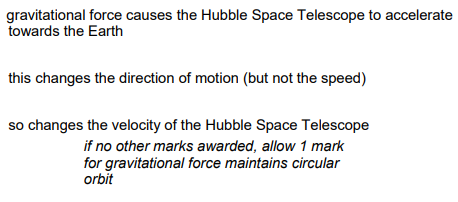
Gravitational force causes Hubble Space Telescope to accelerate towards Earth
changes the direction of motion
This changes velocity of Hubble Space Telescope
Galaxies contain billions of stars.
Compare the formation and life cycles of stars with a similar mass to the Sun to stars with a much greater mass than the Sun. [6 marks]
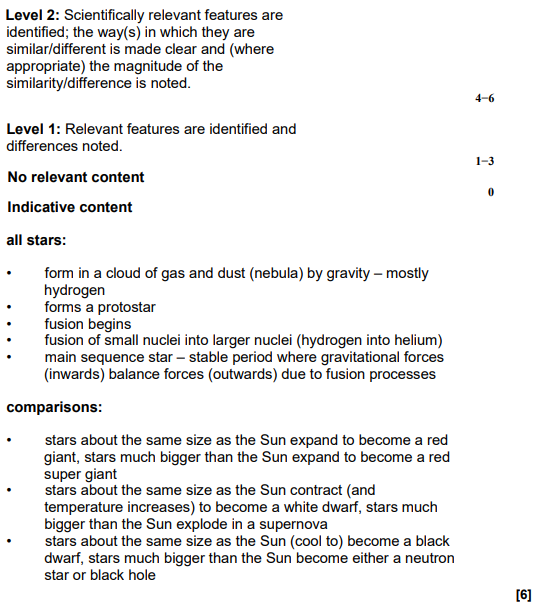
All stars form in nebula by gravity → form protostar → fusion begins → fusion of small nuclei into larger nuclei
Become main sequence stars — stable period where gravitational forces inwards = outward forces due to fusion processes
Stars about same size as Sun — expand to become red giant
Stars bigger than Sun — expand to become red super giant
Stars same size as Sun contract — temperature increases to become a white dwarf
Stars bigger than Sun — explode in supernova
Stars same size as Sun — cool to become black dwarf
Stars bigger than Sun — become:
neutron star or black hole
Describe what is meant by red-shift.
Observed increase in wavelength of light from galaxies
As galaxies move away from us
More distant galaxies = moving faster = bigger observed increase in wavelength
What does the observed red-shift provide evidence for?
Universe is expanding
Big Bang Theory
What does the Big Bang Theory suggest?
Universe began from v/ small region
extremely hot and dense
What does the fact that distant galaxies are receding faster prove about the universe?
Provides evidence that space between galaxies is increasing
entire universe is expanding
How does red-shift support the Big Bang model?
Red-shift shows that galaxies are moving apart + universe is expanding outwards
extrapolating this backwards suggests that universe must have begun from a v/ small, dense, + extremely hot point
How did Edwin Hubble use observations to support the expanding universe theory?
Hubble plotted observational data of red-shifted light f/ different galaxies
found that velocity of galaxy moving away is directly proportional to its distance — confirming the universe is expanding
What is dark energy?
Hypothesised form of energy — responsible for the universe’s ever increasing rate of expansion
What is dark matter?
Hypothesised type of mass (cannot be observed) — used to explain why some galaxies rotate faster than they should for their observed mass
![<ul><li><p>The light spectrum from every galaxy includes dark lines.</p></li><li><p>The lines have the same pattern. </p></li><li><p>The figure shows the position of dark lines in the visible spectra of light from the Sun and from two distant galaxies.</p></li></ul><p>Explain what these light spectra tell us about the velocities of galaxy A and galaxy B. [3 marks]</p>](https://assets.knowt.com/user-attachments/c4bc2e06-e1ab-421b-a3ad-3202c61f70ca.png)
The light spectrum from every galaxy includes dark lines.
The lines have the same pattern.
The figure shows the position of dark lines in the visible spectra of light from the Sun and from two distant galaxies.
Explain what these light spectra tell us about the velocities of galaxy A and galaxy B. [3 marks]
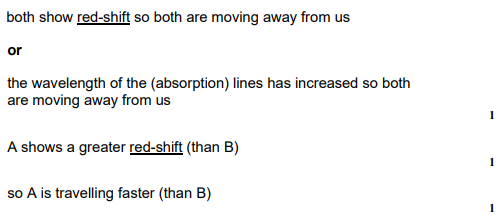
Both show red-shift so both are moving away from us
A shows greater red-shift than B
So A is travelling faster than B
![<ul><li><p>The Hubble Space Telescope can detect visible light from distant galaxies.</p></li><li><p>The visible light spectra from stars and galaxies include dark lines at specific wavelengths. </p></li><li><p>Figure 2 shows the visible light spectra from the Sun and two galaxies.</p></li></ul><p>Explain what conclusions can be made about galaxies A and B. [3 marks]</p>](https://assets.knowt.com/user-attachments/ec5914da-a807-4919-aa55-efff0f235fe2.png)
The Hubble Space Telescope can detect visible light from distant galaxies.
The visible light spectra from stars and galaxies include dark lines at specific wavelengths.
Figure 2 shows the visible light spectra from the Sun and two galaxies.
Explain what conclusions can be made about galaxies A and B. [3 marks]
Galaxy A has the greater red-shift
So A is travelling away from us faster than B
Because A is further away from us than B

![<ul><li><p>The points on diagram represent galaxies that are moving away from the Milky Way.</p></li><li><p>Each arrow represents the velocity of the galaxy relative to the Milky Way.</p></li><li><p>Light from all galaxies represented in the diagram is red-shifted.</p></li></ul><p>Explain how above diagram provides evidence for the Big Bang theory. [2 marks]</p>](https://assets.knowt.com/user-attachments/c5f014bb-c9d8-4bd4-8544-58c9de14c4da.png)
The points on diagram represent galaxies that are moving away from the Milky Way.
Each arrow represents the velocity of the galaxy relative to the Milky Way.
Light from all galaxies represented in the diagram is red-shifted.
Explain how above diagram provides evidence for the Big Bang theory. [2 marks]
The furthest galaxies are moving away from the Milky Way the fastest
Which suggests that at some time all galaxies started at the same point

![<ul><li><p>The points on diagram represent galaxies that are moving away from the Milky Way.</p></li><li><p>Each arrow represents the velocity of the galaxy relative to the Milky Way.</p></li><li><p>Light from all galaxies represented in the diagram is red-shifted.</p></li><li><p>Sometimes scientists have to change theories about the universe. </p></li></ul><p>Give the reason why. [1 mark]</p>](https://assets.knowt.com/user-attachments/e2e9089f-a84c-46e6-b889-6ee694f96de4.png)
The points on diagram represent galaxies that are moving away from the Milky Way.
Each arrow represents the velocity of the galaxy relative to the Milky Way.
Light from all galaxies represented in the diagram is red-shifted.
Sometimes scientists have to change theories about the universe.
Give the reason why. [1 mark]
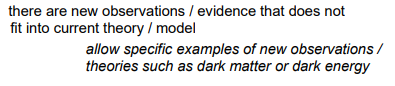
There is new evidence that does not fit into the current theory.