Endocrine Hypothalamus
 Call Kai
 Learn
Learn Practice Test
 Spaced Repetition
 Match
Match Flashcards
 Knowt Play
1/191

There's no tags or description
Looks like no tags are added yet.
Name | Mastery | Learn | Test | Matching | Spaced | Call with Kai | Chat |
|---|
No analytics yet
Send a link to your students to track their progress
192 Terms
1. Thirst Center
2. Feeding Centers
3. Control of Reproductive Behavior -> Steroid hormones (estrogen, progesterone, TST)
4. Regulation of temperature-- Thermostat
5. Control of Biological Rhythm
6. Regulates Secretory activity of Pituitary gland
Endocrine Hypothalamus Functions
• Basal part of the diencephalon lying between the thalamus
• Forms the wall and lower part of the ventricle of the brain
Anatomical Boundaries of Endocrine Hypothalamus

1 Median eminence
2 Hypophyseal Portal System (hypothalamohypophyseal portal system)
Vascular Connections of Endocrine Hypothalamus
Median eminence
Vascular connections that is the *lower part tuber cinereum* which is richly supplied with blood vessels that *drain in the pituitary stalk*
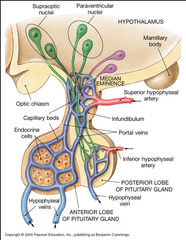
Hypophyseal Portal System (hypothalamohypophyseal portal system)
Vascular connections that is the Vascular link between the *median eminence* and the *pituitary gland*

1 Hypothalamic nuclei
2 Supraoptic nuclei (SON) & Paraventricular nuclei (PVN)
3 Supraopticoparaventricularhypophysial tract
Neural connections of Endocrine Hypothalamus
Hypothalamic nuclei
clusters of neurons
Supraoptic nuclei (SON) and Paraventricular nuclei (PVN)
Composed of cell bodies whose axons extend into the median eminence and then into the neurohypophysis
Supraopticoparaventricularhypophysial tract
A nerve tract composed of the axons of the SON and PVN
1. Thyrotropin Releasing Hormone (TRH)
2. Growth Hormone-Release Inhibiting Hormone (GH-RIH)/Somatostatin (Somatotropin Release-Inhibiting Hormone)
3. Somatocrinin (Growth Hormone-Releasing Hormone)/Somatotropin Releasing Hormone (STH-RH)
4. Gonadotropin-releasing Hormone (GnRH)/Luteinizing HormoneReleasing Hormone (LHRH)
5. Corticotropin Releasing Hormone (CRH)
6. Prolactin Release-Inhibiting Factor (PIF)/Dopamine
7.Prolactin-releasing Factor/Hormone (PRF/H)
8.MSH Release-Inhibiting Hormone (MSH-RIH)
Hypothalamic Releasing Hormones /Hypophysiotropic Hormones (8)
-Thyroid stimulating hormone (TSH)
-PRL
*Thyrotropin Releasing Hormone (TRH)* Functions
-Stimulates the *Anterior Pituitary* to release __
-Stimulates the release of ____in humans (persons with acromegaly and chronic renal insufficiency), cattle, sheep and rats
Growth Hormone-Release Inhibiting Hormone (GH-RIH)/Somatostatin (Somatotropin Release-Inhibiting Hormone)
-Also secreted by *pancreatic delta cells*, *GIT mucosa cells* (clear cells of thyroid gland) and *Hypothalamus*
- Function: *Inhibit the secretion of Growth Hormone* by the anterior pituitary gland
-pancreatic delta cells
-GIT mucosa cells
-hypothalamus
Somatostatin is secreted by
Growth Hormone (GH)
*Somatostatin's* function is to inhibit ___
Somatocrinin (Growth Hormone-Releasing Hormone)/Somatotropin Releasing Hormone (STH-RH)
Function: Stimulate the secretion of GH by the somatotropes in the anterior pituitary gland
Gonadotropin-releasing Hormone (GnRH)/Luteinizing HormoneReleasing Hormone (LHRH)
Function: Stimulate the release of FSH and LH by the anterior pituitary (Gonadotropes secretory cells of FSH and LH)
Corticotropin Releasing Hormone (CRH)
Function: Stimulate the release of ACTH by the anterior pituitary gland (Corticotropes - cells responsible for the secretion of ACTH)
Prolactin Release-Inhibiting Factor (PIF)/Dopamine
Function: Inhibits prolactin release from the anterior pituitary gland
Prolactin-releasing Factor/Hormone (PRF/H)
Function: Synonymous to TRH -> presence of TRH would also mean a release of PRH
MSH Release-Inhibiting Hormone (MSH-RIH)
Function : Under inhibitory control of hypothalamus
Hypophysis Cerebri
Pituitary Gland is also called
Hypothalamic-Pituitary Relationship
• Intimately related morphologically and functionally
• Where nervous and endocrine systems interact
anterior pituitary
Hypothalamus regulates secretions of
hypothalamus
Posterior pituitary is an extension of the
1 body function
2 secretion of other endocrine glands
Anterior pituitary produces nine major hormones that regulates: (2)
hypothalamic-Hypophysial portal system
Anterior lobe of the Pituitary gland is linked to the hypothalamus via the
Hypothalamic-Hypophysial Portal system
*Anterior lobe of the Pituitary gland* is linked to the *hypothalamus* via this area. Thus, blood from the hypothalamus containing *hypothalamic hormones* is delivered directly and in high concentrations to the anterior pituitary.
neural tissue
Posterior lobe of the pituitary gland is derived from the ____. The nerve cell bodies are located in the hypothalamic nuclei. Hormones secreted are synthesized in the hypothalamus, packaged in secretory granules, and transported down the axons to be stored for release by the posterior lobe.
hypothalamic nuclei
nerve cell bodies are located in the
-hypothalamus
-secretory granules
-axons
-posterior lobe
*Hormones* secreted are
-synthesized in
-packaged in
-transported down the ___
-to be stored by release by
roof of the mouth
Anterior Pituitary Gland develops from the
Rathke's pouch
Inward invagination of the oral ectoderm of the stomodeum
floor of the brain
Posterior Pituitary Gland develops from
infundibulum
Posterior Pituitary Gland connects to the *hypothalamus* by
1 Adenohypophysis
2 Neurohypophysis
Structure of Pituitary Gland (2)
Anterior Lobe
-Pars distalis
-Pars tuberalis
Intermediate lobe
-Pars intermedia
Adenohypophsis Parts
• Posterior → Pars nervosa
• Infundibulum → Stalk
Neurohypophysis parts
"Master Endocrine Gland"
Pituitary Gland/Hypophysis other name
fishes
Animals whose Pituitary Gland has *NO distinct neural lobe*
Pars intermedia
*Birds* lacks this part of the Pituitary gland
Birds, Elephants, Whales, Adult humans
Animals that *lacks Pars intermedia*
-Corticotropin (ACTH)
-Basophil
If the Cell type is: Corticotroph, what is the
-Hormone
-Staining Characteristics
-Thyrotropin (TSH)
-Basophil
If the Cell type is: Thyrotroph, what is the
-Hormone
-Staining Characteristics
-Follitropin (FSH) & Lutropin
-both Basophil
If the Cell type is: Gonadotroph
a. FSH
b. LH
, what is the
-Hormone
-Staining Characteristics
-Prolactin (PRL)
-Acidophil
If the Cell type is: Lactotroph (mammotroph), what is the
-Hormone
-Staining Characteristics
-Somatotropin (STH)
-Acidophil
If the Cell type is: Somatotroph , what is the
-Hormone
-Staining Characteristics
tropin/tropic hormones
hormones that regulate the hormone secretion of target endocrine tissues
1. Glycoproteins
2. Somatomammotropins
3. Proopiomelanocortin (POMC) family
Tropins/Tropic Hormones (3)
alpha
*Glycoproteins* subunits that are identical
Beta
*Glycoproteins* subunits that confer specificity
1 Thyroid-Stimulating Hormone (TSH, Thyrotropin)
2 Gonadotropin: LH and FSH
Glycoproteins (2)
Thyroid-Stimulating Hormone (TSH, Thyrotropin)
Stimulates TH synthesis and release
Stimulates ovarian function and steroidogenesis
LH & FSH function in Female
Stimulates testicular function and steroidogenesis
LH & FSH function in Male
Somatomammotropins
Single-peptide chain with disulfide bonds
1. Growth Hormone (GH, somatotropin)
2. Prolactin (mammotropin)
Somatomammotropins (2)
Growth Hormone (GH, somatotropin)
Stimulates somatic growth (via IGF-1) and is counter regulatory to insulin
Prolactin (mammotropin)
promotes lactation in females
Proopiomelanocortin (POMC) family
Precursor for small peptides produced by post-translational processing
1. Adrenocorticotropic hormone (ACTH)
2. Melanocyte Stimulating Hormone (MSH)
Proopiomelanocortin (POMC) family (2)
Adrenocorticotropic hormone (ACTH)
Stimulates adrenal growth and steroidogenesis
Melanocyte Stimulating Hormone (MSH)
Skin darkening in lower animals and at high concentrations in humans physiologic roles not established
Corticotropin-releasing hormone (CRH)
Hypophysiotropic Hormones whose action is to *Stimulates POMC synthesis and ACTH secretion*
Gonadotropin releasing hormone (GnRH)
Hypophysiotropic Hormones whose action is to *Stimulates FSH and LH secretion*
Growth Hormone releasing Hormone (GHRH)
Hypophysiotropic Hormones whose action is to *Stimulates GH release*
Somatostatin (Somatotropin Release-Inhibiting Factor, SRIF)
Hypophysiotropic Hormones whose action is to *Inhibits GH secretion*
Prolactin-stimulating factor
Hypophysiotropic Hormones whose action is *unknown*
Prolactin-inhibiting factor (dopamine)
Hypophysiotropic Hormones whose action is *Inhibits the release of prolactin*
Thyroid releasing Hormone (TRH)
Hypophysiotropic Hormones whose action is *Stimulates TSH and PRL secretion*
1. Thyrotropin/Thyroid Stimulating Hormone/TSH
2. Gonadotropin (FSH & LH)
3. Somatotropin (STH, Growth Hormone)
4. Prolactin (PRL)
5. Adrenocorticotropic Hormone (ACTH)/Corticotropin
6. Melanocyte-stimulating hormone (MSH, intermedin/ melanotropin)
7. Beta endorphins
8. Lipotropins
Anterior Pituitary Hormones (9)
Thyrotropin/Thyroid Stimulating Hormone/TSH
• Glycoprotein with α and β subunits (confer biological activity)
• Amino acid composition of the turtle is similar to that of bovine TSH
1 Control of Thyroid Gland Function
2 Maintain size & functional integrity of chief cells of the thyroid gland
3 Control & Regulation of many Biological processes
4 Functional aspects of Thyroid Physiology
5 Endocytosis & Release of TSH
6 Synthesis & Secretion of Thyroid Hormones
Thyrotropin/Thyroid Stimulating Hormone/TSH FUNCTIONS
inducing metamorphosis
*Thyrotropin* function in *amphibians*
important in thermogenesis
*Thyrotropin* function in *mammals*
Endocytosis & release of TSH
Thyrotropin Principal Action
a) Thyrotropin Releasing Hormone (TRH)
b) Thyroid hormones
c) other factors
Regulation of Secretion of Thyrotropin
Thyrotropin Releasing Hormone (TRH)
Regulation of Secretion of Thyrotropin
wherein there is a Constant exposure of thyrotropes to TRH(Negative Feedback Mechanism)
Thyroid hormones
Regulation of Secretion of Thyrotropin
wherein
- Main factor (Negative Feedback Mechanism)
- Increase in circulating thyroid hormones would lead to an increase sensitivity of thyrotropes to TRH and vice versa
-Lower environmental temperature
-Estrogen
-Inhibitory to TSH: Somatostatin (GH); Dopamine; excess Glucocorticoids (GCC)
Other factors of Regulating of Secretion of Thyrotropin (TSH)
Estrogen
increase the sensitivity of thyrotropins to TRH
Somatostatin (GH); Dopamine; Excess GCC
Inhibitory to TSH
Gonadotropin
Glycoprotein whose half life in *sheep* is 2-4 hrs
a) hypothalamic control
b) environmental conditions
Regulation of Secretion of *Gonadotropin*
-Changing season & daylight length
-ie eye to hypothalamus
Environmental conditions that regulates the secretion of *Gonadotropin*
1 Early development of Ovarian Follicle & Estrogen secretion (F)
2 Spermatid Maturation (M)
3 2 fold role in Male
4 Stimulates synthesis of Testicular (Sertoli cell) androgen-binding protein
Follicle Stimulating Hormone (FSH)/Follitropin Functions
1 ^ LH receptor population of testicular Leydig cells (interstitial cells) -> ^ sensitivity to action of LH
2 together w LH to stimulate spermatogenesis
Two-fold role of FSH in the male
Inhibin
inhibits secretion of FSH
Estradiol
estrogen secreted by the ovaries
1 Stimulate interstitial (Leydig cells) to to secrete Testosterone -> secondary sexual characteristics
2 Dependent on the action of FSH to increase the LH receptor in Leydig cells
3 Stimulate Ovarian follicle toward maturation, Estrogen prod., Ovulation
Luteinizing Hormone or Interstitial Cell Stimulating Hormone/Lutropin Functions
skip
skip Comparative Pituitary Content
Somatotropin (STH, Growth Hormone)
▪ Complex protein - polypeptide
▪ Have species differences but is species specific i.e. Rat responds to fish ___ and man to monkey ___
-Increases osseus & soft tissues of the body
-Hypertrophy
-Hyperplasia
Growth (linear)/Anabolic Effects of *Somatotropin (STH, Growth Hormone*)
epiphyseal plate closes
Growth of the long bone continues until the
Rats
Animal whose *Epiphyseal plate* DOES NOT close
a) Amino acid - "protein-sparing effect"
b) Increases Nitrogen retention in Body
c) Enhances DNA transcription
d) Enhances MRNA translation
e) Increase in cellular uptake of Amino acid
f) Fatty acid
g) Glucose
Metabolic Effects of *Somatotropin (STH, Growth Hormone)
Increases cell permeability to amino acid
How does Somatotropin increase the build up of muscle mass
somatomedins
*Somatotropins* Increases the *cellular uptake of amino acids* & this is mediated indirectly through the actions of _____ released from the liver in response to STH stimulation of hepatocytes
-Increase Lipolysis
-Mobilize adipose tissue
-Increase fatty acid levels in blood (use for energy)
SOMATOTROPINS effects on *Fatty acids*
-Anti-insulinic effect -"pituitary diabetes"
-Elevates Blood Sugar level stimulating the pancreatic islets to produce insulin
SOMATOTROPINS effects on *Glucose*
Pituitary diabetes (diabetes insipidus)
is a condition characterized by persistent thirst and frequent urination. It occurs due to inadequate secretion of vasopressin or ADH from the posterior part of the pituitary gland