1.5 - Offset Lithographic printing and digital printing
 Call Kai
 Learn
Learn Practice Test
 Spaced Repetition
 Match
Match Flashcards
 Knowt Play
1/14

There's no tags or description
Looks like no tags are added yet.
Name | Mastery | Learn | Test | Matching | Spaced | Call with Kai | Chat |
|---|
No analytics yet
Send a link to your students to track their progress
15 Terms
What is offset lithographic printing and what makes it versatile?
-Offset lithographic printing is a high-quality, versatile printing process used for medium to long print runs.
-It can produce single-colour prints (using one roller) or complex multi-colour outputs, such as CMYK plus metallic inks or varnished finishes on advanced machines with up to ten rollers.
-Typical applications include books, magazines, posters, packaging, and business documents.
What range of colours and features can offset lithography achieve?
-1 colour: Simple single-roller systems.
-5 colours: CMYK plus one additional ink (e.g., metallic or spot colour).
-10 features: CMYK, metallic, varnishing, spot varnish, and duplex printing (both sides of the sheet simultaneously).This range allows for highly detailed and decorative commercial printing.
What scientific principle is offset lithographic printing based on
-It relies on the chemical principle that oil and water do not mix.
-The printing plate is chemically treated so that image areas are oleophilic (attract oil-based ink) and non-image areas are hydrophilic (attract water).
-This ensures that ink adheres only to the image areas, maintaining sharpness and clarity in the print.
How are lithographic printing plates prepared and what are their properties
-Plates are made using computer-to-plate (CTP) technology, where a laser etches the image directly onto a thin metal sheet.
-The image areas are treated to attract oil-based ink, while non-image areas attract water. -This creates a precise, durable plate capable of thousands of impressions before replacement.
Explain how water and ink interact on a lithographic plate during printing
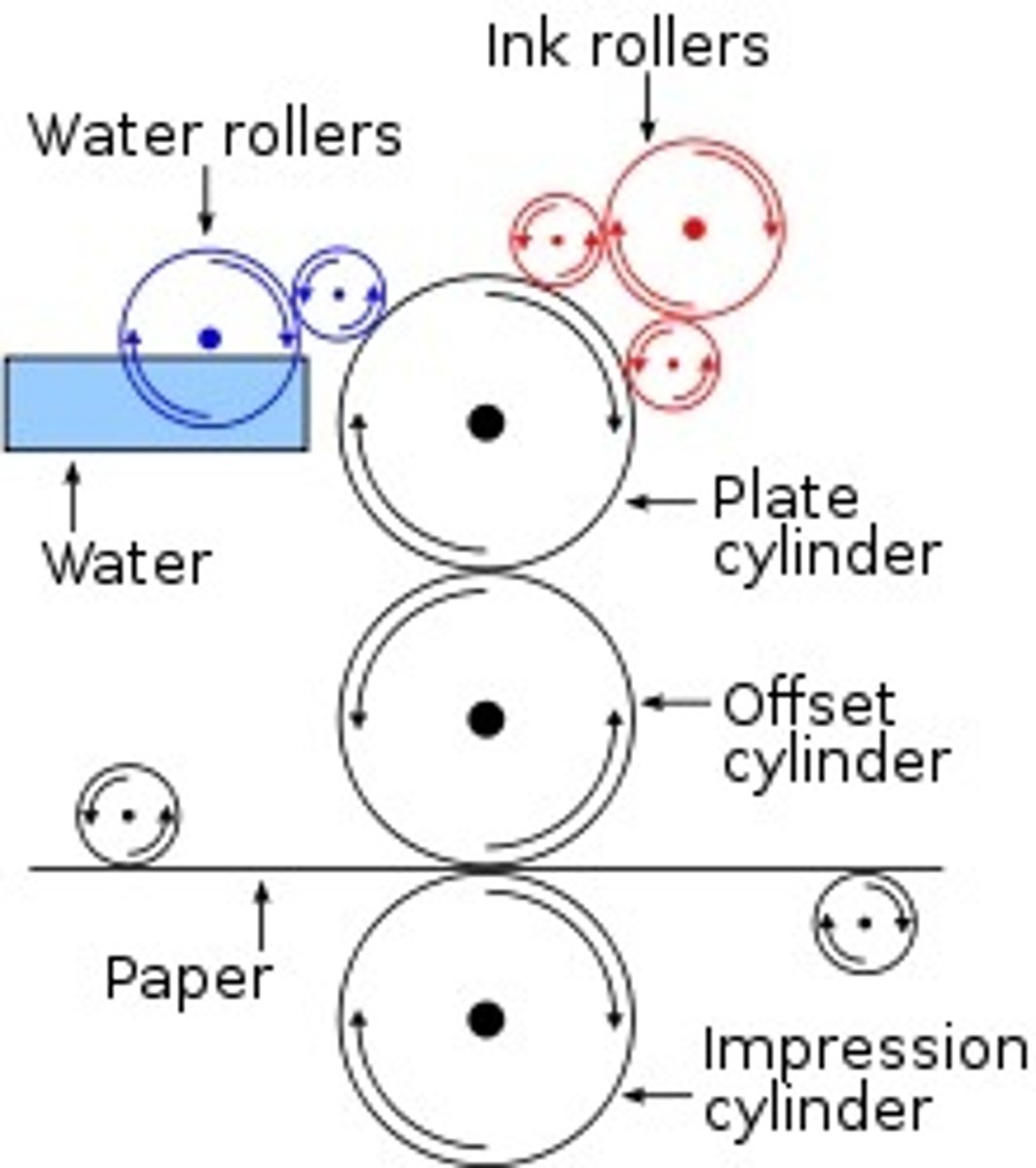
-A fountain (dampening) solution, mainly composed of water, is first applied to the plate by dampening rollers, coating the non-image (hydrophilic) areas.
-Next, inking rollers apply oil-based ink, which adheres to the image (oleophilic) areas.
-The two substances repel each other, preventing ink from spreading to the non-image zones and ensuring crisp image boundaries.
How is the image transferred from the plate to the substrate in offset lithography
-The plate cylinder first transfers the inked image to a rubber blanket roller (rather than directly onto the substrate).
-The image is then offset from this blanket onto the paper or board as it passes through impression cylinders.
-This indirect method allows for consistent pressure and quality, even on textured or uneven surfaces.
What are the two main ways substrates are fed into lithographic printing machines
-Sheet-fed presses: Individual sheets of paper or board are fed into the press, suitable for shorter or high-quality runs.
-Web-fed presses: Continuous rolls of paper (the web) are used for high-speed production such as newspapers and magazines. The choice depends on print volume, material type, and product format.
Summarise the sequence of operations in offset lithographic printing.
-Substrate fed (sheet or web) into the machine.
-Plate produced using computer-to-plate (CTP) laser etching.
-Dampening rollers apply water to non-image areas.
-Inking rollers apply oil-based ink to image areas.
-Plate cylinder transfers inked image to blanket roller.
-Blanket roller transfers the image onto the substrate via impression cylinder.
-The process repeats continuously, producing high-quality, accurately registered prints.
What are the advantages of lithographic printing
-Consistently high image quality
-Sited to volume print runs of 1000 or more
-Quick and easy production of printing plates
-Long life of printing plates because they only come into contact with the printing blanket, which is softer and less abrasive than the substrate
What is the disadvantage of lithographic printing
-Expensive setup and running cost for small quantities. It is only suitable for porous substrate materials
Why is digital printing becoming increasingly popular in modern production
-Digital printing is now one of the most widely used printing methods due to its speed, efficiency, and flexibility.
-It allows high-quality colour printing without the need for plates, making it ideal for quick turnaround times and on-demand production in both commercial and promotional industries.
What does a digital printer look like and how does it operate
-Digital printers resemble large photocopiers and are capable of producing full-colour, highly detailed prints.
-They can print different designs on each page, including double-sided (duplex) prints, making them suitable for variable data and personalised printing.
How does digital printing apply colour to the substrate
-Digital printers apply colour similarly to laser printers, where the ink or toner sits on top of the substrate rather than soaking into it.
-The ink is then dried or laminated, giving a smooth and durable surface finish.
-This method provides sharp detail and vibrant colours, even on coated papers.
What types of print runs and products are suitable for digital printing
-Digital printing is used for both low and high-volume print runs, making it highly versatile.
-It is commonly used for business flyers, brochures, posters, and business cards — ideal for short runs, test prints, or quick updates where traditional methods would be too time-consuming or expensive.
Why is digital printing ideal for mass customisation
-Digital printing allows variable data printing, meaning each item in a print run can feature unique text or imagery (e.g., individual names on drinks cans).
-This flexibility is supported by fast-drying inks, similar to those used in flexography, which allow rapid production with minimal downtime or smudging.