3.3.14/15/16 - Organic synthesis, NMR & chromatography
 Call Kai
 Learn
Learn Practice Test
 Spaced Repetition
 Match
Match Flashcards
 Knowt Play
1/36

There's no tags or description
Looks like no tags are added yet.
Name | Mastery | Learn | Test | Matching | Spaced | Call with Kai | Chat |
|---|
No analytics yet
Send a link to your students to track their progress
37 Terms
How are chemists making organic synthesis to make drugs cost-effective, safe & have minimal environmental impact?
They use safe starting materials that have low toxicity levels to living things
Reactions with a high atom economy & percentage yield are preferred to reduce waste (synthetic processes that have less steps generally have less waste & are more efficient)
Synthetic routes are developed where solvents are not used or minimised, as they are often flammable, toxic & increase waste
What is Nuclear Magnetic Resonance (NMR) spectroscopy & what are the two types?
A technique used to help determine the structure of a molecule:
13C NMR (provides information on how carbon atoms are arranged)
1H (proton) NMR (provides information on how hydrogen atoms are arranged)
Why is the overall effect of the external magnetic field on each nucleus different?
It is dependent on the nucleus’ environment within the molecule:
a nucleus is partly shielded from the effects of an external magnetic field by its surrounding electrons
any other atoms & groups of atoms that are around a nucleus will also affect the amount of electron shielding
What does the strength of the magnetic field determine?
The size of the energy gap between a nucleus being aligned with or against an external magnetic field
Therefore, nuclei in different environments will absorb different frequencies
What does an atom’s environment depend on?
All the groups it’s connected to, along the full chain (not just the atoms it’s immediately bonded to)
For an atom to be in the same environment, it must be bonded to an atom or group of atoms that are identical
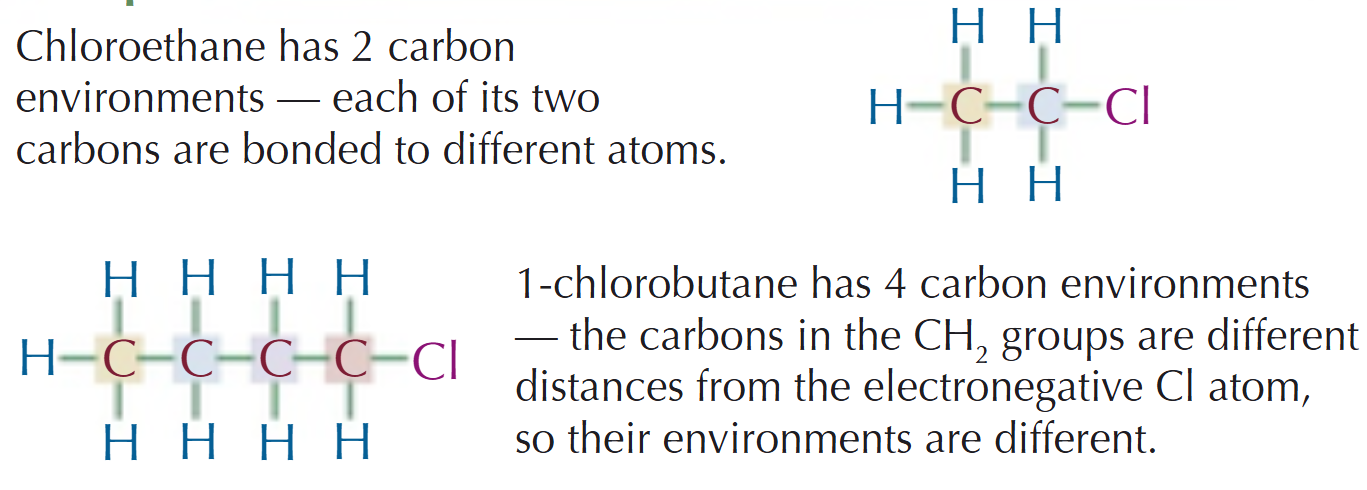
What is the chemical shift (δ) ?
The difference in the energy absorbed by nuclei in different environments relative to a standard substance:
measured in parts per million (ppm) relative to a standard
What is the standard substance in NMR & why?
Tetramethylsilane (TMS):
has 12 hydrogen & 4 carbon atoms all in identical environments, so produces a large, single absorption peak well away from other absorption peaks
it is inert (doesn’t react with the sample), non-toxic & volatile (easy to remove from the sample)
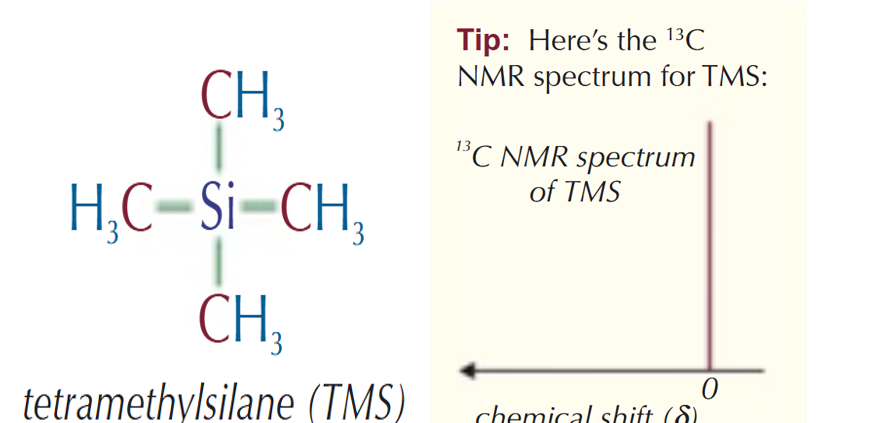
What does each absorption peak on a 13C NMR spectrum represent?
Each carbon environment in the molecule
Which carbon atoms will be less shielded & have a higher chemical shift?
Carbon atoms which are closer to more electronegative atoms (e.g. oxygen, nitrogen or chlorine)

What are the steps to interpreting a 13C NMR spectrum?
Count the number of peaks in the spectrum (excluding the TMS peak) to find the number of carbon environments in the molecule
Use the table of chemical shift data to work out what kind of carbon environment is causing each peak
Use this information to figure out the structure of the molecule
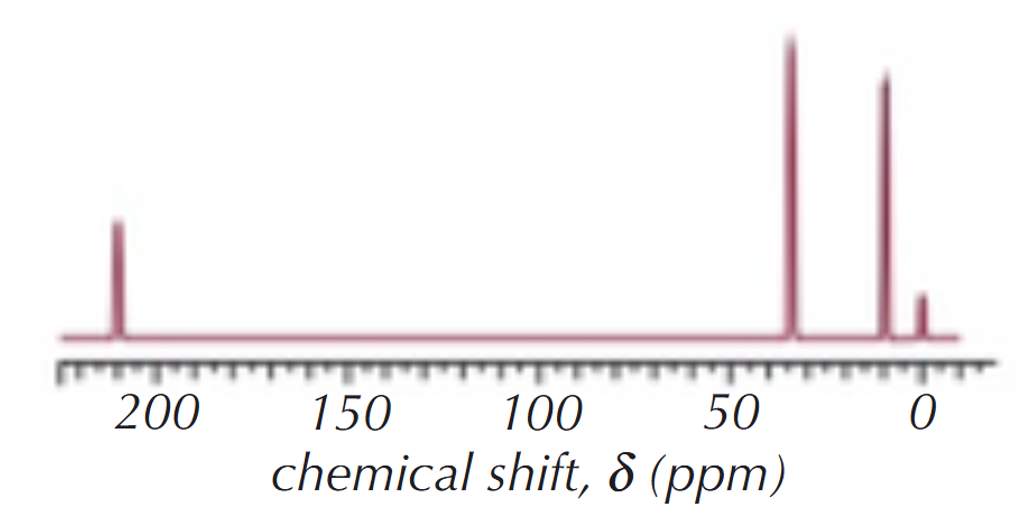
The 13C NMR spectrum of a straight-chain molecule with the molecular formula C5H10O is shown below. Use the spectrum, along with a table of chemical shift data to identify the molecule

What do the number of peaks on a 13C NMR spectrum of a cyclic compound depend on?
The symmetry of the molecule
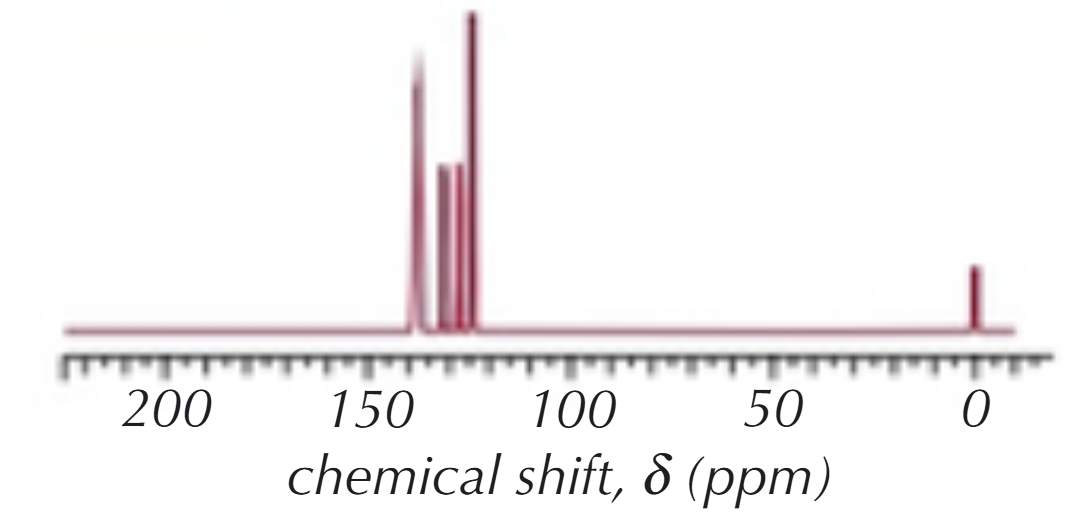
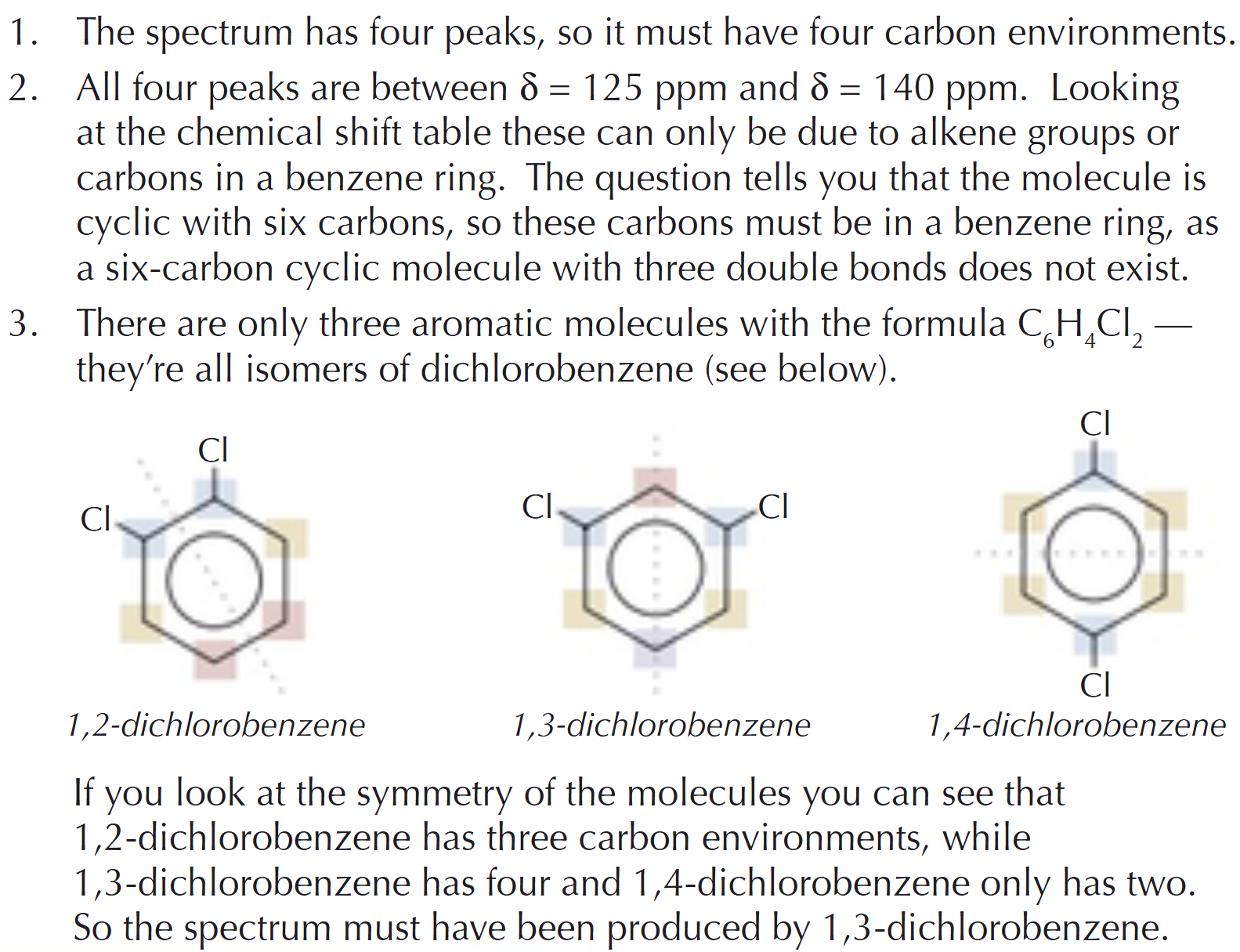
The 13C NMR spectrum of a cyclic molecule with formula C6H4Cl2 is shown below. Identify the molecule that produced this spectrum
What is each peak on a 1H NMR due to?
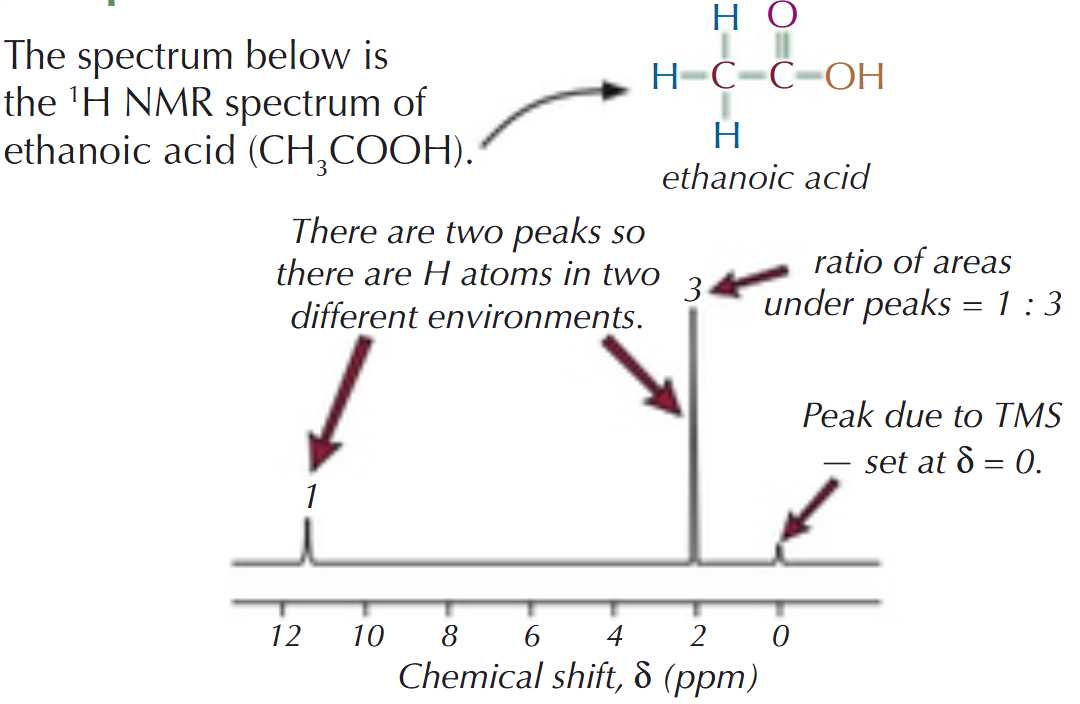
One or more hydrogen nuclei (protons) in a particular environment:
the relative area under each peak also tells you the number of hydrogen atoms in each environment
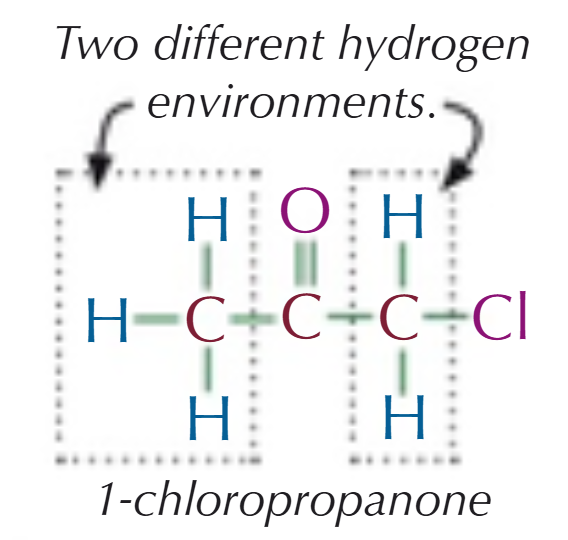
How many peaks will be present on the ¹H NMR spectrum of 1-chloropropanone & predict the ratio of the areas of these peaks?
2 different hydrogen environments, so 2 peaks
There are 2 hydrogens in one environment & 3 hydrogens in the other, so the ratio of the peak areas will be 2:3
What is an integration trace?
The stepped line on a 1H NMR spectrum that shows the relative number of protons responsible for each peak

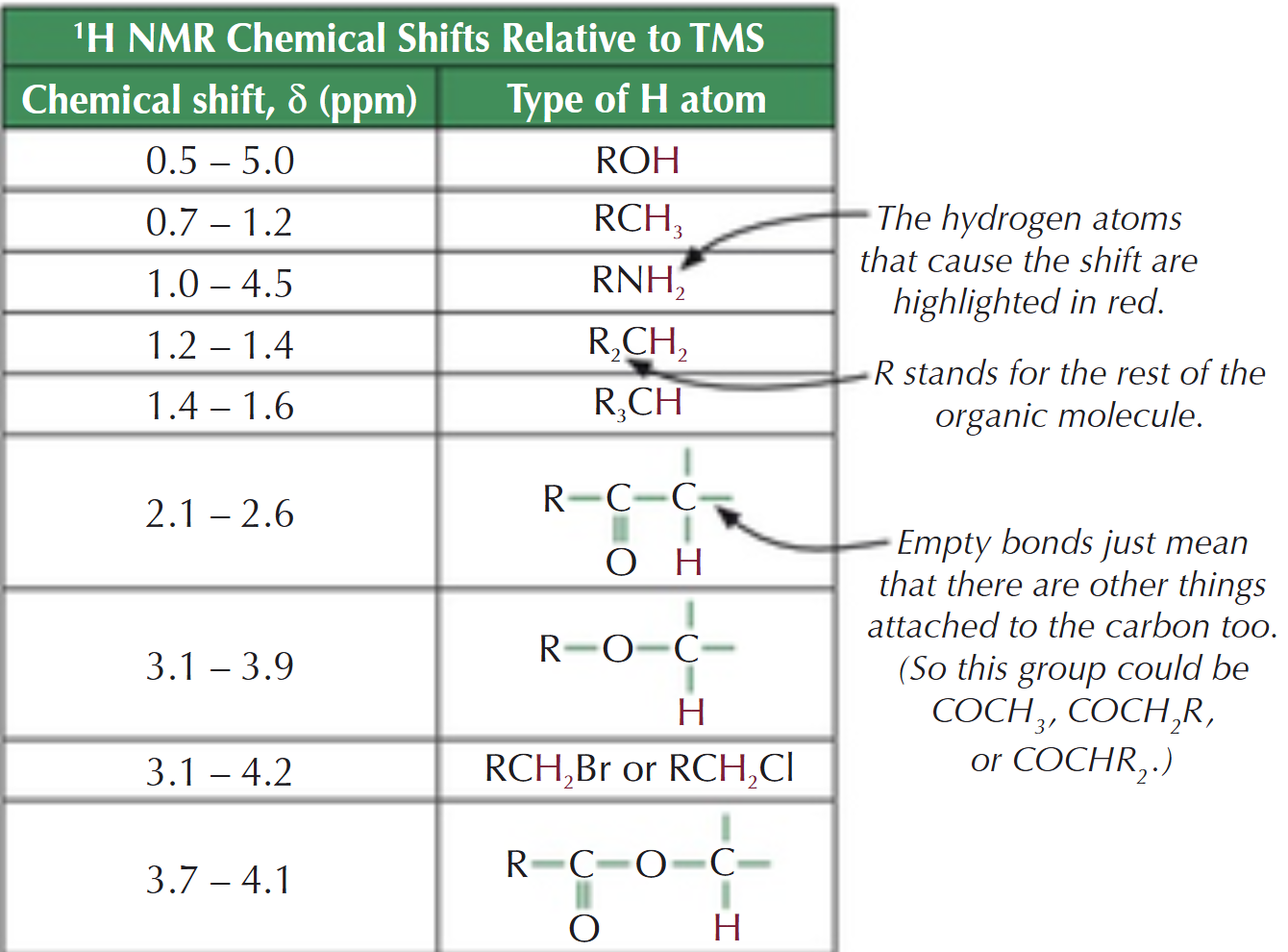
What do the hydrogen atoms that are bold, highlighted in red, etc on a 1H NMR chemical shift data table represent?
The hydrogen atoms that cause the shift
What is spin-spin splitting?
The peaks on a 1H NMR spectrum may be split into smaller peaks
What are the split peaks called in 1H NMR?
Multiplets: peaks always split into the number of hydrogens on the neighbouring carbon/s, plus one (n+1 rule)
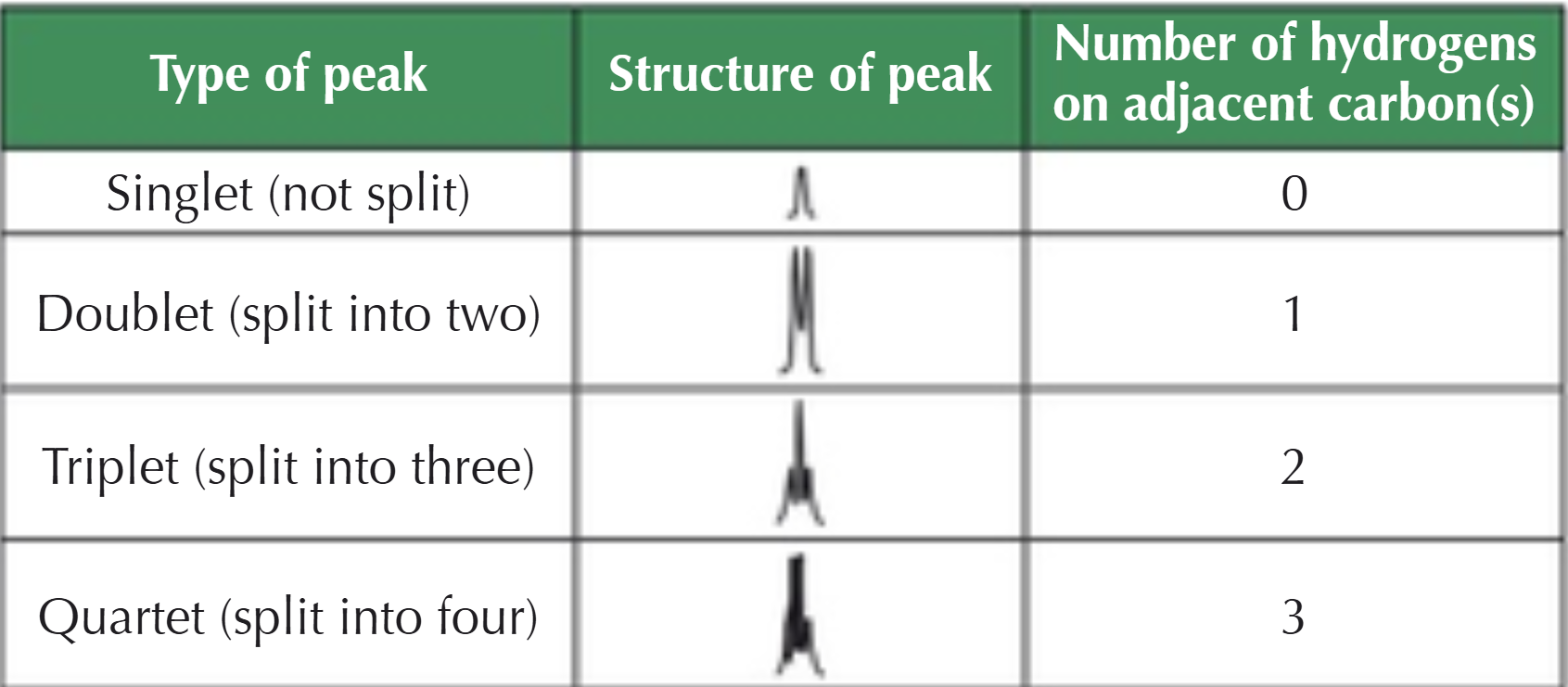
What are the different splitting patterns in 1H NMR?
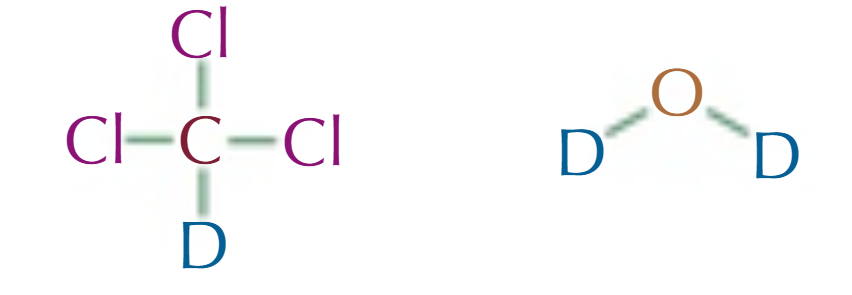
What type of solvent is used if a sample has to be dissolved in 1H NMR & why?
Proton-free solvents to avoid extra peaks:
deuterated solvents are commonly used, as their hydrogen atoms are replaced by deuterium (D or 2H), which does not produce peaks in a 1H NMR spectrum
CCl4 can also be used, as it contains no hydrogen atoms
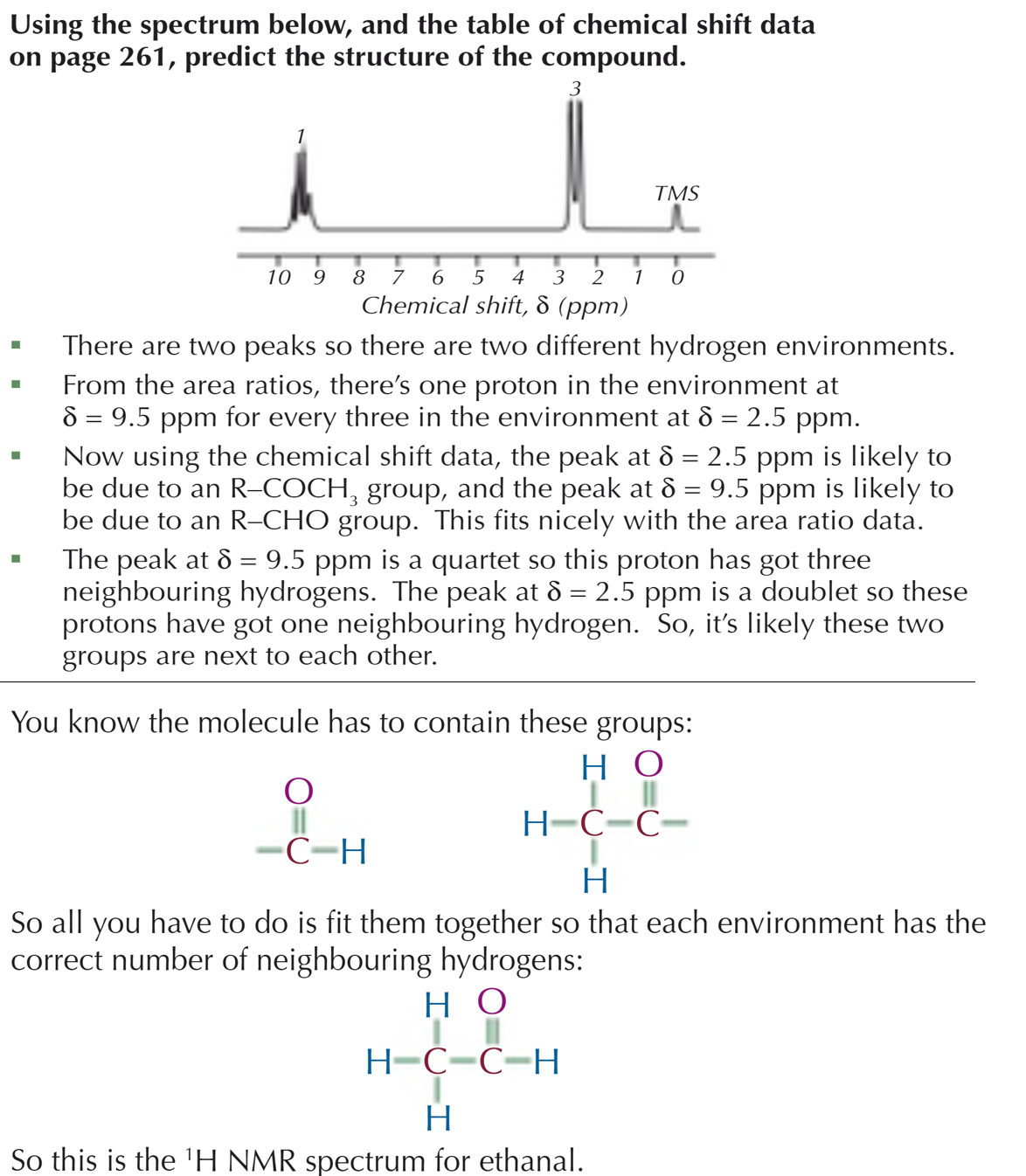
1H NMR spectra provides a lot of information to analyse. What are the key things to look out for?
The number of peaks = how many different hydrogen environments there are
The ratio of the peak areas = the relative number of hydrogens in each environment
(sometimes these ratios are written above the peaks; other times you may have to use integration traces)
The chemical shift of each peak = what type of environment the hydrogen is in
The splitting pattern of each peak = the number of hydrogens on the adjacent carbon (n+1 rule)
What is the purpose of chromatography & what two phases does it consist of?
Used to separate & identify chemicals in mixtures:
mobile phase (where the molecules can move; always a liquid or gas)
stationary phase (where the molecules can’t move; must be a solid, or a liquid on a solid support)
How does chromatography work?
The mobile phase moves through or over the stationary phase
The distance each substance moves depends on its solubility in the mobile phase & its retention by the stationary phase
components that are more soluble in the mobile phase travel further than components that are more strongly adsorbed (attracted) to the stationary phase
What is thin-layer chromatography (TLC) ?
The mobile phase is a liquid solvent (e.g. ethanol)
The stationary phase is a thin layer of silica (silicon dioxide) or alumina (aluminium oxide) fixed to a glass or metal plate
How does thin-layer chromatography (TLC) work?
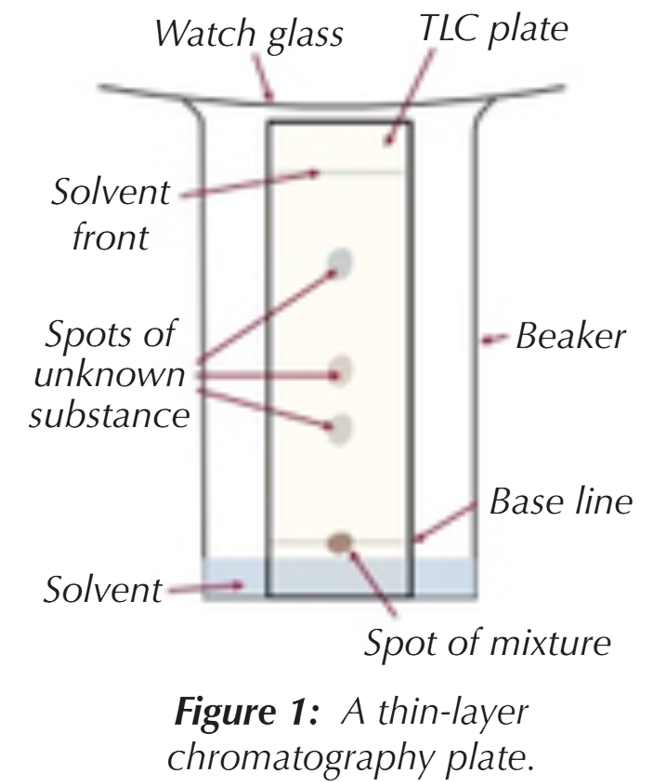
Draw a line in pencil near the bottom of the TLC plate (the baseline) & put a very small drop of each mixture to be separated on the line
Allow the spots on the plate to dry
Place the plate in a beaker with a small volume of solvent (mobile phase). The solvent level must be below the baseline, so it doesn’t dissolve the samples away. Cover the top of the beaker with a watch glass
The solvent will start to move up the plate. As it moves, the solvent will carry the substances in the mixture with it (some chemicals will be carried faster than others & so travel further up the plate)
Leave the beaker until the solvent has moved almost to the top of the plate. Then remove the plate from the beaker. Before it’s evaporated, use a pencil to mark how far the solvent travelled up the plate (solvent front)
Place the plate in a fume cupboard & leave it to dry (fume cupboard prevents any toxic or flammable fumes from escaping into the room)
The result is called a chromatogram. The positions of the chemicals can be used to identify what they are
What are the two ways of revealing colourless chemicals (e.g. amino acids) in chromatrography?
Many TLC plates have a fluorescent dye added to the silica or alumina layer that glows when UV light shines on it. The plate can be put under a UV lamp & dark patches can be drawn around to show where the spots of chemicals are
Expose the chromatogram to iodine vapour (leave the plate in a sealed jar with iodine crystals). Iodine vapour is a locating agent, so it sticks to the chemicals on the plate & they appear as purple spots
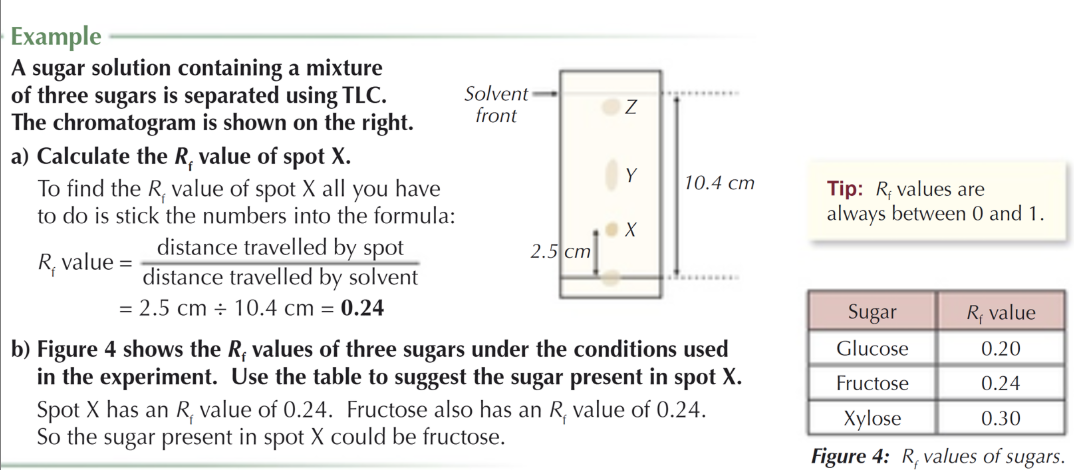
What is the formula to calculate the Rf value?
Rf = distance travelled by solute / distance travelled by solvent
What is the purpose of column chromatography (CC) & what is the process behind it?
Used to purify an organic product, separating it from unreacted chemicals or side products:
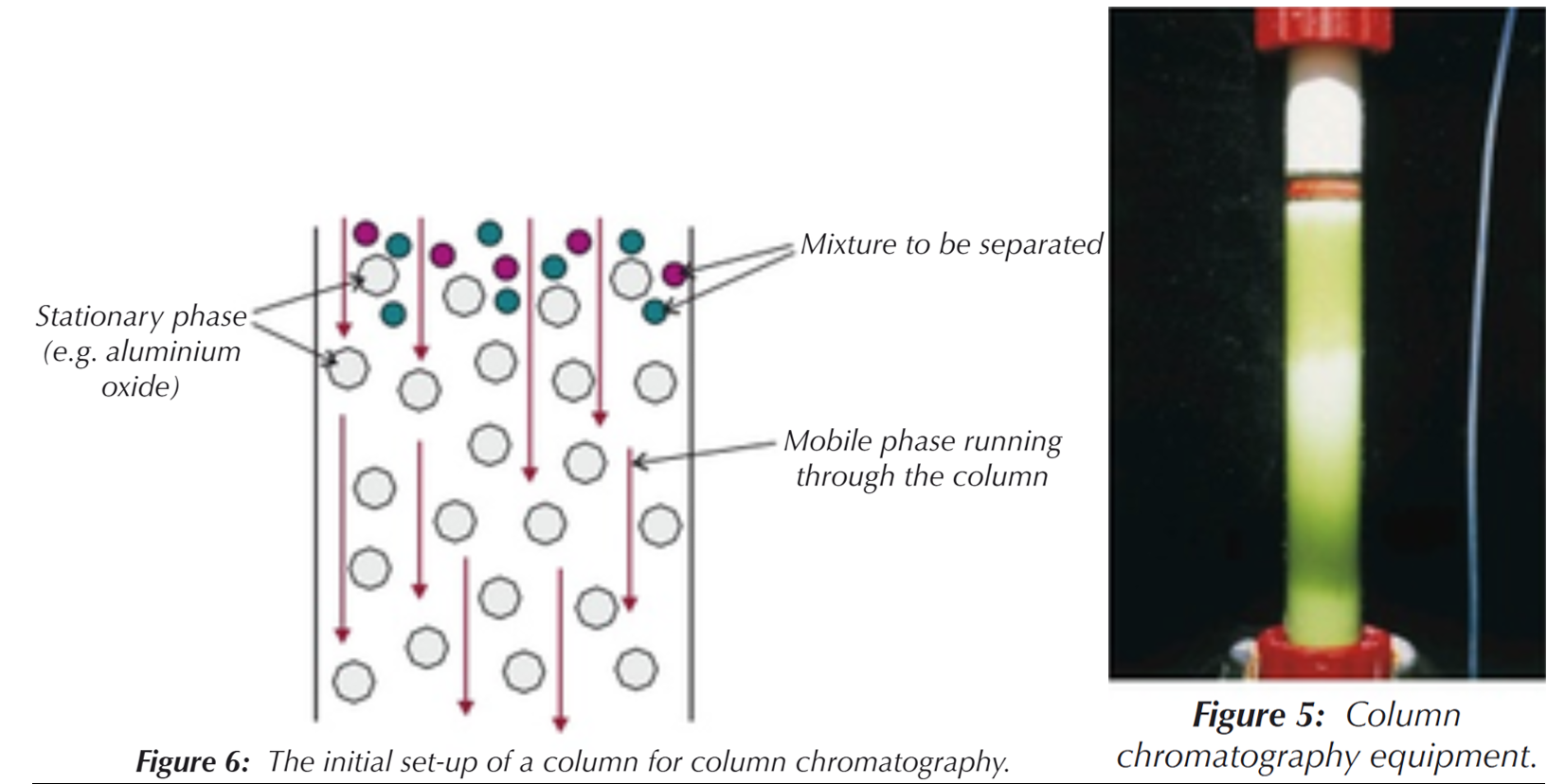
a glass column is packed with a solid, absorbent material (e.g. aluminium oxide coated with water) → this mixture is called a slurry & acts as the stationary phase
the mixture to be separated is added to the top of the column & allowed to drain down into the slurry
a solvent is then run slowly & continuously through the column (mobile phase)
as the mixture moves through the column, its components separate based on how soluble they are in the mobile phase & how strongly they are adsorbed onto the stationary phase (retention)
as a component of the mixture reaches the end of the column, it is collected & can be identified using the time taken to pass through the column (retention time) or another technique (e.g. mass spectrometry)
How does the separation work in column chromatography (CC) ?
Each component spends some time adsorbed (stuck) to the stationary phase & dissolved in the mobile phase:
if a component spends more time dissolved in the mobile phase, it travels down the column faster
if a component spends more time adsorbed to the stationary phase, it moves more slowly
the more soluble a component is in the mobile phase, the faster it passes through the column

What is gas chromatography (GC) ?
Used to separate a mixture of volatile liquids (turn into gases easily), so they can be identified:
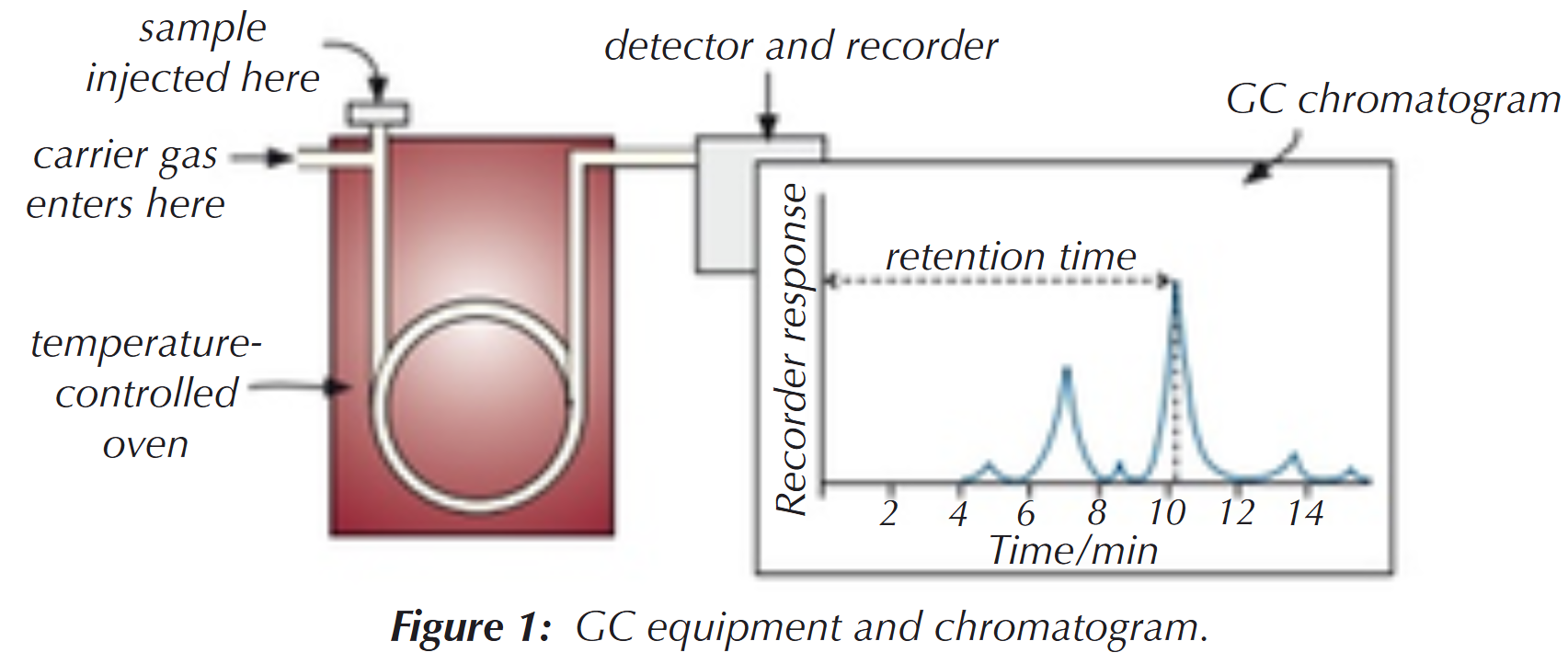
the stationary phase is a solid or a solid coated by a viscous liquid (e.g. oil), packed into a long column (coiled to save space & built into an oven)
the mobile phase is an unreactive carrier gas (e.g. nitrogen)
the sample is vaporised & passes through the oven as a gas
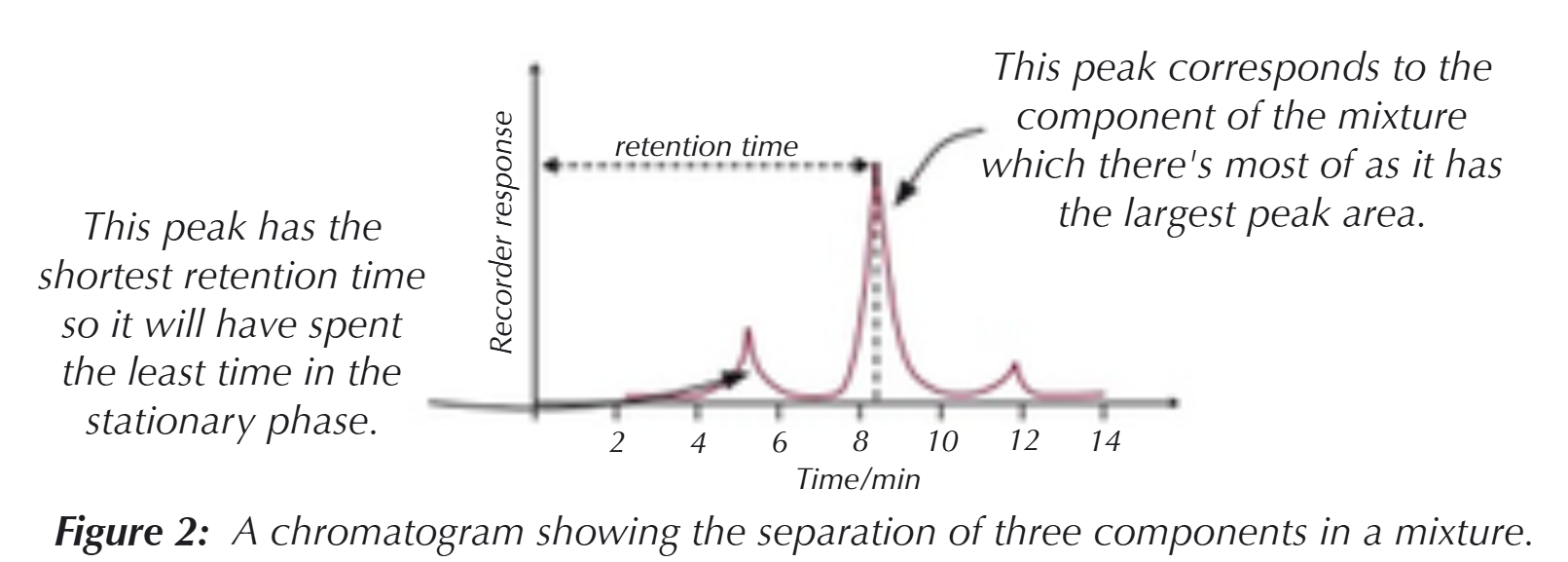
What is the retention time in gas chromatography & what does it depend on?
The amount of time from being injected into the column to being recorded at the other end:
depends on how much time the component spends moving along with the carrier gas & how much time it spends adsorbed to the viscous liquid
under standard conditions, each separate substance will have a unique retention time, so components of the mixture can be identified (have to run a known sample under the same conditions for comparison)

What does the area under each peak tell you on a gas chromatogram?
The relative amount of each component that’s present in the mixture
What are the uses of gas chromatography?
Used to find the level of alcohol in blood or urine (results are accurate enough to be used as evidence in court)
Used to find the proportions of various esters in oils used in paints (allows picture restorers know exactly what paint was originally used)
Why is gas chromatography-mass spectrometry (GC-MS) used?
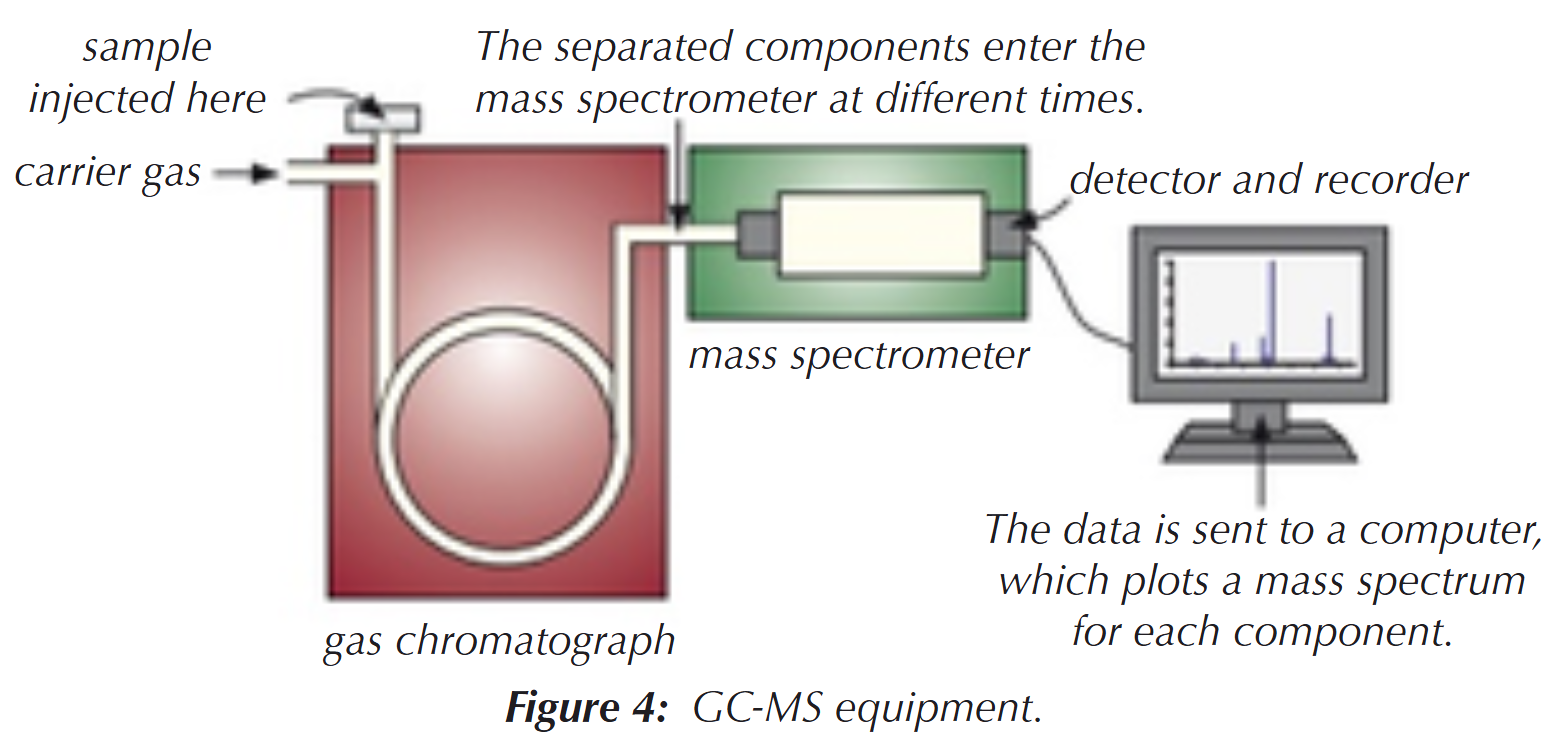
GC-MS combines gas chromatography & mass spectrometry:
gas chromatography separates a mixture into its individual components, while mass spectrometry identifies substances from their m/z ratios
this provide a useful method for separating & identifying compounds in a mixture
How does gas chromatography-mass spectrometry work?
Components are separated by gas chromatography & then, are fed into a mass spectrometer (instead of going to a detector)
Each component produces a mass spectrum, which is matched against a computer database to identify each component & show what the original sample consisted of
What is an advantage of gas chromatography-mass spectrometry over normal gas chromatography?
The components separated out by the chromatography can be positively identified:
this can be impossible from a chromatogram alone, as compounds which are similar often have very similar retention times