The Cold War Intensifies (last topic in origins of the cold war)
 Call Kai
 Learn
Learn Practice Test
 Spaced Repetition
 Match
Match Flashcards
 Knowt Play
1/12

Earn XP
Description and Tags
Includes the arms race, Warsaw pact, Soviet control and invasion of Hungary
Name | Mastery | Learn | Test | Matching | Spaced | Call with Kai | Chat |
|---|
No analytics yet
Send a link to your students to track their progress
13 Terms
What was the arms race?
Up to 1949, the United States thought it could use its monopoly of nuclear weapons to deter Soviet attack (remember US bombed Japan in 1945).
But the USSR tested its own atomic bomb in 1949.
However, by the mid 1950s the development of nuclear weapons to include bigger warheads and missile delivery systems meant that any nuclear war would destroy both sides resulting in Mutually Assured Destruction (MAD).
This meant that the USA and the Soviet Union had to find ways of stopping disputes between them turning into dangerous wars that involved nuclear weapons.
What was the significance of the Warsaw pact?
The Warsaw Pact was a collective defence treaty involving the Soviet Union, Poland, Hungary, East Germany, Czechoslovakia, Romania, Albania and Bulgaria. It was set up on 14 May 1955 following West Germany’s entry into NATO on 9 May 1955.
• The formation of the Warsaw Pact meant there were now two opposing alliances in Europe separated by the Iron Curtain.
• Both alliances planned for military action against the other, including the use of nuclear and conventional weapons.
• The Warsaw Pact gave the Soviet Union direct control over the armed forces of its satellite states, thus strengthening its grip on Eastern Europe.
What were the effects of Soviet control in Hungary?
Hungary suffered a lot under Stalin’s control.
Food and industrial products were shipped off to Russia.
Any opposition in Hungary was ruthlessly wiped out.
Matyas Rakosi was a brutal ruler. He called himself ‘Stalin’s best pupil’ but was known as the ‘Bald Butcher’.
Communist rule became very unpopular.
What was destalinisation?
When Stalin died, Khrushchev took over as Soviet leader. In 1956, in his ‘secret speech’, Khrushchev hinted that Soviet control would relax.
In October 1956, poor harvests and bread shortages meant that Hungarians started demonstrating against communist control with statues of Stalin pulled down and local communists attacked. Khrushchev appointed a more liberal Prime Minister for Hungary – Imre Nagy – in the hope that the situation would calm down.
Soviet Union no longer saw itself as a dictatorship. Instead it became a one-party state, governed by the Politburo with Khrushchev as its leader. Many Hungarians mistakenly believed that the end of Stalin’s rule would bring an end to communism in Hungary, especially as Soviet troops had already withdrawn from neighbouring Austria
What was Nagy like as Prime Minister?
Nagy wanted the following reforms for Hungary.
• Leave the Warsaw Pact and become a neutral country.
• Hold free elections leading to no more single-party communist government.
• UN protection from the Soviet Union.
However this was a problem for the Soviet Union because if Nagy succeeded in Hungary other countries in Eastern Europe would follow and the Warsaw Pact would collapse
What happened during the Soviet invasion of Hungary?
Khrushchev was worried that the unrest in Hungary would spread to other Satellite states, meaning that the USSR could lose its control over Eastern Europe.
Over 5000 Hungarians were killed as a result of the invasion, including around 1000 Soviet troops.
Imre Nagy was arrested, tried and executed. Khrushchev wanted to prevent rebellions in other communist countries, such as Poland, and hoped he could do so by making an example of Nagy.
A new leader, Janos Kadar, was appointed. He introduced the Fifteen Point Programme, which aimed to re-establish communist rule in Hungary. Kadar’s policies were more moderate than those of other Soviet satellite states and resulted in Hungary having better living standards than other East European states. Hungarians, aware that the United States was not prepared to help them, grudgingly accepted this modified form of communist rule.
What were the international responses to the invasion of Hungary?
The United Nations condemned Soviet actions. Some countries boycotted the 1956 Olympics in protest. But stronger actions did not happen.
The USA supported Hungary’s uprising – with money, medical aid and words. The USA accepted 80000 refugees from Hungary, but could not send troops due to risk of nuclear war.
Satellite states saw that the USA would not defend them against the Soviet Union. Soviet control retightened across Eastern Europe.
What was the refugee problem in Berlin?
Between 1949 and 1961, 2.7 million East Germans crossed from the East to the West in Berlin.
The population of West Germany increased while the economy benefitted from an influx of skilled workers. Many left for the West, leaving the East with a skills shortage. This looked bad for the Soviets: people clearly preferred West Germany. You could get better jobs with higher wages in the West.
What was Khrushchev’s Berlin Ultimatum?
This stated that all Berlin belonged to East Germany and that occupying troops must leave in six months.
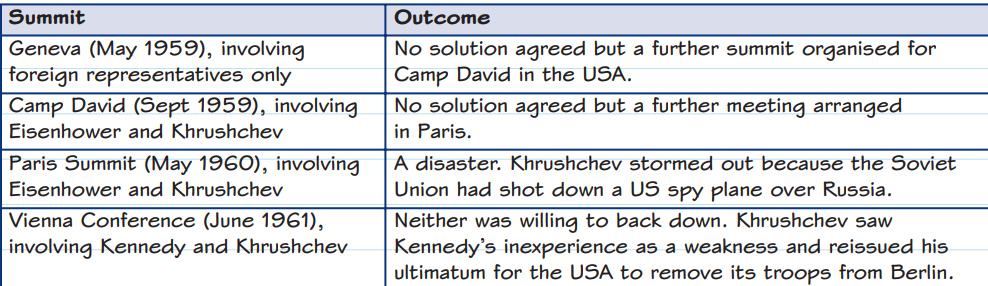
• The Soviet Union knew that if it tried to push the West out of Berlin by force, a war would start that it could not win, as the US had more nuclear weapons. So, a series of summit meetings took place between the leaders of the USA and the Soviet Union.
What happened during the Summit meetings?
1959 - 61
Describe the relationship between the superpowers and Cuba
Before 1959 Cuba was very closely linked to the USA, for example, there were lots of US-owned businesses. Cuba had a socialist revolution in 1959 and the USA refused to deal with the new government. Instead, Cuba started to build economic links with the Soviet Union, for example, trading Soviet oil for Cuban sugar. The relationship between Cuba and the USA deteriorated.
What was the relationship between Castro and the US?
The USA refused to recognise Castro’s government because it did not want a socialist country in their sphere of influence, especially not a country with close links to the Soviet Union.
• The CIA tried to assassinate the leader of Cuba, Fidel Castro, with no success.
• The CIA convinced President Kennedy that a US-backed invasion of Cuba, designed to overthrow Castro, could solve the problem.
Describe the bay of the pigs
1961
What the CIA told Kennedy:
The invasion will look like a Cuban revolt – we’ve trained Cuban exiles and disguised old US planes as Cuban.
Castro’s control of Cuba is very weak.
Most Cubans hate Castro.
What actually happened:
The planes were recognised as US planes and photographed, and the information was published. The world knew that the USA had backed the invasion.
In fact, Castro knew of the invasion in advance and 1400 US-backed troops met 20 000 of Castro’s troops. The US-backed troops surrendered.
In fact, most Cubans did not want their old leader, Batista, back again, because he had been corrupt.
The impact:
• Ended all chances of a friendly USA-Cuba relationship.
• Castro announced that he was a communist.
• Cuba and the Soviet Union started building closer ties