Approaches
0.0(0)
Studied by 0 people Note
Note Call Kai
 Learn
Learn Practice Test
 Spaced Repetition
 Match
Match Flashcards
 Knowt Play
Card Sorting
1/67

There's no tags or description
Looks like no tags are added yet.
Last updated 10:26 AM on 5/24/23
Name | Mastery | Learn | Test | Matching | Spaced | Call with Kai | Chat |
|---|
No analytics yet
Send a link to your students to track their progress
68 Terms
1
New cards
Define psychology
Psychology is the scientific study of behavior and mental processes. It involves the examination of thoughts, emotions, and behaviors of individuals and how they are affected by internal and external factors.
2
New cards
Timeline of psychology
Introspection- Wundt
Psychodynamic approach- Freud
Behavioural approach- Skinner, Pavlov
Humanistic approach- Maslow, Rogers
Cognitive approach
Social Learning theory- Bandura
Biological approach
Cognitive neuroscience
Psychodynamic approach- Freud
Behavioural approach- Skinner, Pavlov
Humanistic approach- Maslow, Rogers
Cognitive approach
Social Learning theory- Bandura
Biological approach
Cognitive neuroscience
3
New cards
Define introspection
Introspection examines one's thoughts, feelings, and mental states. It's used in psychology and philosophy to gain insight into the mind and understand behaviour and motivations.
4
New cards
Introspection as experimental self observation
* First systematic attempt to study the mind under controlled conditions
* People observing own thoughts were highly trained to emphasise objectivity
* Process was rigid, highly controlled, and standardised
* Observers would often just report yes or no
* Stimuli were usually presented in the same order
* Ensuring reliability, every observation had to be capable of being repeated under same conditions
* People observing own thoughts were highly trained to emphasise objectivity
* Process was rigid, highly controlled, and standardised
* Observers would often just report yes or no
* Stimuli were usually presented in the same order
* Ensuring reliability, every observation had to be capable of being repeated under same conditions
5
New cards
Structuralism
Isolating the structure of conciousness
6
New cards
Importance of Wundt
Emphasised objectivity and paved the way for later controlled research (behaviourists) and the study of mental processes (cognitive psychologist)
7
New cards
AO3 strength of Introspection
* First attempt to study the mind scientifically
* Some aspects were scientific
* Controlling stimuli and tasks that participants thought about
* Limited range of responses they might give
* Trained his participants so they would give the most detailed observations possible
* Marked separation of modern scientific psych from philosophical roots
* Showed that psychology was a valid experimental study
* Pave the way for establishing psychology as a scientific discipline
* Inspired others to apply it to more complex mental processes such as learning, language, emotion
* Some aspects were scientific
* Controlling stimuli and tasks that participants thought about
* Limited range of responses they might give
* Trained his participants so they would give the most detailed observations possible
* Marked separation of modern scientific psych from philosophical roots
* Showed that psychology was a valid experimental study
* Pave the way for establishing psychology as a scientific discipline
* Inspired others to apply it to more complex mental processes such as learning, language, emotion
8
New cards
AO3 Limitations of Introspection
* Some aspects of Wundt’s scientific research considered unscientific today
* Overreliance on subjective self report of unobservable phenomena
* Difficult to establish general rules and principles of behaviour
* Wundt did not maintain critical distance and objectivity
* Dispo factor- small sample sizes (1/2 ppt)
* Overreliance on subjective self report of unobservable phenomena
* Difficult to establish general rules and principles of behaviour
* Wundt did not maintain critical distance and objectivity
* Dispo factor- small sample sizes (1/2 ppt)
9
New cards
Assumptions of psychodynamic approach
1. Unconcious process
2. Psyche contains three structures (tripartite model)
* Id, Ego, Superego are in constant conflict, creating anxiety which is dealt with through adopting defence mechanisms (denial, repression and displacement)
3. Early childhood experiences determine adult personality, feelings, and behaviours
4. Adult personality shaped through the psychosexual stages of development
10
New cards
Role of the Unconcious
* We have an unconscious mind which influences our behaviour
* Our conscious mind is unaware of what thoughts and emotions occur in the unconscious
* Unconscious thoughts and feelings can have effect on conscious mind
* Can reveal itself through dreams or Freudian slips
* Defence mechanisms employed by the ego prevents us being aware of the content in our unconscious as they may cause anxiety
* Our conscious mind is unaware of what thoughts and emotions occur in the unconscious
* Unconscious thoughts and feelings can have effect on conscious mind
* Can reveal itself through dreams or Freudian slips
* Defence mechanisms employed by the ego prevents us being aware of the content in our unconscious as they may cause anxiety
11
New cards
What is between conscious and unconscious
preconscious
12
New cards
Why do we have defence mechanisms
* Prevent us from being aware of the content in our unconscious mind, in order to balance the conflicting demands of our superego and Id, Ego adopts defence mechanisms
* Unconscious process- used when a person faces a situation they are unable to deal with rationally
* They distort reality to reduce anxiety to prevent us from being overwhelmed by threats and traumas
* Unconscious process- used when a person faces a situation they are unable to deal with rationally
* They distort reality to reduce anxiety to prevent us from being overwhelmed by threats and traumas
13
New cards
Denial
Unconsciously refusing to believe something because it is too painful to acknowledge the reality
14
New cards
Repression
Unconsciously forcing a distressing memory from the conscious mind
15
New cards
Displacement
Unconsciously transferring feelings from true source of distressing emotion onto a substitute target
16
New cards
Structure of personality (3 part model)
Id- pleasure principle
Ego- reality principle
Superego- morality principle
Ego- reality principle
Superego- morality principle
17
New cards
Id
* Formed from birth-18 months
* Operates solely in unconscious
* Represents innate, instinctual, biological drives within us
* Demanding, impulsive, aggressive, irrational, selfish
* Pleasure principle- every wishful impulse should be satisfied immediately, regardless of consequence
* Operates solely in unconscious
* Represents innate, instinctual, biological drives within us
* Demanding, impulsive, aggressive, irrational, selfish
* Pleasure principle- every wishful impulse should be satisfied immediately, regardless of consequence
18
New cards
Ego
* Emerges from 18 months- 3 years
* Mediator between Id and Superego
* Based on reality principle- controls the demands of the Id whilst taking into consideration the moralistic constraints of the Superego
* Realistic, logical, orderly
* Conscious process
* Mediator between Id and Superego
* Based on reality principle- controls the demands of the Id whilst taking into consideration the moralistic constraints of the Superego
* Realistic, logical, orderly
* Conscious process
19
New cards
Superego
* Emerges from 3-6 years
* Located in the unconscious
* Based on morality principle- internalisation of same-sex moral standards
* Blocks Id’s urges, persuades Ego to be more moralistic and strive for perfection
* Punishes Ego with guilt if perfection not achieved
* Located in the unconscious
* Based on morality principle- internalisation of same-sex moral standards
* Blocks Id’s urges, persuades Ego to be more moralistic and strive for perfection
* Punishes Ego with guilt if perfection not achieved
20
New cards
Description of psychosexual stages
* Child development occur in five stages
* Each stage is marked with different conflict that needs resolving in order to successfully progress to the next stage
* If the conflict is unresolved a fixation may occur
* Meaning that individual carries certain behaviours associated with that stage through to adult life
* Each stage is marked with different conflict that needs resolving in order to successfully progress to the next stage
* If the conflict is unresolved a fixation may occur
* Meaning that individual carries certain behaviours associated with that stage through to adult life
21
New cards
Psychosexual stages
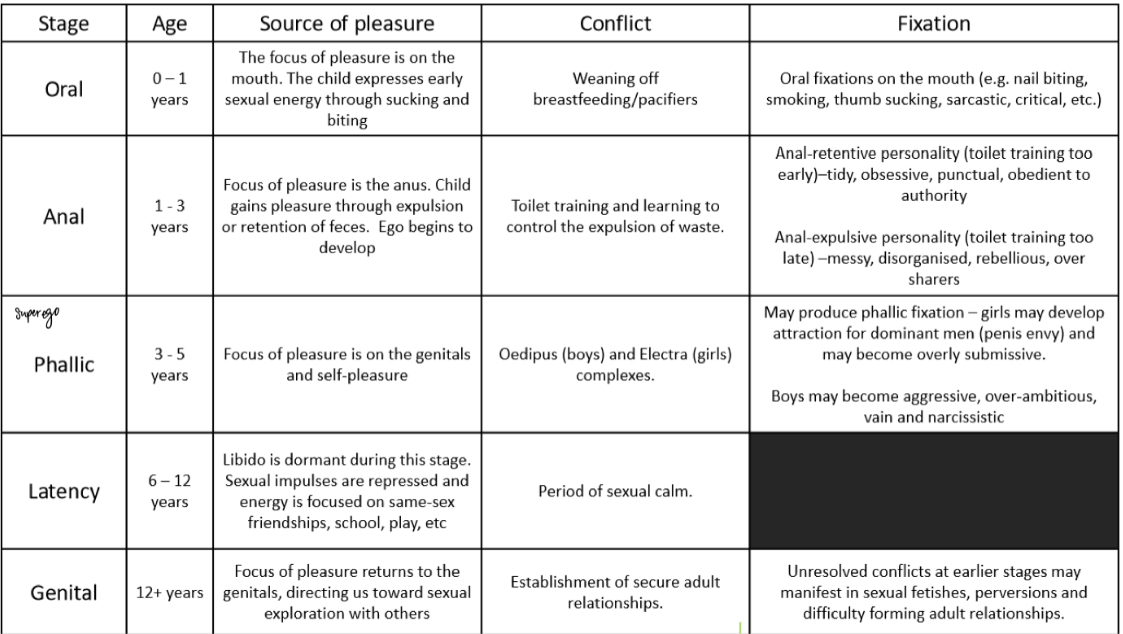
22
New cards
AO3 Strength of Psychodynamic approach
* Huge influence on Psychology
* Influence on western contemporary thought
* Used to explain a large range of phenomena
* Some evidence of ego defence mechanisms (PTSD)
* Case studies gather large amounts of data
* Psychotherapy laid foundations for modern psychiatry
* Influence on western contemporary thought
* Used to explain a large range of phenomena
* Some evidence of ego defence mechanisms (PTSD)
* Case studies gather large amounts of data
* Psychotherapy laid foundations for modern psychiatry
23
New cards
AO3 Limitations of Psychodynamic approach
* Pseudoscientific
* Evidence based on case studies lack scientific rigour (Little Hans- use unstructured interviews- data interpretation is subjective)
* Lacks falsification
* Not open to hypothesis testing or empirical experimentation
* Relies on post hoc reasoning
* Psychic determinism
* All behaviour controlled by unconscious forces which we cannot control
* No room for free will
* Evidence based on case studies lack scientific rigour (Little Hans- use unstructured interviews- data interpretation is subjective)
* Lacks falsification
* Not open to hypothesis testing or empirical experimentation
* Relies on post hoc reasoning
* Psychic determinism
* All behaviour controlled by unconscious forces which we cannot control
* No room for free will
24
New cards
Learning approaches: Behaviourism
* Classical conditioning
* Operant conditioning
* Operant conditioning
25
New cards
Behaviourism Assumptions
* Only interested in behaviour that can be observed and measured
* Stimulus response model
* No interest in investigating mental processes
* Basic processes that govern learning are the same in all species therefore animals can be studies in place of humans
* Tabula rasa- we are born as a blank slate and all behaviour is learned
* There are two major forms of learning: classical, operant
* Stimulus response model
* No interest in investigating mental processes
* Basic processes that govern learning are the same in all species therefore animals can be studies in place of humans
* Tabula rasa- we are born as a blank slate and all behaviour is learned
* There are two major forms of learning: classical, operant
26
New cards
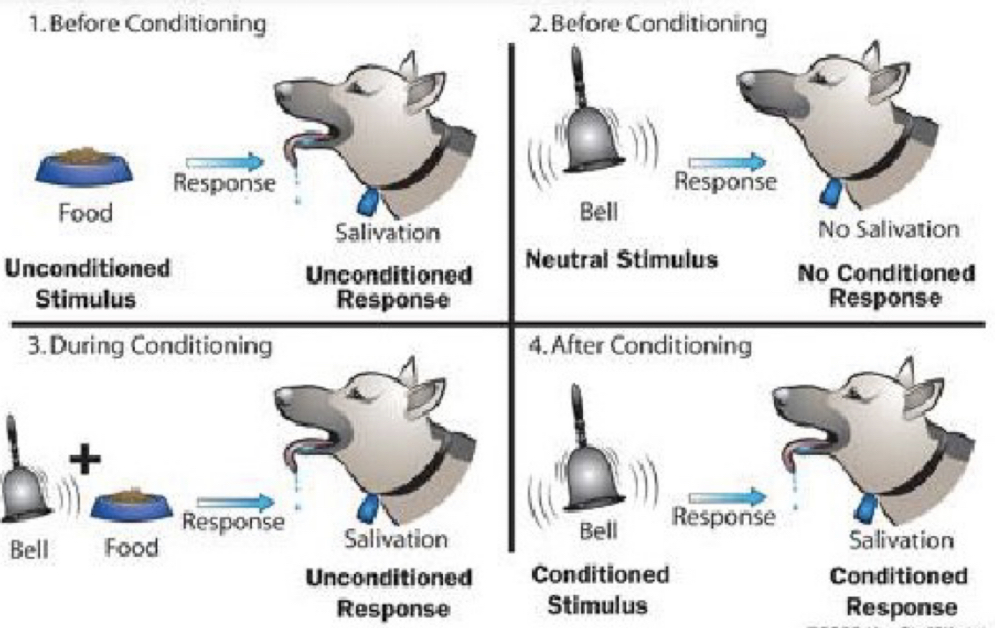
Operant Conditioning (Pavlov)
* Classical conditioning is a learning process that occurs when two stimuli are repeatedly paired/ associated
* The response is at first elicited by the second stimulus (unconditioned stimuli) is eventually elicited by the first stimulus (neutral stimuli)
* Learning via association
* The response is at first elicited by the second stimulus (unconditioned stimuli) is eventually elicited by the first stimulus (neutral stimuli)
* Learning via association
27
New cards
Operant conditioning
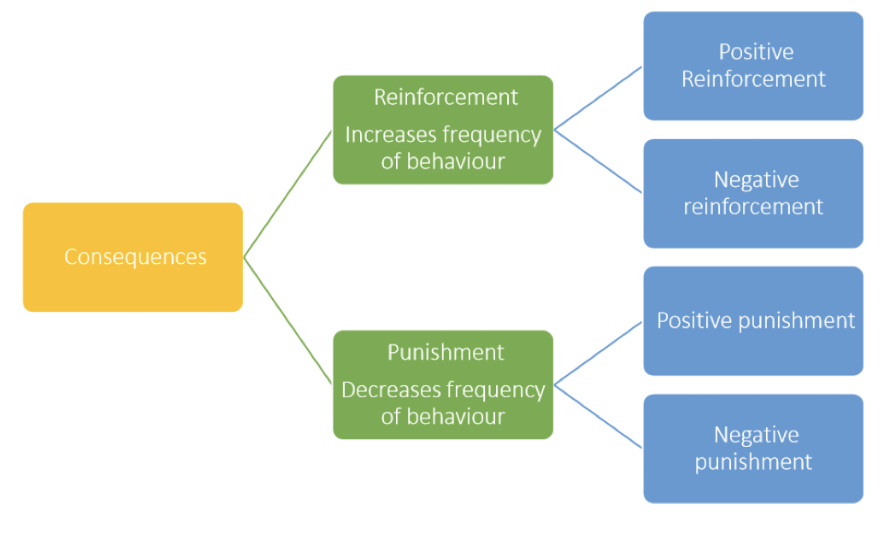
28
New cards
Skinner- Reinforcement
Positive- rat received food when behaviour is performed
Negative- rat constantly shocked when pressing lever, shock stop
\
Goal: increase freq of behaviour
Negative- rat constantly shocked when pressing lever, shock stop
\
Goal: increase freq of behaviour
29
New cards
Punishent decreases likelihood of behaviour being repeated
* Unpleasant consequence when undesirable behaviour is performed
* Eg. Getting told off, phone taken
* Frequency of behaviour decreases
* Eg. Getting told off, phone taken
* Frequency of behaviour decreases
30
New cards
What are primary & secondary reinforcers
P- biological eg. food, drink, pleasure
\
S- conditioned eg. money, grades, tokens
(These need to be associated with primary reinforcers)
\
S- conditioned eg. money, grades, tokens
(These need to be associated with primary reinforcers)
31
New cards
AO3 Strengths of Behaviourist approach
* Highly scientific and credible- eg. controlled lab exp, objective, replicable
* Real life application- eg. token economies, treatment for phobias
* Real life application- eg. token economies, treatment for phobias
32
New cards
AO3 Limitations of Behaviourist approach
* Reliance on animals- generalisable to humans?
* Highly reductionist- reduces complex human behaviour to stimulus-response
* Environmental determinism
* Highly reductionist- reduces complex human behaviour to stimulus-response
* Environmental determinism
33
New cards
Social Learning Theory Assumptions
* Behaviour is learned by experience through observing the behaviour of models and the consequences (reinforcement or punishment) they receive for that behaviour (vicarious learning)
* The characteristics of models influence the likelihood of imitating the behaviour (modelling)
* We are more likely to copy models similar to us or those that have desirable qualities (identification)
* Learning is a social process
* Cognition is involved in learning (Mediational processes)
* The characteristics of models influence the likelihood of imitating the behaviour (modelling)
* We are more likely to copy models similar to us or those that have desirable qualities (identification)
* Learning is a social process
* Cognition is involved in learning (Mediational processes)
34
New cards
Mediational processes
ARRM
Attention
Retention
Motor
Motivation
Attention
Retention
Motor
Motivation
35
New cards
Attention
The extent to which we notice certain behaviours
36
New cards
Retention
How well the behaviour is remembered in LTM
37
New cards
Motor reproduction
The ability to perform the behaviour
38
New cards
Motivation
The will to imitate the behaviour (dependent on vicarious learning)
39
New cards
Bandura’s bobo doll research
Aim- to investigate if social behaviours (aggression) can be acquired by observation and imitation
\
Procedure
Stage one- modelling
* Children either exposed to aggressive model, non aggressive model, or no model
Stage two- aggression arousal
* Children were taken to a room with attractive toys they weren’t allowed to play with
Stage three- test for imitation
* Children were observed in a room and rated on their behaviour through a one-way mirror
\
Procedure
Stage one- modelling
* Children either exposed to aggressive model, non aggressive model, or no model
Stage two- aggression arousal
* Children were taken to a room with attractive toys they weren’t allowed to play with
Stage three- test for imitation
* Children were observed in a room and rated on their behaviour through a one-way mirror
40
New cards
Bandura’s findings
Aggressive model- more likely to imitate aggressive acts (hitting Bobo doll)
Boys were more physically aggressive than girls
Children were more likely to imitate a same sex model
Follow up study, children who saw the model being rewarded for aggressive acts were more likely to show aggressive behaviour (vicarious reinforcement)
Boys were more physically aggressive than girls
Children were more likely to imitate a same sex model
Follow up study, children who saw the model being rewarded for aggressive acts were more likely to show aggressive behaviour (vicarious reinforcement)
41
New cards
Identification
* People are more likely to imitate people they identify with
* Occurs when an observer associates themselves with the model and therefore wants to be like the model thereby modelling their behaviour
* More likely to model if model is similar to us (same sex, possesses desirable characteristics, is attractive, has high status)
* Role model doesn’t have to be physically present
* Imitation of the model more likely to occur if the behaviour is seen to be reinforced rather than punished (vicarious reinforcement)
* Occurs when an observer associates themselves with the model and therefore wants to be like the model thereby modelling their behaviour
* More likely to model if model is similar to us (same sex, possesses desirable characteristics, is attractive, has high status)
* Role model doesn’t have to be physically present
* Imitation of the model more likely to occur if the behaviour is seen to be reinforced rather than punished (vicarious reinforcement)
42
New cards
AO3 Strength of SLT
* Strong supportive evidence- Bandura Bobo doll studies- found strong inter-observer reliability (r=0.89)
* Application in explaining aggressive or criminal behaviour
* Soft (reciprocal determinism)
* Behaviour is determined by observations of others (vicarious learning) and so behaviour is largely a product of our experience (i.e. it is determined)
* However, although the learning process provides the tools to conduct a particular behaviour, it is up to the individual how and when to apply these tools (i.e. free will)
* Application in explaining aggressive or criminal behaviour
* Soft (reciprocal determinism)
* Behaviour is determined by observations of others (vicarious learning) and so behaviour is largely a product of our experience (i.e. it is determined)
* However, although the learning process provides the tools to conduct a particular behaviour, it is up to the individual how and when to apply these tools (i.e. free will)
43
New cards
AO3 Limitations of SLT
* Controlled observations- demand characteristics?
* Mediating cognitive factors rely on interference
* Ignores biological factors as an important influence on observable learning
* Mediating cognitive factors rely on interference
* Ignores biological factors as an important influence on observable learning
44
New cards
Biological approach assumptions
* Everything psychological is at first biological
* Behaviour is explained through biological structures and processes
* Much of human behaviour has physiological cause which is may be genetically or environmentally altered
* The mind lives in the brain- all thoughts, feelings, and behaviour have a physical basis
* Behaviour is explained through biological structures and processes
* Much of human behaviour has physiological cause which is may be genetically or environmentally altered
* The mind lives in the brain- all thoughts, feelings, and behaviour have a physical basis
45
New cards
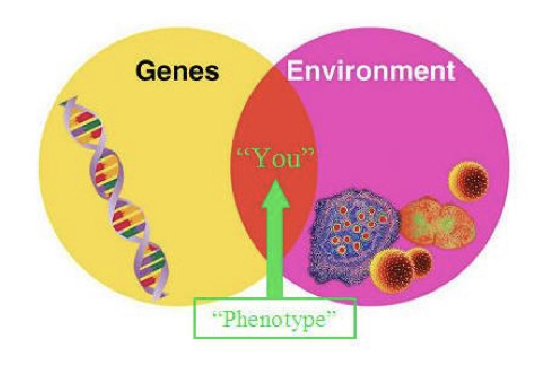
Genetic basis of behaviour
Biological psychologists are interested in trying to find the extent of which psychological characteristics (eg. Intelligence) are the product of inheritance (genes) or environmental influences
46
New cards
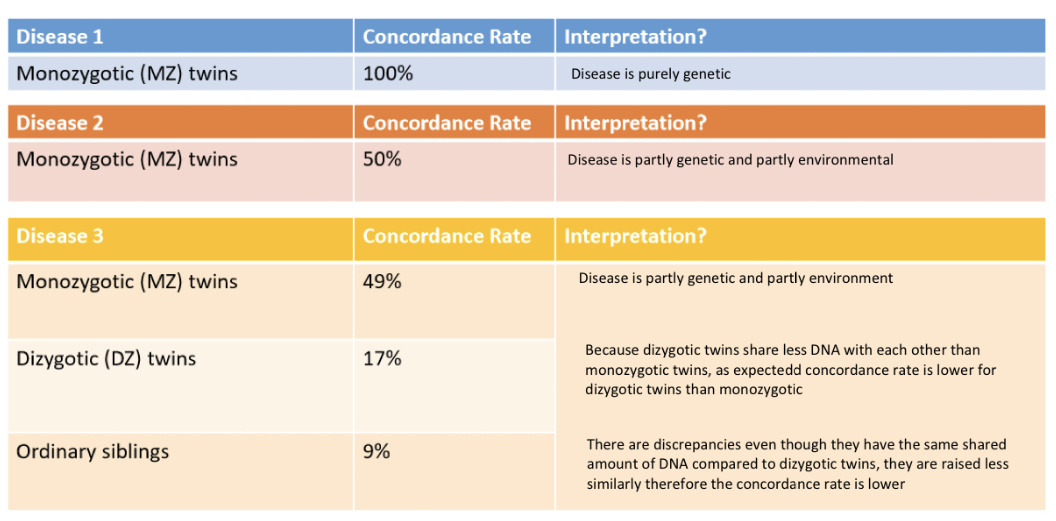
Twin studies
MZ- 100% genetic makeup
DZ- 50% genetic makeup
DZ- 50% genetic makeup
47
New cards
Concordance rates
SZ
MZ-48%
DZ-17%
MZ-48%
DZ-17%
48
New cards
Genotype
Particular set of genes a person possesses
49
New cards
Phenotype
The way genes are expressed through, physical, behavioural and psychological traits
50
New cards
Evolution of behaviour
* Any genetically determined behaviour that enhances an individuals survival will continue in future generations via the process of evolution
* Focus on the changes in inherited characteristics/behaviours in a biological population over successive generations
* Critical traits and behaviours which are adaptive get passed on
* Eg. Memory, aggression, attachment
* Focus on the changes in inherited characteristics/behaviours in a biological population over successive generations
* Critical traits and behaviours which are adaptive get passed on
* Eg. Memory, aggression, attachment
51
New cards
How are we influenced biologically
* Nervous system - parasympathetic and sympathetic
* Brain structure
* Neurotransmitters
* Hormones
* Brain structure
* Neurotransmitters
* Hormones
52
New cards
AO3 Strengths of Biological approach
* Highly scientific and reliable methods of investigation
* Real world application
* Real world application
53
New cards
AO3 Limitations of Biological approach
* Highly deterministic
* Our behaviour is the result of our biology which we cannot control
* No room for free will
* Highly reductionist
* All behaviour is explained by biological processes
* Difficulty separating nature and nurture
* Confounding variable of shared environment
* Our behaviour is the result of our biology which we cannot control
* No room for free will
* Highly reductionist
* All behaviour is explained by biological processes
* Difficulty separating nature and nurture
* Confounding variable of shared environment
54
New cards
History of Cognitive approach
* Up to 50s and 60s, behaviourism was the dominant paradigm in psychology
* However, psychologists began to believe that internal mental processes, not just behaviour should be studied scientifically under strict and controlled conditions eg. Memory, perception, thinking
* The human mind is likened to an information processor, or more commonly known today as a computer, emerged the same time that computers came into popularity
* However, psychologists began to believe that internal mental processes, not just behaviour should be studied scientifically under strict and controlled conditions eg. Memory, perception, thinking
* The human mind is likened to an information processor, or more commonly known today as a computer, emerged the same time that computers came into popularity
55
New cards
Assumptions of the cognitive approach
* Internal mental processes that occur in the human mind can and should be studies
* These internal mental processes are investigated experimentally under very strict and controlled conditions
* As these processes are internal, we must study them indirectly by making inferences
* Humans are information processors. Theoretical and computer models (MSM, WMM, long term memory) are used to explain how information flows through the cognitive system in a series of stages (input, storage, output)
* Cognitive processing can be affected by schema
* The cognitive approach (with the advancement of neuroimaging technology) has led to the development of cognitive neuroscience
* These internal mental processes are investigated experimentally under very strict and controlled conditions
* As these processes are internal, we must study them indirectly by making inferences
* Humans are information processors. Theoretical and computer models (MSM, WMM, long term memory) are used to explain how information flows through the cognitive system in a series of stages (input, storage, output)
* Cognitive processing can be affected by schema
* The cognitive approach (with the advancement of neuroimaging technology) has led to the development of cognitive neuroscience
56
New cards
Role of inference
The cognitive approach is concerned with studying internal mental processes that cannot be observed, therefore relying on inference
Inference is going beyond the immediate evidence, to make assumptions and draw conclusions about mental processes based on observable behaviour
Inference is going beyond the immediate evidence, to make assumptions and draw conclusions about mental processes based on observable behaviour
57
New cards
Schema
* A collection of ideas about a person or situation formed through experience which helps the individual to organise information and to understand and predict the world around them
* A cognitive framework
* Becomes more and more sophisticated as we experience the world
* A cognitive framework
* Becomes more and more sophisticated as we experience the world
58
New cards
Theoretical models of cognitive processes
Input → Mental processing → Output
59
New cards
Emergence of Cognitive neuroscience
* Scientific study of brain structures, mechanisms, processes, and chemistry that underlie our mental processes
* Made possible due to brain imaging techniques like fMRI or pet scans
* As a result, alongside experimental methods, cognitive neuroscience is rapidly becoming the dominant paradigm in modern psychology
* Made possible due to brain imaging techniques like fMRI or pet scans
* As a result, alongside experimental methods, cognitive neuroscience is rapidly becoming the dominant paradigm in modern psychology
60
New cards
AO3 Strengths of Cognitive approach
* Highly controlled research using lab experiments
* Application in treatment of mental disorders Eg. CBT to treat depression
* Cognitive neuroscience has a scientific basis by blending bio and cognitive psych together
* Human participants
* Application in treatment of mental disorders Eg. CBT to treat depression
* Cognitive neuroscience has a scientific basis by blending bio and cognitive psych together
* Human participants
61
New cards
AO3 Limitations of Cognitive approach
* Issues with the artificiality of lab experiments
* Over-reliance on inference
* Soft determinism
* Computer analogy is criticised for its machine reductionism
* Over-reliance on inference
* Soft determinism
* Computer analogy is criticised for its machine reductionism
62
New cards
Humanistic approach assumptions
* We have free will over our behaviour
* Each person seeks to grow psychologically and achieve self actualisation by progressing up Maslow’s hierarchy of needs
* Emphasises the personal worth of the self and says that in order to grow and achieve, you have to close the gap between the self and ideal self to achieve congruence
* Conditions of worth developed in childhood may prevent personal growth
* Client centered therapy focuses on building self worth and achieving congruence through unconditional positive regard
* Each person seeks to grow psychologically and achieve self actualisation by progressing up Maslow’s hierarchy of needs
* Emphasises the personal worth of the self and says that in order to grow and achieve, you have to close the gap between the self and ideal self to achieve congruence
* Conditions of worth developed in childhood may prevent personal growth
* Client centered therapy focuses on building self worth and achieving congruence through unconditional positive regard
63
New cards
Free will
Notion that humans can make choices and are not determined by internal or external forces
64
New cards
Maslow’s hierarchy of needs
Self actualisation
Esteem needs
Love and belonging needs
Safety needs
Physiological needs
Esteem needs
Love and belonging needs
Safety needs
Physiological needs
65
New cards
Rogers
Congruence is the consistency between our self and our ideal self
Greater consistency leads to greater feelings of self worth
The greater the gap between self and ideal self, the greater the incongruence
Measured using Q sort assessment
Greater consistency leads to greater feelings of self worth
The greater the gap between self and ideal self, the greater the incongruence
Measured using Q sort assessment
66
New cards
Conditions of Worth
Conditions that must be present in order for the child to be accepted by others and see themselves positively
A parent who sets boundaries or limits on their love for their child is storing up psychological problems for that child in the future
A parent who sets boundaries or limits on their love for their child is storing up psychological problems for that child in the future
67
New cards
AO3 Strengths of Humanistic approach
* Applications in client centered therapy
* Emphasises free will
* More positive approach
* Holistic, increasing validity
* Subjective human experience can only be understood by considering the whole person in real life contexts
* Rejects reductionism
* Emphasises free will
* More positive approach
* Holistic, increasing validity
* Subjective human experience can only be understood by considering the whole person in real life contexts
* Rejects reductionism
68
New cards
AO3 Limitations of Humanistic approach
* Lacks empirical evidence
* Anti science
* Vague concepts
* Relies on subjective self report
* Cultural bias
* Self actualisation, autonomy, personal growth is associated with individualistic cultures
* Anti science
* Vague concepts
* Relies on subjective self report
* Cultural bias
* Self actualisation, autonomy, personal growth is associated with individualistic cultures