FLYING TO RPL
 Call Kai
 Learn
Learn Practice Test
 Spaced Repetition
 Match
Match Flashcards
 Knowt Play
1/84

There's no tags or description
Looks like no tags are added yet.
Name | Mastery | Learn | Test | Matching | Spaced | Call with Kai | Chat |
|---|
No analytics yet
Send a link to your students to track their progress
85 Terms
Aerofoil
Cross section shape of the wing (SIDE VIEW)
Chord Line
A straight line joining the leading and trailing edge of the aerofoil
Relative Airflow
Relative motion between an aerofoil and the free stream airflow. Always opposite to the aerofoils motion
Angle of Attack
The angle between the chord line and the relative airflow.
Centre of Gravity
A position through which the aircraft's total weight acts
Centre of Pressure
A position through which total lifting force produced by the aerofoil acts
Camber
The curvature of the aerofoil. The mean camber line gives an average picture of the aerofoil curvature.
Static Pressure
Pressure which is felt from the weight of the atmosphere acting on an object.
Dynamic Pressure
The extra pressure which is felt on an object in motion through the atmosphere.
Bernoulli’s Theorem
Total pressure of a fluid remains CONSTANT when set in motion. While total pressure remains unchanged, STATIC PRESSURE DECREASES when there is an increase in fluid velocity.
Bernoulli’s Theorem EQN
Ptotal = Pstat + Pdynamic
Coanda effect
The phenomena in which a jet flow attaches itself to a nearby surface and remains attached even when the surface curves away from the initial jet direction.
LIFT EQN
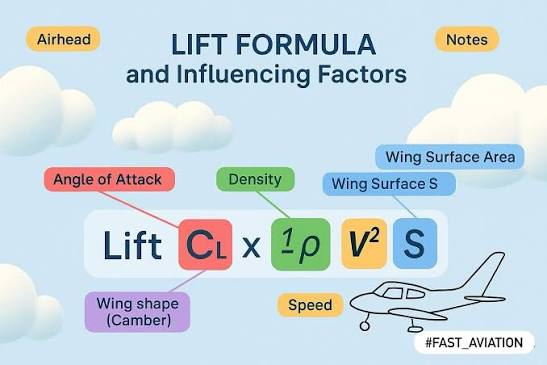
If INDICATED AIRSPEED remains constant and ANGLE OF ATTACK increases, LIFT will…
INCREASE
The 3 Axis of Movement
Pitch, Yaw, Roll
Primary Effect of Elevator:
Pitching the nose up or down. Moves the aircraft about the LATERAL axis
Secondary Effect of Elevator:
Changing the pitch results in the change of the AIRSPEED and ALTITUDE
Primary Effect of Ailerons
Rolling the aircraft left or right. Moves the aircraft about the LONGITUDINAL axis
Secondary Effect of Ailerons
Once the aircraft is established in a roll a sideslip occurs resulting in YAW.
Primary Effect of Rudder
Yaws the aircraft left or right. Moves the aircraft about the NORMAL axis.
Secondary Effect of Rudder
As the aircraft yaws one wing travels faster than the other. This increase in airspeed results in more lift being generated on the outer wing. This results in a ROLL in the direction of the yaw.
What effect takes place when an aircrafts flaps are lowered?
Balloon effect
How do we combat a balloon effect?
Pitch plane nose downwards by placing downward pressure on control column.
What is trim used for?
Used to relieve a pilot’s elevator control load in flight
What is mixture used for?
Used to adjust the fuel/air ratio.
What is the IDEAL FUEL RATIO?
Approx 15 (air) : 1 (fuel)
What does the THROTTLE do?
Adjusts power delivery from the engine.
What does it control?
Controls the RPM of the engine.
What is a SLIPSTREAM?
The propeller is rotated clockwise then viewed from the cockpit creating a backwards spiral airflow. This spiral airflow hits the vertical stabiliser causing YAW, this must be counteracted by the use of the right rudder
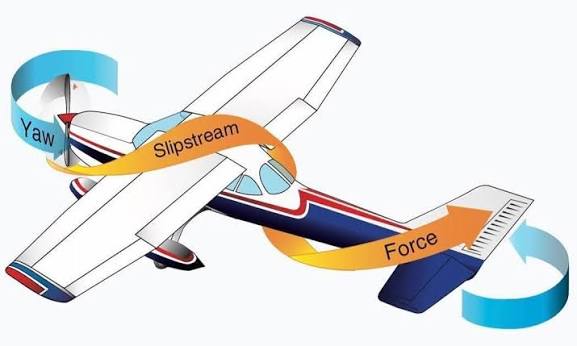
What is an effect of POWER?
Increase in power causes the nose to pitch up and yaw left. The opposite occurs with decrease in power, (yaw right, pitch downwards).
At HIGH speed, what can the controls be described as?
Heavier and firmer, with a greater control response for given control surface definition.
At LOW speed, what can the controls be described as?
Light, less effective, less of a control response, so greater control input is required.
Skin friction drag
Exists between an object and the air moving around it.
Form drag
Results from airflow separation (where it leaves the surface), this can be reduced by streamlining sections of the aircraft.
Interference drag
Caused by the mixing of airstreams travelling in multiple directions at various speeds. The mixing occurs at junctions (corners) which are part of the aircraft's design. The sharper the junction the greater the effect.
What are skin friction drag, interference drag AND form drag sub-catergories of?
PARASITE DRAG
Parasite drag will ____ with an INCREASE in airspeed.
INCREASE
Induced drag
Induced drag is a function of AoA, it occurs when high pressure under the wing spills over the wingtip as it tries to move to an area of lower pressure. The span wise airflow produced creates wingtip vortices which are amplified at higher AoA, generating even more induced drag.
Induced drag will ____ with an increase in airspeed being a function of AoA
DECREASE
What is TOTAL DRAG?
The sum of both parasite AND induced drag
Stability
The natural tendency for an aircraft to return to its original position following a disturbance
What are the two types of STABILITY?
Static and Dynamic
Static stability
Static stability is the initial tendency of an aircraft to revert to its original position following a disturbance. Static stability can be positive (stable), neutral or negative (unstable).
Dynamic stability
Dynamic stability is when an aircraft attempts to return to its original position but oscillates about this point over time. Dynamic stability can be positive, neutral or negative.
Longitudinal Stability
An aircraft with positive longitudinal stability is said to be stable about its lateral axis.
How can an aircraft be designed to achieve longitudinal stability?
With an horizontal stabiliser having a lower angle of incidence than the main aerofoil.
Lateral stability
An aircraft with positive lateral stability is said to be stable about its longitudinal axis.
How can aircraft designers can achieve lateral stability?
Through the use of the pendulous effect and/or dihedral wing design.
Directional stability
Directional stability is stability about the aircraft's normal axis.
What is the PAP for a NORMAL cruise?
Power - 2300 RPM Attitude - 3 or 4 fingers Performance - 110 KIAS
What is the PAP for a SLOW cruise?
Power - 2100 RPM Attitude - 2 fingers Performance - 80 KIAS
What is the PAP for a FAST cruise?
Power - 2500 RPM Attitude - 5 fingers Performance - 120 KIAS
What does ALAP stand for?
Attitude, Lookout, Attitude, Performance
What acronym is performed for PRE-ENTRY checks?
RHAL - Reference feature, Heading, Altitude and Lookout
In a climb, lift is ___ than weight
LESS
In headwind, ___ increases and ROC… what?
ANGLE OF CLIMB increases and Rate of climb REMAINS THE SAME
In tailwind, ___ decreases and ROC… what?
ANGLE OF CLIMB decreases and Rate of climb REMAINS THE SAME
Descending
? is less than weight
Thrust is ? than drag
Lift, LESS
When descending, to maintain a constant speed, what must be reduced?
THRUST
A high L/D ratio gives the aircraft a better ? range
GLIDE RANGE
Maximum Glide Range
Any deviation from ? kts will increase drag
68 KTS
Descending - Effect of Flaps
Flaps give a small ? in LIFT, and a greater ? in DRAG (proportionally), therefore they always ? the L:D ratio
INCREASE , INCREASE , DECREASE
If the angle of descent increases the angle in headwind, does the Rate of descent increase or decrease in headwind?
NEITHER, it remains the same
What is Centripetal force
The force which pulls you into a turn
What is Angle of bank
The angle (in degrees) between the lateral axis and the horizon
What is a Medium level turn
30 degrees AoB maintaining a constant altitude, balance and power.
An increase in lift (AoA) will also increase ____?
Drag
The natural stability of an aircraft is to yaw INTO the turn, BUT ___________ tends to yaw the aircraft OUT of the turn.
Adverse aileron yaw
What is the definition of Stalling
Stalling is a state of flight in which the aircraft is not producing enough lift to sustain the weight of an aircraft.
Symptoms of a stall:
High nose attitude
Low decreasing IAS
Sloppy controls
Stall warning
Control buffet (at the onset of a stall)
Reducing the ______ is vital in the stall recovery; this is achieved by ______ back pressure.
Angle of Attack , REDUCING
As stalling occurs at a particular angle (_____) the only way for the pilot to know when it will occur is to use the AoA to airspeed relationship.
What degree does a STALL occur?
16 DEGREES
What is the standard configuration speed of stall in a Cessna 172?
For the Cessna 172, this is 48 KIAS
What can cause a wing drop?
Aircraft is out of balance, turbulence, use of aileron or imperfections on the wings (ice or damage)
We must NOT use _____ to correct a wing drop. This will further stall this wing and could cause the aircraft to enter a spin.
AILERONS
TYPES OF DESCENTS:
What is the PaP of a CRUISE descent?
Power: 2100rpm, attitude: 5 fingers, performance: -500fpm
TYPES OF DESCENTS:
What is the PaP of a GLIDE descent?
Power: idle, attitude: 2 fingers, performance: 68 KIAS
TYPES OF DESCENTS:
What is the PaP of an APPROACH (20 DEGREE FLAPS) descent?
Power: 1500 rpm, attitude: 4 fingers on top of compass, performance: 75 KIAS or -500 fpm
CLIMBS
Performance of a BroC?
74 KIAS
CLIMBS
Performance of a BaoC?
62 KIAS
CLIMBS
Performance of a cruise climb?
90 KIAS
CLIMBS
Attitude of a BroC?
Horizon in line with top of control panel screens
CLIMBS
Attitude of a BaoC?
Horizon in line with the artificial horizon on screen
CLIMBS
Attitude of a cruise climb?
Horizon in line with top of the control panel
What is our flap setting for approach descent?
Less than 110 KIAS = 10 degrees
Less than 85 KIAS = 20 degrees