Psych Chap 6 - The Demand for Sleep
 Call Kai
 Learn
Learn Practice Test
 Spaced Repetition
 Match
Match Flashcards
 Knowt Play
1/91

There's no tags or description
Looks like no tags are added yet.
92 Terms
Consciousness
Awareness and responsiveness to the internal and external environment. It is personal, selective, continuous and changing.
State of consciousness
A variable state of awareness associated with distinguishable psychological and physiological characteristics
Sleep
A reversible, regular and (typically) naturally occurring ASC that involves a loss of awareness and disengagement with internal and external stimuli, i.e. a partial or total suspension of awareness.
NWC
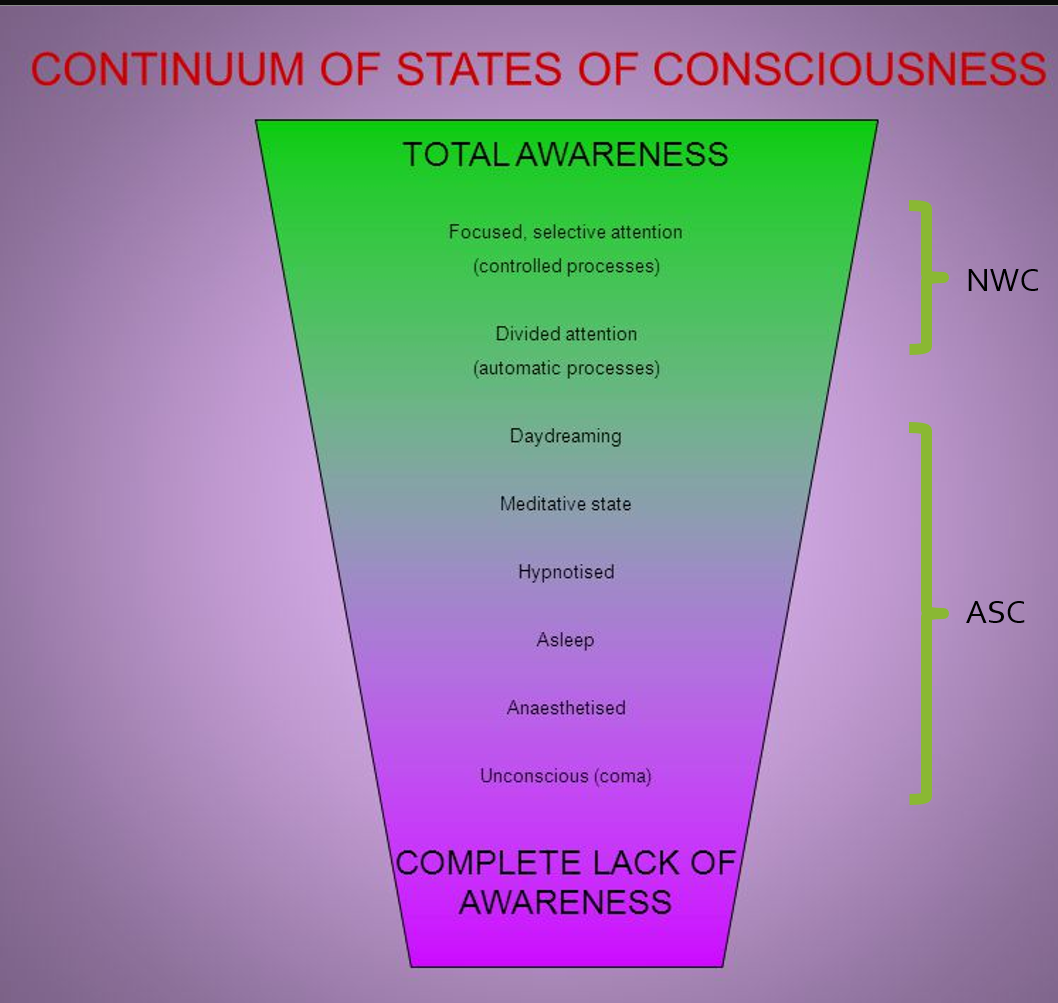
Normal Waking Consciousness; when a person is awake, in control of their movements, aware of their thoughts and feelings, perceives the passage of time accurately, and can accurately perceive internal and external stimuli.
ASC
Altered States of Consciousness; any state of consciousness that is significantly different from NWC in terms of level of awareness and experience
Naturally occurring ASC
Altered states of consciousness such as sleep, dreaming during sleep and daydreaming when awake, that are naturally occurring in the course of everyday activities without the need for any aid
Induced ASC
A temporary change in one's normal mental state without being considered unconscious, that is achieved through some form of assistance/aid e.g. medication, meditation, hypnosis, brain damage, disease or disorder
Continuum of States of Consciousness
Psychological Construct
(Hypothetical construct). An agreed upon description and understanding of psychological phenomena that is believed to occur, but that cannot be overtly measured or observed.
Why is consciousness (and similarly sleep) a psychological construct?
• Abstract concept, not a physical thing
• Cannot be directly demonstrated to exist or measured (and instead relies on self-reports + observations to make inferences)
• Useful for organising our understanding of mental experiences and awareness
What 3 measurements are used by researchers to investigate sleep
- information provided by individuals
- behaviour that is demonstrated
- physiological changes that can be measured
EEG
An Electroencephalograph instrument detects, amplifies and records the electrical activity of the brain through electrodes to indicate levels of activity in different regions, averaging electrical activity to create a visual pattern of brain waves.
Brain waves
Spontaneous, rhythmic electrical impulses that come from different brain areas.
How do ASCs typically present on an EEG and an EMG?
EEG - Higher amplitude waves, with a lower frequency (relaxed)
EMG - Decreased muscle tone and less activity
Electroencephalograms
The recorded graphical display of information gathered through an Electroencephalograph.
Frequency
The number of brain waves per second (more = faster)
Amplitude/intensity
Measured in microvolts and can be visually judged by the size of the peaks and troughs of the waves from a baseline of zero activity.
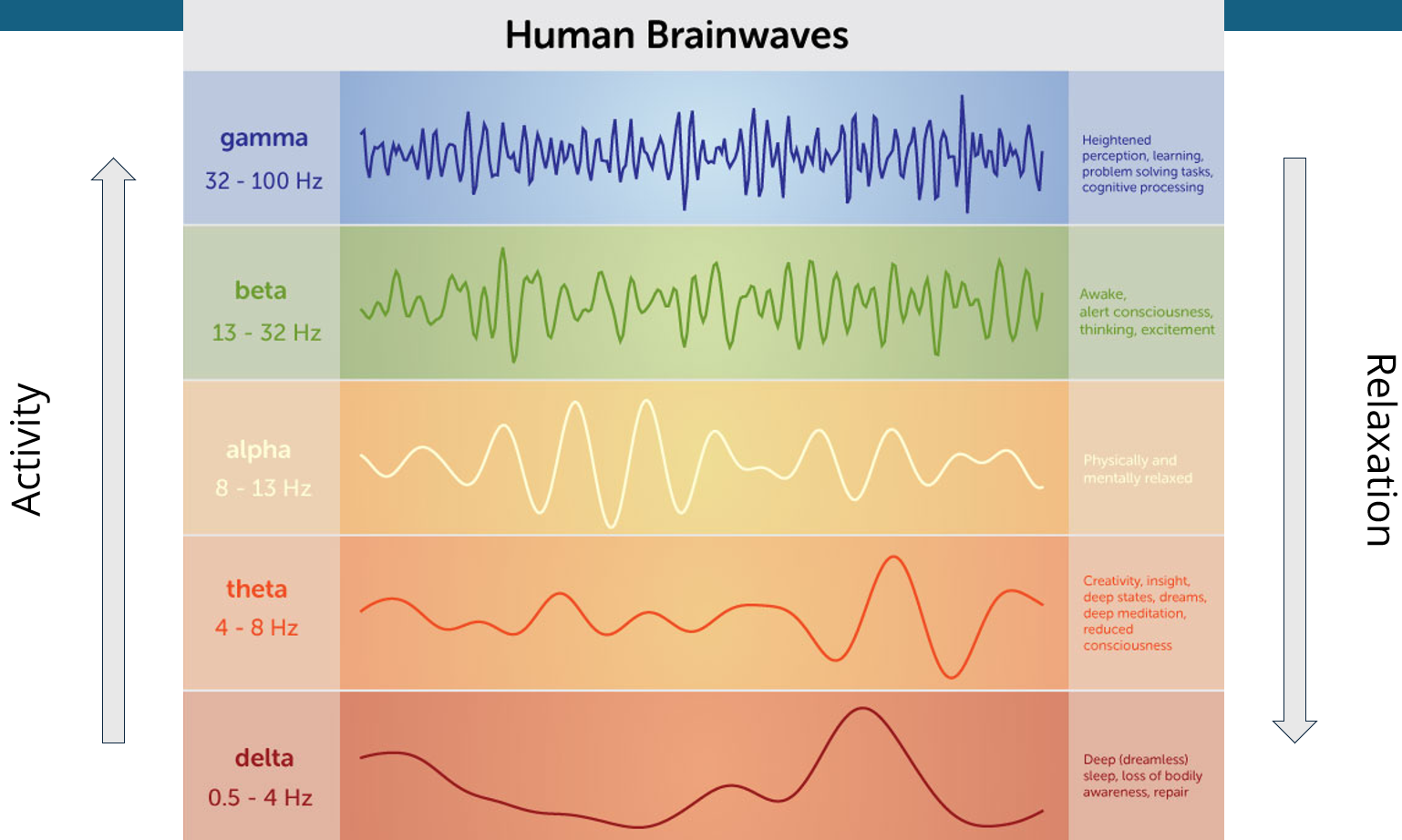
4 commonly described brain waves, ordered from fastest to slowest (and therefore lowest to highest amplitude)
Beta, alpha, theta, delta
Beta wave pattern
Alertness and intensive mental activity during normal waking consciousness, as well as dreaming in REM sleep.
Alpha wave pattern
Awake and alert but mentally and physically relaxed and internally focused
Theta wave pattern
Drowsy, when falling asleep or just before waking. May also be produced during creative activities while awake
Delta wave pattern
Deep, dreamless sleep or unconsciousness
EMG
An Electromyograph device detects, amplifies and records electrical activity in the skeletal muscles, to indicate level of muscle tone/activity in different areas (also can see leg jerking around sleep onset).
What are the 3 studies of sleep-related physiological changes?
Electroencephalography - a method of studying brain wave patterns by recording the electrical activity of the brain
Electromyography - a method of studying the electrical activity of muscles during sleep
Electro-oculargraphy - a method of measuring eye movements or eye positions during sleep
EOG
An Electro-oculargraph detects, amplifies and records electrical activity in the muscles that control eye movements indicate eye activity.
Sleep diaries
A self-report record of sleep and wake time activities over a period of time, with information on things like timings, feelings of restfulness and tiredness, and timing of food, exercise, meds, caffeine, alcohol and other things throughout the day. Helps to better understand sleep in the natural environment
Video monitoring
Using a video camera at a sleep laboratory to monitor and record externally observable aspects of sleep such as posture in bed, changing position, breathing, behaviours when awakening or awakening from a nightmare, and sleepwalking.
Biological rhythm
A naturally occurring cycle of physiological, psychological or behavioural changes. Often linked to environmental stimuli. Two categories are circadian and ultradian.
Biological clock
An innate timing mechanism that regulates the cycle of a biological rhythm. Its functioning is genetically determined and occurs at the cellular level.
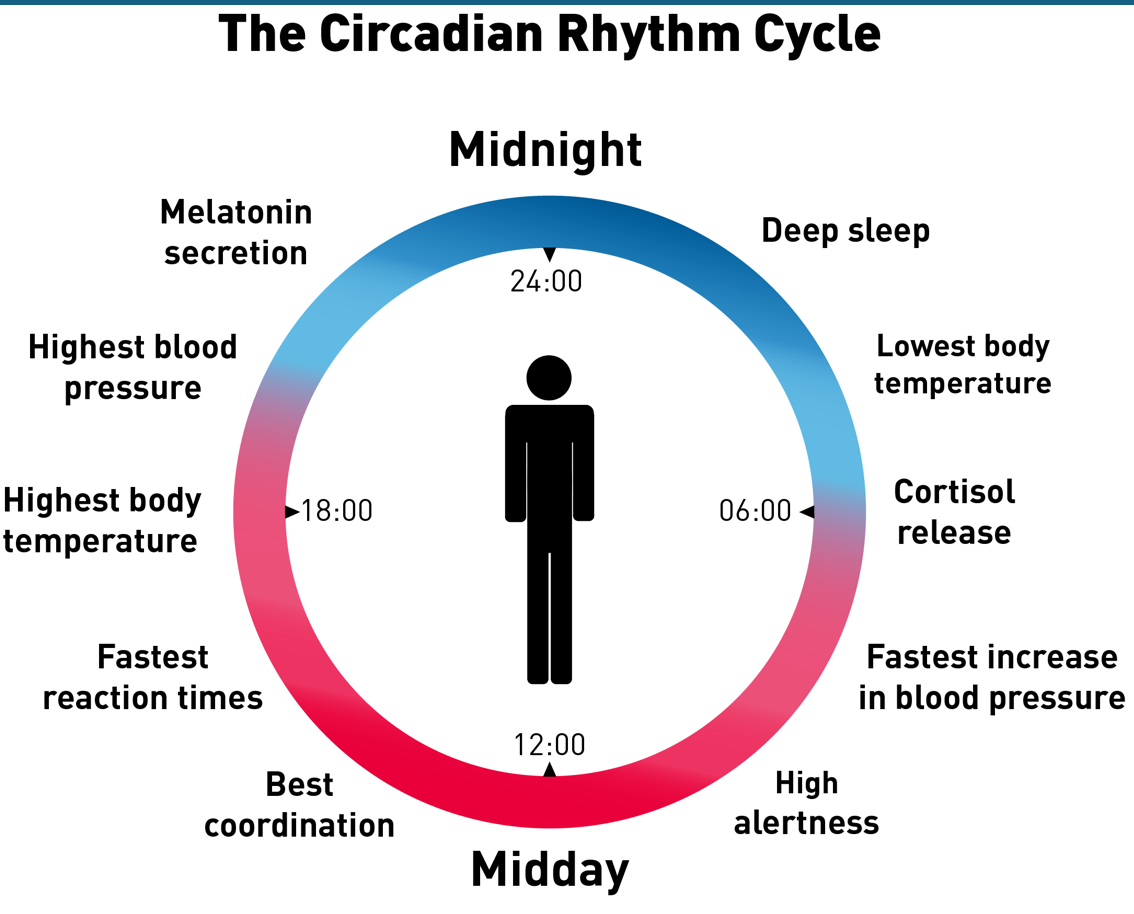
The Circadian Rhythm Cycle Diagram
Circadian Rhythm
A biological rhythm involving physiological, psychological or behavioural changes that occur as part of a cycle with a duration of about 24 hours
Endogenous vs exogenous
Endogenous refers to something that originates within an organism (e.g. sleep-wake cycle) while exogenous refers to something that has its origins outside an organism (e.g. environmental time cues)
What structure regulates ALL CIRCADIAN RHYTHMS
The Suprachiasmatic Nucleus (SCN) in the hypothalamus (as a part of the nervous system).
Suprachiasmatic Nucleus
Pair of nuclei located above the optic chiasm that respond to light to control melatonin production to regulate the timing and activity of the sleep-wake cycle, among other biological clocks involved with circadian rhythms (therefore is also is involved in all other circadian rhythms)
Optic chiasm
The point where the optic nerves that connect the eyes and brain cross.
How does the SCN regulate melatonin levels?
The suprachiasmatic nucleus receives light information from the eyes, along with information about melatonin levels in the brain, then stimulates the pineal gland for secretion in order to moderate the output of melatonin.
What functions does the SCN perform when light is detected?
- Initiates an increase in body temperature
- Stimulates release of hormones like cortisol to promote alertness and support other arousal activities
- Supresses the release of melatonin
(These functions are all supressed when it's dark)
Blue light
Bluer wave lengths of light are even more effective at supressing melatonin release from the pineal gland than other wavelengths are, meaning that looking at blue light keep us awake for longer.
Zeitgeber
Environmental and social variables that are capable of acting as circadian time cues to help sync biological rhythms. Includes light, food intake and physical activity.
Melatonin
Hormone secreted by the pineal gland into the bloodstream that is involved in the initiation of sleep, drowsiness, quality of rest, and regulation of the sleep-wake cycle. Levels stay high from dusk till dawn (i.e. when it's dark or when asleep). Levels determine sleepiness.
Synthetic melatonin
Produced to help those with insomnia or those who are blind; shown to have little negative side effects over short-term use.
Ultradian rhythm
A biological rhythm that involves physiological, psychological or behavioural changes that occur as part of a cycle shorter than 24 hours.
Why is sleep both a circadian and ultradian rhythm?
It's a circadian rhythm because it occurs at a predictable time every day, and it is an ultradian rhythm because it involves different stages of sleep that we cycle in an out of several times per night.
Examples of ultradian rhythms
Heartbeat, breathing, hunger, hormone and neurotransmitter activity
What factors can influence an ultradian sleep cycle?
Age, health and environmental cues
Stages of an ultradian sleep cycle?
- REM
- NREM
> Stage 1
> Stage 2
> Stage 3
Key differences between REM and NREM sleep
- REM has rapid eye movements, NREM does not
- NREM has stages, REM does not
- REM is linked to beta brain waves, NREM to alpha, theta and delta
- NREM involves a relatively inactive brain in a body that can move, while REM involves an active brain in a paralysed body
Hypnogram
A sleep graph typically showing sleep types and stages in relation to time
Pattern of REM periods along a sleep period
REM periods tend to increase as a night progresses, and is longest in the last third of the night
What would be shown on an EMG, EOG and EEG if someone was in REM sleep?
EMG - No muscle tone (paralysed body)
EOG - Rapid eye movement
EEG - Beta waves
NREM sleep trends in young adults
Stage 3 deep sleep tends to predominate in an NREM period during the first half of the sleep episode, particularly in the first two cycles. As the night progresses, stage 2 begins to account for the majority of NREM sleep, and stage 3 may disappear.
Awakenings during a sleep episode
Brief awakenings tend to occur later in cycles, but are rarely remembered. Typically occur in transition between REM and NREM. Wakeful periods are considered part of a sleep episode rather than waking time.
NREM sleep
Non-rapid eye movement sleep with three stages involving increasingly deeper sleep and lowering HR, blood pressure, muscle tone, temp and breathing. Accounts for approx. 75-80% of sleep time and occurs more in the first half rather than the second half of the night.
What change in brain waves is detectable on an EEG as a person transitions into deeper stages of NREM sleep?
They get slower and bigger (lower frequency, higher amplitude)
Sleep onset
The transition period from being awake to being asleep
Sleep latency
The amount of time it takes to fall asleep once the attempt to do so is made
NREM stage 1
Very light sleep that typically occurs as we fall asleep and wake up for 1-8 mins. Hypnic jerks and slow, rolling eye movements may occur, and the person is very easily woken, showiong alertness to small sounds. Alpha giving way to theta waves on EEG.
Hypnic jerks
Involuntary muscle twitches as muscles relax during sleep onset. Detectable on EMG.
NREM stage 2
Light-moderate sleep lasting 10-25 mins in the first cycle, and lengthening with each cycle to eventually constitute about half of the total sleep episode. Mostly theta waves, with sleep spindles and K-complexes. Easily roused at start of stage, but harder in the 2nd half. No eye movement.
NREM stage 3
Deep sleep, with delta waves (more than 50% of the time), theta waves, and no eye movements. Also called slow wave sleep or delta sleep. Lasts 20-40 mins in first cycle, then occurs less/not at all towards end. Time when sleep walking, talking, and night terrors occur, and will experience sleep inertia if woken.
Sleep inertia
A temporary period of reduced alertness and performance impairment that occurs immediately after awakening, especially after a poor night’s sleep and if abruptly awakened. Involves grogginess, difficulties with self-orientation and poor memory of sleep events
REM sleep
Paradoxical sleep involving rapid eye movements, high beta-level EEG activity, muscle paralysis and variable arousal threshold. Raised HR, BP, and irregular breathing. When most narrative dreaming occurs. REM periods are longer and occur closer together as a sleep episode progresses to account for a total of 20-25% of our sleep (~1 hour).
Human brainwave continuum image
Number and duration of typical sleep cycles for adults
4-5, duration 90-120 minutes
3 major sleep trends that occur as we get older
- Amount of total sleep decrease
- Proportion of NREM sleep decreases
- Proportion of REM sleep stays relatively stable after a big drop in the first two years
Sleep in infants <2-3 months
- Total sleep time is 16 hours per day (stays till 12 months)
- Sleep onset can occur at any time
- Sleep has irregular lengths (30 mins up to 4 hours) with bottle-fed infants sleeping longer at a time (3-4) compared to breast-fed (2-3)
- Ultradian cycle is present but less cycles occur per episode
- Sleep onset occurs through REM
- REM makes up 50-40% of sleep and involves facial and muscular movements and twitches
Why do infants in their first 2 weeks of life spend 50% of their sleep in REM sleep?
Various theories exist.
- REM provides essential stimulation to mature nervous system
- Muscle and face twitches and movements (that occur in infants' REM) provide sensory feedback to guide sensori-motor network development
What is the reasoning for infants' distinctive sleep pattern?
Because their circadian rhythms are not fully developed or synchronised with the daily day-night cycle of their external environment.
Sleep in infants - 3 months
- Circadian rhythm starts to exert influence over melatonin production leading to more typical biological clock
- Greater responsiveness to social cues e.g. bedtime routines
- NREM-REM cycle is more regular
- Sleep onset begins with NREM stage 1
- REM sleep decreases and shifts to later part of sleep cycle
- Typical cycle is 50-60 mins
Sleep in infants - 6 months
- Longest sleep episodes are 5-8 hours at night
- Full NREM cycle with all stages emerges
- Muscle paralysis in REM has set in
- Changes due to maturation of brain and biological mechanisms that govern the NREM-REM sleep cycle
Sleep in infants - 12 months
- Sleep 14-15 hours per day, majorly as one sleep at night, with 1-2 naps in the day
- Full sleep cycles, but still with a high proportion of REM sleep
Sleep in children
- Time asleep decreases from 13 hours at 2 years to 10-11 at 5 years (which stays consistent till adolescence)
- REM proportion decreases to 20-25% and NREM increases
- More time in N2+3
- Half of NREM is stage 3 deep sleep, decreasing markedly from age 10
Why does sleep time decrease as a child gets older from ages 2 to 5?
Biological - Maturation, etc.
Social - Decreased daytime napping and preschool routines.
Affect how, with whom, where and how much children sleep.
How is N3 sleep different for young children compared to adults?
Qualitatively - When delta waves are predominant in the night's first sleep cycle it is extremely difficult to wake them
Quantitatively - Children up to mid-adolescence often skip their first REM period, maybe due to quantity and intensity of delta brain wave sleep activity early in the sleep episode
Sleep in adolescents
- Total sleep time decreases to 8-10 hours (though typically 6-10 is gotten)
- Amount of REM sleep decreases unless bedtime is fixed, approx. 20% REM, 80% NREM (note often has less REM than adults)
- N3 decreases by 40% since early childhood while N2 increases
- Sleep wake cycle pushes onset back 1-2 hours
- Irregular sleep patterns due to staying up late and disrupting circadian rhythms and sleep quality, can also cause lethargy + trouble concentrating
Why do adolescents tend to get less sleep than they need to function best?
Lifestyle factors and a biologically driven change in sleep-wake cycle that pushes onset back 1-2 hours
Sleep in adults
- Average of 8 hours sleep (sleep+naps)
- 20-25% of sleep is REM
- Gradual decline in sleep episode duration and REM proportion
- Gradual loss of N3 (sooner for males than females)
- Sleep becomes more fragmented due to less time in N3
- May go to bed and wake up earlier than younger adults
What reasons account for changes in older people's sleep-wake cycle?
May be due to an age-related deterioration in the biological clock (SCN) that drives the cycle and the reduction in melatonin production that is evident in older people.
What may account for difficulties among older people to get to sleep?
1 in 3 females and 1 in 6 males take more than half an hour to get to sleep. This may reflect factors like daytime napping, medical issues, decreased mobility leading to a reduction in exercise and irregular meal times.
Sleep needs in older adults/elderly
Sleep needs don't decline with age, as all adults need roughly 8 hours. In reality difficulties affect adults abilities to sleep well. Sleep apnoea, and insomnia increase with age.
Typically 6 hours of sleep per day, with a REM proportion of 20-23%
Why is sleep reversible?
Because an individual can always be awoken and ‘reversed back’ to normal consciousness if a strong enough stimulus is present
Hypnogogic states of consciousness
States of consciousness like sleep onset that are leading in to sleep
Why is REM sleep often referred to as paradoxical sleep?
Because our body appears to be in a paralysed state that seems inactive externally, but internally the brain is highly active.
States of consciousness exist on a continuum because
They shift easily as we shift our attention
Two types of NWC
Focused/selective attention (controlled processes)
Divided attention (automatic processes)
Typical release of melatonin over the course of 24 hours
From 8pm, melatonin levels rise as light levels lower, in preparation for sleep. During the night, melatonin levels peak around 2am, before slowly lowering to daytime levels by around 6am, and staying low throughout the day.
Type of restoration that occurs in REM and NREM sleep respectively
REM - Restores the brain and mental processes (e.g. memory consolidation, maintenance of neural pathways, brain growth)
NREM - Restores the physical body (e.g. Physical growth, cell regeneration and repair, muscles rid of waste products, tissue repair and recovery from fatigue)
Restorative Theory of sleep
That sleep provides a period during which an individual can recover from physical and mental resource-depleting activities carried out during waking time.
Evidence for restoration theory
•Subjective experience of being refreshed and energetic after sleep
•We sleep longer when we are ill
•We experience extra Stage 3 NREM after strenuous exercise
•REM higher in infants / children (peak brain development)
•REM rebound
•Greater levels of hormone secretion in Stage 3 NREM to assist with cell repair
Why is sleep considered to be an altered state of consciousness?
Because it involves:
• reduced levels of awareness
• lack of control over thoughts
• occurrence of perceptual and cognitive distortions
• reduced emotional awareness
• lack of self-control
• lack of time orientation
• reduced responsiveness to internal and external stimuli.
Daylight
The main naturally occurring zeitgeber that influences the functioning of the SCN and allows it to reset every 24 hours
Patterns of NREM stages across the lifespan
NREM 1 - increases with age
NREM 2 - highest proportion in adults and increases as people age (into elderly)
NREM 3 - highest proportion in childhood and decreases by early adult good.