lecture 23 - DNA replication cont.
 Call Kai
 Learn
Learn Practice Test
 Spaced Repetition
 Match
Match Flashcards
 Knowt Play
1/17

There's no tags or description
Looks like no tags are added yet.
Name | Mastery | Learn | Test | Matching | Spaced | Call with Kai | Chat |
|---|
No analytics yet
Send a link to your students to track their progress
18 Terms
can DNA be made de novo
NOOO!!!
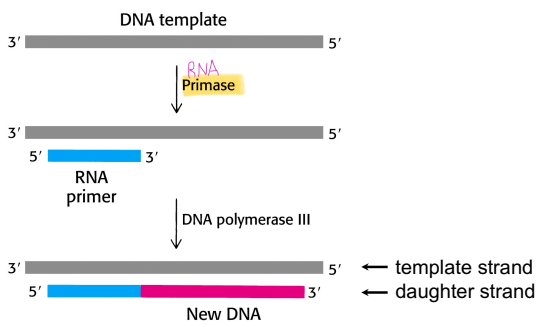
DNA synthesis general process diagram
which enzyme unwinds DNA for replication
helicases unwinds DNA to expose bases of each template strand
role of single-strand binding proteins (SSB) in replication
Bind to the exposed single-stranded template DNA immediately after helicase unwinds the duplex.
Prevent the ssDNA template from re-annealing back into a duplex before it can be copied
Protect the exposed ssDNA from nuclease degradation
Keep the template strand extended/accessible so primase and DNA polymerase can act on it
what is replication primed by and how are they made
short RNA primers
They are synthesized by primase, an RNA polymerase (DE NOVO)
Why does DNA Polymerase Requires a Primer and how is it made (brief). and compare with RNA polymerases (brief)
DNA polymerases cannot synthesize DNA de novo
they require incoming dNMPs to an existing primer with a 3’OH
(RNA polymerases do not need a primer and can synthesize RNA from scratch.)
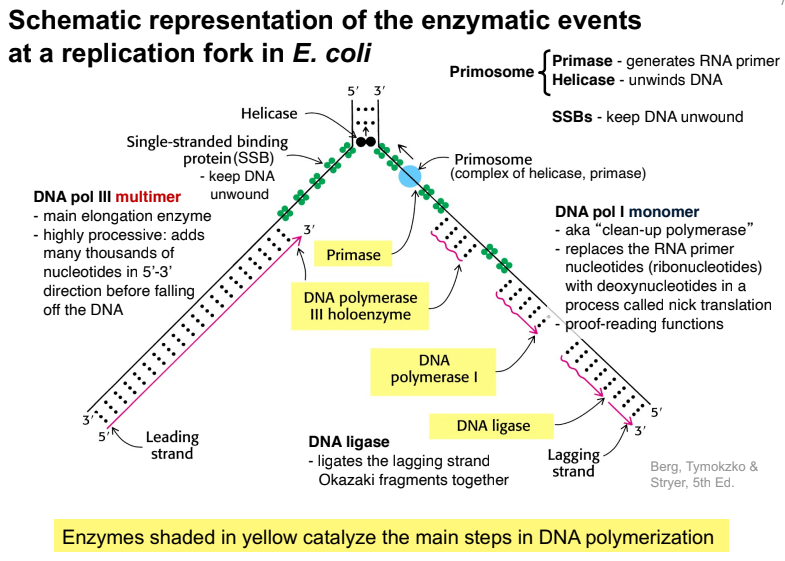
detailed diagram of replication fork
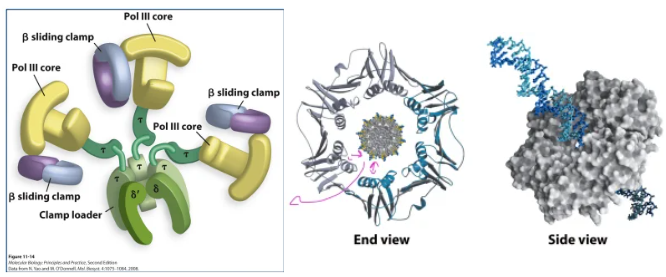
DNA pol III holoenzyme (complex multimeric enzyme) structure & function
copies DNA
Pol III Core (αεθ): The α subunit builds the new DNA strand from 5' to 3', the ε subunit checks and fixes errors using 3' to 5' proofreading, and the θ subunit stabilizes the core
Beta Sliding Clamp (β₂): A ring-shaped protein that locks the polymerase onto the DNA strand
Clamp Loader(τ/γ): An ATP-powered assembly (τ, γ, δ, δ', χ, ψ) that opens and places the sliding clamp onto the DNA template
anatomy of E.coli replication fork (dont need to know all details)
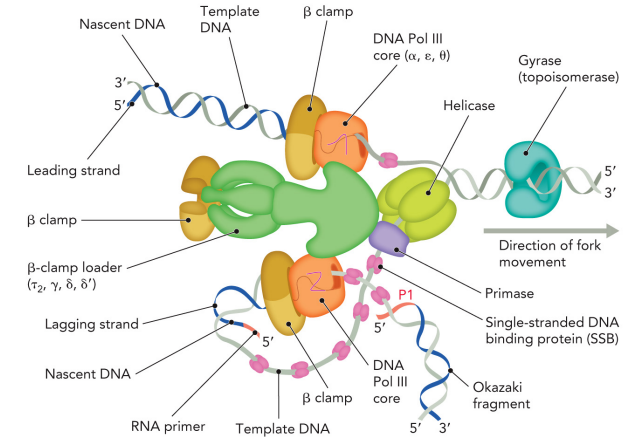
E.coli replication steps 1-2
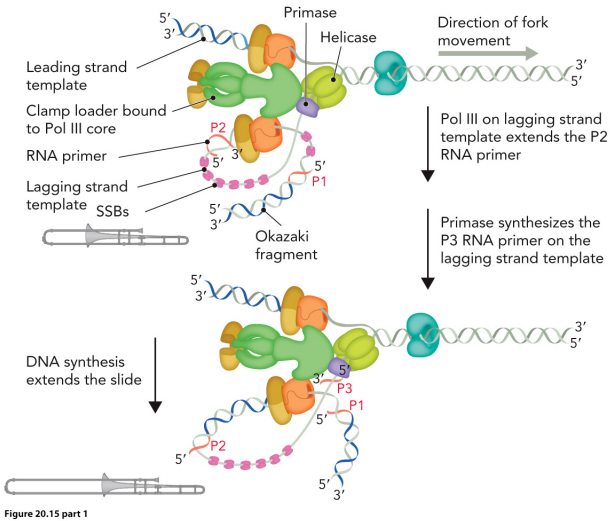
E.coli replication steps 2-3
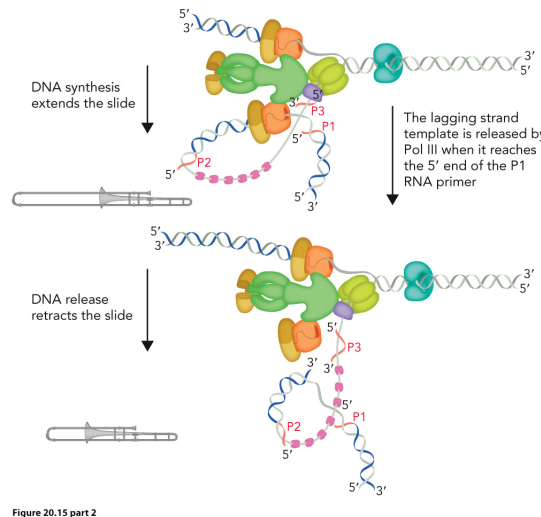
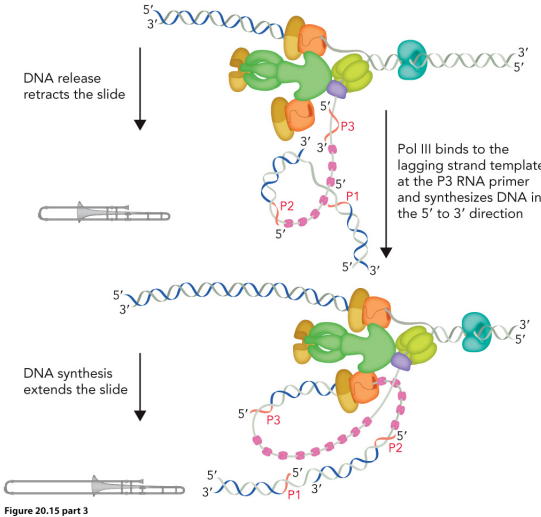
E.coli replication steps 3-4
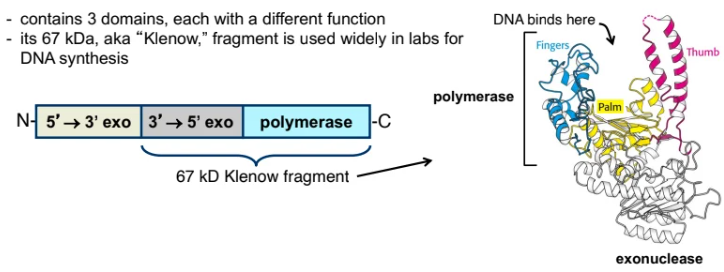
DNA polymerase monomer I structure
Why replication is discontinuous on one strand (leading vs. lagging)
The two template strands of DNA are antiparallel (run 5'→3' in opposite directions), but DNA polymerase can only synthesize new DNA in the 5'→3' direction.
As the replication fork moves in one direction, one template strand is oriented so the new strand can be made continuously in the same direction as fork movement → leading strand
The other template strand is oriented oppositely, so the new strand must be made discontinuously, in short bursts moving away from the fork, each needing its own RNA primer → lagging strand (Okazaki fragments)
This single fork, moving in one direction, is why replication looks symmetric for the duplex overall but asymmetric (continuous vs. discontinuous) at the mechanistic level for each strand
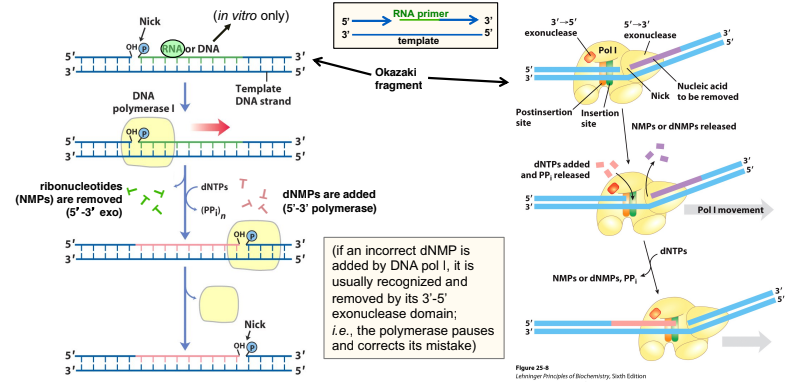
what does DNA pol I do in lagging strand DNA synthesis and what is a name for it?
DNA pol I is essential in lagging strand DNA synthesis
does the following for the lagging strand in DNA synthesis:
removes RNA primers one ribonucleotides at a time w/ 5’ → 3’ exonuclease activity
adds deoxyribonucleotides to the 3’ end of the adjacent Okazaki fragment (lagging strand), w/ 5’ → 3’ polymerase activity (polymerization always occurs 5’ → 3’)
These processes together are called “nick translation,” because the gap (nick) between the Okazaki fragments seems to move (translate) as the RNA ends of one fragment are removed and dNMPs are added to the adjacent Okazaki fragment
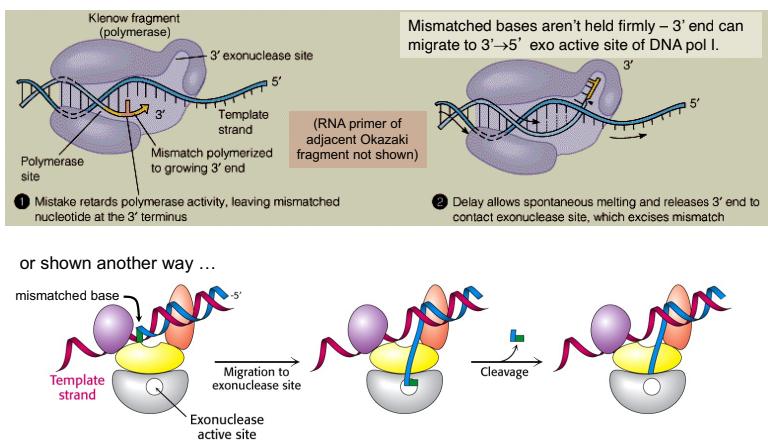
proofreading/editing: excises mismatched/defective nucleotides in the 3’ end of the Okazaki fragments w/ 3’ → 5’ exonuclease
nick translation
Completes synthesis of the lagging strand
Each Okazaki fragment has its own RNA primer that must be removed. DNA pol I simultaneously polymerizes (extends) one end of an Okazaki fragment and excises the RNA primer of an adjacent Okazaki fragment one nucleotide at at time. As it adds dNMPs it checks that they are correct (proof-reads). If they are incorrect, it excises them (3’ → 5’ exonuclease activity) and replaces them with the correct nucleotide.
Because the dNMPs are added to the 3’ end of one Okazaki fragment and the ribonucleotides are removed from the 5’ end of the adjacent RNA primer, the gap (“nick”) between these two strands gets moved (“translated”) along the strand in the 5’ → 3’ direction.
The nick will be subsequently sealed by DNA ligase in an ATP-driven process. .
role of ligase
Seals the remaining nick between Okazaki fragments after DNA pol I has removed the RNA primer and filled the gap with DNA (nick translation)
Catalyzes formation of the final phosphodiester bond between the 3'-OH of one fragment and the 5'-phosphate of the adjacent fragment
Requires ATP hydrolysis to drive the energetically unfavorable bond formation
Without ligase, the lagging strand would remain as a series of disconnected Okazaki fragments
3’→ 5’ proofreading repair by DNA pol I
proofreading/editing: excises mismatched/defective nucleotides in the 3’ end of the Okazaki fragments w/ 3’ → 5’ exonuclease