AP Psych Unit 1A Vocab
 Call Kai
 Learn
Learn Practice Test
 Spaced Repetition
 Match
Match Flashcards
 Knowt Play
1/155

Earn XP
Description and Tags
Name | Mastery | Learn | Test | Matching | Spaced | Call with Kai | Chat |
|---|
No analytics yet
Send a link to your students to track their progress
156 Terms
Module 1.1 - Interaction of Heredity and Environment
nature-nurture issues
the longstanding controversy over the relative contributions that genes and experience make to the development of psychological traits and behaviors. Today’s science views traits and behaviors as arising from the interaction of nature and nurture. (4)
natural selection
the principle that the inherited traits enabling an organism to survive and reproduce in a particular environment will (in competition with other trait variations) most likely be passed on to succeeding generations (5)
evolutionary psychology
the study of the evolution of behavior and the mind, using principles of natural selection (5)
behavior genetics
the study of the relative power and limits of genetic and environmental influences on behavior. (5)
mutation
a random error in gene replication that leads to a change. (7)
environment
every nongenetic influence, from prenatal nutrition to our experiences of the people and things around us. (9)
heredity
the genetic transfer of characteristics from parents to offspring (9).
genes
the biochemical units of heredity. (9)
genome
the complete instructions for making an organisms. (9)
identical (monozygotic) twins
individuals who developed from a single fertilized egg that split in two, creating two genetically identical organisms (11).
fraternal (dizygotic) twins
individuals who developed from separate fertilized eggs. they are genetically no closer than ordinary sibling, but they a prenatal environment (12).
interaction
the interplay that occurs when the effect of one factor (such as the environment) depends on another factor (such as heredity). (15)
epigenetics
“above” or “in addition to” (epi) genetics; the study of the molecular mechanisms by which environments can influence genetic expression (without a DNA change). (16).
Module 1.2 - Overview of the Nervous System
nervous system
the body’s speedy, electrochemical communication network, consisting of all the nerve cells of the peripheral and central nervous systems.
central nervous system (CNS)
the brain and spinal cord.
peripheral nervous system (PNS)
the sensory and motor neurons that connect the central nervous system (CNS) to the rest of the body.
nerves
bundled axons that form neural cables connecting the central nervous system with muscles, glands, and sensory organs.
sensory (afferent) neurons
neurons that carry incoming information from the body’s tissues and sensory receptors to the brain and spinal cord.
motor (efferent) neutrons interneurons
neurons that carry outgoing information from the brain and spinal cord to the muscles and glands.
somatic nervous system
the division of the peripheral nervous system that controls the body’s skeletal muscles. Also called the skeletal nervous system.
autonomic nervous system (ANS)
the part of the peripheral nervous system that controls the glands and the muscles of the internal organs (such as the heart). Its sympathetic division arouses; its parasympathetic division calms.
autonomic nervous system (ANS)
the part of the peripheral nervous system that controls the glands and the muscles of the internal organs (such as the heart). Its sympathetic division arouses; its parasympathetic division calms.
sympathetic nervous system
the division of the autonomic nervous system that arouses the body, mobilizing its energy.
parasympathetic nervous system
the division of the autonomic nervous system that calms the body, conserving its energy.
reflex
a simple, automatic response to a sensory stimulus, such as the knee-jerk response.
Module 1.3a - The Neuron and Neuron Firing: Neural Communication and The Endocrine System
neuron
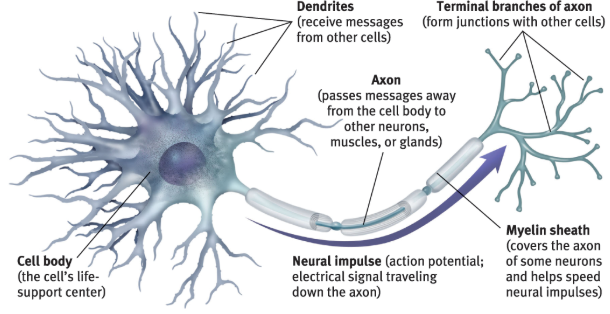
a nerve cell; the basic building block of the nervous system.
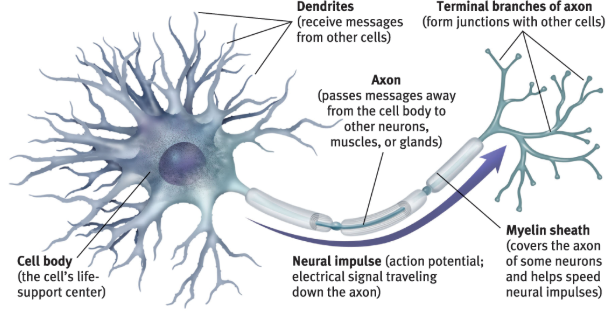
cell body
the part of a neuron that contains the nucleus; the cell’s life-support center.
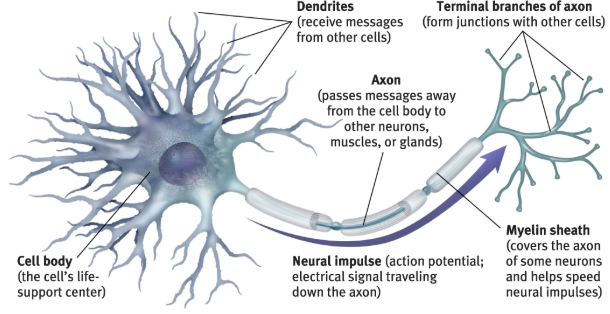
dendrite
a neuron’s often bushy, branching extensions that receive and integrate messages, conducting impulses toward the cell body.
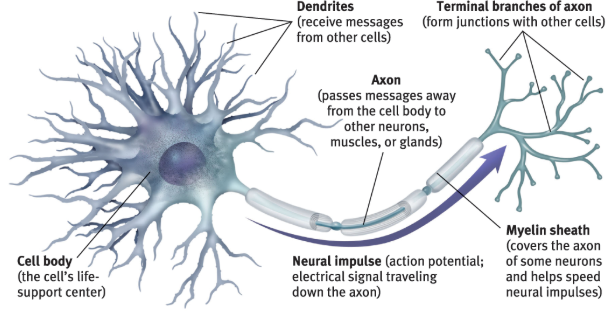
axon
the segmented neuron extension that passes messages through its branches to other neurons or to muscles or glands.
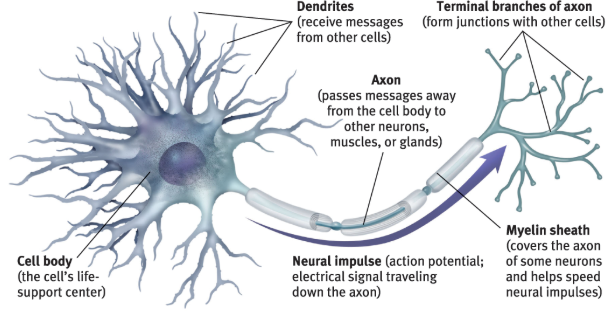
myelin sheath
a fatty tissue layer segmentally encasing the axons of some neurons; it enables vastly greater transmission speed as neural impulses hop from one node to the next.
glial cells (glia)
cells in the nervous system that support, nourish, and protect neurons; they may also play a role in learning, thinking, and memory.
action potential
a neural impulse; a brief electrical charge that travels down an axon.
resting potential
positive-outside and negative inside state of an axon
ions
electrically charged atoms
depolarization
loss of the inside/outside charge difference of an axon’s environment. leads to more sections of axon channels to open.
excitatory signals
most neural signals, chemical and electrical impulses that increase the likelihood of a receiving neuron firing an action potential, promoting neural activity. generated by excitatory neurotransmitters (ex. glutamate)
inhibitory signals
signals sent by one neuron to another to reduce or suppress the likelihood of that second neuron firing an action potential. generated by inhibitory neurotransmitters (ex. GABA)
threshold
the level of stimulation required to trigger a neural impulse.
refractory period
in neural processing, a brief resting pause that occurs after a neuron has fired; subsequent action potentials cannot occur until the axon returns to its resting state.
all-or-none response
a neuron’s reaction of either firing (with a full-strength response) or not firing.
synapse
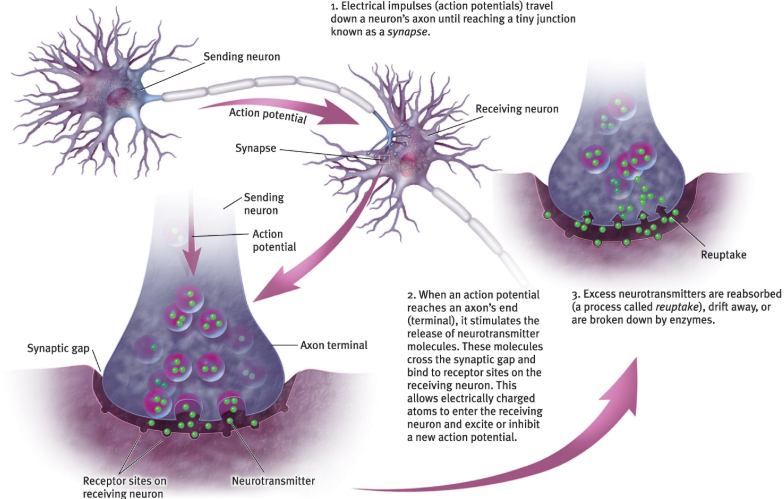
the junction between the axon tip of the sending neuron and the dendrite or cell body of the receiving neuron. The tiny gap at this junction is called the synaptic gap or synaptic cleft.
synaptic gap (cleft)
tiny gap between a receiving and transmitting neuron. called “protoplasmic kisses” by Spanish anatomist Santiago Ramón y Cajal.
neurotransmitters
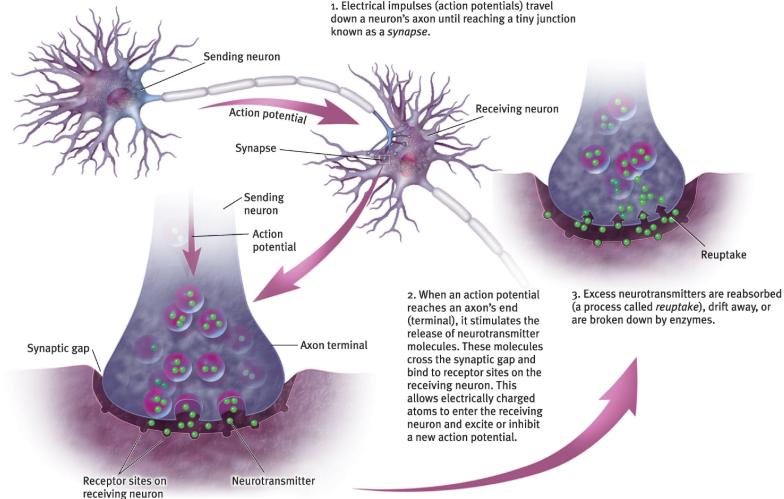
chemical messengers that cross the synaptic gaps between neurons. When released by the sending neuron, neurotransmitters travel across the synapse and bind to receptor sites on the receiving neuron, thereby influencing whether that neuron will generate a neural impulse.
reuptake
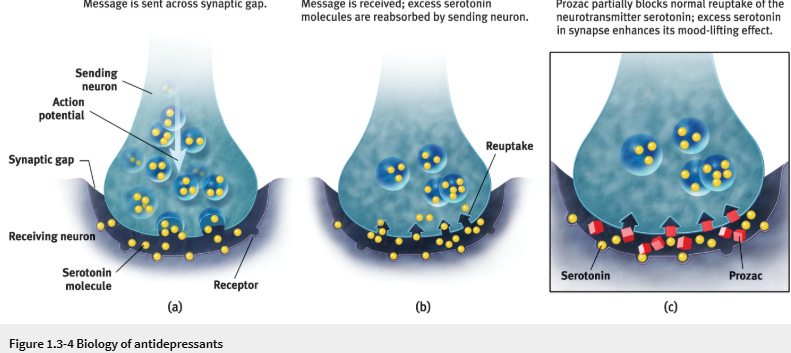
a neurotransmitter’s reabsorption by the sending neuron.
endorphins
“morphine within” — natural, opioid-like neurotransmitters linked to pain control and to pleasure.
agonist
a molecule that increases a neurotransmitter’s action.
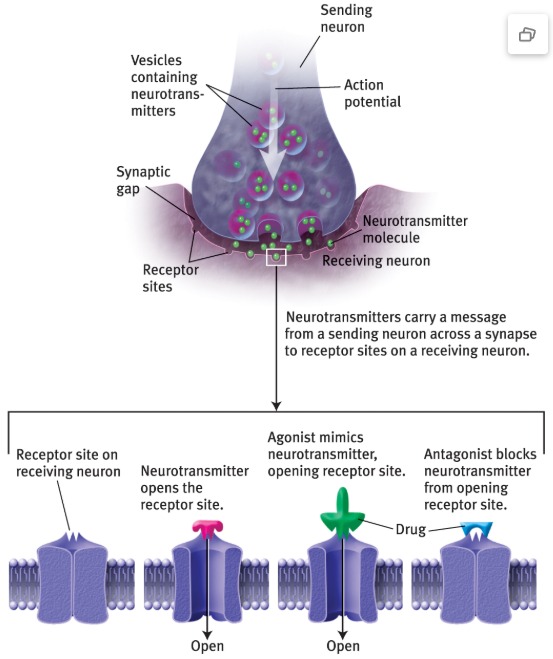
antagonist
a molecule that inhibits or blocks a neurotransmitter’s action.
endocrine system
the body’s “slow” chemical communication system; a set of glands and fat tissue that secrete hormones into the bloodstream.
hormones
chemical messengers that are manufactured by the endocrine glands, travel through the bloodstream, and affect other tissues.
1.3a - 3 Neurotransmitters
Acetylcholine (ACh)
Function: Enables muscle action, learning, and memory
Malfunctions: With Alzheimer’s disease, ACh-producing neurons deteriorate.
Dopamine
Function: Influences movement, learning, attention, and emotion
Malfunctions: Oversupply linked to schizophrenia. Undersupply linked to tremors and decreased mobility in Parkinson’s disease.
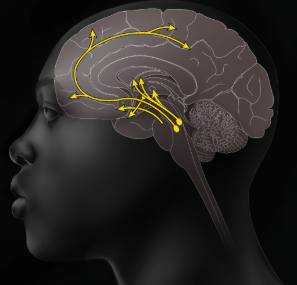
Serotonin
Function: Affects mood, hunger, sleep, and arousal
Malfunctions: Undersupply linked to depression. Some drugs that raise serotonin levels are used to treat depression.
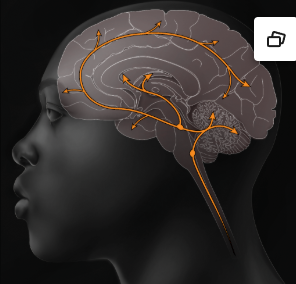
Norepinephrine (nonadrenaline)
Function: Helps control alertness and arousal
Malfunctions: Undersupply can depress mood.
GABA (gamma-aminobutyric acid)
Function: A major inhibitory neurotransmitter
Malfunctions: Undersupply linked to seizures, tremors, and insomnia.
Glutamate
Function: A major excitatory neurotransmitter; involved in memory
Malfunctions: Oversupply can overstimulate the brain, producing migraines or seizures.
Endorphins
Function: Neurotransmitters that influence the perception of pain or pleasure
Malfunctions: Oversupply with opioid drugs can suppress the body’s natural endorphin supply.
Substance P
Function: Involved in pain perception and immune response
Malfunctions: Oversupply can lead to chronic pain.
Endocrine System Vocab
adrenal glands
small, triangle-shaped organs located on top of each kidney that produce vital hormones, regulate metabolism, the immune system, blood pressure, and sexual development, and are controlled by the brain and pituitary gland
epinephrine (adrenaline)
released when the body perceives a threat or danger, naturally produced by the adrenal glands, triggers a series of physiological changes
fight-or-flight response
a natural physiological reaction where the body prepares to confront or flee a perceived threat by releasing stress hormones, increasing heart rate and breathing, and tensing muscles
pituitary gland
a small, "master" gland at the base of the brain that regulates many vital bodily functions through the production and release of hormones
hypothalamus
small but vital part of the brain, acts as the body's central control for maintaining homeostasis, controls ANS and directs endocrine system through interactions with the pituitary gland
oxytocin
produced in the hypothalamus and plays crucial roles in social bonding, sexual reproduction, and childbirth
Module 1.3b - The Neuron and Neuron Firing: Substance Use Disorders and Psychoactive Drugs
psychoactive drug
a chemical substance that alters the brain, causing changes in perceptions and moods.
substance use disorder
a disorder characterized by continued substance use despite significant life disruption.
depressants
drugs that reduce neural activity and slow body functions.
tolerance
the diminishing effect with regular use of the same dose of a drug, requiring the user to take larger and larger doses before experiencing the drug’s effect.
addiction
an everyday term for compulsive substance use (and sometimes for dysfunctional behavior patterns, such as out-of-control gambling) that continue despite harmful consequences. (See also substance use disorder.)
withdrawl
the discomfort and distress that follow discontinuing an addictive drug or behavior.
tranquilizers (sedatives)
a drug that produces a calming, relaxing effect by reducing anxiety, nervous tension, and mental disturbance, often used to treat anxiety disorders and sleep problems. ex. GABA; Xanax & Valium
barbiturates
drugs that depress central nervous system activity, reducing anxiety but impairing memory and judgment.
opioids
opium and its derivatives; they depress neural activity, temporarily lessening pain and anxiety.
stimulants
drugs that excite neural activity and speed up body functions.
hallucinogens
psychedelic (“mind-manifesting”) drugs that distort perceptions and evoke sensory images in the absence of sensory input.
near-death experience
an altered state of consciousness reported after a close brush with death (such as cardiac arrest); often similar to drug-induced hallucinations.
1.3b - 8 (Table 1.3-3 A Guide to Selected Psychoactive Drugs)
Formatting:
Type:
Pleasurable Effects (+):
Possible Negative Effects (-):
Alcohol
Depressant
(+): Initial high followed by relaxation and disinhibition
(-): Depression, memory loss, organ damage, impaired reactions
Heroin
Depressant
(+): Rush of euphoria, relief from pain
(-): Depressed physiology, loss of natural endorphin function
Caffeine
Stimulant
(+): Increased alertness and wakefulness
(-): Anxiety, restlessness, and insomnia in high doses
Nicotine
Stimulant
(+): Arousal and relaxation, sense of well-being
(-): Heart disease, cancer
Cocaine
Stimulant
(+): Rush of euphoria, confidence, energy
(-): Cardiovascular stress, suspiciousness, depressive crash
Methamphetamine
Stimulant
(+): Euphoria, alertness, energy
(-): Irritability, insomnia, hypertension, seizures
Ecstasy (methylenedioxymethamphetamine, MDMA)
Stimulant; mild hallucinogen
(+): Emotional elevation, disinhibition
(-): Dehydration, overheating, depressed mood, impaired cognitive and immune functioning
LSD (lysergic acid diethylamide)
Hallucinogen
(+): Visual “trip”
(-): Risk of panic
Marijuana (delta-9-tetrahydrocannabinol, THC)
Mild hallucinogen
(+): Enhanced sensation, relief of pain, distortion of time, relaxation
(-): Impaired learning and memory, increased risk of psychological disorders
Module 1.4a - The Brain: Neuroplasticity and Tools of Discovery
biological psychology
the scientific study of the links between biological (genetic, neural, hormonal) and psychological processes. (Some biological psychologists call themselves behavioral neuroscientists, neuropsychologists, behavior geneticists, physiological psychologists, or biopsychologists.)
biopsychosocial approach
an integrated approach that incorporates biological, psychological, and social-cultural levels of analysis.
levels of analysis
the differing complementary views, from biological to psychological to social-cultural, for analyzing any given phenomenon.
neuroplasticity
the brain’s ability to change, especially during childhood, by reorganizing after damage or by building new pathways based on experience.
lesion
tissue destruction. Brain lesions may occur naturally (from disease or trauma), during surgery, or experimentally (using electrodes to destroy brain cells).
EEG (electroencephalogram)
an amplified recording of the waves of electrical activity sweeping across the brain’s surface. These waves are measured by electrodes placed on the scalp.
MEG (magnetoencephalography)
a brain-imaging technique that measures magnetic fields from the brain’s natural electrical activity.
CT (computed tomography) scan
a series of X-ray photographs taken from different angles and combined by computer into a composite representation of a slice of the brain’s structure.