Session 4: caries and radiographic interpretation
 Call Kai
 Learn
Learn Practice Test
 Spaced Repetition
 Match
Match Flashcards
 Knowt Play
1/25

There's no tags or description
Looks like no tags are added yet.
Name | Mastery | Learn | Test | Matching | Spaced | Call with Kai | Chat |
|---|
No analytics yet
Send a link to your students to track their progress
26 Terms
toothbrush 2x/day w a F toothpaste (≥1100 ppm F)
follows dental exam instructions based on comprehensive risk: F rinse/gel, interproximal cleaning, oral health behaviors, nutrition and diet, etc
low-moderate risk home care H1
additionally brush teeth 2x/day w 5000 ppm F toothpaste (or as recommended by dentist)
home care for high-extreme ris pt
what are the most significant factors in determining management strategies?
cavitation, activity, and cleansibility
(pt caries risk, contributing then chart caries odontogram or pg 13)
general of home care instructions
Dietary and habits counseling; Brush twice daily with 1100 ppm fluoride; Floss twice daily; rinse with water after every meal
general office care
6- Month Recare and Prophy
Full mouth Fluoride varnish application (for moderate and high-risk patients)
describe ICDAS and radiographic presentation of approximal surfaces

preferred radiograph for caries detection?
bitewings - intraoral
when are caries visible on panoramic radiograph?
when they are large enough to be clincially apparent
which has lower resolution introral or extraoral bw?
extraoral
caries lesion is the manifestation of net (?) loss subsequent to an imbalance in demin-remin over time
mineral
is air radiolucent or raiopaque?
radiolucent
rank enamel, dentin, air, cancellous bone, cortical bone, restorations on scale from radiolucent to radiopaque

what is caries detection?
detection of radiolucency in relative density of enamel and/or dentin
ASA CCS
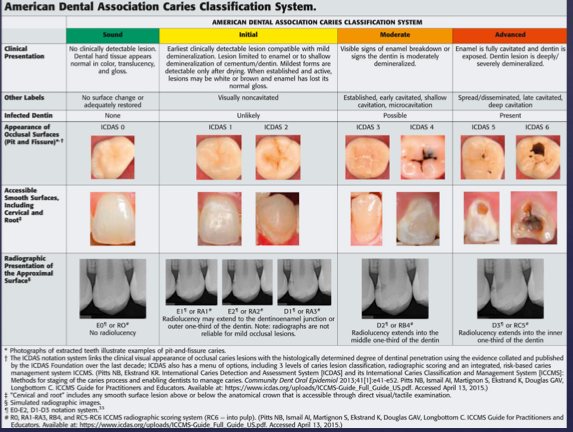
what are the radiographic classifications of caries?
proximal caries
occlusal caries
F/B and L caries
root surface caries
recurrent caries
rampant caries
radiation caries
what are some presentations of proximal lesions?
classic cone shape; band, notch, dot, thin line
caries in outer half of enamel? inner half? outer third of dentin?
RA1 RA2 RA3
caries within middle third of dentin
RB4
caries within inner third of dentin? in contact with pulp?
RC5 RC6
classification for occlusal caries
incipient - difficult to detect
moderate - thin radiolucent line
severe - large cavitation
root surface caries involve what structures?
C and D, associated w gingival recession
define recurrent caries
caries at margin of existing restoration
what are some examples of caries imitators"?
cervical burnout
conical root forms
rotated teeth
mach bands
composite restorations
attrition
tooth brush abrasion

Burnout: Sharp edges on X-ray. Smooth surface. No pain.
Caries: Fuzzy edges on X-ray. Soft surface. Pain or sensitivity.

composite restorations

hypoplastic enamel: defect in enamel thickness, not density, and radiographs primarily detect changes in density; clinical visual inspection with a dental explorer is required for diagnosis.