10. Normal-Tension Glaucoma - Management of Glaucoma Summer 2026
 Call Kai
 Learn
Learn Practice Test
 Spaced Repetition
 Match
Match Flashcards
 Knowt Play
1/111

There's no tags or description
Looks like no tags are added yet.
Name | Mastery | Learn | Test | Matching | Spaced | Call with Kai | Chat |
|---|
No analytics yet
Send a link to your students to track their progress
112 Terms
What is the AAO definition of normal tension glaucoma?
Form of open-angle glaucoma characterized by glaucomatous optic neuropathy in patients with IOP measurements consistently lower than 21 mmHg
What is the Glaucoma Foundation definition of normal tension glaucoma?
A condition characterized by progressive optic nerve damage and VF loss with statistically normal IOP
What is the problem with the AAO definition of normal-tension glaucoma?
21 mmHg is an arbitrary marker for "normal" IOP
NTG should be considered part of the spectrum of ___________
open-angle glaucoma (POAG)
True or False:
Normal tension glaucoma is quite prevalent
true
What is the prevalence of NTG based on the Baltimore Eye Study?
2.4% of the population; 24% of glaucoma patients had NTG
**included a lot of Black patients
What is the prevalence of NTG based on the Beaver Dam Eye Study?
2.1% of the population; 32% of glaucoma causes had IOP
A (large/small) proportion of glaucoma patients have statistically normal IOP
large
True or False:
Some of the clinical findings associated with NTG differ from those of POAG
true
So NTG and POAG have the same result overall? What is the result?
Yes, nerve death
What is the etiology of NTG & how is it different than POAG?
Non-IOP related mechanisms of glaucoma pathophysiology
Does NTG have a unique presentation from POAG?
Yes
Is the treatment of NTG any different than POAG?
Yes -- treatment consideration for NTG are different than those for POAG
There are _____, ______, and _____ theories for glaucoma
mechanical, biochemical, and vascular
If high IOP is NOT causing mechanical stress to the nerve in NTG, what may serve as a hypoxic stimulus for glaucomatous neuropathy?
reduced ocular blood flow
What is the equation for ocular perfusion pressure?
OPP = Diastolic blood pressure - IOP
Anything that diminishes _______ below certain levels can be harmful to ONH perfusion
diastolic BP
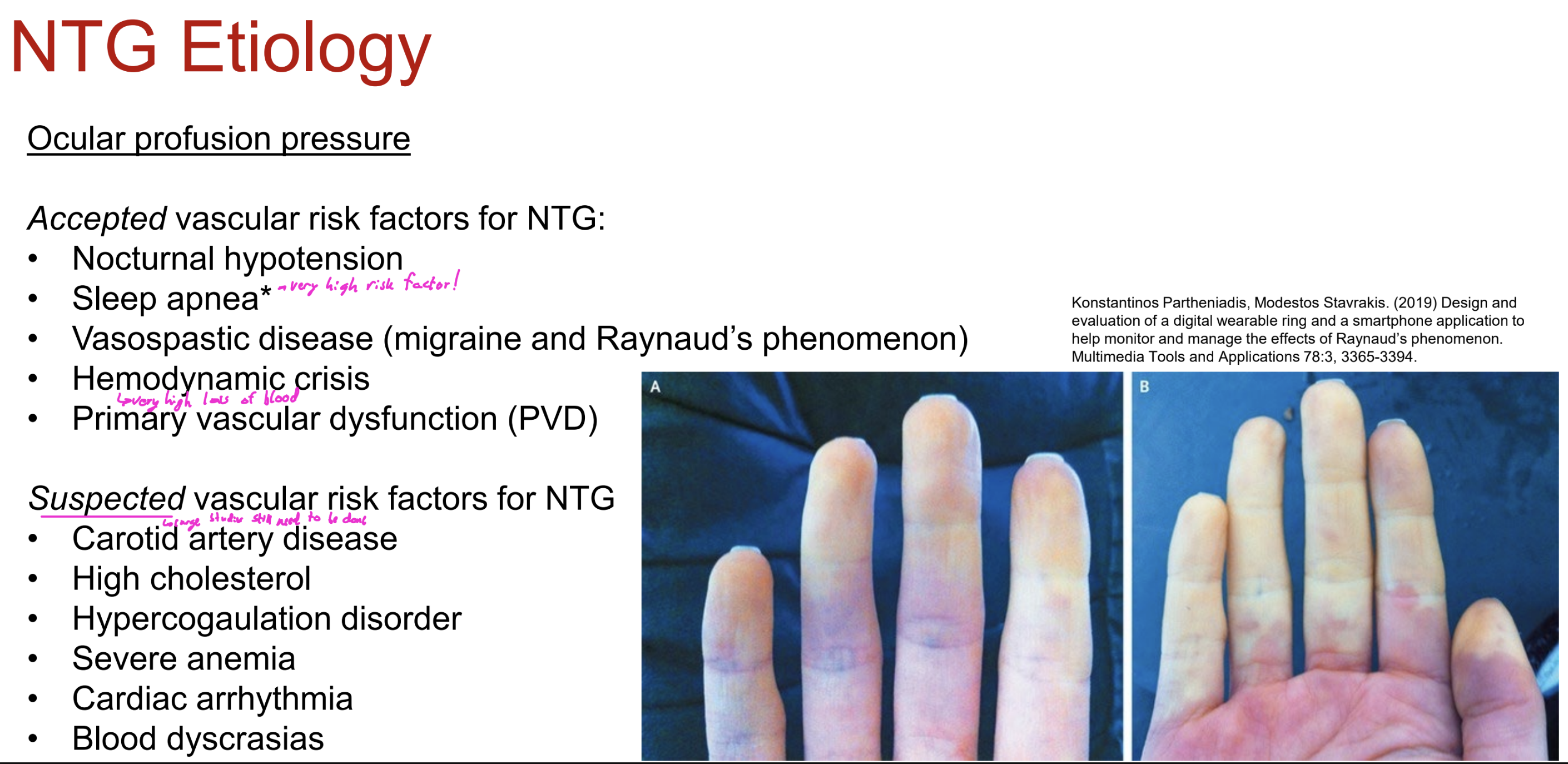
What are the ACCEPTED vascular risk factors for NTG?
Nocturnal hypotension
Sleep apnea
Vasospastic disease (migraine/Raynaud's phenomenon)
Hemodynamic crisis
Primary vascular dysfunction (PVD)
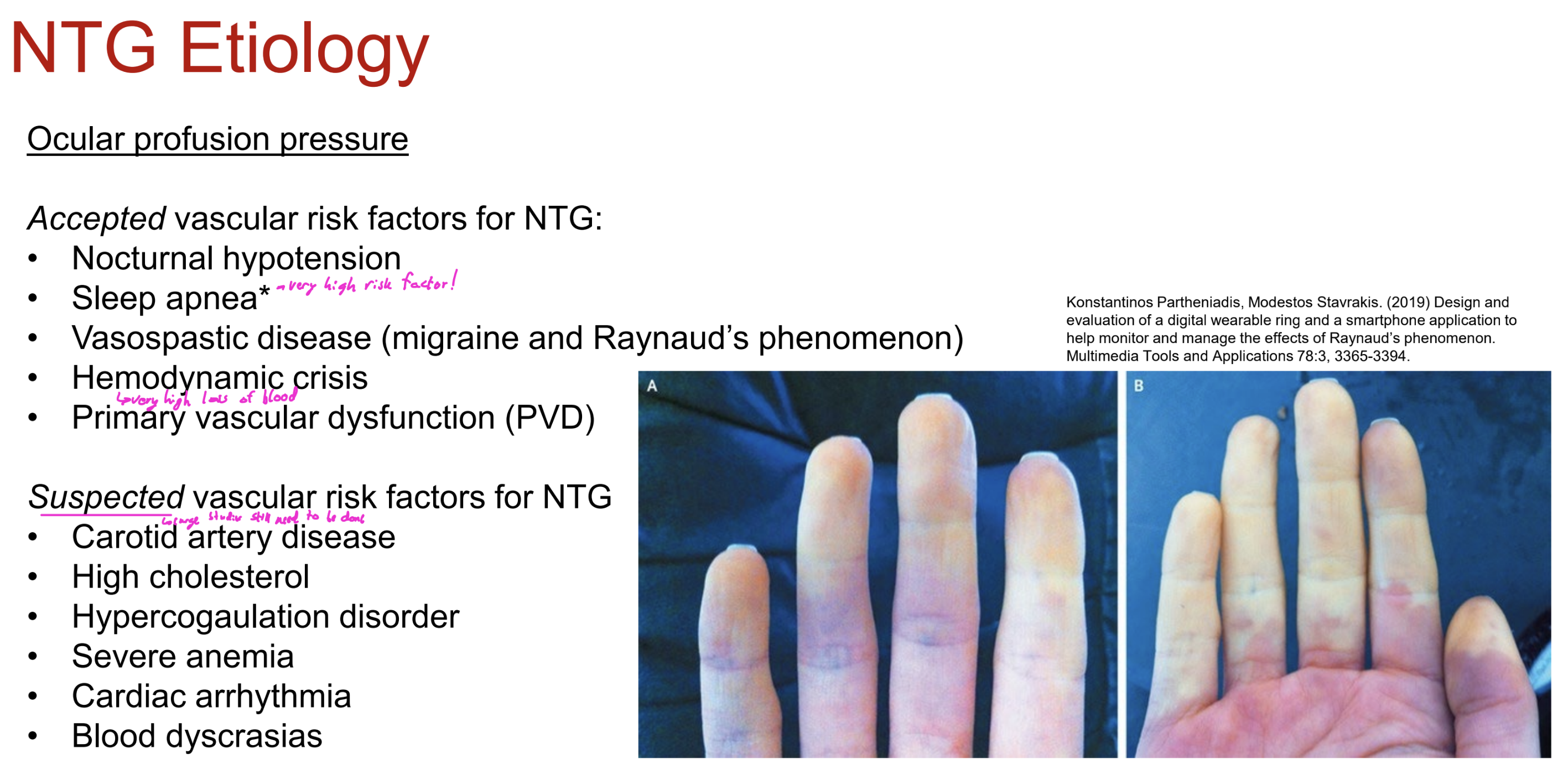
What are the SUSPECTED vascular risk factors for NTG?
Carotid artery disease
High cholesterol
Hypercoagulation disorder
Severe anemia
Cardiac arrhythmia
Blood dyscarias
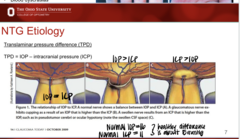
What is translaminar pressure difference (TPD)?
The difference between the pressure inside the eye (IOP) and pressure behind the eye (ICP)
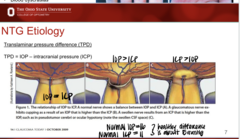
A normal nerve will show a _____ in IOP to ICP
balance
A glaucomatous nerve exhibits cupping as a result of what?
IOP > ICP
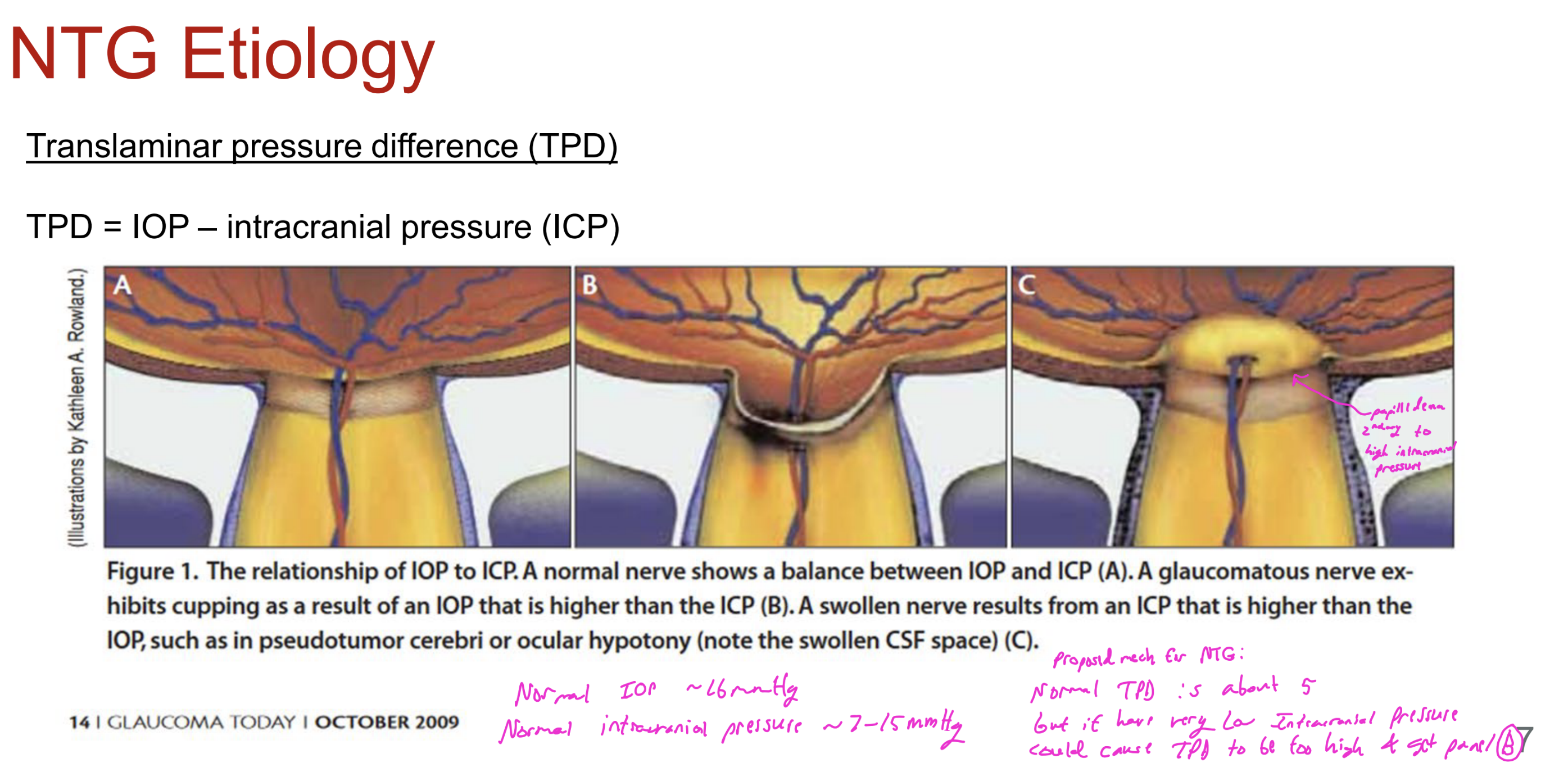
A swollen nerve results from what?
ICP > IOP
What is the equation for TPD?
TPD = IOP - ICP
What is the normal difference in IOP and ICP?
5 mmHg
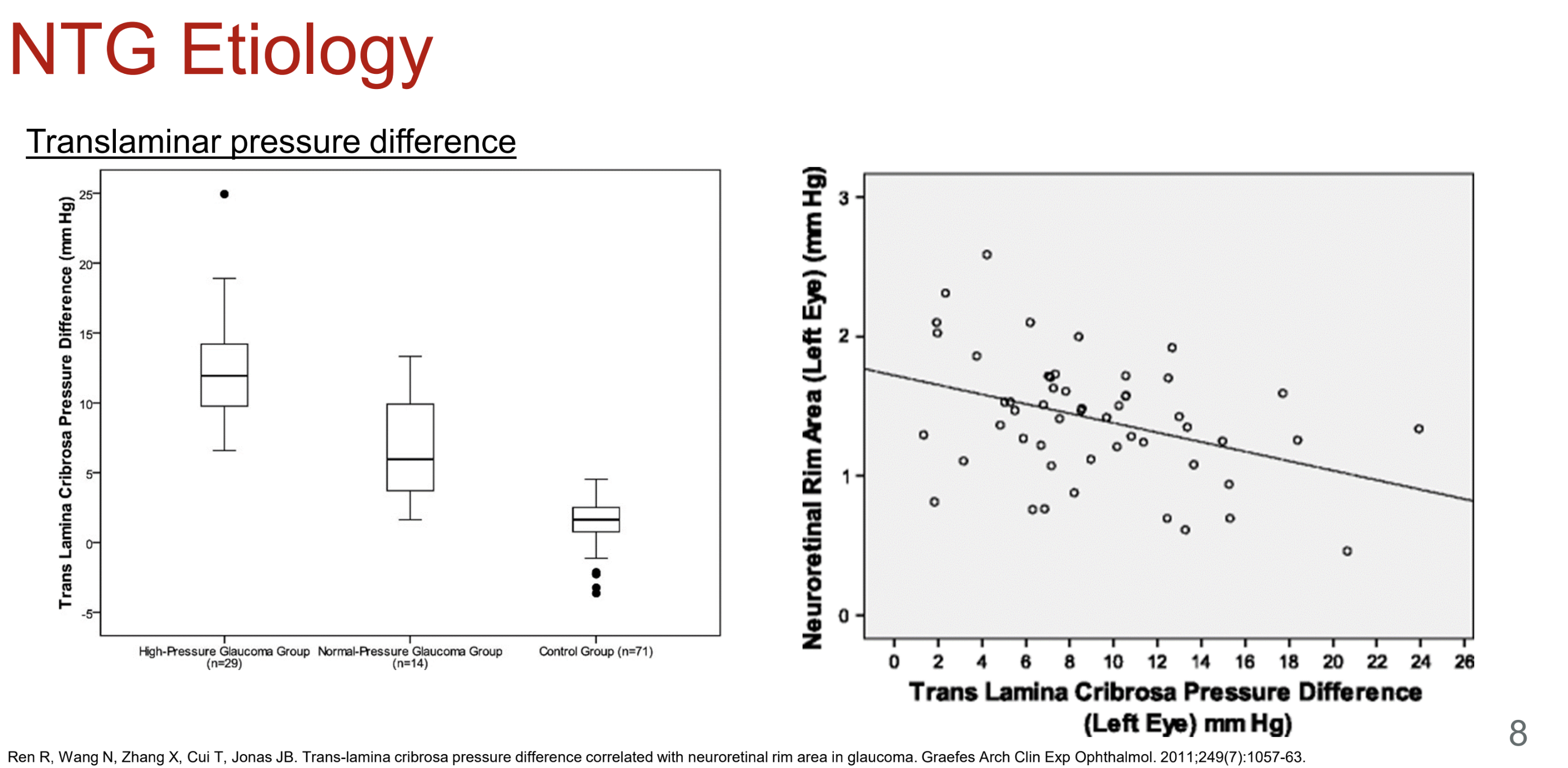
Translaminar Pressure Difference (Pic)
Translaminar Pressure Difference (Pic)
Higher TPD (increases/decreases) risk of damage to the optic nerve
increases
True or False:
Both POAG and NTG patients had higher difference in TPD
true
As rim area declines in all forms of glaucoma, TPD is (higher/lower)
higher
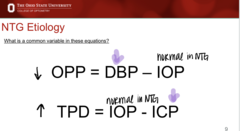
With normal tension glaucoma, since IOP is normal, how do we get a reduced Ocular perfusion pressure?
-OPP = DBP - IOP
-IOP is normal
-DBP needs to be decreased in this equation
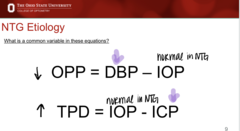
With normal tension glaucoma, since IOP is normal, how do we get an increased TPD?
-TPD = IOP - ICP
-IOP is normal
-ICP needs to be decreased
What are the clinical characteristics of NTG?
-saucer like cupping (shallow and gradual cupping)
-temporal rim thinning
-VF loss
-Drance hemorrhage
What is the likely VF defect in NTG?
deep but localized defect that is often near fixation
What is the prevalence of drance hemorrhage with NTG?
25%
What is the prevalence of drance hemorrhage in POAG?
8%
Which has higher likelihood of drance hemorrhaging?
POAG or NTG
NTG
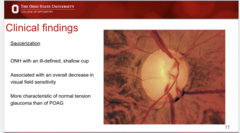
What is saucerization?
ill defined, shallow cup
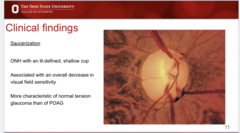
What is saucerization associated with?
overall decrease in VF sensitivity
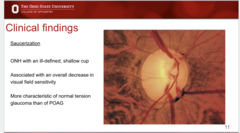
Is saucerization more characteristics of NTG or POAG?
NTG
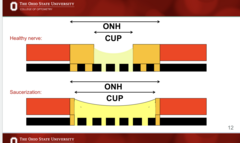
Healthy vs Saucerization of ONH (Pic)
Healthy vs Saucerization of ONH (Pic)
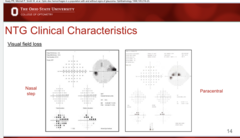
What are possible VF defects that can be seen with NTG commonly?
-nasal step
-paracentral defect
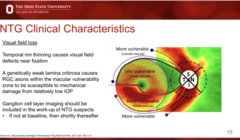
Temporal rim thinning causes VF defects near _____
fixation
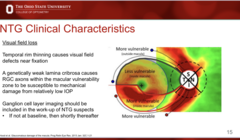
What does a genetically weak lamina cribosa cause?
RGC axons within the macular zone of vulnerability zone to be susceptible to mechanical damage from relatively low IOP
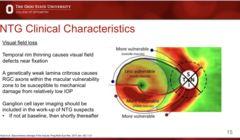
________ imaging should be included in the work-up of NTG suspects
Ganglion cell layer imaging
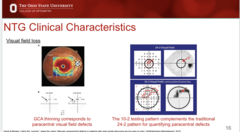
GCA thinning will correspond to _______ VF defects
paracentral
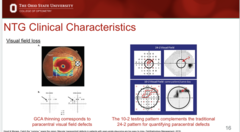
The _____ testing pattern will complement the traditional 24-2 pattern for quantifying paracentral defects
10-2
What are the classical risk factors that increase a patient's risk of presenting with a paracentral glaucomatous defect?
-migraine
-low blood pressure
-sleep apnea
-drance hemorrhage
What is the prevalence of drance hemorrhaging in NTG?
25%
What is the prevalence of drance hemorrhaging in POAG?
8%
Which has higher likelihood of drance hemorrhaging?
POAG or NTG
NTG
With NTG, what type of VF defect is common?
Deep paracentral defect that does not involve peripheral VF points (near fixation)
What is a drance hemorrhage?
"disc hemorrhage"
What does a drance hemorrhage represent?
a nerve under stress
Which occurs first?
Damage to the axon or the drance heme
Not sure 🐓🥚
What is one of the most significant predictors of NTG glaucoma progression?
drance hemorrhage
For the 10th time, drance hemorrhaging is more common in (NTG/POAG)
NTG
What are the differential dx of NTG?
-physiological cupping
-red disease
-POAG with masked high IOP
-Intermittent angle closure
-secondary glaucoma
-non-glaucomatous optic neuropathy
What is physiological cupping?
a harmless, congenital anatomical variation where the central depression (the "cup") in the optic nerve head is naturally large
Since IOP is statistically "normal" in NTG, the initial trigger of concern about an NTG patient is __________
ONH appearance
With NTG, what must we do when viewing the ONH?
Must distinguish nerves damaged by glaucoma from nerves with physiological cupping
Large discs have _____ cups
large
Physiological cupping is _____ over time
consistent
Is the cupping of glaucoma consistent over time?
No
Is physiological cupping associated with functional vision loss or VF defects?
No
is glaucoma associated with functional vision loss or VF defects?
Yes
What is Red Disease?
OCT misinterpretation can cause clinicians to over-diagnose glaucoma
How to differentiate NTG from POAG with masked IOP?
Take multiple IOP measurements at various times of the day
When may POAG present with a masked high IOP?
-thin CCT
-treatment with a systemic beta blocker
When you suspect POAG may be present with a masked high IOP at night, what should be obtained?
Diurnal IOP measurement to get an IOP curve
Every glaucoma suspect needs _______
gonioscopy
When you suspect intermittent angle closure with narrow angles, you should get a _____ IOP
post-dilation
What are the forms of secondary glaucoma that need to be differentiated from NTG?
-PXE
-PDS
-Uveitic glaucoma
What are the causes of non-glaucomatous optic neuropathies that need to be differentiated from NTG?
-ischemic optic neuropathy
-compressive optic neuropathy
-optic neuritis
-prior traumatic optic neuropathy
Non-glaucomatous optic neuropathy OR NTG
bilateral
NTG
Non-glaucomatous optic neuropathy OR NTG
unilateral
Non-glaucomatous optic neuropathy
Non-glaucomatous optic neuropathy OR NTG
pallor > cupping
Non-glaucomatous optic neuropathy
Non-glaucomatous optic neuropathy OR NTG
cupping > pallor
NTG
Non-glaucomatous optic neuropathy OR NTG
VA decrease at the onset of disease
Non-glaucomatous optic neuropathy
Non-glaucomatous optic neuropathy OR NTG
VA decrease only in severe disease
NTG
Non-glaucomatous optic neuropathy OR NTG
dyschromatopsia
Non-glaucomatous optic neuropathy
Non-glaucomatous optic neuropathy OR NTG
VF loss will respect the vertical midline
Non-glaucomatous optic neuropathy
Non-glaucomatous optic neuropathy OR NTG
VF damage will be worse than the disc appearance
Non-glaucomatous optic neuropathy
Non-glaucomatous optic neuropathy OR NTG
Rapidly progressing VF loss of VA decrease
Non-glaucomatous optic neuropathy
Non-glaucomatous optic neuropathy OR NTG
Slowly progressing VF loss of VA decrease
NTG
What are the ancillary tests that may be helpful in detecting NTG?
-10-2 threshold VF
-GCL analysis
-fundus photos
-color vision
-corneal hysteresis
What corneal hysteresis value is considered a risk factor for conversion or progression of NTG?
What corneal hysteresis value is considered suspicious for conversion or progression of NTG?
9-9.5 mmHg
What corneal hysteresis value is considered the normal/avg value?
10 mmHg
What corneal hysteresis value is protective against conversion/progression of NTG
>11 mmHg
What were the patient characterstics for enrollment into the Collaborative Normal Tension Glaucoma Study?
-Avg IOP
What was the "treatment" in the Collaborative Normal Tension Glaucoma Study?
Subjects randomized to no treatment, or 30% reduction in IOP using CAIs only (no a2 agonists or beta blockers) or surgical treatment
What were the results of the Collaborative Normal Tension Glaucoma Study?
-65% of randomized, untreated eyes DID NOT SHOW progression
-35% of untreated eyes progressed, compared to only 12% of treated eyes
-IOP reduction is beneficial to eyes at risk of progression
What are the risk factors for NTG glaucomatous progression?
-Disc hemes
-Migraine
-Female sex
-African ancestry
Disc hemes made a patient ____X more likely more glaucomatous progression in the Collaborative Normal Tension Glaucoma Study
2.72
Migraine made a patient ____X more likely more glaucomatous progression in the Collaborative Normal Tension Glaucoma Study
2.58
Female sex made a patient ____X more likely more glaucomatous progression in the Collaborative Normal Tension Glaucoma Study
1.85
What are the confirmed NON-RISK factors from glaucomatous progression in the Collaborative Normal Tension Glaucoma Study?
-Baseline IOP
-Age
-FMHx
-Hypertension
What are the management protocols for NTG?
-Do not rush to treat
-Check for progression over time
-Check IOP numerous times at various times of the day
-Consider extra testing
Why should you NOT rush to treat NTG?
-Many patients do not progress without treatment
-Progression timeline is slow
How should you check for progression of NTG over time?
-OCT
-optic disc photos
-VFs