9. Neural Circuits
 Call Kai
 Learn
Learn Practice Test
 Spaced Repetition
 Match
Match Flashcards
 Knowt Play
1/12

There's no tags or description
Looks like no tags are added yet.
Name | Mastery | Learn | Test | Matching | Spaced | Call with Kai | Chat |
|---|
No analytics yet
Send a link to your students to track their progress
13 Terms
Neural Circuits
The CNS contains billions of neurons organized into complex neural circuits that are functional groups of neurons that process specific types of information.
Neural Circuits: Series Circuit
One presynaptic neuron stimulates one postsynaptic neuron, which then stimulates the next neuron.
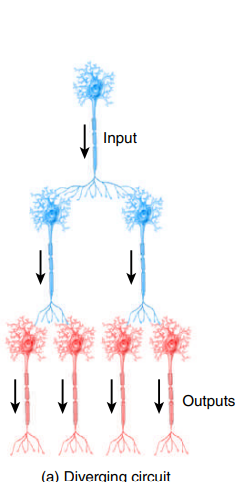
Divergence
Divergence occurs when one presynaptic neuron synapses with several postsynaptic neurons (or several muscle fibers or gland cells) at the same time
Diverging Circuit
In a diverging circuit, one presynaptic nerve impulse stimulates an increasing number of cells along the circuit, amplifying the signal.

Divergence: Example
A small number of brain neurons controlling a body movement can stimulate a much larger number of neurons in the spinal cord.
Convergence
Convergence occurs when several presynaptic neurons synapse with a single postsynaptic neuron, thereby receiving and combining information from multiple sources, producing more effective stimulation or inhibition.

Converging Circuit
A single postsynaptic neuron can receive input from several pathways originating in different regions of the brain.

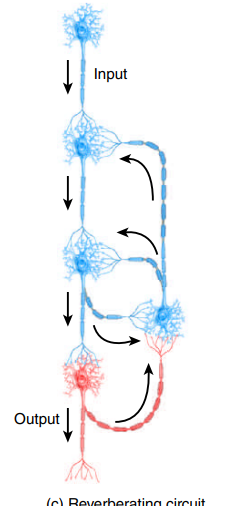
Reverberating Circuit
A reverberating circuit is a neural circuit in which later neurons send impulses back to earlier neurons, causing the signal to repeat.
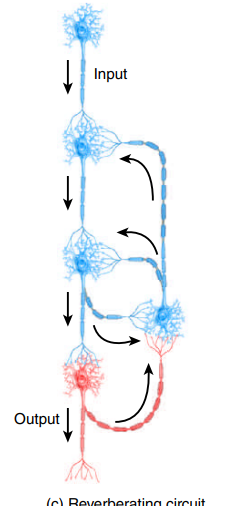
Reverberating Circuit: Pathway
The first neuron stimulates the second → second stimulates third → later neurons send signals back to earlier neurons → the circuit repeats.

Reverberating Circuit: Functions
Reverberating circuits are thought to contribute to breathing, coordinated muscle activity, waking up, and short-term memory.
Parallel After-Discharge Circuit
A parallel after-discharge circuit occurs when one presynaptic neuron stimulates several neurons, which then all synapse with a common postsynaptic neuron.

Parallel After-Discharge Circuit: Synaptic Delays
Different numbers of synapses between the first and last neurons create different synaptic delays, so that the last neuron exhibits multiple EPSPs or IPSPs over time.

Parallel After-Discharge Circuit: Excitatory Input
If the input is excitatory, the postsynaptic neuron can produce a rapid stream of nerve impulses.
