Campbell biology 12th edition chapter 3
 Call Kai
 Learn
Learn Practice Test
 Spaced Repetition
 Match
Match Flashcards
 Knowt Play
1/24

There's no tags or description
Looks like no tags are added yet.
Name | Mastery | Learn | Test | Matching | Spaced | Call with Kai | Chat |
|---|
No analytics yet
Send a link to your students to track their progress
25 Terms
polar molecule
molecule with an unequal distribution of charge, resulting in the molecule having a positive end and a negative end

Cohesion
Attraction between molecules of the same substance

surface tension
a measure of the force necessary to stretch or break the surface of a liquid, is related to cohesion.

specific heat
The amount of energy required to raise the temperature of 1 gram of a substance by 1 degree celcius

Temperature
Temperature measures average kinetic energy of molecules in a body of matter regardless of volume

evaporative cooling
The process in which the surface of an object becomes cooler during evaporation, a result of the molecules with the greatest kinetic energy changing from the liquid to the gaseous state.

Heat of vaporization
Heat of vaporization is the quantity of heat that a liquid must absorb for 1 g of it to be converted from liquid to gas.

Solvent
A liquid substance capable of dissolving other substances

Hydrophilic
Attracted to water Hydrophilic substances are dominated by ionic or polar bonds.

Hydrophobic
Water fearing substances are nonionic and have nonpolar covalent bonds.

Molarity
the number of moles of solute per liter of solution.

solute
A substance that is dissolved in a solution.

Solution
A mixture that forms when one substance dissolves another.

Mole
The number of grams of a substance that equals its molecular or atomic mass in daltons; a mole contains Avogadro's number of the molecules or atoms in question.
Molecular mass
The sum of the masses of all the atoms in a molecule; sometimes called molecular weight.
pH
A measure of hydrogen ion concentration equal to −log[H+] and ranging in value from 0 to 14.
Buffer
A solution that contains a weak acid and its corresponding base. A buffer minimizes changes in pH when acids or bases are added to the solution.
ocean acidification
The process by which the pH of the ocean is lowered (made more acidic) when excess CO2 dissolves in seawater and forms carbonic acid (H2CO3).
Total amount or summation
The total amount or summation of kinetic energy associated with the random movement of atoms or molecules in a given volume of space is called thermal energy.
Heat
Heat is the transfer of thermal energy from one body to another

Vaporization
The transformation of a molecule from a liquid to a gas is called vaporization, or evaporation.Vaporization occurs when a molecule moves fast enough to overcome the attraction of other molecules in the liquid.

hydrophilic molecules
dissolve in water since they have either charged or uncharged polar groups that form electrostatic attractions or hydrogen bonds with water
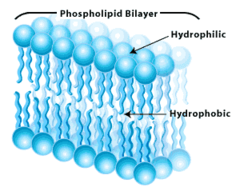
Hydrophobic molecules
do not interact with water and form a cage like structure that surrounds them

Acids
is a substance that increases the hydrogen ion concentration in a solution. 7 and lower on the pH scales

Bases
Any substance that reduces the hydrogen ion concentration in a solution