2 - Osmosis, Tonicity, and Pressures
 Call Kai
 Learn
Learn Practice Test
 Spaced Repetition
 Match
Match Flashcards
 Knowt Play
1/80

There's no tags or description
Looks like no tags are added yet.
Name | Mastery | Learn | Test | Matching | Spaced | Call with Kai | Chat |
|---|
No analytics yet
Send a link to your students to track their progress
81 Terms
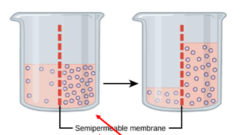
_____ is the flow of water across a semipermeable membrane due to differences in solute concentration (membrane blocks movement of solute)
osmosis
Concentration difference of solutes causes difference in _____, which will cause osmosis
osmotic pressure
Osmosis is diffusion of water. True or false?
false
Osmosis occurs because of a difference in _____
pressure
![<p>If one side has more solute, it has [lower/greater] osmotic pressure</p>](https://assets.knowt.com/user-attachments/b97933e7-6ecd-4253-900e-c850973890ea.png)
If one side has more solute, it has [lower/greater] osmotic pressure
greater
Osmotic pressure is a [pushing/pulling] pressure
pulling
Hydrostatic pressure is a [pushing/pulling] pressure
pushing
_____ is pressure exerted by a stationary fluid at equilibrium - causes water/fluid to move or be pushed
hydrostatic pressure
Why are osmotic and hydrostatic pressures very important in cells and blood vessels?
allow fluid exchange across capillaries
Due to hydrostatic pressure, water and some very small solutes [enter/leave] blood vessels
leave
With tissues and cells, osmotic pressure is referred to as _____ or _____
colloidal osmotic; oncotic pressure
High osmolarity (many solute particles) exerts [high/low] osmotic pressure to pull water into a space, such as a blood vessel
high
Pressures favor filtration out of capillaries and into tissues. True or false?
true
Osmolar concentrations express the osmotic strength of solutions such as ___, ___, and ___
urine; plasma; NaCl
Osmolarity is the concentration of _____ per _____ of solution (osm/Lor mOsm/L)
osmotically active particles; liter
A 1 mmol/L NaCl solution would
have an osmolarity of _____ mOsm/L
2
[Osmolarity/osmolality] is the concentration of osmotically active particles per liter of solution (osm/Lor mOsm/L
osmolarity
[Osmolarity/osmolality] is the concentration of osmotically active particles expressed as osmoles/kg of water
osmolality
Osmolality is functionally the same as osmolarity. True or false?
true
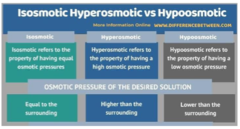
Solutions of equal solute concentrations are known as _____
isosmotic
Refers to solution with higher concentration of solute
hyperosmotic
If a solution has the same osmolarity/equal osmotic pressures we call it _____
isosmotic
If a solution has higher osmolarity compared to another solution we call it _____
hyperosmotic
Refers to solution with lower concentration of solute
hypo-osmotic
If a solution has a lower osmolarity compared to another solution we call it _____
hypo-osmotic
A hypo-osmotic solution exerts [more/less] pressure
less
Review
reviewed
A measure of the effective osmotic pressure
tissue tone
_____ is defined by the response of cells or tissues immersed in the solution
tonicity
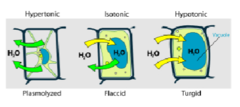
A solution is _____ to cells/tissues if cells/tissues neither swell nor shrink when immersed in solution
isotonic
A solution is _____ to cells/tissues if cells/tissues swell when immersed in solution
hypotonic
A solution is _____ to cells/tissues if cells/tissues shrink when immersed in solution
hypertonic
No osmotic pressure difference between cell interior and extracellular solution
isotonic
More solutes inside cell (higher osmolarity) relative to extracellular environment, greater osmotic pressure inside cell
hypotonic
Less solutes inside cell (lower osmolarity) relative to extracellular environment, greater osmotic pressure outside cell
hypertonic
Review
reviewed
Form of osmotic pressure specifically exerted by proteins, mostly albumin, within blood vessels
oncotic pressure
Oncotic pressure is specifically exerted by _____, mostly albumin, within blood vessels
proteins
Oncotic pressure tends to pull water [into/out of] blood vessels
into
Oncotic pressure opposes _____ pressure (tissue proteins that want to pull water out of vessels)
interstitial colloidal osmotic
Edema is a decrease in _____
blood oncotic pressure
A solution is _____ to cells/tissues if cells/tissues swell when immersed in solution
hypotonic
Solutions of equal solute concentrations
isotonic
Why does water move, in relation to osmosis?
osmotic pressure
The semipermeable membrane is permeable to _____, but not to _______
solvent; solute
Can solute move across a semipermeable membrane? What about solvent, like water?
solute - no
water - yes
Lot of solute = [greater/lesser] osmotic pressure -> _____
greater; osmosis
If there was equal amount of solute on each side, would water move?
no
More solute on one side = greater osmotic pressure = [push/pull] water to that side of the membrane
pull
Hydrostatic pressure = [pushing/pulling] pressure
pushing
-Pressure exerted by a stationary fluid
-"More fluid -> more pressure to move -> driving force" (think of watering hose)
hydrostatic pressure
More fluid in blood vessels = [more/less] pressure
more
Substances move out of capillaries and into tissues due to _____
hydrostatic pressure
Osmotic and hydrostatic pressure play a role in cells and blood vessels at the same time. True or false?
true
Generally, _____ is the dominant pressure between blood vessels and tissues
hydrostatic pressure
Osmotic pressure = [in/out] of blood vessels
Hydrostatic pressure = [in/out] of blood vessels
in; out
Hydrostatic pressure is due to _____, while osmotic pressure is due to _____
fluids; solutes
Pressure exerted by fluids between cells and tissues
interstitial hydrostatic pressure
Pressure exerted by fluid within the blood vessels (usually high b/c most cominant)
blood hydrostatic pressure
With dehydration, blood volume [increases/decreases]. Does the blood hydrostatic pressure increase or decrease?
decreases; decrease
Hydrostatic pressure opposes _____ pressure
osmotic
_____ pressure tends to pull water, while _____ pressure tends to push
osmotic; hydrostatic
Many solute particles (high conc.) = [high/low] osmolarity
high
Concentration of solute increases in the blood vessel & more water begins to be pulled in. What will happen to blood pressure?
increase
If a lot of fluid leaves the blood vessel and enters tissues, what happens?
edema
_____ pressure is dominant
hydrostatic
Pressures favor filtration [in/out] of capillaries into tissues in a normal, healthy, situation
out
1kg of water (osmolality) = ~ _____ L (osmolarity)
1
Equal solute concentrations -> same osmolarity -> same osmotic pressure
isosmotic
What happens to a normal cell placed in an isosmotic solution?
nothing
Solution with higher concentration of solutes -> higher osmolarity -> higher osmotic pressure
hyperosmotic
What happens to a normal cell placed in a hyperosmotic solution?
water moves from cell to solution -> cell shrivels up
What happens to a normal cell placed in a hypoosmotic solution?
water moves into cell from solution -> cell explodes/lyses
Tonicity is a measure of the effective _____ pressure
osmotic
Isotonic = _____
isosmotic
Cell/ tissues swell = solution is _____tonic to cell/tissue
hypo
Cell/tissues shrink = solution is _____tonic to cell/tissue
hyper
Oncotic pressure is pressure specifically exerted by _____ within blood vessels
proteins
Most of the protein within blood is _____
albumin
We have a much [higher/lower] blood oncotic pressure because of the proteins, compared to within the tissue space
higher
Decrease in oncotic pressure is associated with tissue _____
edema