Part 4.2 - CNS-PYSCHOSIS
 Call Kai
 Learn
Learn Practice Test
 Spaced Repetition
 Match
Match Flashcards
 Knowt Play
1/122

Earn XP
Description and Tags
Proverbs 16:3
Name | Mastery | Learn | Test | Matching | Spaced | Call with Kai | Chat |
|---|
No analytics yet
Send a link to your students to track their progress
123 Terms
c. Schizophrenia
Research suggests that a combination of physical, genetic, psychological, environmental factors can make a person more likely to develop this condition
a. MDD
b. Parkinsonism
c. Schizophrenia
d. Bipolar Disorder
c. Schizophrenia
It is a type of disorder characterized by several types of symptoms, including positive and negative symptoms
a. MDD
b. Parkinsonism
c. Schizophrenia
d. Bipolar Disorder
a. ↑ dopamine ↑ serotonin
Have been reported to cause the symptoms of schizophrenia
a. ↑ dopamine ↑ serotonin
b. ↓ dopamine ↓ serotonin
c. ↑ dopamine ↓ serotonin
d. ↑ serotonin ↓ dopamine
a. Positive symptoms
-auditory: most common type
Hallucinations
a. Positive symptoms
b. Negative symptoms
a. Positive symptoms
-paranoia or grandeur delusions
Delusions
a. Positive symptoms
b. Negative symptoms
a. Positive symptoms
-random rumbling of words)
Disorganized speech
a. Positive symptoms
b. Negative symptoms
a. Positive symptoms
Bizzare behavior
a. Positive symptoms
b. Negative symptoms
b. Negative symptoms
-inability to speak because of mental defect, mental confusion, or aphasia
Alogia
a. Positive symptoms
b. Negative symptoms
b. Negative symptoms
-lack of interest pleasure
Anhedonia
a. Positive symptoms
b. Negative symptoms
b. Negative symptoms
-lack of motivation
Avolition
a. Positive symptoms
b. Negative symptoms
b. Negative symptoms
-isolate themselves
Asociality
a. Positive symptoms
b. Negative symptoms
b. Negative symptoms
Flattening of affect (poor eye contact)
a. Positive symptoms
b. Negative symptoms
b. Traditional/Classical/Typical antipsychotics
First-generation antipsychotics are also known as ________.
a. Atypical antipsychotics
b. Traditional/Classical/Typical antipsychotics
c. Selective serotonin antagonists
d. Mood stabilizers
a. Atypical antipsychotics
Second-generation antipsychotics are also known as ________
a. Atypical antipsychotics
b. Traditional/Classical/Typical antipsychotics
c. Selective serotonin antagonists
d. Mood stabilizers
a. Block D₂ receptors (non-selective)
The primary mechanism of action (MOA) of first-generation antipsychotics is ________.
a. Block D₂ receptors (non-selective)
b. Stimulate D₂ receptors
c. Activate 5-HT₂A receptors
d. Open Cl⁻ channels
a. first-generation antipsychotics
-(antiHistamine, anti-Alpha receptor, anti-Muscarinic receptor)
Block HAM receptors
a. first-generation antipsychotics
b. second-generation antipsychotics
b. second-generation antipsychotics
Block D2 < D4 receptors
a. first-generation antipsychotics
b. second-generation antipsychotics
b. second-generation antipsychotics
Block 5-HT2A receptors
a. first-generation antipsychotics
b. second-generation antipsychotics
a. Reduction of positive symptoms
Blockade of D2 receptors in the mesolimbic pathway → reduction of positive symptoms
Blockade of D2 receptors in the mesocortical pathway → worsening of negative symptoms
Blockade of D2 receptors in nigrostriatal pathway → Extrapyramidal Symptoms
Blockade of D2 receptors in tuberoinfundibular → inc prolactin released
[1st Generation Antipsychotics]
Blockade of D2 receptors in the mesolimbic pathway
a. Reduction of positive symptoms
b. Worsening of negative symptoms
c. Extrapyramidal Symptoms
d. Increases prolactin release
b. Worsening of negative symptoms
Blockade of D2 receptors in the mesolimbic pathway → reduction of positive symptoms
Blockade of D2 receptors in the mesocortical pathway → worsening of negative symptoms
Blockade of D2 receptors in nigrostriatal pathway → Extrapyramidal Symptoms
Blockade of D2 receptors in tuberoinfundibular → inc prolactin released
[1st Generation Antipsychotics]
Blockade of D2 receptors in the mesocortical pathway
a. Reduction of positive symptoms
b. Worsening of negative symptoms
c. Extrapyramidal Symptoms
d. Increases prolactin release
d. Increases prolactin release
Blockade of D2 receptors in the mesolimbic pathway → reduction of positive symptoms
Blockade of D2 receptors in the mesocortical pathway → worsening of negative symptoms
Blockade of D2 receptors in nigrostriatal pathway → Extrapyramidal Symptoms
Blockade of D2 receptors in tuberoinfundibular → inc prolactin released
[1st Generation Antipsychotics]
Blockade of D2 receptors in tuberoinfundibular
a. Reduction of positive symptoms
b. Worsening of negative symptoms
c. Extrapyramidal Symptoms
d. Increases prolactin release
c. Extrapyramidal Symptoms
Blockade of D2 receptors in the mesolimbic pathway → reduction of positive symptoms
Blockade of D2 receptors in the mesocortical pathway → worsening of negative symptoms
Blockade of D2 receptors in nigrostriatal pathway → Extrapyramidal Symptoms
Blockade of D2 receptors in tuberoinfundibular → inc prolactin released
[1st Generation Antipsychotics]
Blockade of D2 receptors in nigrostriatal pathway
a. Reduction of positive symptoms
b. Worsening of negative symptoms
c. Extrapyramidal Symptoms
d. Increases prolactin release
b. -azine
[1st Generation Antipsychotics]
Phenothiazines are commonly identified by the suffix ________.
a. -thix
b. -azine
c. -peridol
d. -ridone
c. -peridol
[1st Generation Antipsychotics]
Butyrophenones are commonly identified by the suffix ________.
a. -azine
b. -thix
c. -peridol
d. -curonium
c. -thix
[1st Generation Antipsychotics]
Thioxanthenes are commonly identified by the suffix ________.
a. -azine
b. -ridazine
c. -thix
d. -olol
b. Chlorpromazine (-promazine)
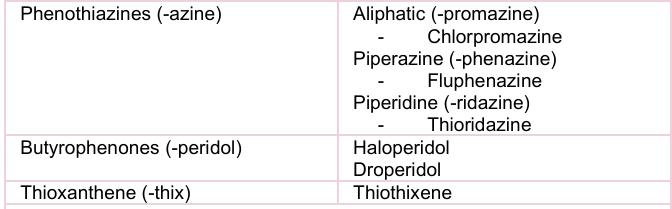
[1st Generation Antipsychotics]
Which of the following is an aliphatic phenothiazine?
a. Fluphenazine
b. Chlorpromazine
c. Thioridazine
d. Haloperidol
a. Fluphenazine (-phenazine)
[1st Generation Antipsychotics]
Which of the following is a piperazine phenothiazine?
a. Fluphenazine
b. Droperidol
c. Thiothixene
d. Chlorpromazine
b. Thioridazine (-ridazine)
[1st Generation Antipsychotics]
Which of the following is a piperidine phenothiazine?
a. Haloperidol
b. Thioridazine
c. Fluphenazine
d. Thiothixene
b. Butyrophenones = Piperazines > Piperidines ≥ Thioxanthenes > Aliphatic
[1st Generation Antipsychotics]
The potency of first-generation antipsychotics
a. Aliphatic > Thioxanthenes > Piperidines > Piperazines > Butyrophenones
b. Butyrophenones = Piperazines > Piperidines ≥ Thioxanthenes > Aliphatic
c. Piperidines > Butyrophenones > Aliphatic > Thioxanthenes
d. Thioxanthenes > Piperazines > Aliphatic > Butyrophenones
b. Butyrophenones and Piperazines
[1st Generation Antipsychotics]
________ and ________ are considered the most potent first-generation antipsychotics.
a. Aliphatics and Piperidines
b. Butyrophenones and Piperazines
c. Thioxanthenes and Aliphatics
d. Piperidines and Aliphatics
b. Directly
Inversely = HAM receptor affinity.
[1st Generation Antipsychotics]
Potency of first-generation antipsychotics is ________ proportional to D₂ receptor affinity.
a. Inversely
b. Directly
b. Inversely
Directly = D₂ receptor affinity.
[1st Generation Antipsychotics]
Potency of first-generation antipsychotics is ________ proportional to HAM receptor affinity.
a. Directly
b. Inversely
b. -zapine
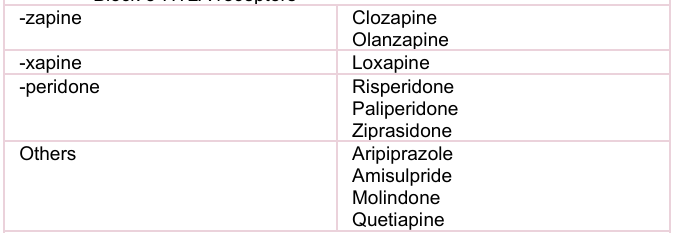
[2nd Generation Antipsychotics]
Atypical antipsychotics
a. -peridol
b. -zapine
c. -azine
d. -thix
a. -xapine
[2nd Generation Antipsychotics]
Atypical antipsychotics
a. -xapine
b. -peridol
c. -azine
d. -thix
a. -peridone
[2nd Generation Antipsychotics]
Atypical antipsychotics
a. -peridone
b. -peridol
c. -azine
d. -thix
b. Reduced side effects, especially EPS
[2nd Generation Antipsychotics]
An advantage of atypical antipsychotics over typical antipsychotics is ________.
a. Increased EPS
b. Reduced side effects, especially EPS
c. Complete absence of adverse effects
d. Reduced efficacy in schizophrenia
b. Therapy-resistant schizophrenia
[2nd Generation Antipsychotics]
Atypical antipsychotics have greater affinity and activity in ________.
a. Acute asthma
b. Therapy-resistant schizophrenia
c. Hypertension
d. Motion sickness
b. Negative symptoms
[2nd Generation Antipsychotics]
Compared with first-generation antipsychotics, second-generation antipsychotics are more effective in treating ________.
a. Positive symptoms
b. Negative symptoms
c. 2nd generation > 1st generation
[2nd Generation Antipsychotics]
Efficacy in treatment of negative symptoms is ________.
a. 1st generation > 2nd generation
b. 1st generation = 2nd generation
c. 2nd generation > 1st generation
d. Neither generation is effective
b. 1st generation = 2nd generation
[2nd Generation Antipsychotics]
Efficacy in treatment of positive symptoms is ________.
a. 1st generation > 2nd generation
b. 1st generation = 2nd generation
c. 2nd generation > 1st generation
d. Neither generation is effective
c. Clozapine
[2nd Generation Antipsychotics]
_______ is the only antipsychotic drug that does NOT cause EPS.
a. Haloperidol
b. Risperidone
c. Clozapine
d. Olanzapine
b. SAM (Seizure, Agranulocytosis, Myocarditis)
[2nd Generation Antipsychotics]
Clozapine is never given as a first-line drug because of ________.
a. Severe bronchoconstriction
b. SAM (Seizure, Agranulocytosis, Myocarditis)
c. Renal toxicity only
d. Complete treatment failure
a. Haloperidol
[2nd Generation Antipsychotics]
Management of phencyclidine intoxication
a. Haloperidol
b. Olanzapine
c. Quetiapine
d. Amisulpride
a. Haloperidol
[2nd Generation Antipsychotics]
Used in management of Tourette’s syndrome
a. Haloperidol
b. Risperidone
c. Ziprasidone
d. Loxapine
c. Both acute mania and severe depression
[2nd Generation Antipsychotics]
Antipsychotic drugs may also be used in management of ________.
a. Acute mania
b. Severe depression
c. Both acute mania and severe depression
d. Hyperthyroidism
b. Dopamine and acetylcholine
[ADR: Due to Dopamine Blockade]
Extrapyramidal syndrome (EPS) is a movement disorder caused by imbalance between ________.
a. Dopamine and serotonin
b. Dopamine and acetylcholine
c. Histamine and dopamine
d. GABA and glutamate
b. Decreasing acetylcholine
[ADR: Due to Dopamine Blockade]
Management of EPS generally involves ________.
a. Increasing acetylcholine
b. Decreasing acetylcholine
c. Blocking dopamine completely
d. Increasing serotonin
All
“BBT”
[ADR: Due to Dopamine Blockade]
Anticholinergics (centrally acting)
I. Biperiden
II. Benztropine
III. Trihexyphenidyl
b. Akathisia
[ADR: Due to Dopamine Blockade]
Characterized by uncontrolled restlessness
a. Dystonia
b. Akathisia
c. Tardive dyskinesia
d. Pseudoparkinsonism
b. Akathisia
[ADR: Due to Dopamine Blockade]
most difficult EPS to treat
a. Dystonia
b. Akathisia
c. Tardive dyskinesia
d. Pseudoparkinsonism
b. Akathisia
[ADR: Due to Dopamine Blockade]
Only EPS not treated by Anticholinergic drugs
a. Dystonia
b. Akathisia
c. Tardive dyskinesia
d. Pseudoparkinsonism
b. Beta blockers and benzodiazepines (BZP’s)
[ADR: Due to Dopamine Blockade]
Management of akathisia
a. Anticholinergic drugs
b. Beta blockers and benzodiazepines (BZP’s)
c. IV diphenhydramine
d. Dantrolene
a. Dystonia
[ADR: Due to Dopamine Blockade]
Usually the 1st EPS seen
a. Dystonia
b. Akathisia
c. Tardive dyskinesia
d. Pseudoparkinsonism
a. Dystonia
[ADR: Due to Dopamine Blockade]
Torticollis/Retrocollis (twisting of the neck)
a. Dystonia
b. Akathisia
c. Tardive dyskinesia
d. Pseudoparkinsonism
a. Dystonia
[ADR: Due to Dopamine Blockade]
Easier to treat but FATAL
a. Dystonia
b. Akathisia
c. Tardive dyskinesia
d. Pseudoparkinsonism
b. IV diphenhydramine and anticholinergic agents
[ADR: Due to Dopamine Blockade]
Management of dystonia
a. Beta blockers and BZPs
b. IV diphenhydramine and anticholinergic agents
c. Dantrolene
d. Clozapine
b. Low dopamine levels
[ADR: Due to Dopamine Blockade]
Pseudoparkinsonism is associated with ________.
a. High dopamine levels
b. Low dopamine levels
c. High serotonin levels
d. Increased histamine activity
c. Pseudoparkinsonism
[ADR: Due to Dopamine Blockade]
Tremors, rigidity, akinesia, and postural instability are features of ________.
a. Dystonia
b. Akathisia
c. Pseudoparkinsonism
d. Hyperprolactinemia
c. Tardive dyskinesia
[ADR: Due to Dopamine Blockade]
Potentially irreversible
a. Dystonia
b. Akathisia
c. Tardive dyskinesia
d. Pseudoparkinsonism
c. Tardive dyskinesia
[ADR: Due to Dopamine Blockade]
Due to hypersensitivity of D2 receptor
a. Dystonia
b. Akathisia
c. Tardive dyskinesia
d. Pseudoparkinsonism
c. Tardive dyskinesia
[ADR: Due to Dopamine Blockade]
Characterized by Tic-like motion
a. Dystonia
b. Akathisia
c. Tardive dyskinesia
d. Pseudoparkinsonism
a. Clozapine or Olanzapine
[ADR: Due to Dopamine Blockade]
Management of tardive dyskinesia includes discontinuing the drug and using ________.
a. Clozapine or Olanzapine
b. Haloperidol only
c. Dantrolene only
d. Diphenhydramine only
a. Amenorrhea, galactorrhea, and impotence
[ADR: Due to Dopamine Blockade]
Hyperprolactinemia due to dopamine blockade may cause ________.
a. Amenorrhea, galactorrhea, and impotence
b. Bronchodilation and tachycardia
c. Hypertension and insomnia
d. Hyperglycemia only
b. Prolactin-inhibiting hormone
↓ Dopamine = ↑ Prolactin = Hyperprolactinemia
[ADR: Due to Dopamine Blockade]
Dopamine acts as a ________.
a. Prolactin-enhancing hormone
b. Prolactin-inhibiting hormone
c. Growth hormone stimulator only
d. Histamine antagonist
a. Bromocriptine
[ADR: Due to Dopamine Blockade]
D₂ agonist is used in mothers who wish to stop breastfeeding and in hyperprolactinemia
a. Bromocriptine
b. Haloperidol
c. Benztropine
d. Olanzapine
b. Malignant hyperthermia
[ADR: Due to Dopamine Blockade]
Neuroleptic malignant syndrome (NMS) resembles ________.
a. Parkinson disease
b. Malignant hyperthermia
c. Migraine
d. Tourette syndrome
a. Dantrolene and Bromocriptine
Dantrolene (Ca+ antagonist; muscle relaxant)
Bromocriptine (D2 agonist)
[ADR: Due to Dopamine Blockade]
Management of neuroleptic malignant syndrome
a. Dantrolene and Bromocriptine
b. Haloperidol only
c. Diphenhydramine only
d. Benztropine only
a. Due to Dopamine receptor blockade
Extrapyramidal syndrome (EPS) is an ADR due to
a. Due to Dopamine receptor blockade
b. Due to Histamine receptor blockade
c. Due to Alpha 1 receptor blockade
d. Due to Muscarinic blockade
a. Due to Dopamine receptor blockade
Hyperprolactinemia is an ADR due to
a. Due to Dopamine receptor blockade
b. Due to Histamine receptor blockade
c. Due to Alpha 1 receptor blockade
d. Due to Muscarinic blockade
a. Due to Dopamine receptor blockade
Neuroleptic malignant syndrome (NMS) is an ADR due to
a. Due to Dopamine receptor blockade
b. Due to Histamine receptor blockade
c. Due to Alpha 1 receptor blockade
d. Due to Muscarinic blockade
b. Due to Histamine receptor blockade
Sedation is an ADR due to
a. Due to Dopamine receptor blockade
b. Due to Histamine receptor blockade
c. Due to Alpha 1 receptor blockade
d. Due to Muscarinic blockade
c. Due to Alpha 1 receptor blockade
Orthostatic hypotension is an ADR due to
a. Due to Dopamine receptor blockade
b. Due to Histamine receptor blockade
c. Due to Alpha 1 receptor blockade
d. Due to Muscarinic blockade
d. Due to Muscarinic blockade
Anticholinergic is an ADR due to
a. Due to Dopamine receptor blockade
b. Due to Histamine receptor blockade
c. Due to Alpha 1 receptor blockade
d. Due to Muscarinic blockade
b. Clozapine
[Other ADR of antipsychotics]
antipsychotic is most commonly associated with seizures
a. Haloperidol
b. Clozapine
c. Risperidone
d. Ziprasidone
b. Clozapine
“SAM”
(Seizure, Agranulocytosis, Myocarditis)
[Other ADR of antipsychotics]
Agranulocytosis is strongly associated with ________.
a. Ziprasidone
b. Clozapine
c. Haloperidol
d. Aripiprazole
a. 3 weeks
“Weekly for 6 months, then every 3 weeks.”
[Other ADR of antipsychotics]
After count monitoring every week for the first 6 months of clozapine therapy, WBC count monitoring should continue every ________.
a. 3 weeks
b. 3 days
c. 6 months
d. 12 weeks
b. Myocarditis
“SAM”
(Seizure, Agranulocytosis, Myocarditis)
[Other ADR of antipsychotics]
Cardiac adverse effect is associated with clozapine
a. QT prolongation only
b. Myocarditis
c. Retinal deposits
d. Bronchospasm
a. Myositis
Myositis
Inflammation of skeletal muscles
Myocarditis
Inflammation of the heart muscle
[Other ADR of antipsychotics]
Cardiac adverse effect is associated with clozapine
a. Myositis
b. Hypertension
c. Cataracts
d. Hyperthyroidism
a. Ziprasidone
[Other ADR of antipsychotics]
QT prolongation is associated with:
a. Ziprasidone
b. Benztropine
c. Trihexyphenidyl
d. Molindone
b. Mioridazine
[Other ADR of antipsychotics]
QT prolongation is associated with:
a. Clozapine
b. Mioridazine
c. Trihexyphenidyl
d. Molindone
d. Thioridazine
[Other ADR of antipsychotics]
QT prolongation is associated with:
a. Molindone
b. Benztropine
c. Trihexyphenidyl
d. Thioridazine
c. Thioridazine
reTinal =Thioridazine = causes blindness
Corneal = Chlorpromazine = doesn’t cause blindness
[Other ADR of antipsychotics]
Retinal deposits causing blindness
a. Clozapine
b. Chlorpromazine
c. Thioridazine
d. Thiothixene
b. Chlorpromazine
reTinal =Thioridazine = causes blindness
Corneal = Chlorpromazine = doesn’t cause blindness
[Other ADR of antipsychotics]
Corneal deposit doesn’t cause blindness
a. Clozapine
b. Chlorpromazine
c. Thioridazine
d. Thiothixene
b. Second-generation antipsychotics
[Other ADR of antipsychotics]
Weight gain is common among ________.
a. First-generation antipsychotics only
b. Second-generation antipsychotics
c. Anticholinergics only
d. Benzodiazepines only
b. Amisulpride
“AMA”
Amisulpride, Molindone, Aripiprazole
[Other ADR of antipsychotics]
Exception to weight gain among second-generation antipsychotics
a. Olanzapine
b. Amisulpride
c. Quetiapine
d. Clozapine
a. Molindone
“AMA”
Amisulpride, Molindone, Aripiprazole
[Other ADR of antipsychotics]
Exception to weight gain among second-generation antipsychotics
a. Molindone
b. Risperidone
c. Paliperidone
d. Ziprasidone
a. Aripiprazole
“AMA”
Amisulpride, Molindone, Aripiprazole
[Other ADR of antipsychotics]
Exception to weight gain among second-generation antipsychotics
a. Aripiprazole
b. Olanzapine
c. Clozapine
d. Quetiapine
a. Olanzapine
[Other ADR of antipsychotics]
Risk of diabetes mellitus is especially associated with ________.
a. Olanzapine
b. Haloperidol
c. Benztropine
d. Thioridazine
a. Chlorpromazine
Chlorpromazine=Moderate to high
Fluphenazine=High (if Oral)
Haloperidol=High
[ADR of 1st Generation]
Moderate to high potential for EPS
a. Chlorpromazine
b. Fluphenazine
c. Haloperidol
c. Haloperidol
Chlorpromazine=Moderate to high
Fluphenazine=High (if Oral)
Haloperidol=High
[ADR of 1st Generation]
High potential for EPS
a. Chlorpromazine
b. Fluphenazine
c. Haloperidol
b. Fluphenazine
Chlorpromazine=Moderate to high
Fluphenazine=High (if Oral)
Haloperidol=High
[ADR of 1st Generation]
Oral formulation has a high potential for EPS
a. Chlorpromazine
b. Fluphenazine
c. Haloperidol
a. Chlorpromazine
Chlorpromazine=Moderate to high
Fluphenazine=Low
Haloperidol=Low
[ADR of 1st Generation]
Moderate to high potential for weight gain, orthostasis, and sedation
a. Chlorpromazine
b. Fluphenazine
c. Haloperidol
b. Fluphenazine &
c. Haloperidol
Chlorpromazine=Moderate to high
Fluphenazine=Low
Haloperidol=Low
[ADR of 1st Generation]
Low potential for weight gain, orthostasis, and sedation
a. Chlorpromazine
b. Fluphenazine
c. Haloperidol
a. Chlorpromazine
Chlorpromazine=Moderate to high
Fluphenazine=Low to Moderate
Haloperidol=Low
[ADR of 1st Generation]
Moderate to high potential for antimuscarinic effects
a. Chlorpromazine
b. Fluphenazine
c. Haloperidol
b. Fluphenazine
Chlorpromazine=Moderate to high
Fluphenazine=Low to Moderate
Haloperidol=Low
[ADR of 1st Generation]
Low to moderate potential for antimuscarinic effects
a. Chlorpromazine
b. Fluphenazine
c. Haloperidol
c. Haloperidol
Chlorpromazine=Moderate to high
Fluphenazine=Low to Moderate
Haloperidol=Low
[ADR of 1st Generation]
Low potential for antimuscarinic effects
a. Chlorpromazine
b. Fluphenazine
c. Haloperidol
b. Fluphenazine
[ADR of 1st Generation]
Common use is in the LAI formulation administered every 23 weeks in patients with schizophrenia and a history of noncompliance with oral antipsychotic regimens
a. Chlorpromazine
b. Fluphenazine
c. Haloperidol
c. Aripiprazole &
d. Olanzapine
[ADR of 2nd Generation]
Low potential for EPS
a. Paliperidone
b. Clozapine
c. Aripiprazole
d. Olanzapine
c. Aripiprazole
[ADR of 2nd Generation]
low potential for weight gain
a. Paliperidone
b. Clozapine
c. Aripiprazole
d. Olanzapine
c. Aripiprazole
[ADR of 2nd Generation]
low potential for sedation and antimuscarinic effects
a. Paliperidone
b. Clozapine
c. Aripiprazole
d. Olanzapine