Divisibility Rules
 Call Kai
 Learn
Learn Practice Test
 Spaced Repetition
 Match
Match Flashcards
 Knowt Play
1/61

Earn XP
Description and Tags
Flashcards reviewing basic divisibility rules for numbers 2, 3, 4, 5, 6, and 9.
Name | Mastery | Learn | Test | Matching | Spaced | Call with Kai | Chat |
|---|
No analytics yet
Send a link to your students to track their progress
62 Terms
Divisibility Rule for 2
A number is divisible by 2 if it ends in 0, 2, 4, 6, or 8.
Divisibility Rule for 5
A number is divisible by 5 if it ends in 0 or 5.
Divisibility Rule for 4
A number is divisible by 4 if its last 2 digits are divisible by 4.
Divisibility Rule for 3
A number is divisible by 3 if the sum of all its digits is divisible by 3.
Divisibility Rule for 9
A number is divisible by 9 if the sum of all its digits is divisible by 9.
Divisibility Rule for 6
A number is divisible by 6 if it satisfies the divisibility rules for both 2 and 3 at the same time.
Prime number
A natural number greater than 1 that has exactly two distinct positive divisors: 1 and itself.
Prime numbers between 1 and 10
2, 3, 5, 7 (Total: 4)
Prime numbers between 11 and 20
11, 13, 17, 19 (Total: 4)
Prime numbers between 21 and 30
23, 29 (Total: 2)
Prime numbers between 31 and 40
31, 37 (Total: 2)
Prime numbers between 41 and 50
41, 43, 47 (Total: 3)
Prime numbers between 51 and 60
53, 59 (Total: 2)
All Prime numbers from 1 to 60
2, 3, 5, 7, 11, 13, 17, 19, 23, 29, 31, 37, 41, 43, 47, 53, 59 (Total: 17 prime numbers)
Rule for testing if a number n is prime
Test divisibility by prime numbers up to n. If no prime number less than or equal to n divides n, then n is prime.
Prime numbers between 1 and 10
2, 3, 5, 7 (Total: 4)
Prime numbers between 11 and 20
11, 13, 17, 19 (Total: 4)
Prime numbers between 21 and 30
23, 29 (Total: 2)
Prime numbers between 31 and 40
31, 37 (Total: 2)
Prime numbers between 41 and 50
41, 43, 47 (Total: 3)
Prime numbers between 51 and 60
53, 59 (Total: 2)
All Prime numbers from 1 to 60
2, 3, 5, 7, 11, 13, 17, 19, 23, 29, 31, 37, 41, 43, 47, 53, 59 (Total: 17 prime numbers)
Rule for testing if a number n is prime
Test divisibility by prime numbers up to n. If no prime number less than or equal to n divides n, then n is prime.
Algebraic form of prime numbers greater than 3
All prime numbers greater than 3 can be expressed in the form 6k+1 or 6k−1, where k is a positive integer.
Divisibilidad entre 2
Un número es divisible entre 2 si termina en 0, 2, 4, 6 u 8.
Divisibility Rule for 2
A number is divisible by 2 if it ends in 0, 2, 4, 6, or 8.
Divisibility Rule for 5
A number is divisible by 5 if it ends in 0 or 5.
Divisibility Rule for 4
A number is divisible by 4 if its last 2 digits are divisible by 4.
Divisibility Rule for 3
A number is divisible by 3 if the sum of all its digits is divisible by 3.
Divisibility Rule for 9
A number is divisible by 9 if the sum of all its digits is divisible by 9.
Divisibility Rule for 6
A number is divisible by 6 if it satisfies the divisibility rules for both 2 and 3 at the same time.
Prime number
A natural number greater than 1 that has exactly two distinct positive divisors: 1 and itself.
Prime numbers between 1 and 10
2, 3, 5, 7 (Total: 4)
Prime numbers between 11 and 20
11, 13, 17, 19 (Total: 4)
Prime numbers between 21 and 30
23, 29 (Total: 2)
Prime numbers between 31 and 40
31, 37 (Total: 2)
Prime numbers between 41 and 50
41, 43, 47 (Total: 3)
Prime numbers between 51 and 60
53, 59 (Total: 2)
All Prime numbers from 1 to 60
2, 3, 5, 7, 11, 13, 17, 19, 23, 29, 31, 37, 41, 43, 47, 53, 59 (Total: 17 prime numbers)
Rule for testing if a number n is prime
Test divisibility by prime numbers up to n. If no prime number less than or equal to n divides n, then n is prime.
Algebraic form of prime numbers greater than 3
All prime numbers greater than 3 can be expressed in the form 6k+1 or 6k−1, where k is a positive integer.
Divisibilidad entre 2
Un número es divisible entre 2 si termina en 0, 2, 4, 6 u 8.
Divisibilidad entre 5
Un número es divisible entre 5 si termina en 0 o 5.
Divisibilidad entre 4
Un número es divisible entre 4 si sus últimos 2 dígitos son divisibles entre 4.
Divisibilidad entre 3
Un número es divisible entre 3 si la suma de todos sus dígitos es divisible entre 3.
Divisibilidad entre 9
Un número es divisible entre 9 si la suma de todos sus dígitos es divisible entre 9.
Divisibilidad entre 6
Un número es divisible entre 6 si cumple las reglas de divisibilidad entre 2 y 3 al mismo tiempo.
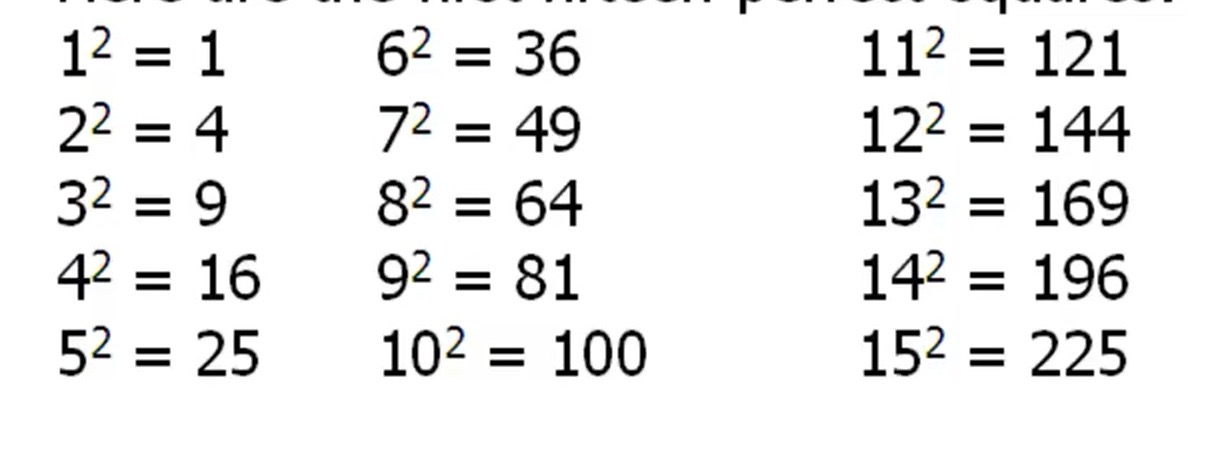
12
1
22
4
32
9
42
16
52
25
62
36
72
49
82
64
92
81
102
100
112
121
122
144
132
169
142
196
152
225