PDC
 Call Kai
 Learn
Learn Practice Test
 Spaced Repetition
 Match
Match Flashcards
 Knowt Play
1/17

There's no tags or description
Looks like no tags are added yet.
Name | Mastery | Learn | Test | Matching | Spaced | Call with Kai | Chat |
|---|
No analytics yet
Send a link to your students to track their progress
18 Terms
What is the name of Enzyme 1?
Pyruvate dehydrogenase
What is the name of Enzyme 2?
Dihydrolipoyl transacetylase
What is the name of Enzyme 3?
Dihydrolipoyl dehydrogenase
What are the 5 cofactors?
Thiamine Pyrophosphate: bound to E1
Lipoamide: bound to E2
FAD: bound to E3
NAD+: free
CoASH: free
What are the 7 steps of the PDC Mechanism?
Pyruvate enters E1.
TPP attacks pyruvate and decarboxylates Pyruvate to form hydroxyethyl-TPP
Lipoamide arm swings toward E1. Hydroxyethyl group is oxidized to an acetyl group and transferred to lipoamide arm.
Lipoamide arm swings into E2.
The acetyl group is transferred to free CoA-SH, forming Acetyl CoA. Lipoamide arm is reduced. Acetyl CoA-SH leaves.
Lipoamide arm swings into E3. FAD oxidizes lipoamide arm. FAD is reduced to FADH22
NAD+ enters E3 and reoxidizes FADH2 to FAD. NAD+ is reduced to NADH which leaves E3.
How is the Pyruvate Dehydrogenase Complex regulated in E2 and E3?
[Acetyl Coa] inhibits E2
[NADH] inhibits E3
How is the Pyruvate Dehydrogenase Complex regulated in E1?
Phosphorylation by PDH kinase leads to inhibition of E1 (and therefore, the complex)
Pyruvate, NAD+ and ADP all inhibit the kinase
Acetyl CoA, NADH, and ATP all stimulate the kinase
Cell signaling such increased [Ca2+] and insulin activate PDH phosphotase that results in dephosphorylation of E1
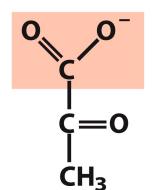
What is this structure?
Pyruvate
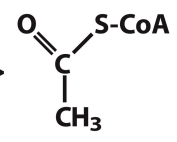
What is this structure?
Acetyl CoA
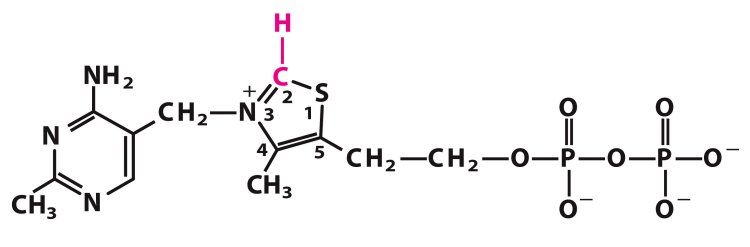
What is this structure?
Thiamine Pyrophosphate
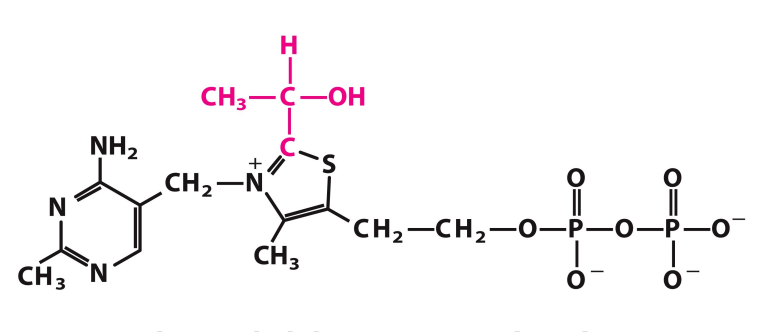
What is this structure?
Hydroxyethyl thiamine pyrophosphate
What is step 1 of the PDC mechanism?
Pyruvate enters E1.
What is step 2 of the PDC mechanism?
TPP attacks pyruvate and decarboxylates Pyruvate to form hydroxyethyl-TPP
What is step 3 of the PDC mechanism?
Lipoamide arm swings toward E1. Hydroxyethyl group is oxidized to an acetyl group and transferred to lipoamide arm.
What is step 4 of the PDC mechanism?
Lipoamide arm swings into E2.
What is step 5 of the PDC mechanism?
The acetyl group is transferred to free CoA-SH, forming Acetyl CoA. Lipoamide arm is reduced. Acetyl CoA-SH leaves.
What is step 6 of the PDC mechanism?
Lipoamide arm swings into E3. FAD oxidizes lipoamide arm. FAD is reduced to FADH2
What is step 7 of the PDC mechanism?
NAD+ enters E3 and reoxidizes FADH2 to FAD. NAD+ is reduced to NADH which leaves E3.