Chemistry: Acids & Bases
 Call Kai
 Learn
Learn Practice Test
 Spaced Repetition
 Match
Match Flashcards
 Knowt Play
1/103

Earn XP
Description and Tags
Partially AIded. CAN you spot the works of AI?
Name | Mastery | Learn | Test | Matching | Spaced | Call with Kai | Chat |
|---|
No analytics yet
Send a link to your students to track their progress
104 Terms
The definition of an acid:
A substance that produces hydrogen ions (H+) in an aqueous solution
Every acidic compound contains at one hydrogen atom (True/False)
True
All compounds which contain at least two hydrogen atoms are acids (True/False)
False. Not all compounds that contain hydrogen atoms are acids
What does the bascity of an acid refer to?
The number of hydrogen ions that one molecule of that acid can give away when in an aqeuous solution
How could the bascity of an acid be deduced from its formula (4)?
By looking at the subscript of the H in a formula:
1→Monobasic
1 molecule produces 1 hydrogen ion upon
ionisation
2→Dibasic
1 molecule produces 2 hydrogen ions upon
ionisation
3→Tribasic
1 molecule produces 3 hydrogen ions upon
ionisation
Physical properties of acids (6):
Have a sour taste
Have a pH less than 7
Turn blue litmus paper red
Do not change the colour of red litmus paper
Turn Universal Indicator from green 🟩 to yellow 🟨 or orange 🟧 or red 🟥
Are good conductors of electricity in aqueous solutions (mobile ions)
Salt definition:
An ionic compound that is formed when a metal or ammonium ion replaces one or more hydrogen ion of an acid
List a few common metals unreactive with acids:
Copper (Cu)
Silver (Ag)
Gold (Au)
Which metals are too reactive with acids?
Group 1 & Group 2 metals
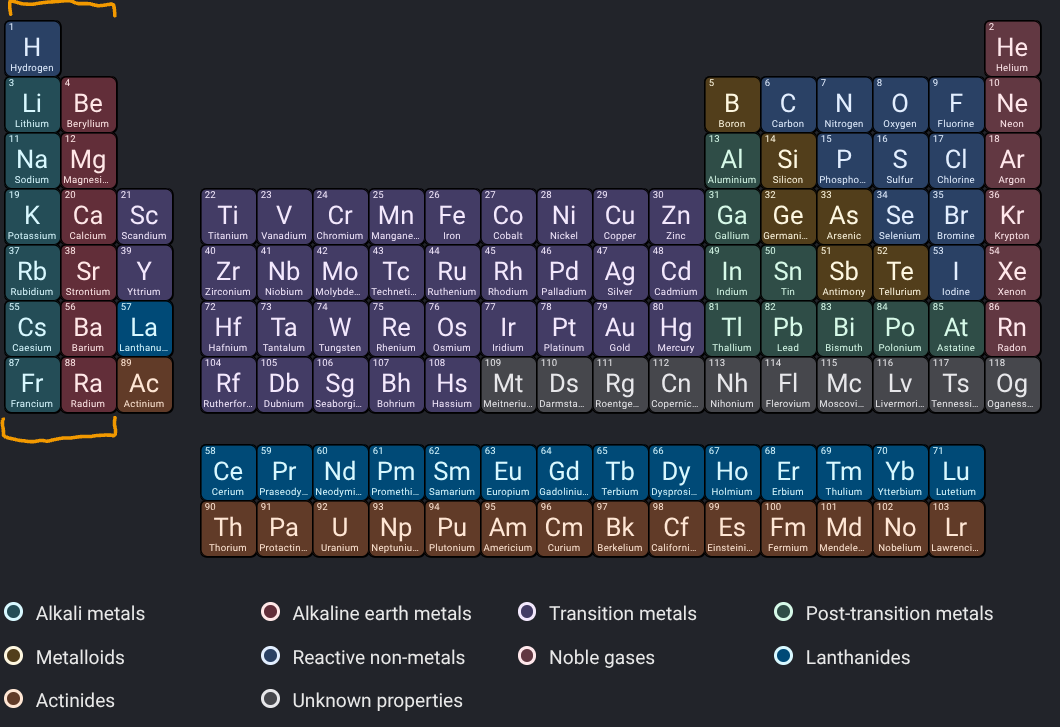
Base definition:
Metal oxides or metal hydroxides that react with acids to form only salt & water
Why do acids display their acidic properties in water but not organic solvents (…)?
Acids produce hydrogen ions in aqueous solution, which give acids their acidic properties, but do not produce such ions (Ionise) in organic solvents & thus do not display any acidic properties in organic solvents
The chemical properties of acids (equation with a description):
Acids react with reactive metals to form a salt & hydrogen gas
ACID + METAL → SALT + HYDROGEN
Acids react with bases to form a salt & water only (neutralisation)
ACID + BASE → SALT + WATER
Acids react with metal carbonates to form a salt, water & carbon dioxide gas
ACID + METAL CARBONATE → SALT + WATER + CARBON DIOXIDE
Alkali definition:
Any base that dissolves in water & produces hydroxide ions in aqueous solutions
An alkali produces oxide ions in aqueous solutions (True/False)
False. An alkali produces hydroxide ions in aqueous solutions
The similarities and differences between bases and alkalis
Similarities:
Both neutralise acids to produce only salt & water
Differences:
All alkalis are bases while not all bases are alkalis
Bases are either soluble or insoluble while alkalis are strictly soluble
Physical properties of alkalis (7):
Have a bitter taste
Have a soapy feel
Have a pH greater than 7
Turns damp red litmus paper blue
Do not change the colour of damp blue litmus paper
Turn Universal Indicator from green 🟩 to blue 🟦 or violet 🟪
Are good conductors of electricity in aqueous solutions (mobile ions)
The chemical properties of alkalis (with a description):
Alkalis react with acids to form a salt & water only (neutralisation)
ALKALI + ACID → SALT + WATER
Alkalis react with ammonium salts to form a salt, water & ammonia gas
ALKALI + AMMONIUM SALT → SALT + WATER + AMMONIA
The last reaction takes place properly only in the presence of heat
What is the ionic equation of the reaction between hydrochloric acid and sodium hydroxide?
H+ (aq) + OH- (aq) → H2O (l)
The standard equation for an acid-alkali neutralisation reaction
What is the ionic equation of the reaction between potassium hydroxide and nitric acid?
OH- (aq) + H+ (aq) → H2O (l)
The standard equation for an alkali-acid neutralisation reaction
「H+ (aq) + OH- (aq) → H2O (l)」is the standard ionic equation for an acid-oxide reaction (True/False)
False. It is the standard equation for an acid-alkali reaction
What gas is released when lead reacts vigorously with dilute nitric acid?
Nitrogen oxide
How does the solubility of lead nitrate in nitric acid affect the reaction between lead and dilute nitric acid?
Its high solubility allows the lead to dissolve completely
Why does concentrated nitric acid react slower with lead than with dilute nitric acid?
The concentrated form forms an insoluble layer of lead nitrate that prevents the acid from reaching the metal
What insoluble layer forms on the surface of lead when it reacts with dilute hydrochloric acid?
Lead (II) chloride
What gas is produced during the slow reaction of lead with dilute hydrochloric acid?
Hydrogen gas
Lead reacts very slowly with dilute hydrochloric acid because the layer of _____ quickly stops the reaction.
Lead (II) chloride
Why is lead able to dissolve in highly concentrated hydrochloric acid but not in the dilute form?
Concentrated acid dissolves the lead chloride layer into soluble complex ions
What specific substance forms a protective coating on lead when it is exposed to dilute sulfuric acid?
Lead sulfate
How does the lead sulfate coating affect the reaction between lead and dilute sulfuric acid?
It isolates the metal, causing the reaction to practically stop
Sulfuric acid
Under what conditions will concentrated sulfuric acid react with lead to strip the metal?
When the acid is hot
What gaseous byproduct is released during the reaction of lead with hot, concentrated sulfuric acid?
Sulfur dioxide
Identify the three chemical products formed when lead reacts with hot, concentrated sulfuric acid:
Sulfur dioxide (SO2), lead sulfate (PbSO4) & water (H2O)
Nitric acid
How does the physical state of lead nitrate differ when formed in dilute versus highly concentrated nitric acid?
It is highly soluble in dilute acid but forms an insoluble layer in concentrated acid
Passivation definition: (in lead reactions)
The formation of an insoluble layer (like lead sulfate or lead chloride) that protects the underlying metal from further acid attack
Concentration of an acid definition:
A measure of the amount (mol) of acid solute dissolved in a specific volume of solution
This ‘specific volume’ is usually 1 dm3
How could the concentration of an acid or an alkali in a solution be changed (4)?
Variables:
Solvent volume
Solute volume
Change:
Solvent volume ∝ 1/concentration
Solute volume ∝ concentration
What does the strength of an acid refer to?
A measure of the extent of ionisation (dissociation) of an acid or an alkali, when dissolved in water, to produce H+ or OH- ions
How could the strength of an acid or an alklai in a solution be changed?
It cannot be changed
As per the current syllabus (Chemistry, 2026), it cannot be easily changed & the methods to are not taught anyway
Describing strong or weak acids or alkali (0):
A [strong/weak]1 [acid/alkali]2 is an [ ]2 that is [completely v partially]1 ionised in an aqueous solution
Self notation:
/ calls for a decision made regardless of preceding clauses (if any), while v calls for a decision which considers preceding clauses, in this case a ‘former or latter’ format
A list of common strong and weak acids, with their formulas:
Strong:
Hydrochloric acid (HCl)
Sulfuric acid (H2SO4)
Nitric acid (HNO3)
Weak:
Carbonic acid (H2CO3)
Citric acid (C6H8O7)
Ethanoic acid (CH3COOH)
A list of common strong and weak alkalis, with their formulas:
Strong:
Potassium hydroxide (KOH)
Sodium hydroxide (NaOH)
Weak
(Aqueous) ammonia/Ammonium hydroxide (NH4OH)
How is strength affected by concentration?
It is not. Every individual molecule will dissociate (and release a certain amount of ions) according to its strength, its concentration notwithstanding
Strength is a fixed property, while concentration can be changed
What is pH?
A measure of the concentration of hydrogen ions in an aqueous solution
What do the numbers (1, 7 and 14) on a pH scale indicate (3)?
1 indicates the lowest pH and the most acidic environment (largest concentration of hydrogen ions)
7 indicates the middle pH & a neutral environment (same concentration of hydrogen & hydroxide ions)
14 indicates the highest pH & the most alkaline environment (lowest concentration of hydrogen ions)
What can be used to measure pH?
pH indicator (different colours)
pH meter
pH sensor (connected to a data logger)
pH indicator defnition:
Coloured dyes which change colour when added to an acid or an alkali
How can pH be used to compare the strength (not concentration) of different acids (4)?
Prepare the desired acids for comparison
Ensure that all are of the same concentration
Dissolve each acid in the same volume of water
Measure the pH (Indicator, meter, sensor)
The lower the pH, the stronger the acid (greater extent of ionisation), and vice versa
How does the Universal indicator work?
It contains a mixture of dyes that each change colour depending on the concentration of hydrogen ions in a solution
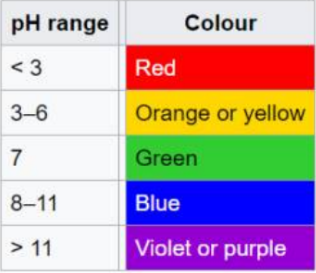
The different colours that the universal indicator changes to with each pH range:
Red 🟥→pH <3
Orange/Yellow 🟧/🟨→pH 3-6
Green 🟩→pH 7 (neutral)
Blue 🟦→pH 8-11
Violet/Purple 🟪→pH 11-14
Red 🟥
Yellow 🟨
Methyl orange transitions between colors within the pH range of _____ to _____.
3, 5
What color does screened (combined with green/blue dye) methyl orange exhibit in an acidic solution?
Violet 🟪
Green 🟩
The indicator screened methyl orange changes color within the pH range of _____ to _____.
3, 5
Red 🟥
Blue 🟦
Litmus transitions between colors within the pH range of _____ to _____.
5, 8
Colourless
Blue 🟦
Thymolphthalein transitions between colors within the pH range of _____ to _____.
9, 10.5
Yellow 🟨
Blue 🟦
Bromothymol blue transitions between colors within the pH range of _____ to _____.
6, 8
Colourless
PInk 🩷
Phenolphthalein transitions between colors within the pH range of _____ to _____.
8, 10
Which indicator transitions from colorless to blue in the pH range of 9 to 10.5?
Thymolphthalein
Which indicator transitions from violet to green in the pH range of 3 to 5?
Screened methyl orange
Colourless
Which indicator transitions from yellow to blue between pH 6 and pH 8?
Bromothymol blue
Phenolphthalein
Which two indicators in the table share the same pH color change range of 3 to 5?
Methyl orange & Screened methyl orange
Why is it important to take note of soil pH?
The pH of soil affects the growth & development of plants by determining how easily plants can absorb nitrogen
Which factors affect the pH of soils?
Type of soil
Fertilisers used
The pH of soils range from 3-5 (True/False)
False. It ranges from pH 4-8
Do plants have an optimum soil pH (?)?
Yes. It ranges from slightly acidic to neutral; pH 5-7
What makes soil unsuitable for plant growth?
Acid rain
Excessive use of fertilisers
They abnormally alter soil pH
What could be done when soil is too acidic?
Liming the soil by adding bases [calcium (hydr)oxide]
Why must the liming of soil always be done together with ammonium-based fertiliser?
They should never be done together. Such bases would react with ammonium salts to form ammonia gas which escapes into the atmosphere. Thus, the plants cannot absorb the ammonium ion which provides the nitrogen it needs. The calcium oxide/hydroxide required to neutralise the soil acidity would also be lost
Oxide definition:
Compounds of oxygen and another element
What are the five classifications of oxides?
There are only four oxides:
Acidic
Basic
Amphoteric
Neutral
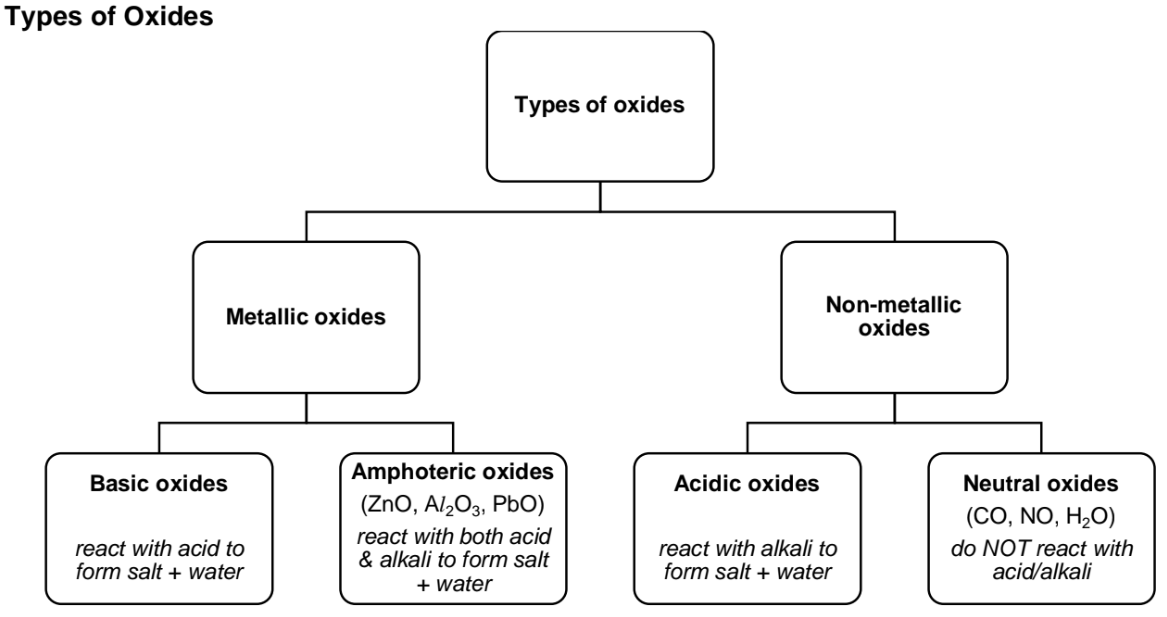
Basic oxides
Salt & water only
Amphoteric oxides
Salt & water only
Zinc oxide (ZnO), aluminium oxide (Al2O3), & lead(II) oxide (PbO)
Describe the water solubility of these amphoteric oxides: Zinc oxide, Aluminum oxide, and Lead (II)oxide
They are all insoluble in water
Acidic oxides
Salt & water only
Carbonic acid (H2CO3)
Sulfur trioxide (SO3)
The reaction between phosphorus (V) oxide (P4O10) and water (H20) yields which acid?
Phosphoric acid (H3PO2)