Biology Lecture 19 Immune and Respiratory Systems
 Studied by 0 people
 Call with Kai
 Learn
Learn Practice Test
 Spaced Repetition
 Match
Match Flashcards
 Knowt Play
1/12

There's no tags or description
Looks like no tags are added yet.
Name | Mastery | Learn | Test | Matching | Spaced | Call with Kai |
|---|
No study sessions yet.
13 Terms
Distinguish innate versus acquired features of the immune system.
Innate features provide immediate, nonspecific responses to pathogens. Acquired features provide delayed, but specific responses to novel pathogens because it retains a “memory”
Describe the different components of the acute inflammatory response.
Attract immune cells
Limit the movement of pathogens into the body by directing them to the lymphatic system
Promote tissue repair once the infection is under control
Explain how and why infected interstitial fluids at the site of an infection (during an acute inflammatory response) are channeled into the lymphatic system.
How? By passing through a network of lymph nodes before entering general cirulation
Why? Because the lymph nodes are filled with macrophages (part of innate immune system) as well as B and T Cells
Describe the functional properties of antibodies.
They help immune cells detect, target, and destroy specific pathogens.
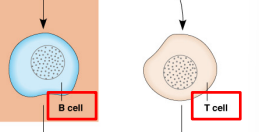
Distinguish between B and T cells.
B Cells - Bone marrow cells, make antibodies that bind to pathogens
T Cells - Thymus cells, Kill infected cells or coordinate immune responses.
Explain how lymphocytes display both specificity and diversity.
Diversity? Gene segments that code for the antigen receptor are randomly rearrange during development
Specificity? Each close expresses a unique antibody which may bind to a protein on an infecting pathogen
Describe clonal selection of B cells.
Proteins from the invader enter the lymph node and grab the attention of one B cell. That B cell clones itself thousands of times and sends antibodies via the bloodstream to the infection site. There, antibodies bind to the invader bacteria, acting as a red flag.
Explain how clonal selection of specific memory cells enhances future responses of the immune system to a particular pathogen.
The B-cell clones “remember” the specific pathogen that the original targeted. It permits a more rapid immune response to future infections by the same pathogen.
Explain how the immune system uses antigen presenting cells to help combat viruses.
Virus-infected cells digest the viruses and then “present” fragments of the virus via Class I MHC. Specific T cell clones bind to the virus fragment and differentiate into cytotoxic T cells, which attack and kill other virus-infected T cells.
Discuss the role of mast cells in allergic reactions.
They release inflammatory mediators that cause allergy symptoms.
Distinguish between a local and systemic allergic reaction.
A local reaction is annoying, while a systemic reaction is life threatening.
Release of histamine in sinuses and eyes vs throughout the body (anaphylactic shock)
Describe how fish respire, and how they exploit countercurrent exchange to increase the efficiency of gas exchange.
Fish use their gills to extract O2 from water and excrete CO2.
As oxygenated water flows through the gill lamellae, the % of total O2 is always higher in water than in blood. This ensures diffusion of O2 along the length of the lamellae.
Describe how humans move air in and out of the respiratory system.
Fresh air is drawn into the lungs by negative pressure caused by the contraction of different muscle systems in the rib cage (makes the lungs expand). Air is released as the muscles return to their resting positions.