Enzymes for Module 2
 Call Kai
 Learn
Learn Practice Test
 Spaced Repetition
 Match
Match Flashcards
 Knowt Play
1/35

Earn XP
Description and Tags
Name | Mastery | Learn | Test | Matching | Spaced | Call with Kai | Chat |
|---|
No analytics yet
Send a link to your students to track their progress
36 Terms
Hexokinase
adds a phosphate group to glucose, yielding G6P and using 1 ATP. Inhibited by G6P and ATP.
Phosphoglucoisomerase
changes G6P into F6P, an isomer
Phosphofructokinase-1
adds a second phosphate to F6P, yielding F1,6BP using 1 ATP. Inhibited by ATP and citrate. Activated by F2,6BP and AMP.
Aldolase
C-C cleavage of F1,6BP, yielding a 3C GAP and DHAP (isomers)
Triosephosphate isomerase
converts DHAP molecules into GAP, should have 2 GAP going forward
Glyceraldehyde-3-phosphate dehydrogenase
REDOX reaction, GAP is oxidized and NAD is reduced yielding 1,3-bisphosphoglycerate and NADH
Phosphoglycerokinase
1,3-bisphosphoglycerate is converted into 3-phosphoglycerate, yielding 1 ATP (x2)
Phosphoglyceromutase
rearranges the phosphate group on 3-phosphoglycerate, yielding 2-phosphoglycerate
Enolase
converts 2-phosphoglycerate into PEP, producing H2O
Pyruvate kinase
transfers a phosphate from PEP to ADP, yielding ATP and pyruvate (x2). Inhibited by ATP and acetyl-CoA. Activated by F1,6BP.
Pyruvate carboxylase
converts pyruvate into oxaloacetate. Activated by acetyl-CoA
Phosphophoenolpyruvate carboxykinase (PEPCK)
converts oxaloacetate into PEP, using a GTP.
Fructose-1,6-biphosphatase
removes the 1’ phosphate from F1,6BP via hydrolysis, yielding F6P. Inhibited by F2,6BP and AMP.
Glucose-6-phosphatase
removes the phosphate group from G6P, yielding glucose.
Citrate synthase
condensation of acetyl-CoA with oxaloacetate to form citrate. Inhibited by ATP, NADH, citrate, and succinyl-CoA. Activated by oxaloacetate.
Acontinase
removal and addition of water from 3’ to 4’ of citrate, yielding isocitrate (an isomer)
Isocitrate dehydrogenase
REDOX reaction, oxidative decarboxylation of isocitrate to form alpha-ketoglutarate. NADH and CO2 are produced. Inhibited by ATP and NADH. Activated by ADP and calcium ions.
Alpha-ketoglutarate dehydrogenase
REDOX reaction, alpha-ketoglutarate is oxidized and NAD is reduced to NADH. CO2 is removed, CoA is added, yielding 4C succinyl-CoA. Inhibited by ATP, NADH, and succinyl-CoA. Activated by calcium ions.
Succinyl-CoA synthase
CoA is removed from succinyl-CoA to form succinate. Substrate-level phosphorylation produces GTP.
Succinate dehydrogenase
REDOX reaction, succinate is oxidized to fumarate while FAD is reduced to FADH2.
Fumarase
reversible hydration of fumarate to yield L-malate
Malate dehydrogenase
REDOX reaction, malate is oxidized to oxaloacetate while NAD is reduced to NADH
NADH-coenzyme Q oxidation complex (NADH dehydrogenase)
transfers NADH electrons to ubiquinone (Complex I)
Succinate-coenzyme Q oxidoreductase complex (succinate dehydrogenase)
succinate is oxidized to fumarate while FAD is reduced to FADH2. CoQH2 is formed.
Coenzyme Q-cytochrome c oxireductase complex
transfer electrons from ubiquinol to cytochrome c
Cytochrome c oxidase
transfer electrons are transferred from cytochrome c to Fe in cytochrome a and a3, then Cu transfers electrons to O2, forming H2O
RNA Polymerase I
Synthesizes ribosomal RNA (rRNA).
RNA Polymerase II
Synthesizes all protein-coding messenger RNA (mRNA) and several small non-coding RNAs.
RNA Polymerase III
Synthesizes transfer RNA (tRNA) and some small rRNAs.
Glycolysis Equation

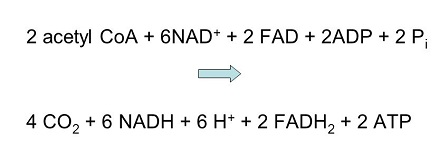
TCA Cycle Equation
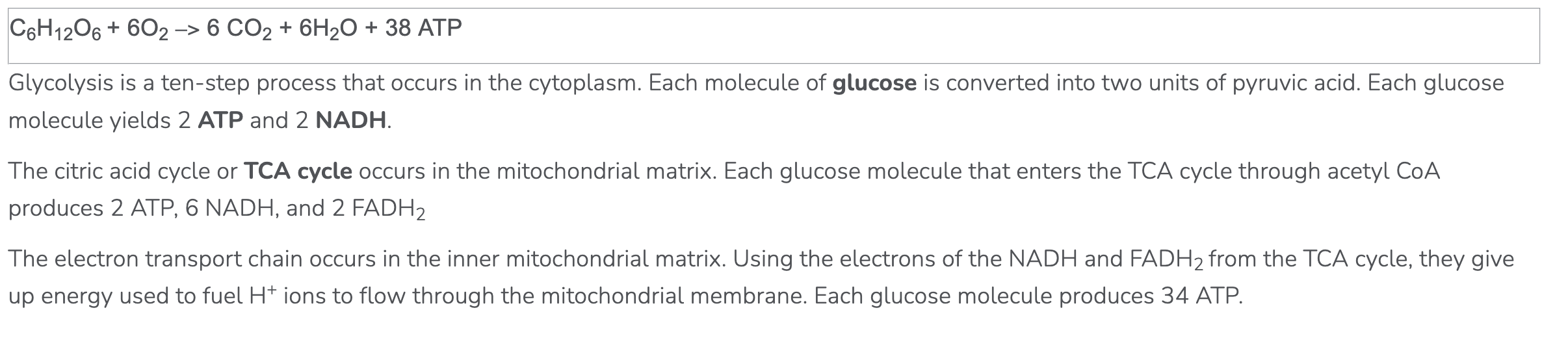
Respiration net equation