biology exam 1
 Call Kai
 Learn
Learn Practice Test
 Spaced Repetition
 Match
Match Flashcards
 Knowt Play
1/158

There's no tags or description
Looks like no tags are added yet.
Name | Mastery | Learn | Test | Matching | Spaced | Call with Kai | Chat |
|---|
No analytics yet
Send a link to your students to track their progress
159 Terms
cell
the basic unit of structure and function; the lowest level of organization that can perform all activities required for life
are enclosed by a membrane
use DNA as their genetic information
Chromosomes
_____________ contain most of a cell’s genetic material in the form of DNA (deoxyribonucleic acid)
genes
are the units of inheritance that transmit information from parents to offspring; are expressed and form functional molecules such as proteins
Feedback mechanisms allow biological processes to ___________
self-regulate
prokaryotic cell
a type of cell that lacks a membrane-enclosed nucleus and membrane-enclosed organelles; dna floats freely
simpler and usually smaller than eukaryotic cells
characteristic of organisms in domains Bacteria and Archaea (kingdoms)
circular dna
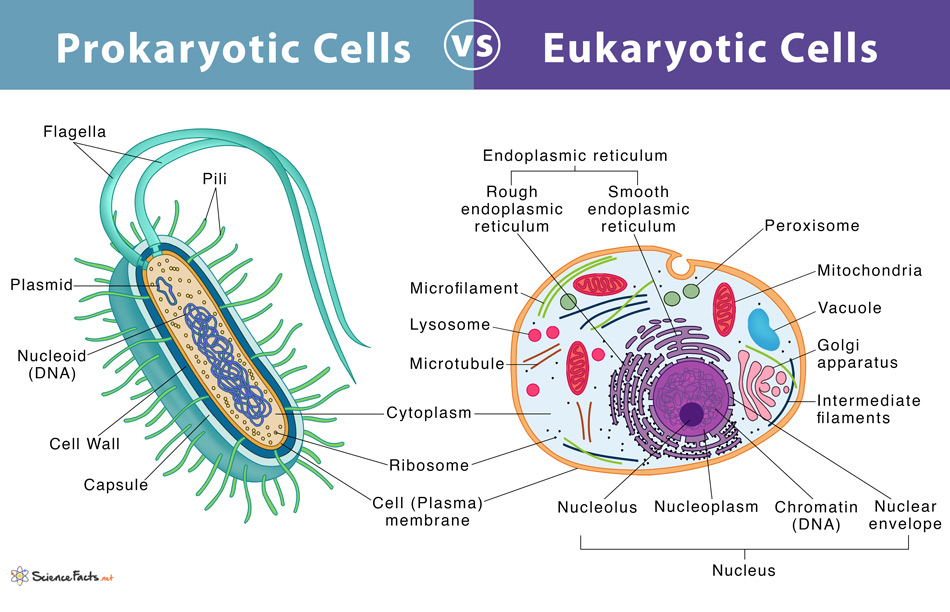
eukaryotic cell
a type of cell with a membrane-enclosed nucleus and membrane-enclosed organelles; contains mitochondria
larger and more complex than prokaryotic cells
characteristic of organisms in domain Eukarya (protists, plants, fungi, and animals - kingdoms)
linear dna
negative feedback
a control mechanism that “damps” its stimulus and stabilizes an issue ; plays a major role in homeostasis in animals.
Ex: when you exercise vigorously, you produce heat, which increases your body temperature. Your nervous system detects this increase and triggers sweating. The evaporation of sweat from your skin then cools your body, helping return body temperature to its set point and eliminating the stimulus
positive feedback
a control mechanism that amplifies the stimulus; help drive processes to completion by causing more movement (making it extreme)
Ex: during child-birth, the pressure of the baby’s head against sensors near the opening of the mother’s uterus stimulates the uterus to contract. These contractions result in greater pressure against the opening of the uterus, heightening the contractions and thereby causing even greater pressure, ultimately causing the baby to be born
Taxonomy
branch of biology that names and classifies species into groups of increasing breadth
Charles Darwin
published “On the Origin of Species by Means of Natural Selection in 1859”
modification
Darwin’s Two Points
Species showed evidence of “descent with _____________” from common ancestors
Natural selection is the mechanism behind “descent with modification”
Darwin’s theory, produced
explained the duality of unity and diversity (evolution unifies biology)
Individuals in a population have traits that vary, many of which were heritable
More offspring are __________ than survive
Species are generally suited to their environments
element
a substance that cannot be broken down to other substances by chemical reactions
compound
a substance consisting of two or more elements in a fixed ratio (sodium chloride)
C, H, O, and N
96% of living matter
Ca, P, K, and S
Most of the remaining 4% consists of
Trace elements
required by an organism in minute quantities
Makes up less than .01% of human body weight
oxidation
Copper makes blood blue, Iron makes blood red through _______
Atoms
are composed of subatomic particles (neutrons, protons, elections); elements are consisted of them
Isotopes
are two atoms of an element that differ in number of neutrons
radioactive isotopes
decay spontaneously, giving off particles and energy; fossil dating, tracing metabolic processes, and diagnosing medical disorders
energy
the capacity to cause change
frozen energy = matter
potential energy
is the energy that matter has because of its location or structure; the top of a hill
electron shell
an energy level or region surrounding an atom's nucleus where electrons are located; The layer closest to the center has the lowest energy. Layers further out have higher energy.
energy absorbed goes away from nucleus
energy lost goes to nucleus
valence electrons
are those in the outermost shell, or valence shell
The chemical behavior of an atom is determined by the distribution of electrons in electron shells
orbital
the three-dimensional space that an electron occupies 90% of the time
incomplete
Atoms with __________ valence shells can share or transfer valence electrons with certain other atoms
covalent bond
sharing of a pair of valence electrons by two atoms; strongest bonds in organisms are _____________ that form a cell’s molecules

molecule
consists of two or more atoms held together by covalent bonds
Ex: diatomic hydrogen (H2) H:H
nonpolar covalent bond
the atoms share the electron equally
polar covalent bond
one atom is more electronegative, and the atoms do not share the electron equally
electronegativity
is an atom’s attraction for the electrons in a covalent bond
Ionic Bonds
Atoms sometimes strip electrons from their bonding partners; an attraction between an anion and a cation
An example is the transfer of an electron from sodium to chlorine (now both valence shells complete)

cation
a positively charged ion
anion
a negatively charged ion
ionic compounds, or salts
Compounds formed by ionic bonds; Salts, such as sodium chloride (table salt), are often found in nature as crystals
ionic bonds in water and hydrogen bonds
What are the weak chemical bonds
hydrogen bond
forms when a hydrogen atom covalently bonded to one electronegative atom is also attracted to another electronegative atom
electronegative
In living cells, the _____________ partners are usually oxygen or nitrogen atoms
If electrons are distributed ____________ in molecules or atoms, they can result in “hot spots” of positive or negative charge
asymmetrically
Van der Waals interactions
attractions between molecules that are close together as a result of these charges
valence orbitals
Molecular shape is determined by the positions of its atoms’ _____________
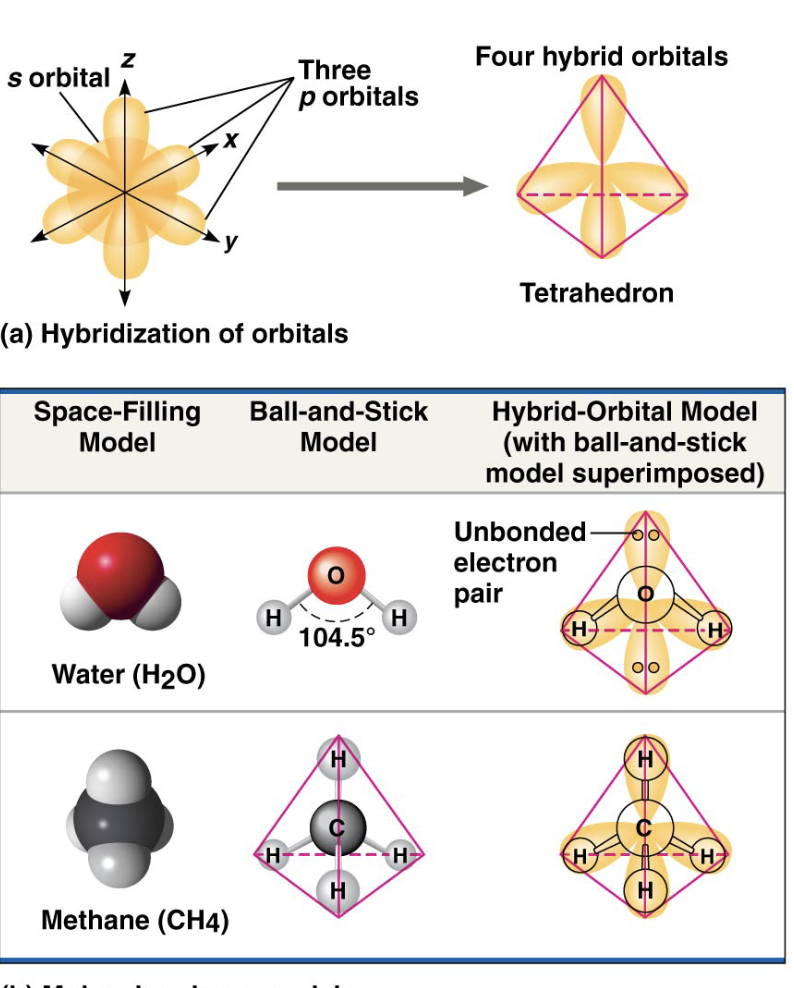
Molecular specificity
_________________ based on molecular shape. Molecules with similar shapes can have similar biological effects

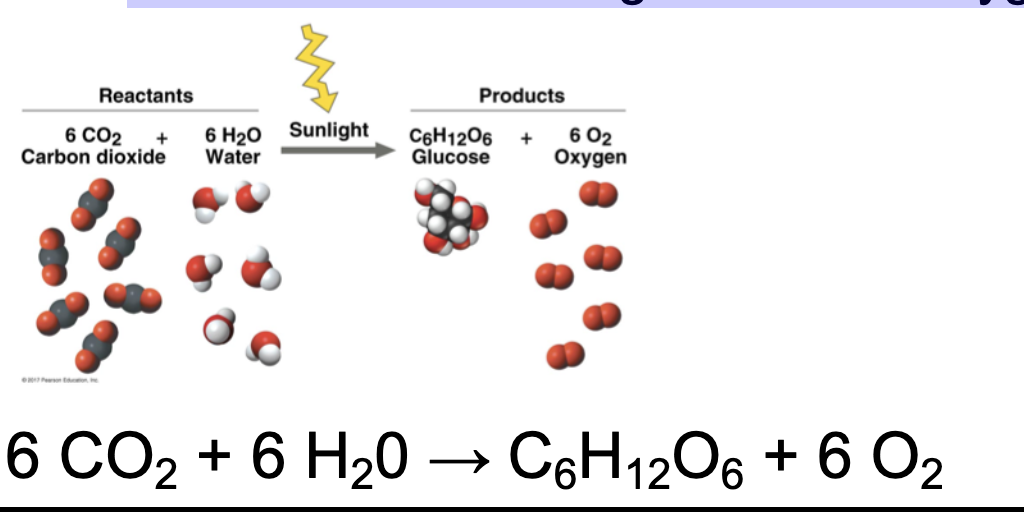
chemical reactions
are the making and breaking of chemical bonds

Sunlight
___________ powers the conversion of carbon dioxide and water to glucose and oxygen
lewis dot diagrams
shows the valence electrons (outer shell electrons) of a molecule or atom
Dots show unshared electrons (lone pairs).
Lines show shared pairs of electrons in a covalent bond (one line equals two shared electrons).
The Octet Rule guides the drawings, meaning most atoms want eight electrons in their outer shell to feel stable. Hydrogen only wants two

water
All living organisms require _______ more than any other substance; Most cells are surrounded by water, and cells themselves are about 70–95% water
polar
Water molecules are _______ because they’re constructed from two polar covalent bonds
makes water a versatile solvent

Multiple, reform
This polarity and the ”V” geometry of the water molecule allow for:
Water polarity and H-bonding
_________ hydrogen bonds
Liquid water H-bonds break and ______
Bond “flickering”
Cohesive, temperature, expansion, solvent
Four of water’s (emergent) properties that facilitate an environment for life are:
__________ behavior
Ability to moderate _________
__________ upon freezing
Versatility as a _________
cohesion
hydrogen bonds hold water molecules together
Adhesion
an attraction between different substances, for example, between water and plant cell walls

absorbs, stored
Water _________ heat from warmer air and releases ________ heat to cooler air
heat bank,
Water functions as a _________, it can absorb or release a large amount of heat with only a slight change in its own temperature
Total thermal energy (kinetic energy)
Temperature is a measure of heat intensity (average kinetic energy, regardless of volume)
specific heat
the amount of heat that must be absorbed or lost for 1 g of a substance to change temperature by 1ºC
Ex: Water is 1 cal/g ºC – this is relatively high
resists
Water ________ changing its temperature because of its high specific heat
Water will change its temperature less as it absorbs or loses heat relative to other materials (like a metal pot on the burner)
hydrogen bonding, break
Water’s high specific heat can be traced to _____________
Heat is absorbed when hydrogen bonds _______ (absorbed heat must break bonds before accelerating water molecules)
Heat is released when hydrogen bonds form
evaporation
is transformation of a substance from liquid to gas
Some evaporation occurs at any temperature
evaporative cooling
As a liquid evaporates, its remaining surface cools, a process called ______________
helps stabilize temperatures in organisms and bodies of water (sweating)
Heat of vaporization
the heat a liquid must absorb for 1 g to be converted to gas
less dense (spread out)
Ice floats in liquid water because hydrogen bonds in ice are more “ordered,” making ice ____________

4°C
Water reaches its greatest density at ______ • If ice sank, all bodies of water would eventually freeze solid, making life impossible on Earth
solution, solvent, solute
A ___________ is a liquid that is a homogeneous mixture of substances
_________: dissolving agent (Aqueous solution if water is the solvent)
________: The substance that is dissolved
hydrophilic
substance is one that has an affinity for water (can combine w/ water)
hydrophobic
substance is one that does not have an affinity for water (does not combine w/ water; oil)
Molecules are hydrophobic because they have relatively nonpolar bonds
A hydrogen atom in a hydrogen bond between two water molecules can ______ from one to the other
shift

hydrogen ion, hydronium, hydroxide
The hydrogen atom leaves its electron behind and is transferred as a proton, or ___________ (H +)
The molecule with the extra proton is now a __________ ion (H 3O+), though it is often represented as H +
The molecule that lost the proton is now a ___________ ion (OH-)
concentrations
Changes in ___________ of H + and OH – can drastically affect the chemistry of a cell’s Amino acids, proteins, enzymes, and other molecules are affected
Adding certain solutes, called acids and bases, modifies the concentrations of H + and OH –
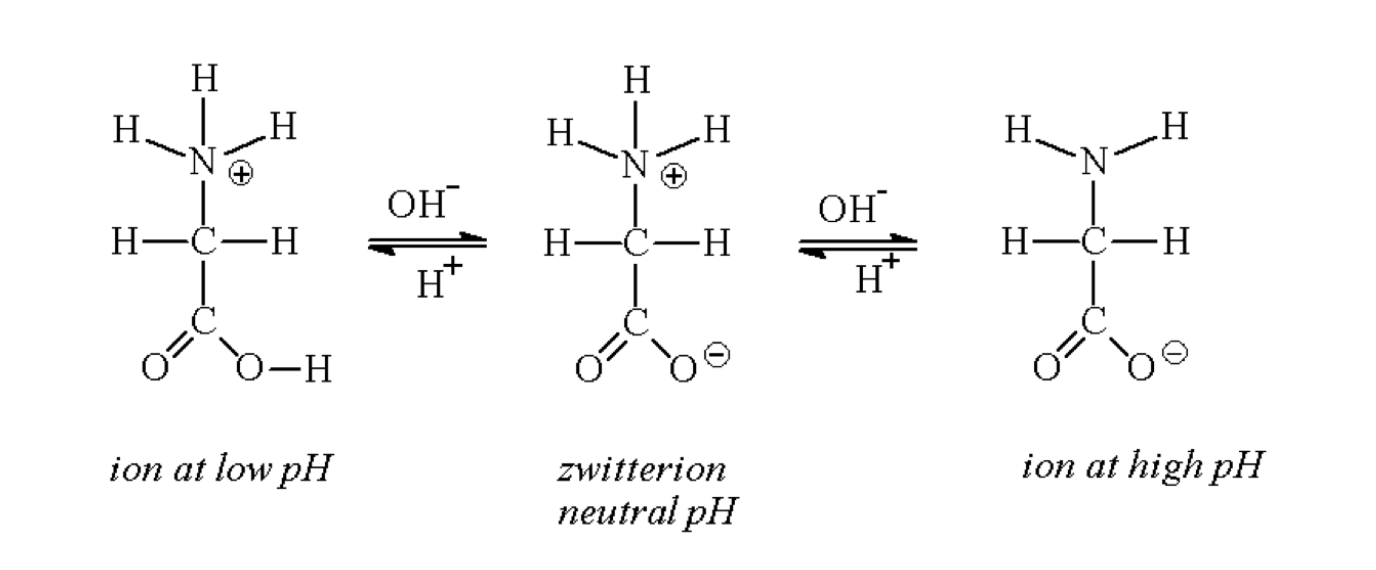
equal
Concentrations of H + and OH – are ________ in pure water (10^-7M at 25°C)
acid
any substance that increases the H + concentration of a solution (HCl)
HCl → H+ + Cl-
base
any substance that reduces the H + concentration of a solution (NH 3)
NH3 + H+ <-> NH4+
NaOH → Na+ + OH-
constant
aqueous solution at 25°C the product of H + and OH – is _______

pH
The ______ of a solution is defined by the negative logarithm of H + concentration, written as: pH = –log [H +]
neutral
For a __________ aqueous solution: [H +] is 10 –7 = –(–7) = 7
Acidic, Basic
________ solutions have pH values less than 7
______ solutions have pH values greater than 7
14
At room temperature (25°C) the sum of pH and pOH is always _____
molar concentration conversions
for questions asking to find pH solution w/ a concentration of M

7
The internal pH of most living cells must remain close to pH ___
Buffers
_________ are substances that minimize changes in concentrations of H + and OH – in a solution
hydrogen
Most buffers consist of an acid-base pair that reversibly combines with _________

carbonic acid
One major blood buffer is ___________/H2CO3 (dissociates to bicarbonate and H+)
Add 0.01 mol of strong acid to water and pH goes from 7 to 2
Add same amount of acid to human blood and pH goes from 7.4 to 7.3
Organic chemistry
__________ is the study of compounds that contain carbon
Although cells are 70–95% water, the rest consists mostly of carbon-based compounds
Most organic compounds contain hydrogen atoms in addition to carbon atoms
Miller’s 1953 experiment
tested whether complex organic molecules could arise spontaneously under conditions thought to have existed on the early Earth
abiotically
Organic molecules may have been synthesized __________ (through non-living physical and chemical processes) on the early Earth
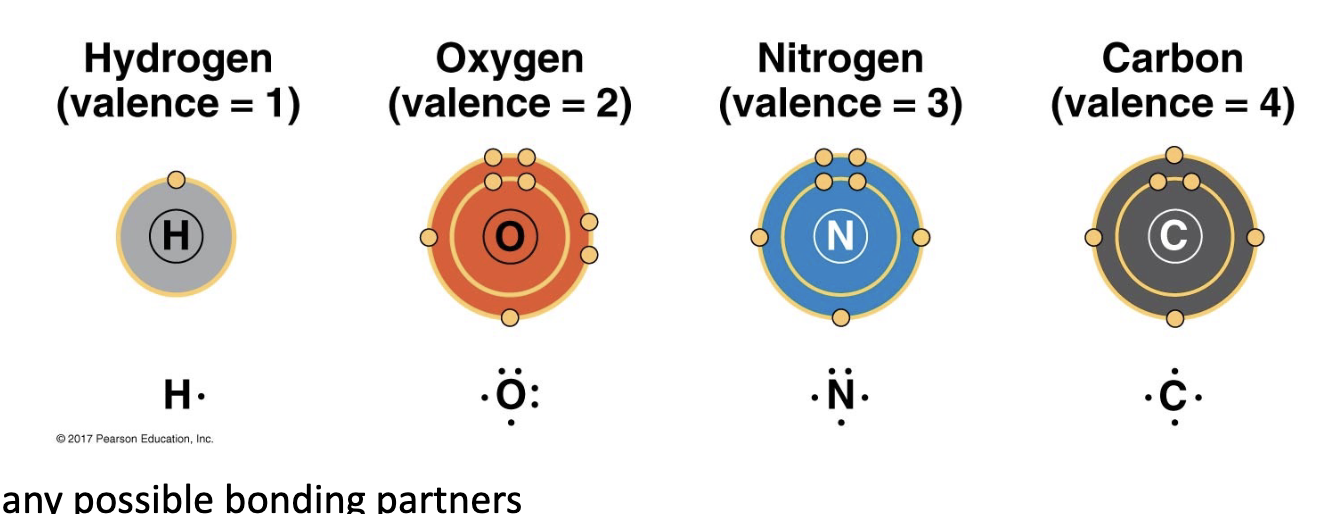
3 special traits of carbon
Has many possible bonding partners
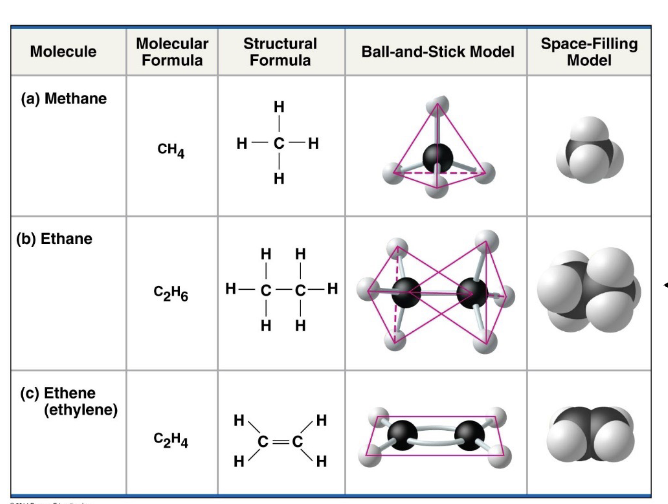
Makes single or double bonds (and more)
Forms chains, branches and rings
hydrogen, oxygen, nitrogen
has many bonding partners such as
methane, ethane, and ethene
Makes single or double bonds (and more) such as
skeletons
Forms chains, branches and rings; Carbon chains form the _________ of most organic molecules

hydrocarbons
organic molecules consisting of only carbon and hydrogen; they are not prevalent by themselves in organisms
Many organic molecules, such as fats, have components of it (gray circles in the diagram)
can undergo reactions that release a large amount of energy

Isomers
are compounds with the same molecular formula but different structures and properties
Ex: (C6H12O6) = glucose and fructose, glucose contains an aldehyde group (an aldose) while fructose contains a ketone group (a ketose)
Structural isomers
isomers that have different arrangements of their atoms

cis-trans isomers
isomers that have the same covalent arrangements but differ in spatial arrangements
cis = same side
trans = opposite side

Enantiomers
are isomers that are images of each other


components
Distinctive properties of organic molecules depend not only on the carbon skeleton but also on the molecular __________ attached to it
A number of characteristic groups are often attached to skeletons of organic molecules
functional groups
are the components of organic molecules that are most commonly involved in chemical reactions
The number and arrangement give each molecule its unique properties
hydroxyl, carboxyl, amino, sulfhydryl, phosphate, methyl
hydroxyl
(-OH) Polar due to electronegative oxygen; forms hydrogen bonds with water
gives larger molecules the ability to mix with water, makes them polar, creates alcohol

carboxyl
(-COOH) acts as an acid
act as a weak acid by donating a hydrogen ion and to make molecules polar and water-soluble; lowers pH,

amino
(-NH2) acts as a base
serve as a key building block for proteins in living things, accepts protons, changes charge, raises pH

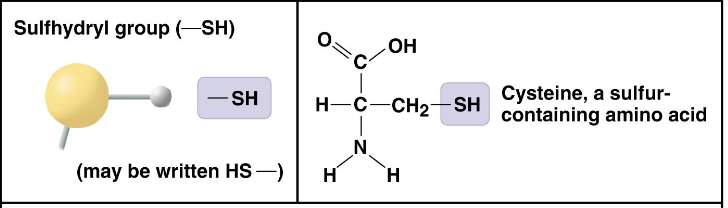
sulfhydryl
(-SH) Two -SH groups can react, forming a “cross-link” that helps stabilize protein structure
active participant in chemical and antioxidant reactions
phosphate
(-OPO32-) Contributes negative charge; when attached, confers on a molecule the ability to react with water, releasing energy
stores energy, builds DNA and RNA, makes cell membranes (phospholipids), signals and regulates chemical reactions, helps molecules dissolve
