Mutations
 Call Kai
 Learn
Learn Practice Test
 Spaced Repetition
 Match
Match Flashcards
 Knowt Play
1/53

There's no tags or description
Looks like no tags are added yet.
Name | Mastery | Learn | Test | Matching | Spaced | Call with Kai | Chat |
|---|
No analytics yet
Send a link to your students to track their progress
54 Terms
Mutation
permanent change in DNA sequence
change in gene or chromosome leading to new characteristics in an organism
Induced mutations
mutation caused by mutagenic agent
spontaneous mutation
mutation that occurs due to an error in a natural biological process
Mutagens/mutagenic agents
factors that increase the rate at which mutations occur
e.g.
viruses
radiation (UV rays)
microorganisms
environmental poisons and irritants
alcohol and diet
Cell division
causes mutations (chromosomal) when chromosomes fail to separate/break apart
specifiable during crossing over (break apart and reattach incorrectly) and non-disjunction (failure to separate)
DNA replication
DNA is copied during DNA replication pairs match based on complimentary base pairing rules (AT and CG)
If there is mismatching or nucleotides are added/removed incorrectly, it will lead to mutations (gene/point)
phenotype
observable characteristics due to the genotype
genotype
combination of alleles for a gene
Evolution
gradual change in characteristics of a species
Gene Mutations
a permanent alteration to a single gene
• affects single gene (loci) changing one base pair/thousands of base pairs |
Examples of gene mutations |
Chromosomal mutation
permanent change to the structure and/or number of chromosomes in an organism
• affect more than one gene up to a whole chromosome |
Examples of chromosome mutations |
Somatic mutations
Not inherited by offspring
· Occurs in all body cells except gametes
· Will only affect certain cells (not all)
· Diseases such as cancer
Germline Mutations
May be inherited by offspring
· Occur in gametes only
· Will affect all cells in the body of the offspring
· Often doesn’t affect the individual who has mutation
· Diseases such as Huntington’s disease
heritability mutations
somatic mutations and germline mutations
extent of mutations
gene mutations and chromosomal mutations
Gene/point mutations
Insertion: nucleotide is added
Substitution: an existing nucleotide is replaced with a new nucleotide
Deletion: a nucleotide is removed
Chromosomal mutations (mechanical process)
Duplication(insertion): section of a chromosome occurs twice
Deletion: piece of DNA is removed
Inversion: chromosome breaks and reattaches the wrong way around
Translocation: chromosome breaks and reattaches to the wrong chromosome
Non-dysjunction: chromosome pairs don’t separate during meiosis
point mutations
specific type of gene mutation: insertion, deletion and substitution mutations as they only affect a single nucleotide (change in a single nucleotide therefore only one base is changed)
Frameshift mutation
where the amino acids after the insertion or deletion are all changed
- insertion and deletion may result in a frameshift mutation
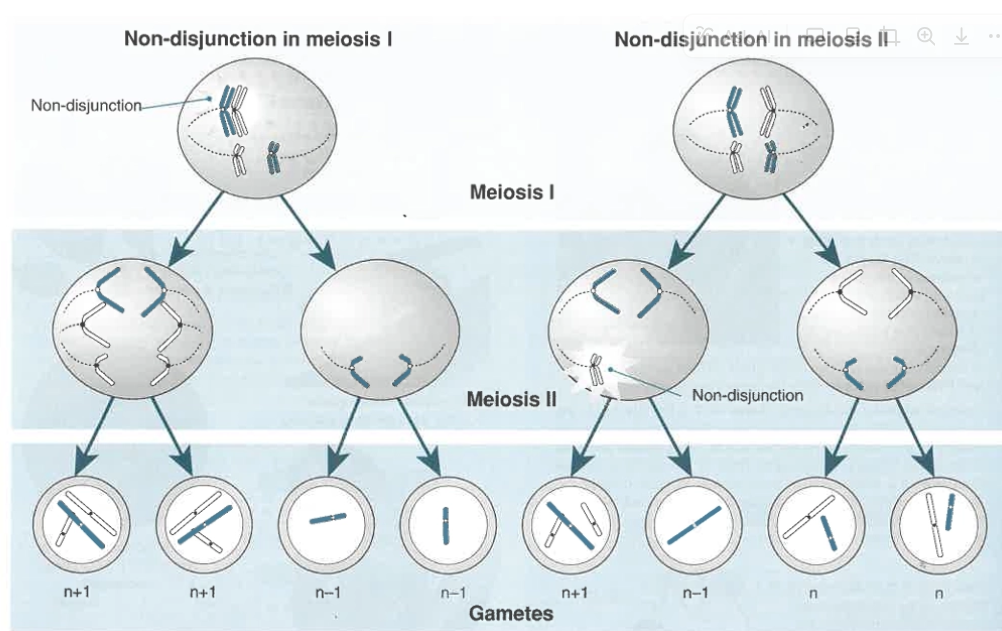
WHY IS NON-DISJUNCTION in meiosis I result in a higher proportion of faulty gametes than non-disjunction in meiosis II?
Because it occurs in the first division of meiosis which is crucial in the formation the egg cell
in this division, homologous chromosomes are paired and separated into 2 cells
If non-disjunction occurs, both homologous pairs end up in the same cell resulting in aneuploidy, leading to and extra chromosome (n+1) or missing chromosome (n-1) in the egg cell
If it occurs in meiosis II, it doesn’t affect majority of the gametes as only half the gametes are produced during this division
aneuploidy
type of mutation where there’s a change in the chromosome number as a result of non-disjunction
non-dysjunction in meiosis
when homologous chromosomes fail to separate properly in meiosis I, or sister chromatids fail to separate in meiosis II, causing one gamete to receive two of the same type of chromosome and the other gamete receives no copy.
this results in abnormal numbers of chromosomes in the gametes
Gel electrophoresis
used to separate DNA strands (RNA or proteins) based on size
before running a PCR product through GEP, you must first use restriction enzymes to cut it to specific lengths/specific nucleotide sequences
GEP is used to create DNA profiles for identification of:
individuals (forensics, crime, fossils)
relatedness (ancestry, family relatedness, species identification)
Genetic diseases - a mutant (disease) allele is often longer/shorter than a normal allele. Can be identified by comparing with the normal allele
GEP process
Prepare the Gel
Load the DNA samples
Apply an electric current
Document the results
Loading dye
glycerol - fat/thick which is dense, and sinks when injected into well, makes DNA visible
visualising dye
coloured to see dye going to well, see them under UV light (flourescence)
Description on preparing the gel
• the gel is made of a polymer, such as agarose, which is dissolved in a buffer |
Description on loading the DNA samples
the DNA samples are loaded into the wells using a micropipette
the DNA samples will contain a loading dye and a visualising dye
Loading dye makes it denser, so it sinks to the bottom of the well making loading easier
the visualising dye will contain a fluorescent dye to enable it to be visualised under IV light
Description on applying an electric current
An electric current is applied to the gel which causes the DNA fragments to move towards the positive electrode
the DNA fragments will move through the gel at a rate that is inversely proportional to their size
smaller DNA fragments will move faster than larger DNA fragments
Description on documenting the results
the results of the gel electrophoresis can be documented by taking a picture of the gel or by scanning the gel into a computer
the size of DNA fragments can be determined by comparing the positions of the bands on the gel to a DNA ladder
DNA sequencing
the process of determining the precise order of the nucleotides in a sample of DNA molecule
DNA synthesised from 4 nucleotides, each with different nitrogenous base - adenine, cytosine, guanine and thymine
Nucleotides = deoxynucleotide triphosphate (contain 3 phosphate groups joined to sugar deoxyribose with its base)
What happens when DNA forms?
each nucleotide loses two phosphate groups
sugar molecule loses hydrogen atom from hydroxy group (OH) when it bonds to the phosphate group of an adjacent nucleotide
synthetic nucleotide stops elongation of sequence because there is no OH group for the next nucleotide to attach to. This occurs to each nucleotide in the DNA sample, creating different lengths of DNA. These can be separated using gel electrophoresis. Knowing which base was added to create each length helps determine the order of nucleotides
purpose of DNA ladder
help show length of different bandings
help estimate size/no. of base pairs of DNA
Evolutionary biology
DNA sequencing can be used to compare the genomes of a different species, which can help us understand the evolutionary pathways
Medical diagnostic
DNA sequencing can be used to diagnose genetic diseases such as, cystic fibrosis, sickle cell anaemia etc., it can also be used to identify the risk of developing certain diseases such as cancer.
Understanding order of nucleotide sequencing allows us to:
identify the degree of genetic variations in a population
identify the degree of genetic diversity between species
establish similarity between species
quantify the degree of genetics molecular clocks/determine the time since organisms shared a common ancestor
genetics molecular clocks: technique used to estimate the time where different species diverged from a common ancestor
Helps construct phylogenetic trees
identify how genes derived from common ancestors have changed over time
uses comparative genomics to help understand the process of evolutionary changes over time
Ethical considerations with genetic information
Autonomy: respect for the right to be self-determining and choose whether or not to be tested. If tested to know and share the information, including the right of an individual to decide their own future, independent of genetic information
confidentiality: use of genetic information is treated sensitively and is accessed only by those who are authorised to access it
equity: right to fair and equal treatment regardless of genetic information
Privacy: right to be ‘left alone’ and to make decisions regarding genetic testing and the resulting information independent for others
PCR (Polymerase Chain Reaction)
polymerase chain reaction uses cycles of heating and cooling and DNA polymerase (enzyme) to rapidly replicate DNA
purpose of PCR
amplify small amounts (degraded) of DNA to enable them to be studied and compared
PCR process
Template DNA - will contain all DNA from the sample
DNA primer two (forward and reverse) single stranded sequences that target the specific sequence to be copied
dictate what will be amplified
only sequences between the forward and reverse primers will be copied
DNA polymerase - (taq polymerase - simplifies it and automates and is thermostable) used to join dNTP’s to the template DNA)
dNTP’s are free nucleotides that will eventually form the new strands of DNA
Buffer solution - maintains the pH to enable optimal enzyme function
enzymes are sensitive to temp, pH
temp changes controlled by thermocycler - which rapidly heat and cool PCR products
Denaturing
96 degrees celsius - used to break down hydrogen bonds holding the two strands
enzyme helicase separates two strands of DNA, allowing each strand to be replicated
Heats the DNA to separate the double strand into single strands (denaturing)
this provides a template for the annealing process
Annealing
55-65 degrees celsius
allows short strands of DNA called primers to bind to single DNA strands
primers are complementary to either end of the sections of DNA to be copied
Cools the reaction down, which allows specific primers to bind to complimentary sequence on the single stranded template strand
Extension
72 degree celsius
Heats the reaction again to allow taq polymerase to add/join free nucleotides and extend the primers
this results in the production of two identical double stranded DNA
Reliability
the extent to which an experiment gives the same results each time it is performed under the same conditions (consistent)
accuracy
extent to which the measurements are correct/close to true value
only possible is you’re using the same equipment
validity
extent to which an experiment tests what it’s supposed to test
how is reliability high/not low?
using modern (new) - maintains voltage/current baseline throughout the entire run (20 mins)
good (not contaminated) buffer solution) - right conc, won’t conduct too much electrical current preventing DNA fragments from denaturing
how to ensure reliability
repeat trial on another day with the same gel and buffer solution
run duplicate lanes → sample a, b and c have two lanes each sid by side to prove they have the same band positions
how to ensure accuracy?
select right molecular ladder - ladder must have known sizes to frame unknown samples
prevent sample overloading - if too much DNA is loaded it causes bands to look advanced/smeared
don’t manually guess band size by eye but do it by using a pixel-analysis software