obsteric haemorrhage : APH
 Call Kai
 Learn
Learn Practice Test
 Spaced Repetition
 Match
Match Flashcards
 Knowt Play
1/59

There's no tags or description
Looks like no tags are added yet.
Name | Mastery | Learn | Test | Matching | Spaced | Call with Kai | Chat |
|---|
No analytics yet
Send a link to your students to track their progress
60 Terms
What are the causes of obstetric haemorrhage? (5) in the past
Patient deltas in seeking medical care
Lack of blood + blood products
Lack os stuff / overburdened services
Delayed treatment due to inaccurate estimation of blood loss
Substandard care with inadequate resuscitation
What are the causes of OH in this triennum? (5)
Bleeding at C/S or after
PPH after vaginal delivery
APH- Abruptio placenta
Placenta praevia
Ruptured uterus (both scarred and unscarred)
Define obstetric haemorrhage
Any kind of abnormal bleeding that is related to pregnancy can can occur antepartum, during delivery of postpartum
What are some causes of bleeding antepartum? (6)
Placenta praevia
Abruptio
Coagulopathy
Uterine rupture
Cervical lesions
APHUO (after 20 wks)
What is a cause of bleeding intrapartum?
Lacerations during vaginal delivery
What are some causes of bleeding postpartum? (4)
Bleeding from a morbidly adherent placenta
Uterine atony
Retained placenta
Cervical tear
Define antepartum haemorrhage (aph)
Bleeding from / into the genital tract occurring from 20 weeks or after the gestation age of viability (26-28) and prior to delivery
What are some signs of significant volume depletion shock in APH ? (3)
Fetal distress
Fetal demise (death in the womb)
Clinical shock
How does the RCOG define APH severity?
Spotting > staining / streaks of blood on underwear
Minor haemorrhage > blood less <50 mls
Major haemorrhage > blood loss of 50 - 1000 mls with no signs of clinical shock
Massive haemorrhage > blood loss > 1000 mls and/ signs of clinical shock
Define recurrent APH
More than 1 episode of APH
What are the placental causes of APH ? (3)
Placenta praevia
Abruptio placentae (placenta separates from uterine wall before baby is born cutting of its oxygen & nutritional supply)
Vasa praevia (unprotected vessels from the umbilical cord / placenta cross the opening of the cervix)
What are the genital tract causes of APH? (4)
Cervicitis
Trauma
Cervical tumour
Sexual intercourse
What is an unexplained caused of APH?
Antepartum haemorrhage of unknown origin
Define Abruptio placentae
Premature separation of a normally implanted placenta from the uterus prior to delivery of foetus
could be minor / major associated complications with fetal death and maternal morbidity
How often does abruptio plancentae occur?
In 0.6 - 1.2% with more causes happening at term causing more than 10% preterm babies
What is abruptio placentae strongly associated with?
Premature rupture of membrane (PROM) in both a caudal and consequential manner
What is strongest risk factor for abruptio placentae?
Previous abruptio placentae (10-15% recurrence risk)
Risk factors for maternal substance use for abruptio placentae? (2)
Cigarette smoking
Cocaine and other drug use
Risk factors of maternal diseases associated with abruptio placentae? (4)
Pre-eclampsia & eclampsia
Chronic hypertension
Pregestational diabetes mellitus
Iron-deficiency anemia
Risk factors of uterine factors associated with abruptio placentae? (3)
Fibroids
Uterine synechiae
Previous uterine surgery
What are the other risk factors for abruptio placentae? (4)
Trauma
Rapid uterine decompression associated with multiple pregnancies & polyhydraminos
Oligohydramnios (low amniotic fluid in the baby)
Chorioamniontis (bacterial infection of amniotic fluid e.g Step B / E. Coli)
Define acute abruptio placentae
Sudden onset of bleeding which occurs from centrally located and larger deciduous arteries
What are some associations of acute abruptio placentae? (4)
Abdominal plain and uterine tenderness with tachysystole (more then 5 contractions in 10 minutes)
Abnormal fetal heart rate patterns
Maternal hypotension and coagulopathy
Fetal death
Define chronic abruptio placentae
Light to moderate vaginal bleeding which occurs from peripherally located smaller deciduous veins
What are some associations of chronic abruptio placentae?
Signs of chronic placental inflammation and dysfunction like oligohydramnios, FGR, pPROM
What are the clinical presentations of abruptio placentae caused by? (3)
Whether it’s an acute / chronic abruptio
Is it an overt / concealed abruptio
Severity of bleeding > abdominal plain better predictor of poor maternal & fetal outcome
How do we diagnose an abruptio?
Clinical diagnosis that is supported by radiological, laboratory and pathological studies
What are the 3 locations radiology can identify to support the diagnoses of abruptio placentae?
Subchorionic - between placentae + membranes
Retroplacental - between placenta + myometrium (worst prognosis)
Preplacental - between placenta + amino
Define placenta praevia
Abnormal placental location occurs when the placenta covers the internal cervical os completely/ extends close enough to the cervix to cause bleeding when the cervix dilates / lower uterine segment effaces (thins & stretches) after 20 weeks
Define low-lying placenta
Occurs if the placental edge is <2cm from internal os but does not cover it
When should a low-lying placenta and placenta praevia be followed up?
At 32 weeks and 36 weeks
Define placental migration
Resolution of the placenta praevia that occurs near term as the pregnancy advances to the stationary lower placental edge from the development of the lower segment
Define trophotropism
The growth of trophoblastic tissue away from the cervical os towards the fundus
What are the risk factors of placenta praevia? (8)
Previous placenta praevia
Previous C/S increases with number
Previous TOP
Multipartity
AMA (>40)
Smoking
Deficient endometrium due to uterine scar, endometritis, submucous fibriods, MROP
Assited reproductive therapy (IVF)
What are clinical features of placenta praevia on history? (3)
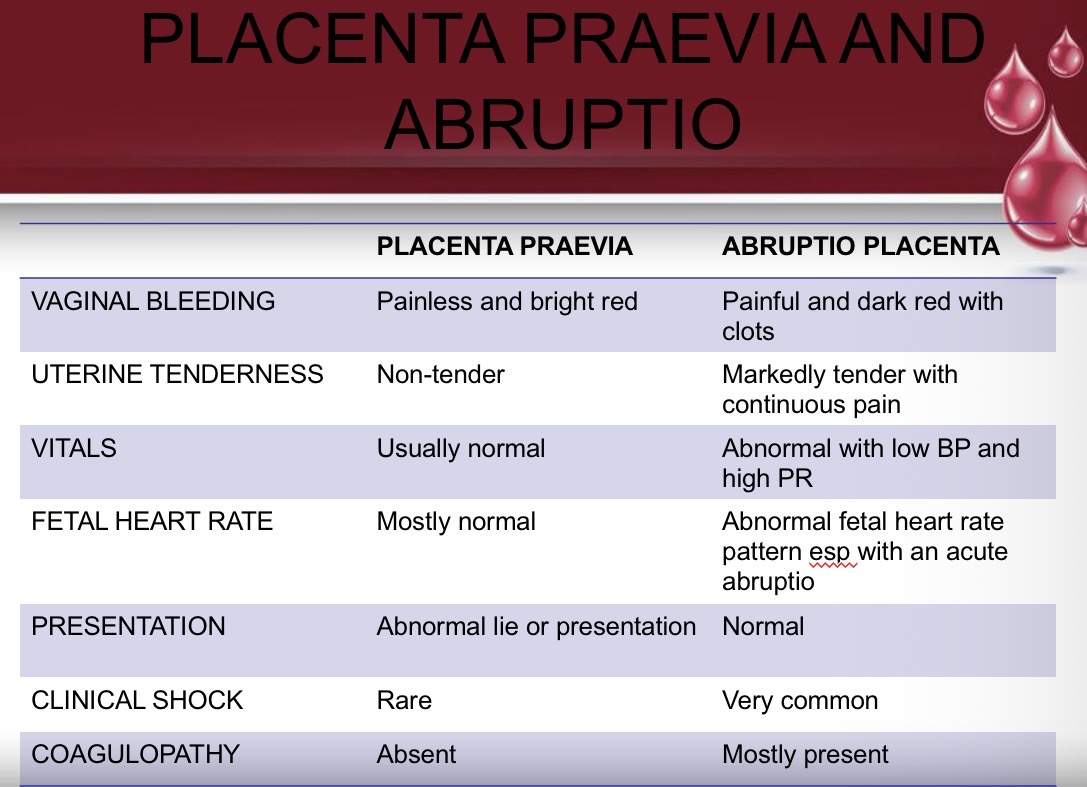
Vaginal bleeding is painless
Blood is bright red
Fetal movement are well felt
What are clinical features of placenta praevia on examination ? (3)
Normal vitals with no signs of shock + normal fetal heart rate
Uterus is soft, not tender / irritable
Presenting part is high + abnormal
Different between placenta praevia and abruptio (7)
Define vasa praevia
Fetal vessels run via the free placental membrane and are more likely to rupture in active labour / amniotomy is preformed to induce / augment labour , located near or over the cervix
What are the classifications of vasa praevia
Type 1 - vessels connect to a velamentous umbilical cord
Type 2 - vessels connect the placenta with a succenturiate / accessory lobe
Define uterine rupture
It’s a complete separation of all uterine layers including the serosa resulting in rapid massive maternal haemorrhage
What can a uterine rupture lead to? (6)
Hysterectomy
Urological injury
Haemodynamic instability
Coagulopathy
Massive blood transfusion
Maternal death
How do we confirm placenta praevia?
Transvaginal ultrasound (NO VAGINAL EXAMINATION)
Define uterine dehiscence
Incomplete separation of the uterine scar, often with disruption of the endometrium and myometrium with intact serosa resulting in a uterine window that may be seen during c/s with no adverse perinatal outcome
what are the risk factors of a uterine rupture? (5)
Previous C/S (higher with previous classical C/S)
Previous uterine rupture
Previous uterine surgery (eg. Myomectomy)
Induction of labour / augmentation
Interpregnancy interval <18 months
How do we diagnose uterine rupture? (7)
Sudden onset of fetal distress on CTG
Loss of fetal station
Acute vaginal bleeding
Severe abdominal pain
Loss of contractions
Haematuria
Haemodynamic instability
How do we approach a patient with antepartum haemorrhage?
If patient is unable to give Hx, resuscitation should be started immediately and mother is main priority
If patient it is stable, a full history should be taken
What are the 6 main questions to ask a patient with APH during history taking?
Is there pain associated with haemorrhage
Identity RFs
Is the fetus moving well
When was the last cervical smear done
Has the pt have history of c/s or underground induction of labour
Did the bleeding start after artificial rupture of membrane (AROM) / spontaneous rupture of membrane (SROM)
During an abdominal palpation for APH investigation, if I feel a tender or soft abdomen what does that mean?
Tender, hard - significant abruptio
Soft, nontender - bleeding from genital tract / placenta praevia / vasa praevia
What is a speculum exam useful in?
cervical dilation / lower genital tract lesion
When is a CTG performed during investigation of APH?
After mother is stable and resuscitated
For how long should patients with a past history of IUFD from an abruptio be hospitalised?
Until bleeding has stopped an continues admission for at least 24 hours
Which patients should be administered steroids?
At risk of iatrogenic/ spontaneous preterm birth <34 weeks to reduce the risk of neonatal deaths
True /False :Tocolytic therapy should be given to patients with major haemorrhage, clinical abruptio, haemodynamically unstable
False > decision should be made by senior obstetrician
Which medications should be avoided because they can cause maternal hypotension?
Calcium chanel blockers
How should we manage patients with APH throughout their pregnancy ?
Should be classified as high-risk and have Incressed fetal surveillance during ANC
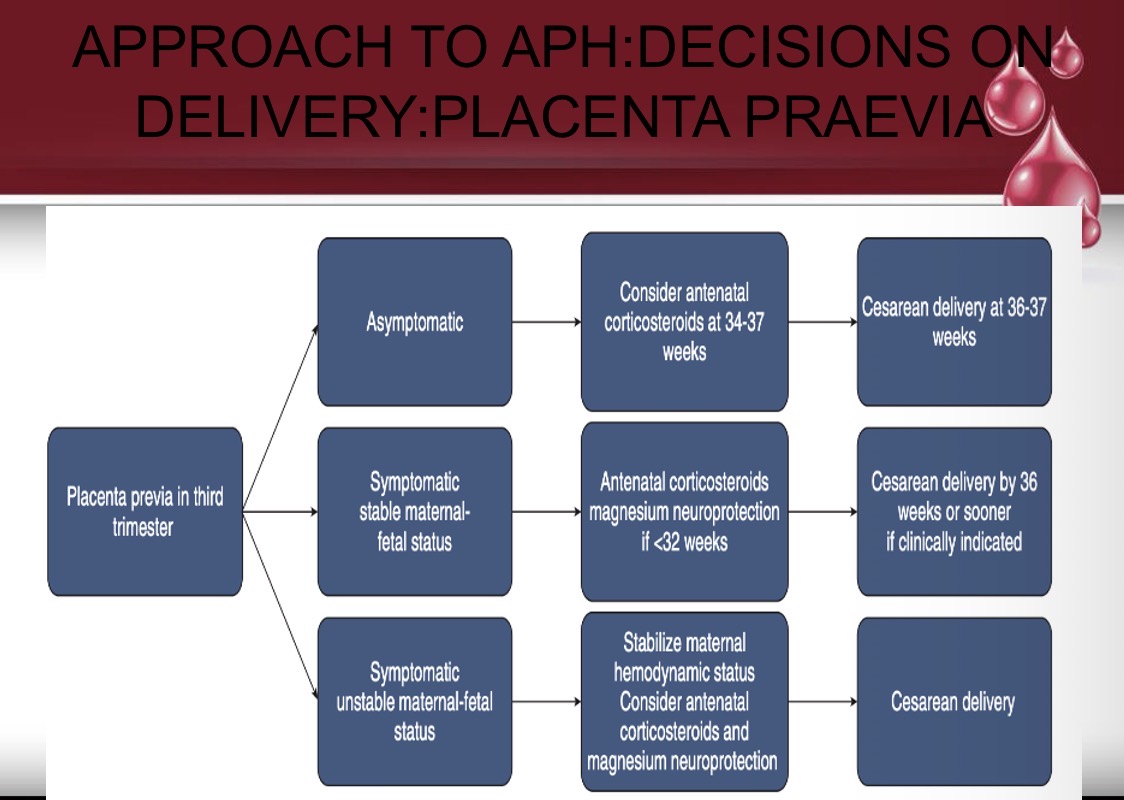
Approach on delivery of placenta praevia
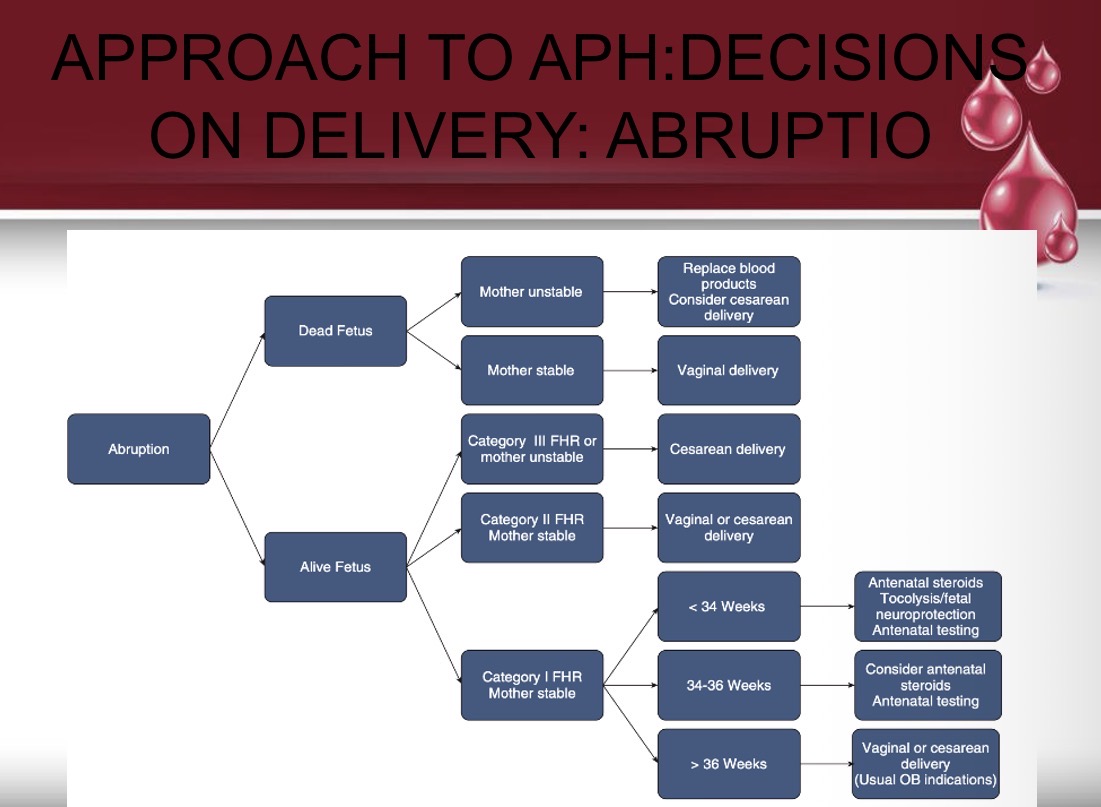
Approach on delivery of abruptio
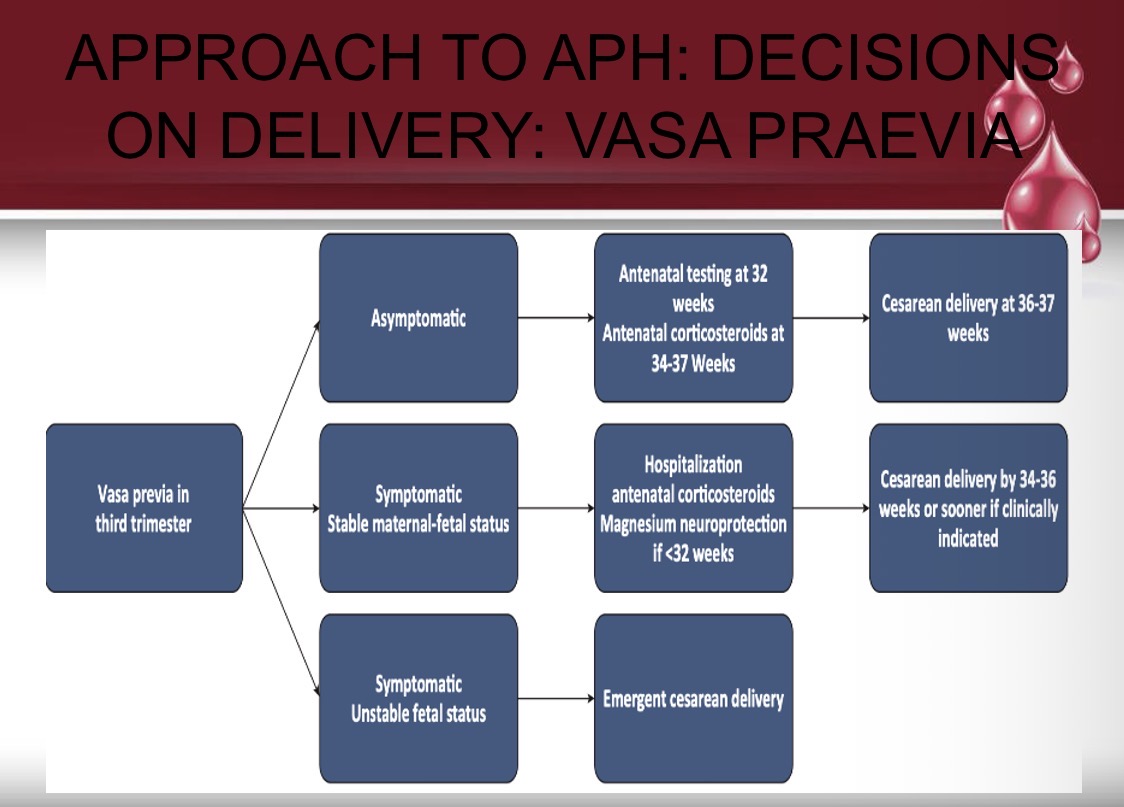
Approach on delivery of vasa praevia
What are the 4 main components of the approach to maternal resuscitation?
Communication > midwife, anaesthetic, obstetrician, neonatologist
Resuscitation > ABCDE
Monitoring and investigations > Continuous check ups
Arrest the bleeding > 4Ts
When should a single dose of steroids be given to mothers and why?
When there’s a risk of iatrogenic / spontaneous PTB <34 weeks to reduce the risk of respiratory distress syndrome & neonatal deaths