CAns Chap 1-5B
 Call Kai
 Learn
Learn Practice Test
 Spaced Repetition
 Match
Match Flashcards
 Knowt Play
1/17

There's no tags or description
Looks like no tags are added yet.
Name | Mastery | Learn | Test | Matching | Spaced | Call with Kai | Chat |
|---|
No analytics yet
Send a link to your students to track their progress
18 Terms
60.0g of ethanoic acid contains 2 mol of ions true/false?
60.0g of ethanoic acid contains 2 mol of ions WRONG
Ethanoic acid is weak acid -> [H+] will be less than 1 mol -> number of moles of ions less than 2!
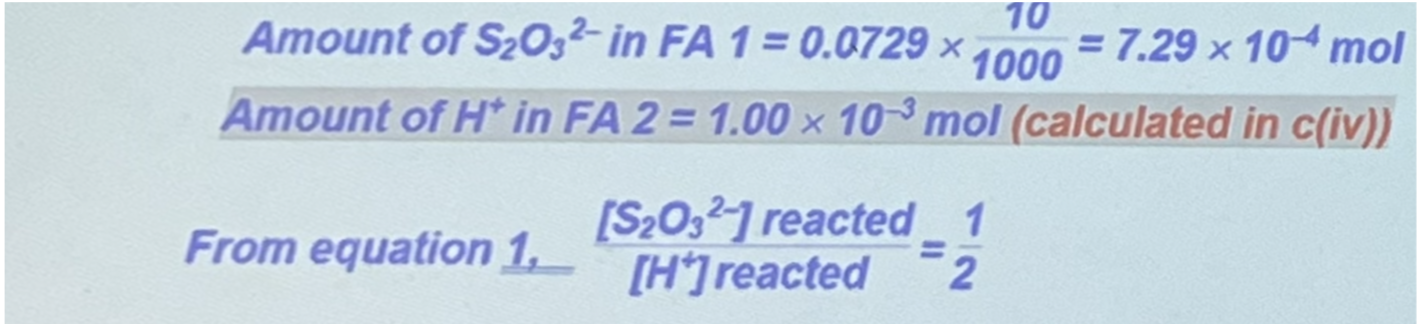
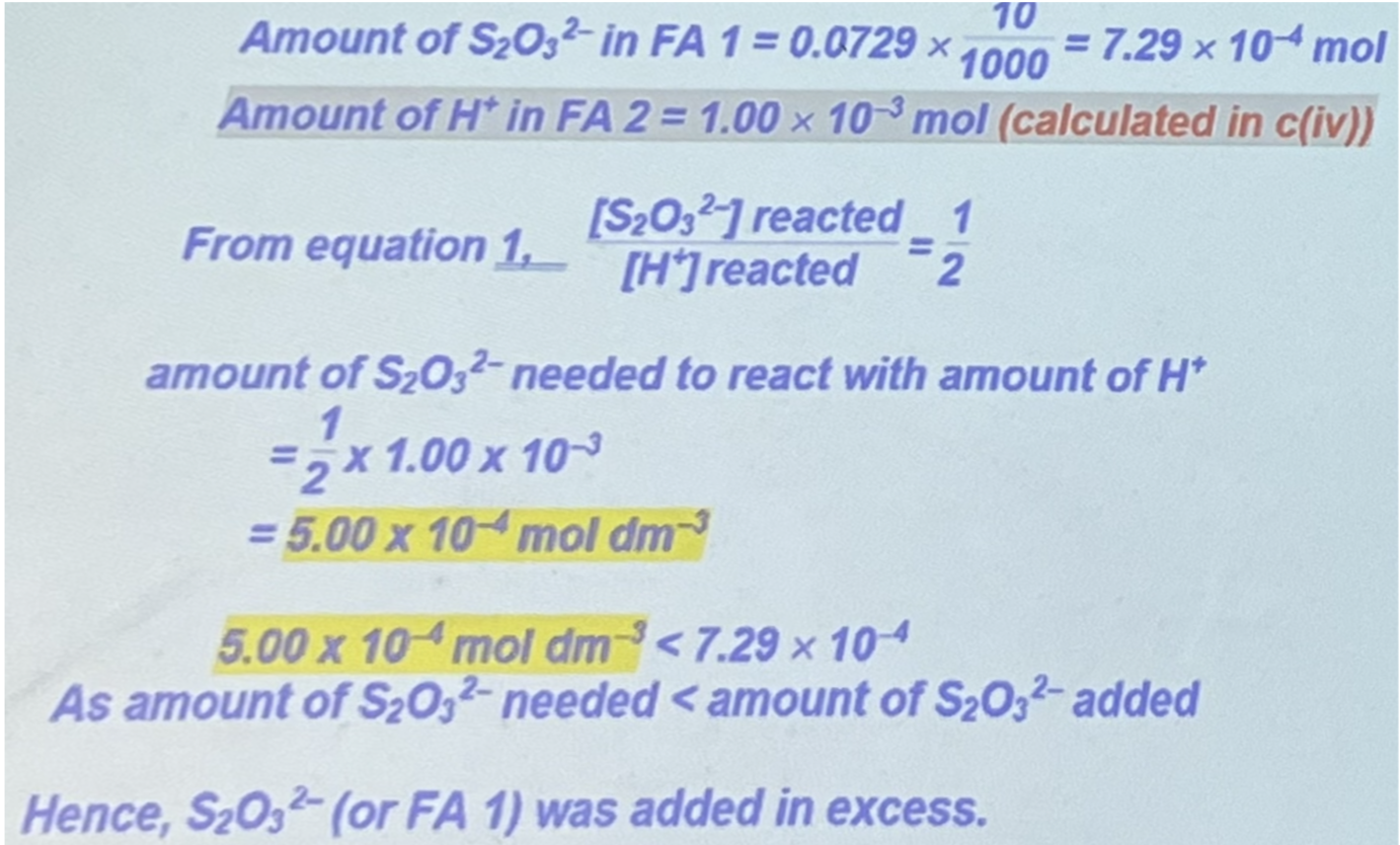
Determine which reagent is in excess answering
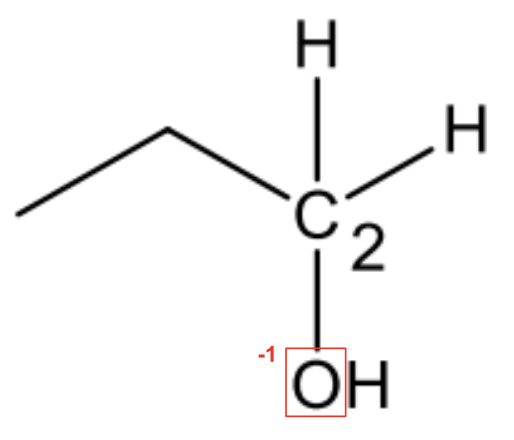
State OS of C2
OS C2: -1
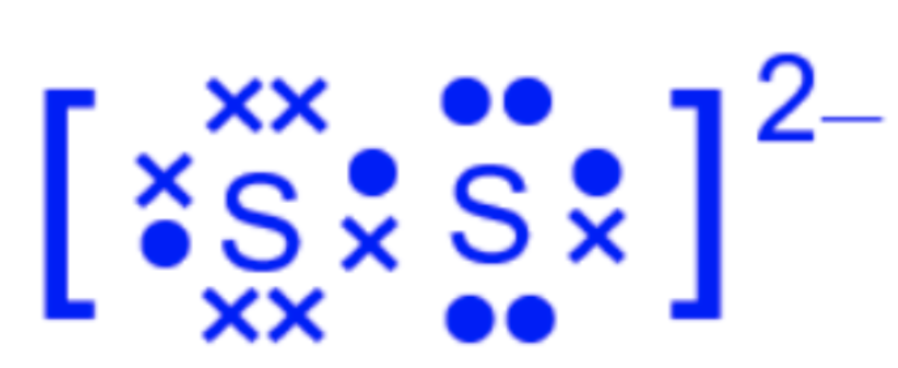
Draw Disulfide ion
Disulfide ion = S2^2-
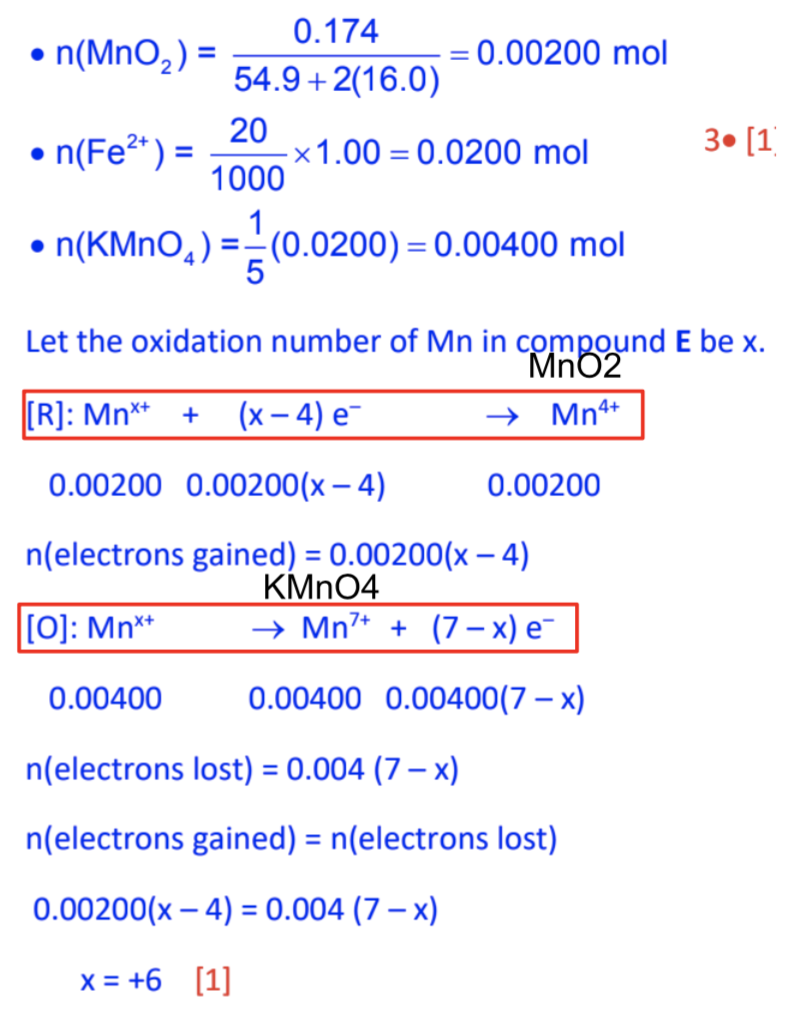
Heating a mixture of MnO2 and KOH with oxygen from the air produces a green compound, E.
On treatment with dilute acid, a sample of compound E reforms 0.174 g of MnO2 and a purple solution of KMnO4
Purple KMnO4 is decolourised by the addition of 20.00 cm3 of 1.00 mol dm–3 iron(II) sulfate
Calculate the oxidation number of manganese in compound E
Shielding effect = inner shell electrons only!
Eg. Explain why the atomic radius of magnesium and sulfur are different.
S: 1s22s22p63s23p4, Mg: 1s22s22p63s2
Shielding effect = inner shell electrons only!
Eg. Explain why the atomic radius of magnesium and sulfur are different.
S: 1s22s22p63s23p4, Mg: 1s22s22p63s2
S has the same number of inner shell electrons as Mg = same shielding effect
S has higher nuclear charge -> greater effective nuclear charge -> S has a smaller atomic radius than Mg
Compare Se electronegativity with O
Compare Se electronegativity with O
Se has larger atomic radius than O -> distance between shared pair of electrons in the covalent bond and nucleus in Se is greater -> weaker electrostatic force of attraction -> harder to draw electrons to itself -> electronegativity of Se less than O
Ion-dipole interactions > hydrogen bonding > pd-pd > dipole induced dipole
Deflection of liquid towards electrostatically charged rod = POLAR molecules
sp2 hybridised: 3 sigma, 1 pi bond
Explain, in terms of structure and bonding, the differences in boiling points (CO, NO, BrF)
Explain, in terms of structure and bonding, the differences in boiling points
CO, NO and BrF are covalent compounds with simple molecular structures consisting of discrete molecules held together by id-id and pd-pd interactions (NOT IMFs)
Explain why N does not form NOCI3 with similar structure as POCI3
Explain why N does not form NOCI3 with similar structure as POCI3
Nitrogen is in Period 2
Nitrogen does not have energetically accessible vacant d orbitals to expand its octet structure
Predict the nature of bonding in Ba (barium) and B (boron) compounds using IE
Predict the nature of bonding in Ba (barium) and B (boron) compounds using IE
To form B3+: I.E. = 799 + 2420 + 3660 = 6879 kJ mol-1
To form Ba: I.E. = 502 + 966 = 1468 kJ mol-1.
B tends to form covalent compounds as IE is very high compared to Ba which tends to form ionic compounds since IE is much lower
Suggest reasons why MgF does not react with F2 to give MgF
Suggest reasons why MgF does not react with F2 to give MgF
Too much IE is required to form Mg4+ and it is unlikely to form 4 covalent bonds with only two valence electrons in Mg
State effect of IMF on vapour pressure
Vapour pressure: pressure exerted by vapour molecules
Stronger IMFs → less molecules escape → lower vapour pressure
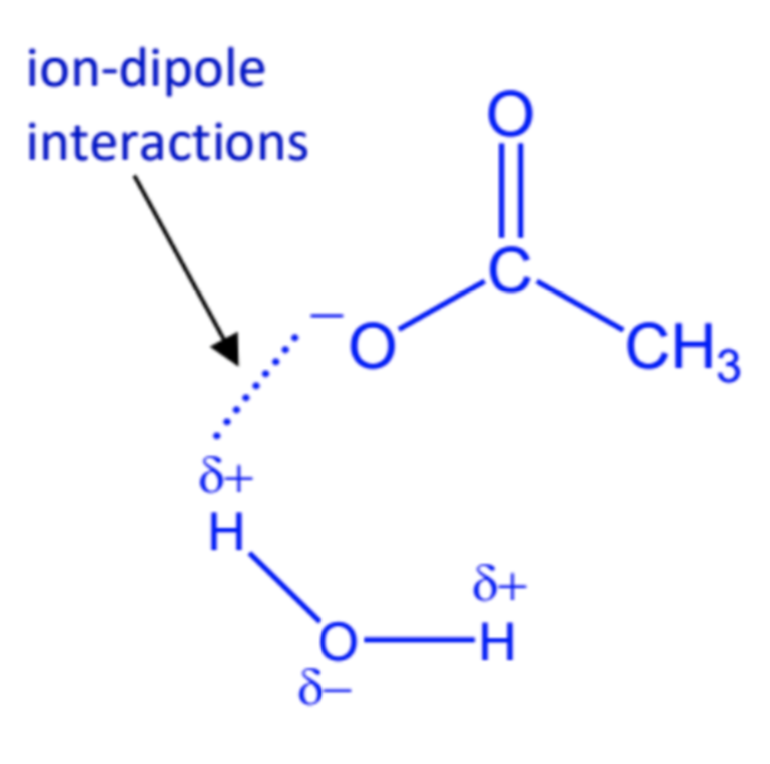
Draw Ion-dipole interactions
Give 2 reasons why the decomposition of ammonium nitrate is explosive
Give 2 reasons why the decomposition of ammonium nitrate is explosive
Enthalpy change of decomposition is highly exothermic -> lot of heat given out
The products are gaseous -> great expansion of volume

RMR clockwise, anticlockwise (not direction of arrow pls)
When using formula, STATE formula!
Explain why the decomposition of methanoic acid vapour is likely reversible
Explain why the decomposition of methanoic acid vapour is likely reversible
Ea of both the forward and backward reactions do not differ very much
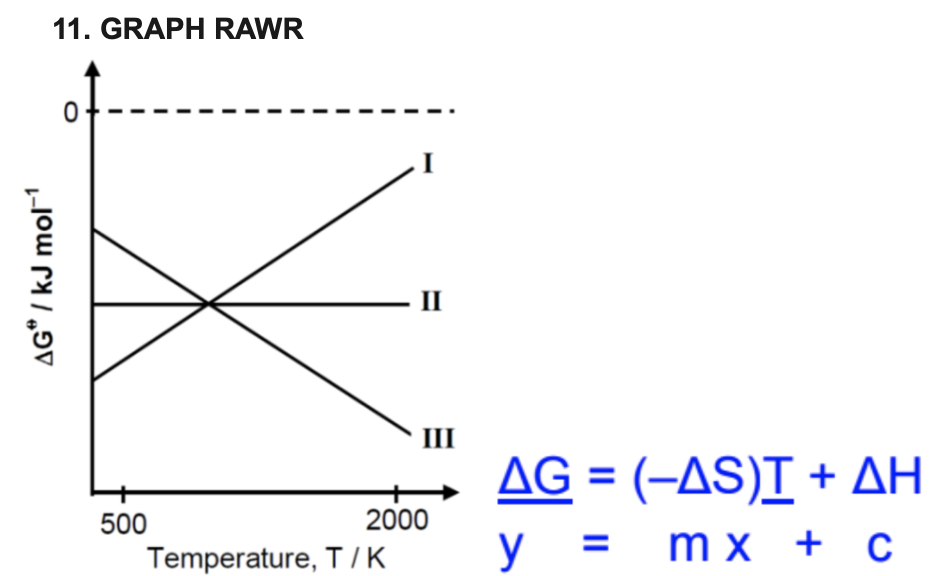
When the pack is squeezed, ammonium nitrate dissolves in the water -> G is -ve! (IK H and S are +ve but read pls)
If question never say temperature, use G standard condition (25C, 298K)