Chemistry Term 1
0.0(0)
Studied by 6 people View linked note
 Call Kai
 Learn
Learn Practice Test
 Spaced Repetition
 Match
Match Flashcards
 Knowt Play
Card Sorting
1/66

Earn XP
Description and Tags
Last updated 9:41 AM on 9/11/22
Name | Mastery | Learn | Test | Matching | Spaced | Call with Kai | Chat |
|---|
No analytics yet
Send a link to your students to track their progress
67 Terms
1
New cards
Chemistry
- The study of matter
- the chemical composition and properties of a substance or object
- the chemical composition and properties of a substance or object
2
New cards
Matter
- Anything that has mass/volume.
- Anything that takes up space.
- Anything that takes up space.
3
New cards
Branches of Chemistry
- Inorganic chemistry - Properties, structures, inorganic compositions.
- Organic chemistry - Properties, structures, organic compositions.
- Analytical chemistry - Calculations and specifications of matter.
- Physical chemistry - Different processes in chemistry.
- Mechanisms, rate, energy, transfer.
- Biochemistry - Animals, plants, etc. (More on biology).
- Organic chemistry - Properties, structures, organic compositions.
- Analytical chemistry - Calculations and specifications of matter.
- Physical chemistry - Different processes in chemistry.
- Mechanisms, rate, energy, transfer.
- Biochemistry - Animals, plants, etc. (More on biology).
4
New cards
Composition
identity and number of the chemical elements that make up any particular compound
5
New cards
Pure substance
Matter with a definite composition
- Melts and Boil at a definite temperature
Ex: H2o
- Melts and Boil at a definite temperature
Ex: H2o
6
New cards
Effects of impurities
affects the value of the melting or boiling point of a substance
7
New cards
Elements
the simplest form of matter that cannot be broken down.
8
New cards
Compounds
chemically bounded group (Two or more) of atoms or elements.
9
New cards
Mixture
- varying composition
- not chemically combined
- can be separated using different techniques
- keep their identity
Ex: Milo in water - can taste still taste milo
- not chemically combined
- can be separated using different techniques
- keep their identity
Ex: Milo in water - can taste still taste milo
10
New cards
Physical change
A change in shape or appearance
Ex: Crumpling paper
Ex: Crumpling paper
11
New cards
Chemical change
Producing a new substance
Ex: Burning paper -> ashes
Ex: Burning paper -> ashes
12
New cards
Metals
Ex: Iron, gold
13
New cards
Non-metals
Ex: Carbon
14
New cards
Metalloids
Ex: Silicon
15
New cards
Diatomic element
Two atoms combined when you see them in nature.
Ex: Hydrogen H2, Nitrogen N2, Oxygen O2
Ex: Hydrogen H2, Nitrogen N2, Oxygen O2
16
New cards
Democritus
- first to hypothesize that matter could be divided.
- Atoms are indivisible and indestructible particles that make up matter.
- Atoms of the same elements are exactly alike and the same is for the opposite.
- Compounds are formed by the joining of atoms of two or more elements.
- Atoms are indivisible and indestructible particles that make up matter.
- Atoms of the same elements are exactly alike and the same is for the opposite.
- Compounds are formed by the joining of atoms of two or more elements.
17
New cards
3 states of matter
- Solid
- Liquid
- Gas
- Liquid
- Gas
18
New cards
room temperature
25°C
19
New cards
The difference between all three states
particle model
20
New cards
What are substances made up of?
particles
21
New cards
Particles that move around posses what?
Kinetic Energy
22
New cards
How does kinetic energy increases?
Increases with temperature
23
New cards
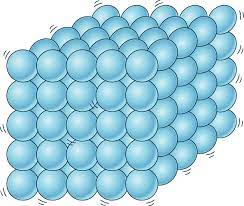
Particles in a solid - animation
move by vibrations because of low kinetic energy and strong attraction.
24
New cards
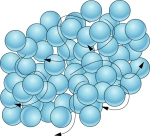
Particles in a liquid - animation
Particles in a liquid move by sliding into another because of moderate kinetic energy and moderate attraction.
25
New cards
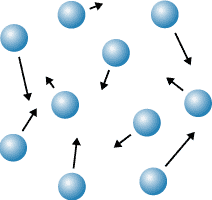
Particles in a gas - animation
Particles in a gas move by spreading apart because of high kinetic energy and almost no attraction.
26
New cards
Colloids
Mixtures of two or more substances can lead to an overlap between the three states
27
New cards
What happens when particles flow?
mix with other substances already present.
28
New cards
Properties of solid
- Fixed volume
- High density
- Not compressible
- Has definite shape—lattice
- Does not flow
- High density
- Not compressible
- Has definite shape—lattice
- Does not flow
29
New cards
Properties of liquid
- Fixed volume
- Moderate density
- Not compressible
- No definite shape
- Flows easily
- Moderate density
- Not compressible
- No definite shape
- Flows easily
30
New cards
Properties of gas
- No fixed volume
- Low density
- No definite shape
- Flows easily
- Compressible
- Can cause pressure
- Low density
- No definite shape
- Flows easily
- Compressible
- Can cause pressure
31
New cards
Gas to Liquid
Condensation
32
New cards
Liquid to gas
Evaporation
33
New cards
Solid to gas
Sublimation
34
New cards
Gas to solid
Deposition
35
New cards
Solid to liquid
Melting
36
New cards
Liquid to solid
Freezing
37
New cards
volatility
the property of how easily a liquid evaporates
38
New cards
Brownian Motion
- Random motion
- Higher concentration to lower concentration
- Higher concentration to lower concentration
39
New cards
placement of time in a heating and cooling curve
Bottom
40
New cards
↗
increase
41
New cards
↙
decrease
42
New cards
—
- static
- constant
The melting and boiling points can have a constant temperature and in that constant temperature, kinetic energy helps the attraction start breaking down.
- constant
The melting and boiling points can have a constant temperature and in that constant temperature, kinetic energy helps the attraction start breaking down.
43
New cards
Diffusion
movement in particles that allows them to spread out & mix with other particles
44
New cards
Rate of diffusion depends on?
the mass
- Big mass = rate of diffusion slower
- Small mass = rate of diffusion faster
- Big mass = rate of diffusion slower
- Small mass = rate of diffusion faster
45
New cards
Solution
formed when a substance (solute) dissolves into another substance (solvent)
46
New cards
solute
the dissolved matter in a solution; the component of a solution that changes its state
47
New cards
solvent
a liquid substance capable of dissolving other substances
48
New cards
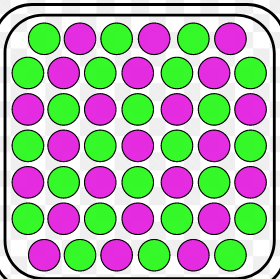
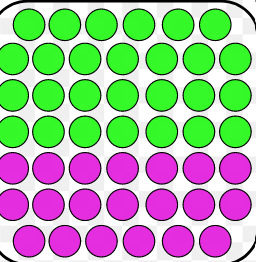
Homogeneous
- single phase
- evenly distributed particles - no lumps
- Ex: juice
- evenly distributed particles - no lumps
- Ex: juice
49
New cards
heterogeneous
- 2 or more phase
- not uniform distribution
- Ex: cereal & milk
- not uniform distribution
- Ex: cereal & milk
50
New cards
dissolving
separate and spread evenly
51
New cards
soluble
will dissolve
52
New cards
insoluble
will not dissolve
53
New cards
aqueous solution
a solution in water
universal solution
universal solution
54
New cards
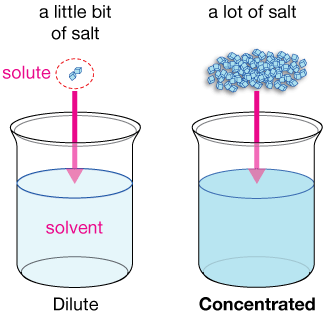
concentration
amount of solute dissolved in solvent
55
New cards
qualitative
Dilute & Concentrated
56
New cards
Dilute
- less solute
- lessen the strength or flavor of a solution or mixture
- lessen the strength or flavor of a solution or mixture
57
New cards
Concentrated
- more solute
- intensely focused
- intensely focused
58
New cards
quantitative
Solubility, Saturated, unsaturated, supersaturated
59
New cards
solubility
how much of solute can dissolve in solvent in a particular temperature
60
New cards
saturated
maximum solute dissolved
61
New cards
unsaturated
not saturated; capable of dissolving more of a substance at a given temperature
62
New cards
supersaturated
- more than max solute is dissolved
- can only be made with heat
- can only be made with heat
63
New cards
How to speed up dissolving
- Mixing - stirring or shaking
- Heating - causes particles to move more quickly and separate (can't be applied to gases)
- Crushing - increase the amount of contact between solute & solvent
- Heating - causes particles to move more quickly and separate (can't be applied to gases)
- Crushing - increase the amount of contact between solute & solvent
64
New cards
Gasoline
solution that is not a aqueous
doesn't have water
doesn't have water
65
New cards
Brass, Steel
solid solution
66
New cards
suspension
a moisture where particles are mixed in a solvent but do not dissolve because they are large
ex: Blood, inside of a Snow globe
ex: Blood, inside of a Snow globe
67
New cards
colloid
Mixtures of two or more substances can lead to an overlap between the three states.
- particles are smaller than in suspension
Ex: Slime, Ice
- particles are smaller than in suspension
Ex: Slime, Ice