UA/BF Study Question
 Call Kai
 Learn
Learn Practice Test
 Spaced Repetition
 Match
Match Flashcards
 Knowt Play
1/166

There's no tags or description
Looks like no tags are added yet.
Name | Mastery | Learn | Test | Matching | Spaced | Call with Kai | Chat |
|---|
No analytics yet
Send a link to your students to track their progress
167 Terms
Urine collected at any time without prior patient preparation
random specimen
The first voided urine specimen collected immediately upon arising; recommended screening specimen
morning specimen
Specimen collected in a sterile container after cleansing the glans penis or urinary meatus; the first portion of urine is voided into the toilet, The midportion is collected, and the remaining portion is voided into the toilet
midstream clean-catch specimen
The technique used to obtain sterile urine specimens for bacterial culture or cytological examination in which a sterile needle is introduced through the abdomen into the bladder
suprapubic aspiration
A urine specimen collected by passing a sterile tube into the bladder
a catheterized urine specimen
Why is a midstream clean-catch urine specimen preferred for culture
It minimizes contamination from the urethra and external genitalia, providing a more accurate assessment of the urinary tract's microbial environment.
How long can a urine specimen be stored at room temperature before analysis?
2 hours
What happens to Nitrite levels when urine stands at room temperature?
Increases (Cause: Bacterial growth)
What happens to pH when urine stands at room temperature?
Increases (Cause: Ammonia production from urea breakdown)
What happens to Turbidity when urine stands at room temperature?
Increases (Cause: Bacterial growth and precipitation of crystals)
What happens to Glucose levels when urine stands at room temperature?
Decreases (Cause: Bacterial consumption of glucose)
What happens to Ketone levels when urine stands at room temperature?
Decreases (Cause: Volatilization/evaporation)
What happens to Bilirubin levels when urine stands at room temperature?
Decreases (Cause: Photo-oxidation and light exposure)
What happens to Urobilinogen levels when urine stands at room temperature?
Decreases (Cause: Oxidation and exposure to air)
What happens to Cells and Casts when urine stands at room temperature?
Decreases (Cause: Sedimentation and deterioration)
Describe the proper procedure for labeling a urine specimen
A urine specimen should be labeled with the patient's name, identification number, date, time of collection, and type of specimen (e.g., random, 24-hour).
What is the purpose of Boric Acid as a 24-hour urine preservative?
Maintains pH and inhibits bacterial growth (commonly used for protein and culture transport).
What is the purpose of Sodium Fluoride as a 24-hour urine preservative?
Inhibits glycolysis and preserves glucose levels during collection.
What is the most common non-chemical preservation method used during a 24-hour urine collection?
Refrigeration, to prevent bacterial overgrowth and degradation of urine constituents.
What is the importance of time-marked containers in 24-hour urine tests?
Time-marked containers ensure accurate measurement of urine volumes collected over the 24-hour period, which is crucial for the reliability of test results.
What physical change often occurs when urine is refrigerated?
Precipitation of amorphous urates (in acidic urine) and amorphous phosphates (in alkaline urine), which causes false turbidity.
How does cold urine affect chemical reagent strip (dipstick) testing?
Cold temperatures slow down enzymatic reactions on the test pads, potentially causing false-negative results.
What crucial step must be taken before testing a refrigerated urine specimen?
The urine specimen must be brought to room temperature to ensure accurate test results.
What errors may occur if urine is not mixed before analysis?
Errors in test results, such as inaccurate concentrations and missed sediment.
Which type of urine specimen is best for detecting early pregnancy?
A first morning urine specimen is best for detecting early pregnancy, as it is more concentrated and contains higher levels of human chorionic gonadotropin (hCG).
What parameters are included in the physical examination of urine?
Parameters include color, clarity, odor, and specific gravity
What substances indicate a Red urine color?
Hemoglobin, Red Blood Cells, Myoglobin, Uroerythrin
What substances indicate a Red-Brown urine color?
Myoglobin, Hemoglobin, Methemoglobin
What substances indicate a Yellow-Brown / Amber / Yellow-Green urine color?
Bilirubin, urobilin, concentrated urine
What substance frequently causes a Bright Yellow urine color?
Vitamin C
What does a Dark Yellow urine color indicate?
Concentrated Specimen, Bilirubin, Urobilin
What conditions or substances indicate a Brown-Black urine color?
Methemoglobin (oxidized RBCs), Homogentisic Acid (Alkaptonuria), Melanin
What condition causes a Blue urine color?
Indican (Tryptophane Metabolic Disorder)
What typically causes a Green / Blue-Green urine color?
Old Urine, Pseudomonas infection
What substance causes a Port Wine urine color?
Porphyrins (Porphyria)
What is the clinical significance of cloudy urine?
Cloudy urine may indicate the presence of various substances such as pus, bacteria, or crystals, suggesting urinary tract infections, kidney stones, or other underlying issues.
What is the definition of urine specific gravity?
he ratio of the weight of a volume of urine to the weight of the same volume of distilled water.
What does specific gravity actually measure in a clinical sense?
The density of the urine, which reflects the kidneys' ability to concentrate or dilute the specimen.
What value is considered a high specific gravity, and what does it indicate?
value greater than 1.030, which indicates concentrated urine.
What are four common causes of a high specific gravity?
1. Dehydration (vomiting, diarrhea, low fluid intake)
2. Diabetes mellitus (due to glucose)
3. Proteinuria
4. Radiographic contrast media (medical imaging dye)
How does refrigeration affect the clarity of a urine specimen?
It causes amorphous urates or amorphous phosphates to precipitate, making the urine look cloudy.
How does refrigeration affect the specific gravity of urine?
It may cause a falsely high reading if measured with a hydrometer while the urine is still cold.
What happens to the clarity of a urine specimen left at room temperature for a prolonged period?
It becomes cloudy due to bacterial growth and the precipitation of crystals.
What happens to the color of a urine specimen left at room temperature for a prolonged period?
It may darken or change color due to the oxidation or reduction of metabolites (e.g., bilirubin breaking down).
What happens to the odor of a urine specimen left at room temperature for a prolonged period?
It develops a strong ammonia smell as bacteria convert urea to ammonia.
What is the reaction principle for pH on a urine reagent strip?
2 Indicators provide a wide spectrum of color changes.
What is the reaction principle for Protein on a urine reagent strip?
Protein error of indicators (pH of strip = 3.5; Dye changes color of the strip).
What is the reaction principle for Glucose on a urine reagent strip?
Glucose oxidase method (Double sequential enzyme)
What is the reaction principle for Ketones on a urine reagent strip?
Sodium nitroprusside + ketones = purple color.
What is the reaction principle for Blood on a urine reagent strip?
2-step enzymatic procedure, peroxidase.
What is the reaction principle for Bilirubin on a urine reagent strip?
Diazonium salt + Bilirubin = bluish/purple color.
What is the reaction principle for Urobilinogen on a urine reagent strip?
Ehrlich's reaction (P-dimethylaminobenzaldehyde + Urobilinogen = peach to pink color).
What is the reaction principle for Nitrite on a urine reagent strip?
Diazo reaction forms a diazonium compound.
What is the reaction principle for Leukocytes on a urine reagent strip?
Leukocyte esterase splits an ester to form a pyrrole compound.
What is the reaction principle for Specific Gravity on a urine reagent strip?
pKa change of a polyelectrolyte.
Which substances are commonly tested in the chemical examination of urine?
1. Protein
2. Glucose
3. Blood
4. Bilirubin
5. Ketones
6. Urobilinogen
7. Leukocytes
8. Nitrites
What does a positive leukocyte esterase test indicate?
The presence of white blood cells in urine, suggesting a urinary tract infection or inflammation.
What specific protein is most often and most easily identified by a urine reagent strip (dipstick)?
Albumin
How does Renal Disease cause proteinuria?
Through glomerular or tubular damage in the kidneys.
How does Multiple Myeloma cause proteinuria?
Through the production and excretion of Bence-Jones proteins.
What is Orthostatic Proteinuria?
Proteinuria that is triggered by standing or an upright posture (and absent when lying down).
How can Strenuous Exercise affect urine protein levels?
It can cause temporary, stress-induced proteinuria.
How are reducing sugars identified in urine?
Using the Clinitest (copper reduction test).
What is the clinical significance of finding ketones in urine?
t indicates conditions such as Diabetes Mellitus (Ketoacidosis), starvation or low-carb dieting, strenuous exercise, or severe vomiting.
What is the confirmatory test for ketones in urine?
Acetest
What is the confirmatory test for bilirubin in urine?
Ictotest
What is the clinical significance of a positive nitrite test in urine?
It signifies a Urinary Tract Infection (UTI) caused by nitrate-reducing bacteria
What conditions or dietary factors may result in acidic urine?
Metabolic or respiratory acidosis
High protein diet
Cranberry juice
What conditions or factors may result in alkaline urine?
Infection
High vegetable diet
Old urine
Alkaline tide
What pH range is considered normal for urine?
between 4.5 and 8.0
What frequently causes a false-positive result for protein on reagent strips?
Highly alkaline urine
How can ascorbic acid (Vitamin C) interfere with chemical urinalysis results?
It can cause false-negative results for glucose, blood, bilirubin, and nitrites.
What is the clinical significance of hematuria (intact red blood cells in urine)?
It may indicate problems anywhere in the urinary tract, including the kidneys, ureters, bladder, or urethra.
What is the definition and physical appearance of Hematuria?
Definition: Intact red blood cells (RBCs) in the urine.
Appearance: Cloudy or smoky red; intact RBCs are visible on a microscopic exam.
What are the common causes of Hematuria?
UTIs, kidney stones, trauma, glomerulonephritis, and tumors.
What is the definition and physical appearance of Hemoglobinuria?
Definition: Free hemoglobin in the urine from RBC destruction.
Appearance: Clear red or reddish-brown; NO intact RBCs seen microscopically.
What are the common causes of Hemoglobinuria?
Hemolytic anemia, transfusion reactions, severe burns, and malaria.
What is the definition and physical appearance of Myoglobinuria?
Myoglobin from muscle breakdown present in the urine.
What are the common causes of Myoglobinuria?
Muscle injury, rhabdomyolysis, crush injuries, and intense exercise.
Why do hematuria, hemoglobinuria, and myoglobinuria all cause a positive chemical blood test on a dipstick?
he dipstick pad reacts positively to the hemoglobin inside intact RBCs, free hemoglobin in the urine, AND myoglobin (which chemically reacts just like hemoglobin).
What does the presence of (or increase in) urobilinogen in urine suggest?
It suggests increased bilirubin production, often due to liver disease or hemolysis.
In Bile Duct Obstruction (biliary obstruction), what are the expected results for urine Bilirubin?
Positive / Increased. (Conjugated bilirubin cannot enter the intestines, so it backs up into the blood and is excreted by the kidneys).
In Bile Duct Obstruction, what are the expected results for urine Urobilinogen?
Decreased / Absent. (Since bilirubin cannot reach the intestines, no urobilinogen is formed.
If a patient has a positive urine Bilirubin but absent Urobilinogen, what condition does this strongly suggest?
Bile duct obstruction.
If a patient has a negative urine Bilirubin but highly increased Urobilinogen, what condition does this strongly suggest?
Hemolytic disease.
What are the common elements observed in urine microscopy?
Common elements include red blood cells, white blood cells, epithelial cells, bacteria, crystals, and casts.
Describe the appearance of red blood cells in urine under the microscope
Red blood cells appear as small round pale yellow to red discs without a nucleus.
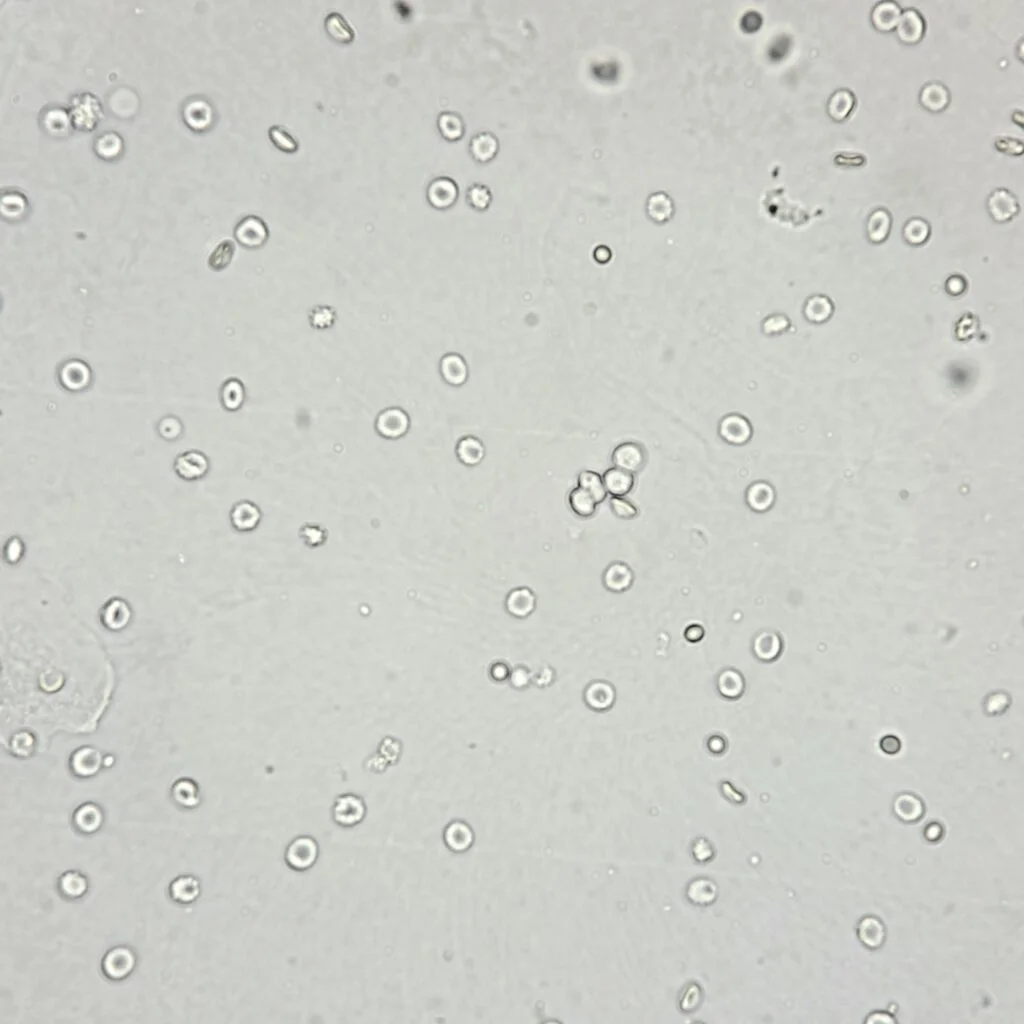
What is the significance of seeing white blood cells in urine?
The presence of white blood cells in urine often indicates inflammation or infection in the urinary tract, such as urinary tract infections (UTIs), interstitial nephritis, or other kidney conditions.
What type of epithelial cells is most significant when seen in urine?
The most significant type of epithelial cells in urine are renal tubular epithelial cells, which can indicate kidney damage or disease when present.
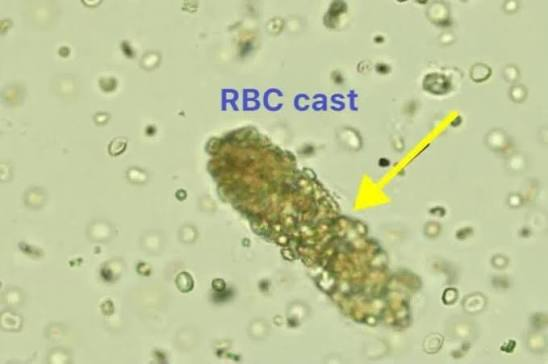
Which specific type of cast is the hallmark finding in Acute Glomerulonephritis?
Red Blood Cell (RBC) casts (indicates bleeding within the nephron).
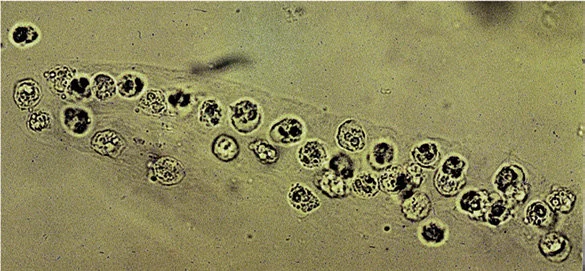
Which specific type of cast is the hallmark finding in Acute Pyelonephritis (kidney infection) and AIN?
White Blood Cell (WBC) casts (indicates inflammation or infection in the nephron).
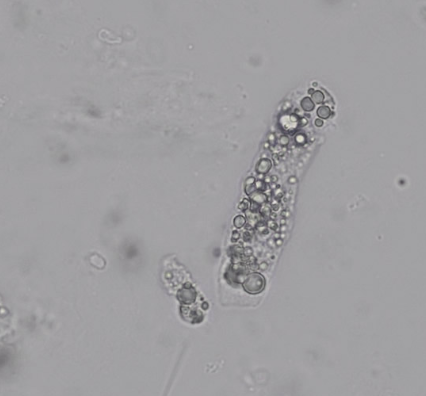
Which specific type of cast is the hallmark finding in Nephrotic Syndrome?
Fatty casts (along with highly elevated protein and oval fat bodies).
Which casts are typically seen in Cystitis / Lower UTI?
No specific casts are typically identified in cystitis, as it primarily affects the bladder.
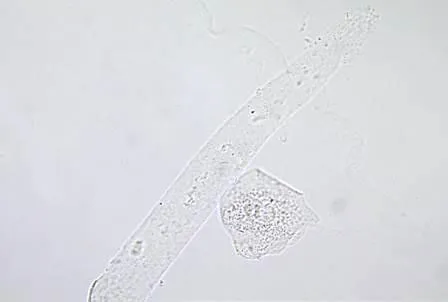
What non-pathological (normal) conditions can cause an increase in Hyaline casts?
Strenuous exercise, dehydration, heat exposure, and emotional stress.
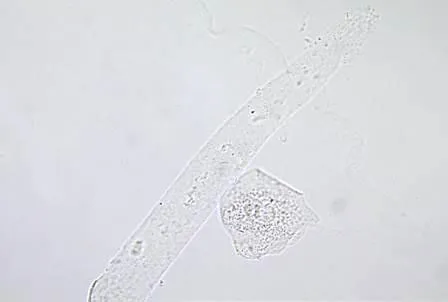
What pathological (abnormal) conditions are associated with increased Hyaline casts?
Acute glomerulonephritis, pyelonephritis, chronic renal disease, and congestive heart failure.
What is the clinical significance of Waxy casts?
They indicate extreme, localized urine stasis in the kidneys. They are most frequently associated with severe chronic renal disease and are often called "renal failure casts."
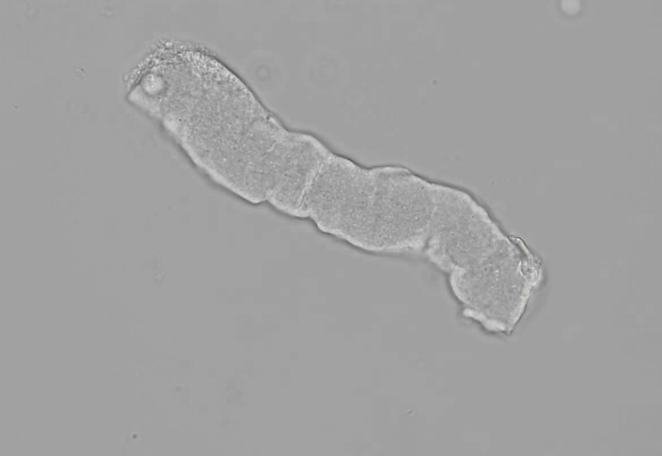
What is the clinical significance of finding Granular casts?
They can be non-pathological (following strenuous exercise) or pathological, indicating significant renal disease like acute tubular necrosis or glomerulonephritis.
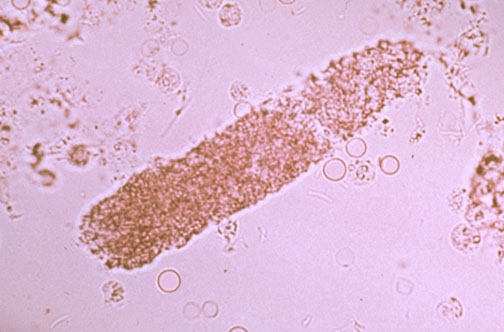
What is the physical appearance of Hyaline casts?
They are clear, colorless, and have smooth borders.
What is the physical appearance of Granular casts compared to hyaline casts?
They are more opaque and contain coarse or fine granules.
What are Hyaline casts primarily made of?
They are primarily composed of Tamm-Horsfall protein, which is secreted by renal tubules.