1.3 Distribution & Excretion
 Call Kai
 Learn
Learn Practice Test
 Spaced Repetition
 Match
Match Flashcards
 Knowt Play
1/25

There's no tags or description
Looks like no tags are added yet.
Name | Mastery | Learn | Test | Matching | Spaced | Call with Kai | Chat |
|---|
No analytics yet
Send a link to your students to track their progress
26 Terms
passive transport
high → low; facilitates (protein transporters, channels)
active transport
low → high; primary active (ATP)
-symport and antiport
absorption variability
F: bioavailability
Ka: absorption rate constant

age effects on drug absorption
reduction in gastric acid & pepsin, reduced intestinal bloodflow
food can alter bioavailability
delay gastric emptying, stimulate bile flow, change GI pH, increase blood flow to large organs (splanchnic)
-affects absorption
food effect example (eythromycin)
do not take food
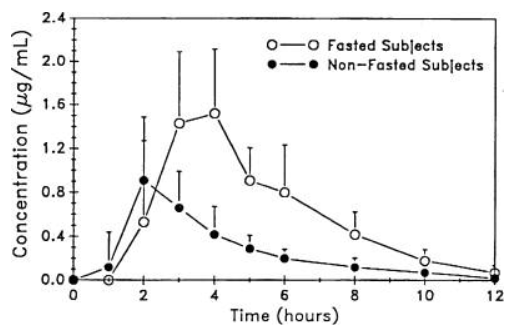
food and disease effect on controlled release budesonide

absorption enterocyte permeability
transcellular: carrier-mediated & passive lipoidal diffusion
paracellular: passive diffusion
first pass effect
goes through GI, absorbed in portal vein, nutrients go through liver (either metabolized or put into circulation)
-amount in circulation = bioavailability

drug distribution
dose → central compartment (blood, liver, kidney) ⇌ peripheral component (fatty tissue) → elimination
distribution tissues
fatty tissue, proteins, highly vs less perfused, CNS, placenta, muscle, specific organs
hydrostatic pressure
difference in pressure between arterial & venous capillary blood
-responsible for movement of water-soluble drugs into spaces between endothelial cells (and possibly lymph)
rate of diffusion
D = diffusion coefficient (cm2/s)
A = surface area of membrane (cm2)
K = partition coefficient (drug’s lipid solubility)
C1-C2 = concentration difference across membrane
h = membrane thickness (cm)

larger A
more absorption surface
higher K
more lipophilic drugs cross membrane more easily
diffusion of drug from capillaries to interstitial spaces
blood plasma, interstitial & lymph fluids, tissues, and other body water
highly perfused
heart, brain, kidney, endocrine glands, skin, muscle, fat, marrow
slowly perfused
bone, ligaments, tendons, cartilage, teeth, hair
major water volumes in a 70 kg human
blood (4.5-5 L) → plasma (3 L) + blood cells (2 L)
-extracellular water (15 L) → plasma (3 L) + interstitial water (12 L)
-intracellular water (27 L)
CNS
brain, cerebrospinal fluid, blood brain barrier (least permeable capillaries)
-brain + choroid plexus have tight junctions
placenta
fetus is exposed to all drugs taken by mother
placental drug transporters
BCRP (breast cancer resistance protein)
MDR (multidrug resistance protein)
MRP (multidrug resistance-associated protein)
NET (noradrenaline transporter)
OAT (organic anion transporter)
OATP (organic anion-transporting polypeptide)
OCTN (novel organic cation transporter)
SER (serotonin transporter)
protein binding
drug can circulate in plasma in a free state, or bound to plasma proteins; usually reversible
-albumin carries acidic drugs, α-1-acid glycoprotein carries basic drugs
apparent volume of distribution (VD)
CP = D/VD
relationship between dose given & concentration from central compartment
distribution and elimination phases
CP = Ae-αt (distribution) + Be-ßt (elimination)
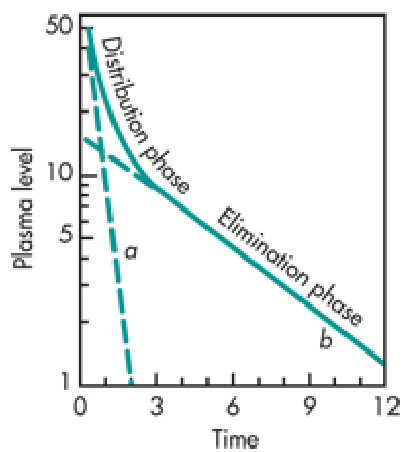
multicompartment PK
