GCSE Combined Science AQA - Physics - Nuclear Decay Equations – Alpha, Beta & Gamma Radiation (2027/28 exams)
 Call Kai
 Learn
Learn Practice Test
 Spaced Repetition
 Match
Match Flashcards
 Knowt Play
1/73

Earn XP
Description and Tags
READ THE WHOLE ENITRE TITLE OF THIS FLASHCARD SET PLEASE - This set is not finsihed yet
Name | Mastery | Learn | Test | Matching | Spaced | Call with Kai | Chat |
|---|
No analytics yet
Send a link to your students to track their progress
74 Terms
What is radioactive decay?
The random process in which an unstable nucleus gives out radiation as it changes to become more stable.
What is an unstable nucleus?
A nucleus that can give out radiation as it changes to become more stable.
What does it mean that radioactive decay is random?
You cannot predict when a particular unstable nucleus will decay.
What nuclear radiation does AQA GCSE Combined Science require you to know?
Alpha (α), beta (β), gamma (γ), and neutrons.
What is activity?
The rate at which a source of unstable nuclei decays.
What unit is activity measured in?
Becquerels (Bq).
What does 1 Bq mean?
One decay per second.
What is count-rate?
The number of decays recorded each second by a detector, such as a Geiger-Müller tube.
What can be used to detect radioactive decay?
A Geiger-Müller tube can detect radiation and record a count-rate.
What is an alpha particle?
A particle consisting of two protons and two neutrons. It is the same as a helium nucleus.
What symbol can represent an alpha particle in a nuclear equation?
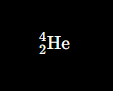
What happens during alpha decay?
An alpha particle is emitted from the nucleus.
What happens to the mass number during alpha decay?
It decreases by 4.
What happens to the atomic number during alpha decay?
It decreases by 2.
Why does the mass number decrease by 4?
An alpha particle contains 2 protons + 2 neutrons = 4 nucleons.
Why does the charge/atomic number of the nucleus decrease during alpha decay?
The nucleus loses 2 protons.
What must happen to the mass number and atomic number in an alpha-decay equation?
Mass number: −4
Atomic number: −2

Complete:
Answer:

What is a beta particle?
A high-speed electron ejected from the nucleus as a neutron turns into a proton.
What symbol can represent a beta particle in a nuclear equation?
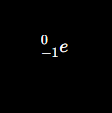
What happens during beta decay?
A neutron turns into a proton, and a high-speed electron is emitted.
What happens to the mass number during beta decay?
It does not change.
What happens to the atomic number during beta decay?
It increases by 1.
Why does the mass number stay the same during beta decay?
A neutron becomes a proton, so the total number of nucleons remains the same.
Why does the atomic number increase by 1?
A neutron becomes a proton, so there is one additional proton in the nucleus.
What must happen to the mass number and atomic number in a beta-decay equation?
Mass number: unchanged
Atomic number: +1

Complete:
Answer:

What is a gamma ray?
Electromagnetic radiation from the nucleus.
Does a gamma ray have mass?
No.
Does a gamma ray have charge?
No
What happens to the mass number when a gamma ray is emitted?
It does not change.
What happens to the charge of the nucleus when a gamma ray is emitted?
It does not change.
Does gamma emission change the nucleus's mass or charge?
No — neither changes
Does AQA Combined Science list neutrons as a type of nuclear radiation?
Yes. AQA lists a neutron (n) as nuclear radiation.
What is a neutron?
A particle found in the nucleus with no charge.
Do you need to write neutron-decay equations for AQA GCSE Combined Science?
No. AQA's specified nuclear-equation skill is writing balanced equations showing single alpha and beta decay.
What is a nuclear equation used to represent?
A: Radioactive decay.
Q: What does AQA require you to balance in alpha and beta nuclear equations?
A: The atomic numbers and mass numbers.
Q: What is the mass number?
A: The total number of protons and neutrons in the nucleus.
Q: What is the atomic number?
A: The number of protons in the nucleus.
Q: What happens to the numbers when balancing alpha decay?

Q: What happens to the numbers when balancing beta decay?

Q: What happens to the mass and charge of the nucleus during gamma emission?
A: Neither changes.
Q: Do you need to identify daughter elements from alpha/beta nuclear equations for AQA Combined Science?
A: No. AQA explicitly states that identification of daughter elements from such decays is not required.
Q: What is the half-life of a radioactive isotope?
A: The time taken for the number of nuclei of the isotope in a sample to halve.
Q: How else can half-life be defined?
A: The time taken for the count-rate from a sample to fall to half its initial level.
Q: How else can half-life be determined using activity?
A: It is the time taken for the activity to fall to half its initial level.
Q: How can radioactive decay be random while a radioactive isotope still has a fixed half-life?
A: You cannot predict when an individual nucleus will decay, but for a large sample the number of undecayed nuclei decreases in a predictable statistical pattern.
Q: What should you do if you are given a graph of count-rate against time and asked to find half-life?
A: Find the initial count-rate, halve it, then find the time at which the count-rate reaches that value.
Q: After one half-life, what fraction remains?
A: 1/2
Q: After two half-lives, what fraction remains?
A: 1/4
Q: After three half-lives, what fraction remains?
A: 1/8
Q: After four half-lives, what fraction remains?
A: 1/16
Q: What additional half-life calculation does AQA require at Higher Tier?
A: Calculating the net decline, expressed as a ratio, in radioactive emission after a given number of half-lives.
Q: Which properties of alpha, beta and gamma radiation does AQA require you to know?

Q: What does penetration mean for nuclear radiation?
A: How easily the radiation passes through materials.
Q: What does range in air mean?
A: How far the radiation travels through air before being absorbed.
Q: What is ionising power?
A: How strongly the radiation can ionise atoms.
Q: How penetrating is alpha radiation compared with beta and gamma?
A: Least penetrating.
Q: How penetrating is beta radiation compared with alpha and gamma?
A: More penetrating than alpha but less penetrating than gamma.
Q: How penetrating is gamma radiation?
A: Most penetrating of the three.
Q: Which of alpha, beta and gamma has the greatest ionising power?
A: Alpha.
Q: How does beta's ionising power compare with alpha and gamma?
A: Less than alpha but greater than gamma.
Q: Which has the lowest ionising power?
A: Gamma.
Q: Which has the shortest range in air?
A: Alpha.
Q: How does beta's range in air compare with alpha and gamma?
A: Greater than alpha but less than gamma.
Q: Which has the greatest range in air?
A: Gamma.
Q: Compare alpha, beta and gamma radiation.

Q: What is the fastest way to remember alpha decay?