Optics III: Chromatic + Monochromatic Aberrations
 Call Kai
 Learn
Learn Practice Test
 Spaced Repetition
 Match
Match Flashcards
 Knowt Play
1/46

There's no tags or description
Looks like no tags are added yet.
Name | Mastery | Learn | Test | Matching | Spaced | Call with Kai | Chat |
|---|
No analytics yet
Send a link to your students to track their progress
47 Terms
Dispersion
White light incident on a prism → Dissociates into constituent colors
RI of the media changed based on the wavelength
Shorter or longer wavelengths bend more?
Shorter (Blue) wavelengths bend more vs. longer wavelengths
Blue is at the bottom of the rainbow
Optics of rainbow formation
White light dispersion through water droplets
Blue light bends more → At bottom of the rainbow
Cause of chromatic aberration
Chromatic aberration occurs due to the fluctuation in power based on a light ray’s wavelength
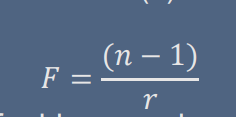
Shorter wavelength → Greater RI → F increases → More bending
And vice versa for longer wavelengths
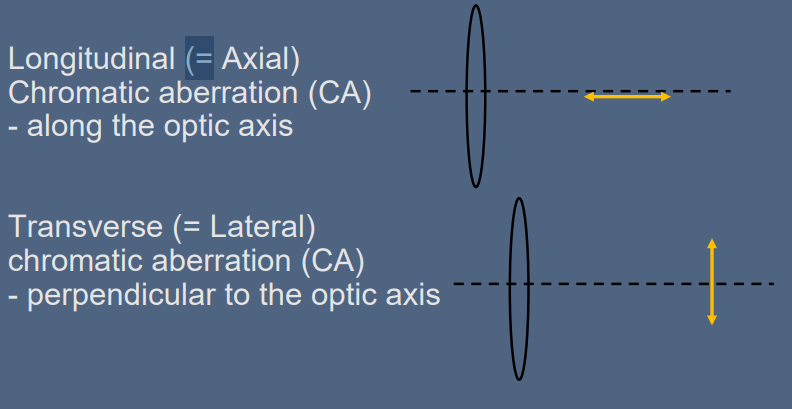
Longitudinal vs Transverse chromatic aberration (CA)
Longitudinal/Axial → Measured along optical axis
Transverse/Lateral → Measured perpendicular to the optical axis
Positive vs. Negative chromatic aberration
Positive
Blue focuses before red (Normal)
Convex lenses
Negative CA
Red focuses before blue
Concave lenses
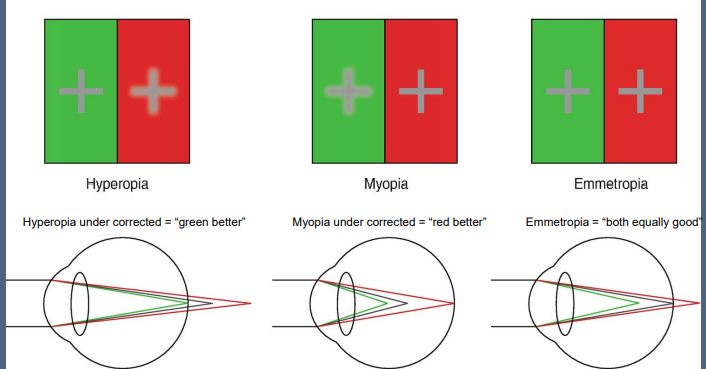
During duochrome what would uncorrected ____ report as clearer
Myopes
Hyperopes
Emmetropes
Myopes → Red is better
Hyperopes → Green is better
Emmetropes → Both equal
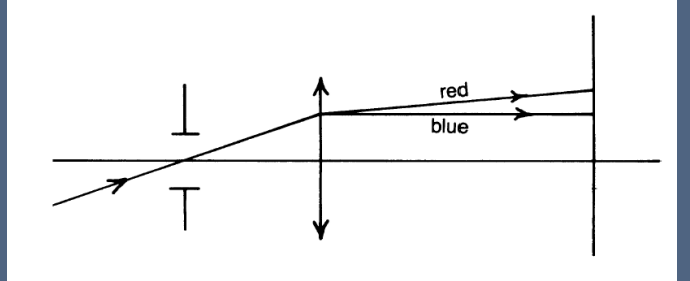
Transverse CA
When an off-axis object experiences chromatic aberration
In the image, blue focuses closer to the fovea than red
Blue light is smaller and sharper
Red part of image would be larger and blurrier
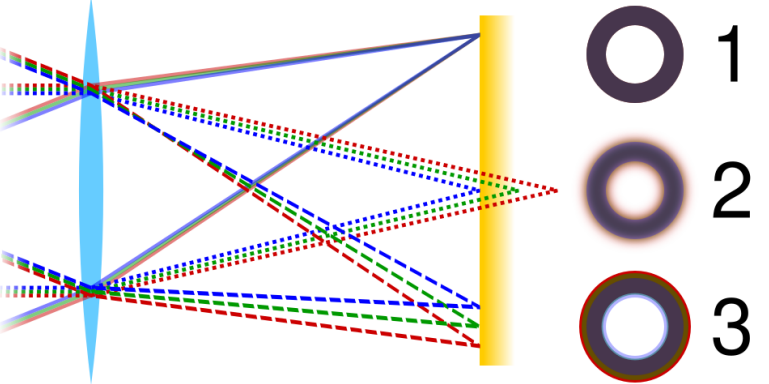
Describe 1, 2, and 3
No chromatic aberration
Longitudinal CA… Production of a red halo
Transverse CA… Rainbow-fringed edges
Eye much more sensitive to transverse CA
3 standard wavelengths
Purpose
Name, wavelength, and the source
Standardize lens powers across the industry (USA)
F → 486nm (Blue) → Hydrogen
d → 587.56nm (Yellow) → Helium
C → 656nm (Red) → Hydrogen
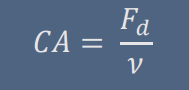
Quantifying CA and Abbe number
CA = FF - FC
Dioptric difference between the red and blue foci
Abbe number (v)
AKA refractive efficiency, nu value, or V-value
= Fd / (FF - FC)
= (nd -1) / (nF - nc)
Relationship between CA and abbe #
CA inversely related to abbe #
Higher Abbe, lower CA
Disadvantages of CA
Ophthalmic lenses
Powers/Magnifications vary
Degrading image quality
The eye
Transverse CA degrading image quality
Production of colored fringes
Advantages of CA
Prism spectrometers
Dissociate white light into spectral components
The eye
Longitudinal CA used for duochrome test
Cue for accommodation direction (Based on amount of CA experienced)
How does CA affect ophthalmic lenses
Degraded images → Reduction in acuity
CA causes overlapping images of different wavelengths
One or more wavelengths displaced due to CA
Colored fringes
Red or blue band seen around borders (Like sheet of paper)
How to reduce CA in ophthalmic lenses
Use materials with higher Abbe number
Crown glass > Polycarbonate
Patient complaints related to CA
Colored fringes
Reduced off-axis VA
Tunnel vision/Blurry periphery
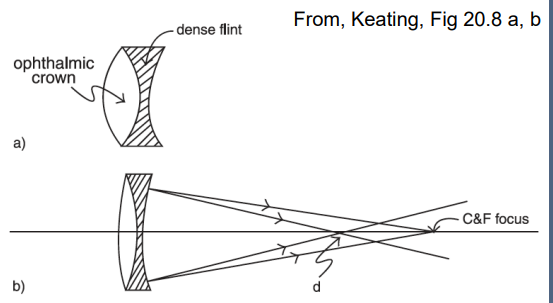
Achromatic doublet
Using a positive and negative lens of differing materials to reduce chromatic aberration
Materials with differing Abbe numbers → Red, yellow, and blue focus at different points
Find the right ratio of (+) or (-) power between both lenses to line up red and blue foci (Yellow foci still unfocused, but better than nothing)
Chromatic aberrations vs. Monochromatic aberrations
Chromatic
Variation of image properties due to dispersion
Monochromatic
Variation of image properties across a lens aperture
Independent of wavelength
Seidel aberrations
Monochromatic aberrations named after the dude who systemized them
First order optics approximation
Snell’s law: n1 sin(i) = n2 sin(r)
Approximation → n1 * i = n2 * r
The sine function should look more like the image
The approximation is assuming sin θ ≈ θ
Only incorporates first order aberrations
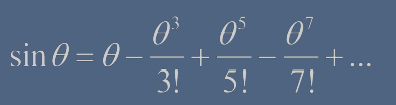
Seidel approximation
Incorporates primary or third order aberrations
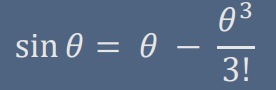
Standard order of Seidel aberrations
Image blur
Spherical aberration
Coma
Radial Astigmatism
Image dislocation
Curvature of field
Distortion
Spherical aberration
Peripheral rays get refracted more than paraxial rays
Only aberration that applies to on-axis and off-axis points
Positive vs. negative spherical aberration
Positive when peripheral rays refract more than paraxial rays (Image)
Periphery focuses first
Negative when paraxial > peripheral
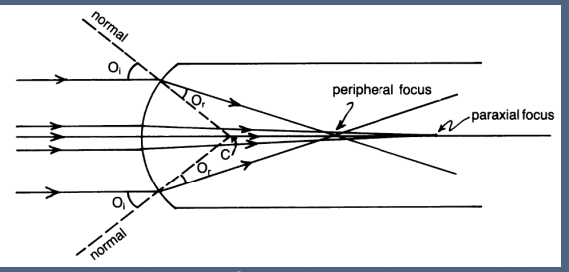
How to reduce SA
Reduce aperture → Less peripheral rays → Less SA
Aspheric surfaces
Change of curvature at periphery reduces SA
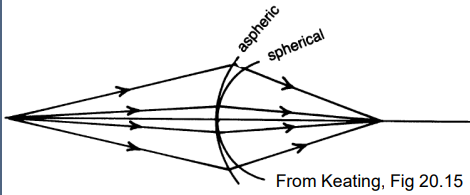
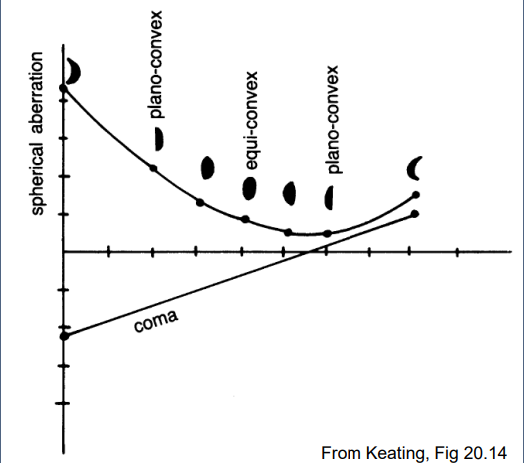
Spherical aberration relation to shape of lens
Coma aberration
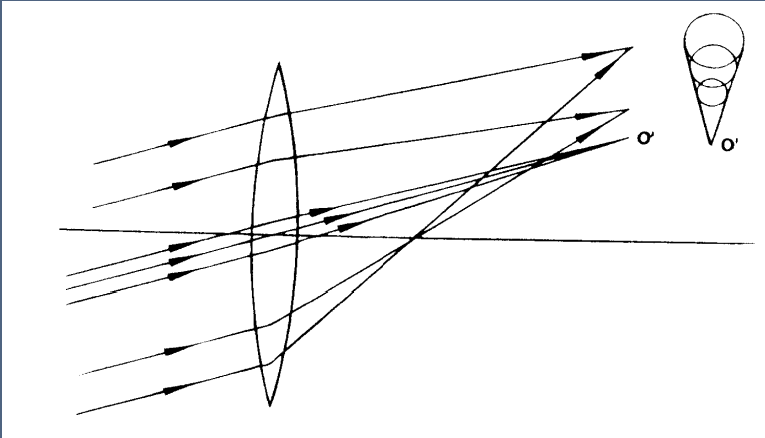
Results from off-axis rays meeting different curvatures of the lens
Deviation of rays is not identical, depends on ray position (Image)
Comet-shaped aberration
Bright head
Dim tail
Most important aberrations to control at high level microscopy
Coma and spherical aberration
Coma dependent on the square of the aperture size
Controlled by reducing aperture size
Radial astigmatism
AKA oblique or marginal astigmatism
Occurs with toric & spherical surfaces
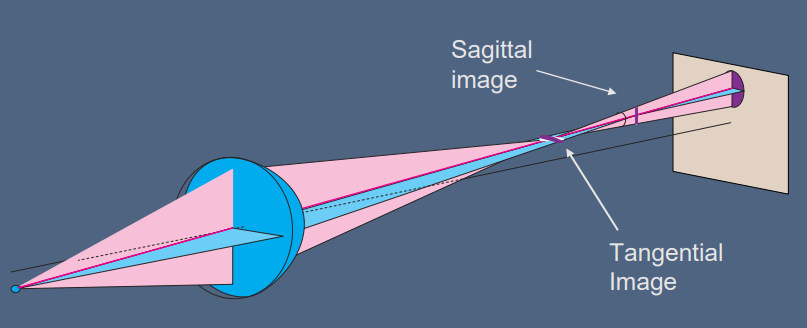
When off-axis light hits spherical lens → Acts as toric surface
Not the same as sphero-cyl astigmatism
Two planes associated with radial astigmatism
Sagittal plane
Horizontal plane
Forms vertical image
Tangential plane
Vertical plane
Forms horizontal image
Astigmatic interval
Dioptric difference between the foci of radial astigmatism
Relationship of radial astigmatism and oblique viewing
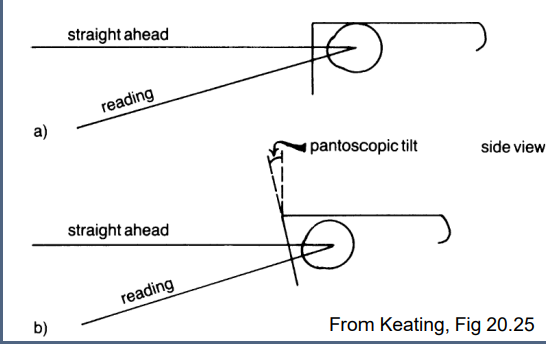
RA generated when looking obliquely through a lens (Image)
Viewing something at near → Look through bottom of lens
↑ Oblique angle → ↑ Average power
Solution: Pantoscopic tilt
Controlling radial astigmatism
Use a lens that minimizes astigmatic interval to ≤ 0.125D
Determinants of the amount of radial astigmatism
Viewing distance
Oblique angle
Back vertex power
Vertex distance
Refractive index
Base curve
Standard oblique angle used in calculations to reduce RA
27 degs
Tscherning ellipse
What is it
X-axis
Y-Axis
Graph showing combinations of base curve/Rx power to reduce radial astigmatism
X-axis → Rx power
Y-Axis → Base curve
Ostwalt branch of tschernings ellipse
Uses flatter base curves
Flatter looking lens, more aesthetic → More common
What what Rx powers is radial astigmatism incurrable
> +8D
< -25D
Curvature of field
AKA Power error
Off-axis object → Goes through curved lens → Focuses in a curved line (Petzval surface)
Problem: Camera sensors and other things lie as a flat surface
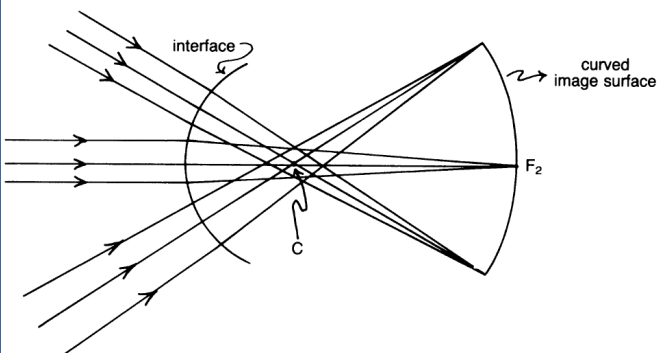
Far point sphere
Surface swept out by the far point of the eye as the eye moves
Compensated for by the lens
FPS is more curved than the petzval surface → Aberration
Power error in myopes vs. hyperopes
Myopia → Off-axis object blur
Image falls farther than far point of the eye
Hyperopia → Less blur (Accomodation)
Minimizing curvature of field/power error in camera & lenses
Cameras → Multi-element lenses to flatten the field
Spectacles
All seidel aberrations are intermixed, compromise between them all
Radial astigmatism corrected first
Distortion
Non-uniform magnification across the VF
Caused by object distance from axis
Can either decrease or increase
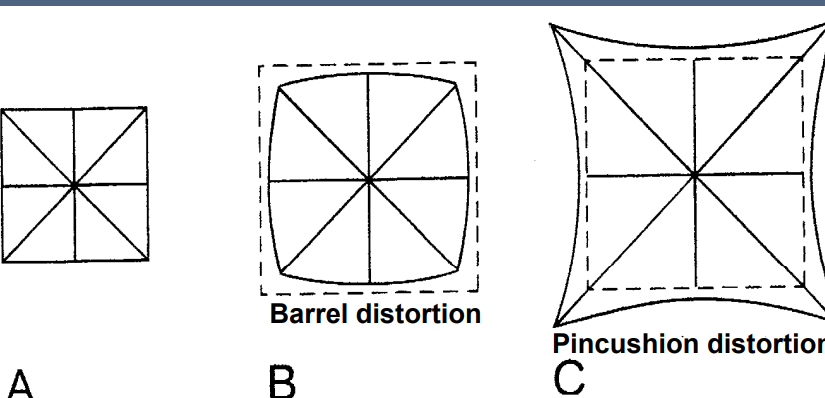
Controlling distortion
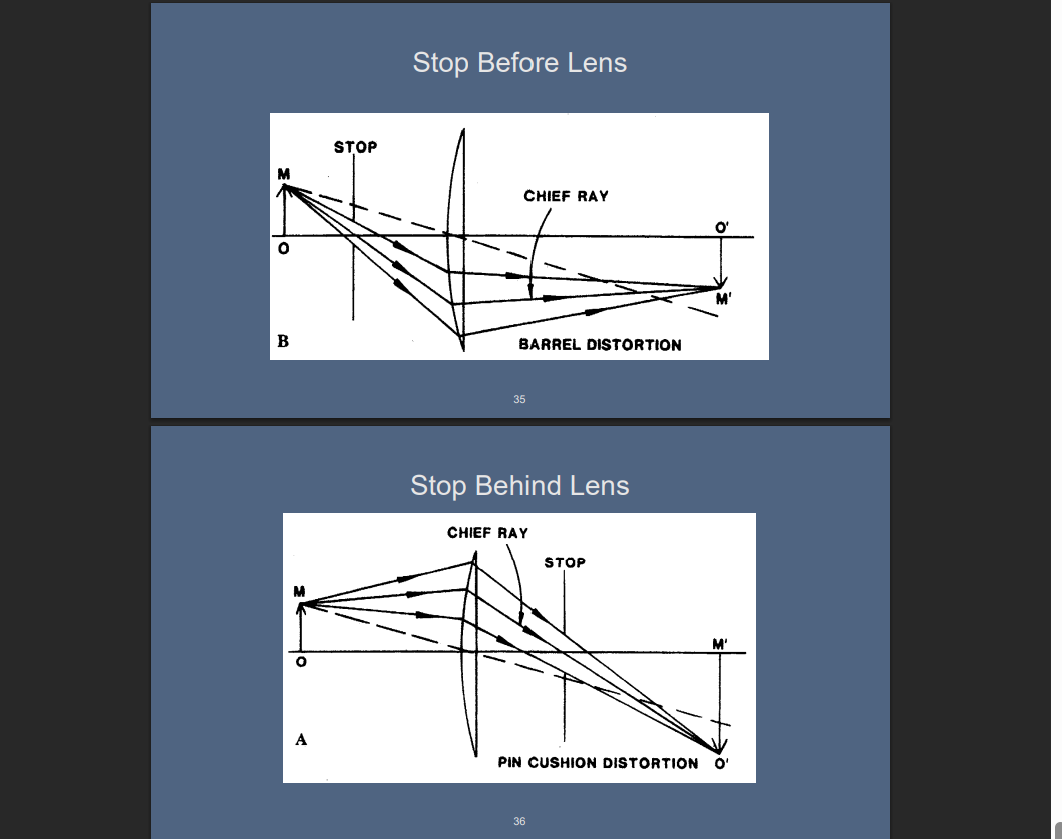
Affected by position of the ‘stop’ from the lens
NOT THE SIZE
Stop too far before the lens
Stop too far after the lens
Stop too far before the lens
Barrel distortion
More mag in middle
Stop too far after the lens
Pincushion distortion
More mag at edges