Grade 12 AP Chemistry - Valence Bond Theory, Hybridization, M/NM/Metalloid Trends + Properties, Co-ordinate Covalent Bonding
 Call Kai
 Learn
Learn Practice Test
 Spaced Repetition
 Match
Match Flashcards
 Knowt Play
1/55

There's no tags or description
Looks like no tags are added yet.
Name | Mastery | Learn | Test | Matching | Spaced | Call with Kai | Chat |
|---|
No analytics yet
Send a link to your students to track their progress
56 Terms
Electron Domains/Steric #
total # of e- pairs (lone + bond pairs)
Electron Domain Geometry
lone pairs + bond pairs
e.g. AX2E2 e- domain geometry = tetrahedral
Molecular Geometry
only bond pairs
e.g. AX2E2 molecular geometry = bent
Bonding Domains
bond pairs
Non-Bonding Domains
lone pairs
Valence Bond Theory
model of bonding
bonding e- pairs are located between bonding atoms
non-bonding e-pairs are located in regions outside the bonding region
Valence bond theory only applies to what cpds?
covalent
Valence bond theory does not work well for ___________ atoms.
hypervalent (e.g. SF6)
Draw the VBD for H2
solution in notebook
Draw the VBD for HF
solution in notebook
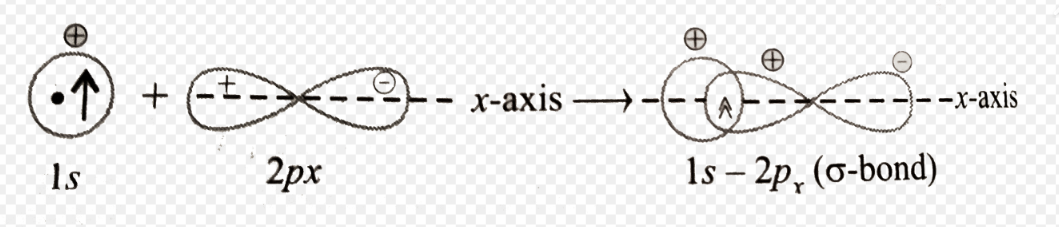
σ bond/end-to-end overlap
bond between two nuclei where bonding e- line up along the internuclear axis
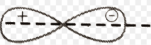
Internuclear Axis
horizontal line that goes through the nucleus
To be able to form a covalent bond, the atom has to be able to _____ and _______ an e-.
offer, receive
The first pair of e- to form a covalent bond is a _ bond. Therefore in covalent bonding, _ bonds are ALWAYS present.
σ, σ
Draw the VBD for F2
solution in notebook
Hybridization
e- being promoted and subshells becoming degenerate
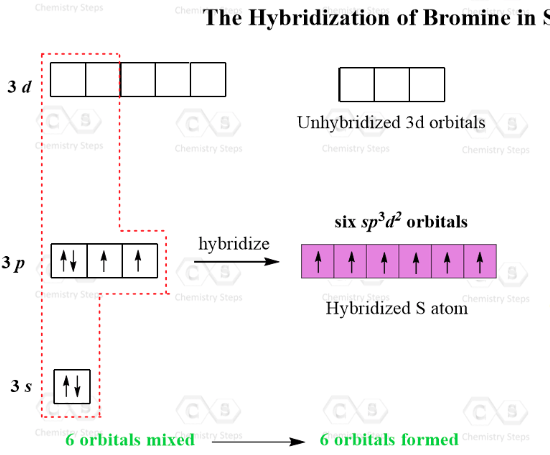
Degenerate Subshells
subshells that are equal in E (e.g. the 5 d subshells)
There are some atoms in cpds that don’t need to hybridize (bc they already have enough valence e-’s) but do. Why is this?
to allow for larger angles between the subshells and ∴ less repulsion ∴ a more stable molecule
When hybridization occurs, it is based on the __ ______ ________.
e- domain geometry
e.g. H2O =
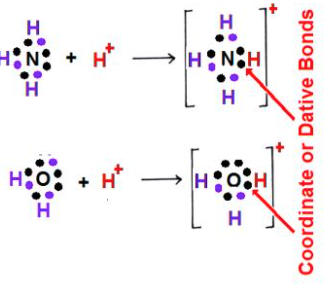
Co-ordinate Covalent Bonding
covalent bond in which both bonding e- come from the same atom
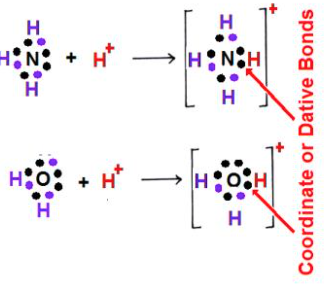
Co-ordinate Covalent Bonding is also called
DATIVE bonding
Hybridization vs Anomalous Configurations
Hybridization:
ONLY happens when atom is bonding
does NOT occur in isolated atoms
Anomalous:
atom is ALWAYS anomalous; it does not “become” anomalous
a) Draw the VSEPR for methane, CH4
b) Draw the VBD for methane, CH4
solution in notebook
a) Draw the VBD for CH2BrI
b) Identify i) the hybridization of the central atom and ii) the bond types
solution in notebook
e-’s in hybridized orbitals always form _ bonds
σ
unhybridized e- in the remaining parts of a multiple bond form _ bonds
π
Draw the VBD for CH2CHBr
solution in notebook
Draw the VBD for CHCBr
solution in notebook
Except for _____ _____, no elements exist in nature as individual atoms. Only _____ _____ are monatomic.
noble gases, noble gases
Metals react with O2 to form _____ oxides. _____ oxides form _____ solutions.
metal, metal, basic
Non-metals react with O2 to form _________ oxides. _________ oxides form ______ solutions.
non-metal, non-metal, acidic
Hydrogen reacts with metals to form the _______ ion, H-
hydride
Noble gases used to be considered “_____” (unable to react). However, under the right conditions, they can form cpds.
inert
_________ are strong oxidizers
peroxides
Oxide vs Peroxide vs Superoxide
Oxide: O-2
Peroxide: O2-2
Superoxide: O2-
Allotrope
different forms of the same element in the same state (e.g. O2 and O3)
Why do NM tend to have high -ve E.A. values?
E.A. is the E change when an e- is added to an atom
if E.A. is -ve that means E is released (as atom becomes more stable)
e- is added to p subshell which is one step closer to having a full valence shell
Give 3 examples of elements that form allotropes
O2, O3
As, As4
P, P4
Oxygen has a strong ability to oxidize other substances. What does this mean?
having strong ability to oxidize other substances means u have a high EN and can ∴ attract their e-’s
Fluorine is one of the strongest oxidizers in the PT. It is also the smallest atom on the PT. How are these two facts related?
F is a strong oxidizer, ∴ it has high EN, ∴ it has a small atomic radius bc it pulls on its e-’s a lot
Metal + water always produces __ gas on top of the base.
H2
Draw the Lewis structure for NO3-
solution in notebook
Resonance (Hybrid) Structures
having more than one (right) structure for a molecule that just have different arrangements of their paired e-
NONE of these structures are the actual structure (the actual structure is a ‘hybrid’ of the resonance structures)
Draw the resonance structures for nitrate, NO3-
solution in notebook
a) Draw the resonance structures for i) O3
b) Suggest a hybrid resonance
solution in notebook
a) Draw the resonance structures for ii)CO3-2
b) Suggest a hybrid resonance
solution in notebook
a) Draw the resonance structures for iii) SO2
b) Suggest a hybrid resonance
solution in notebook
Formal Charges
NOT REAL CHARGES that help determine which structure of a molecule is the dominant one
There are resonance structures when the formal charges are exactly the ____ for all structures AND no one structure is clearly ________ above the others. (e.g. O3)
same, dominant (e.g. try drawing equivalent Lewis diagrams for SCN- … they are NOT resonance structures because one is clearly dominant above the others)
How do you calculate formal charge?
(valence e-) - (e- assigned to the atom)
Calculate the formal charge of the structures of CO2
solution in notebook
What do you do if multiple structures have the same formal charge?
the dominant structure is the one where the -ve charge is on the more EN atom
The dominant structure is the one whose atoms have a formal charge closest to _.
0
3 Exceptions to the Octet Rule
molecule/polyatomic ion has an odd # of e-
molecule/polyatomic ion has < 8 valence e-
molecule/polyatomic ion has > 8 valence e-
Hypervalence
expanded octet
due to forcing e-’s into the d orbital
Any molecule with steric #_ will hybridize.
4