Macromolecules I: Nucleic acids
 Call Kai
 Learn
Learn Practice Test
 Spaced Repetition
 Match
Match Flashcards
 Knowt Play
1/13

There's no tags or description
Looks like no tags are added yet.
Name | Mastery | Learn | Test | Matching | Spaced | Call with Kai | Chat |
|---|
No analytics yet
Send a link to your students to track their progress
14 Terms
What is a polymer?
A polymer is composed of subunits (monomers) connected by covalent bonds
Which of the classes of macromolecules form true polymers, and what specific type of covalent bond links the monomers in each of those classes?
Nucleic acids, proteins and polysaccharides form true polymers
Nucleic acids: covalent phosphodiester bond links nucleotides
Proteins: covalent peptide bond links amino acids
Polysaccharides: covalent glycosidic bond links monosaccharides

What happens during a condensation reaction, and what happens during a hydrolysis reaction?
Condensation reaction: Water is removed, forming a covalent bond between monomers
Hydrolysis reaction: The addition of water to the bond, breaking the covalent bond between monomers

Define what polarity means when describing a biological polymer. How does directional growth result in a polymer with distinct ends?
Polymers have polarity as the ends are chemically different from each other.
New monomers are always added to the same end of the growing polymer so polymer growth is directional.
IMPORTANT NOTE: Polarity just means two parts different. It does not always refer to a difference in charge.
Name the three components of a nucleotide (nucleotide = monomer of nucleic acids).
A nucleotide is composed of a phosphate, sugar, and base
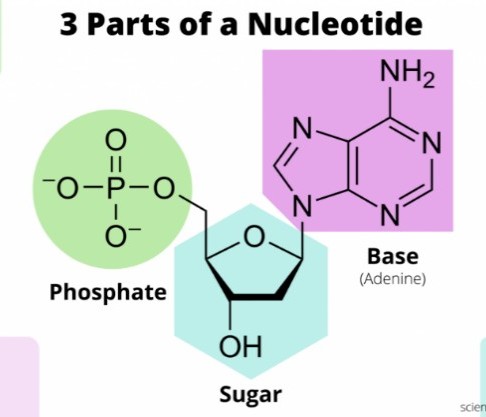
What are the specific bases in DNA and RNA?
DNA and RNA both use adenine (A), guanine (G), and cytosine (C).
But DNA uses thymine (T) while RNA uses uracil (U).
Note: DNA uses deoxyribose sugar, RNA uses ribose sugar

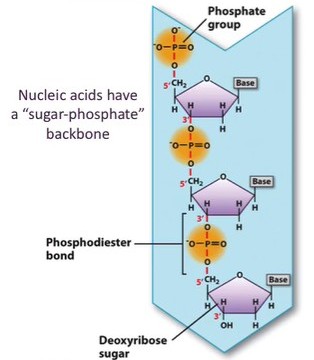
Which component varies to give a nucleotide its specific identity, and which components form the constant sugar-phosphate backbone?
The base varies to give a nucleotide its specific identity. The phosphate and sugar components form the constant sugar-phosphate backbone.
Which parts of a nucleotide are involved in covalent bonds within one nucleic acid strand?
The phosphate and sugar parts are involved in covalent bonds within one nucleic acid strand. The phosphate of one nucleotide forms a covalent bond, called a phosphodiester bond, with the sugar of the next nucleotide.
Which part of the nucleotide is involved in non-covalent interactions in the double helix?
The base is involved in non-covalent interactions in the double helix (i.e. between two nucleic acid strands).

Identify the specific non-covalent interaction responsible for complementary base pairing across strands.
Specific hydrogen bonds between bases across strands generate complementary base pairing
Adenine (A) only pairs with Thymine (T) in DNA [or Uracil (U) in RNA]
Guanine (G) only pairs with Cytosine (C)
Trick to remember: Apple-Tree and Golf-Club
![<p><span style="line-height: 107%;">Specific <strong>hydrogen bonds</strong> between bases across strands generate complementary base pairing</span></p><ul><li><p class="MsoListParagraphCxSpMiddle"><span style="line-height: 107%;">Adenine (<strong>A</strong>) only pairs with Thymine (<strong>T</strong>) in DNA [or Uracil (<strong>U</strong>) in RNA]</span></p></li><li><p class="MsoListParagraphCxSpMiddle"><span style="line-height: 107%;">Guanine (<strong>G</strong>) only pairs with Cytosine (<strong>C</strong>)</span></p></li><li><p class="MsoListParagraphCxSpLast"><span style="line-height: 107%;"><em>Trick to remember: Apple-Tree and Golf-Club</em></span></p></li></ul><p></p>](https://assets.knowt.com/user-attachments/1b534ae4-21ca-47b3-a30e-44dc8ae1de6a.jpg)
Identify the specific non-covalent interaction occurring between base pairs stacked vertically on top of one another.
van der Waals interactions (also called base stacking attraction) occur between base pairs stacked vertically on top of one another. This happens because bases are brought very close to one another in the DNA double helix.

Why is relying on weak non-covalent bonds between strands advantageous for DNA replication?
Weak non-covalent bonds between strands are advantageous for DNA replication as these bonds can be broken to open the strands allowing DNA to be copied.