Macromolecules, Enzymes, Osmosis, and Cells Review
 Call Kai
 Learn
Learn Practice Test
 Spaced Repetition
 Match
Match Flashcards
 Knowt Play
1/37

There's no tags or description
Looks like no tags are added yet.
Name | Mastery | Learn | Test | Matching | Spaced | Call with Kai | Chat |
|---|
No analytics yet
Send a link to your students to track their progress
38 Terms
What is are the cell membranes made of?
Phospholipids, Proteins, Cholesterol, and Carbohydrates
Phospholipids: They make up most of the membrane. They form a bilayer, which acts as the main barrier separating the inside of the cell from the outside environment.
Proteins: They help transport molecules across the membrane. Because the membrane is selectively permeable, certain substances that cannot easily cross the phospholipid bilayer can move through transport proteins instead.
Cholesterol: It helps maintain the membrane’s fluidity and stability. It prevents the membrane from becoming too rigid or too fluid.
Carbohydrates: They are mainly involved in cell identification/recognition, allowing cells to recognize and communicate with one another.
Name the organelles discussed.
Nucleus, Nucleolus, Ribosomes, Rough Endoplasmic Reticulum, Smooth Endplasmic Reticulum, Mitochondria, Lysosomes, Golgi Apparatus, Cytoskeleton, Cytoplasm, Cell membrane, and Centrosome/Centrioles.
Nucleus
Stores the cell’s DNA/genetic information and helps control cell activities.
Nucleolus
Makes the components needed to form ribosomes.
Ribosomes
Site of protein synthesis; they assemble proteins
Rough ER
Has ribosomes attached to it, so it is involved in the production, processing, and packaging of proteins, especially proteins that will be transported elsewhere.
Smooth ER
It does not have ribosomes and it makes lipids and carbohydrates.
Mitochondria
Site of cellular respiration, where energy from sugars is used to produce ATP, usable energy for the cell.
Lysosomes
They break down cellular waste and unwanted material. They are the cell’s garbage disposals.
Golgi Apparatus
It processes, modifies, sorts, and packages proteins so they can be transported to their final destination.
Cytoskeleton
It gives the cell structure and helps with movement.
Cytoplasm
It is fluid inside the cell that contains/surrounds the organelles and is where many cellular processes occur.
Cell Membrane
It is a selectively permeable barrier between the cell and its environment; regulates what enter and leaves.
Centrosome/Centrioles
They organize spindle fibers during cell division, helping chromosomes separate correctly.
Processes that involve cell-membrane movement that do not require energy (passive transport)
Diffusion, Facilitated Diffusion, and Osmosis
Diffusion
Molecules move from an area of high concentration to an area of low concentration until they become more evenly distributed.
Facilitated Diffusion
Molecules move from an area of high concentration to an area of low concentration through a membrane protein. The protein helps them cross, but ATP is still not required.
Osmosis
Diffusion specifically involving water across a selectively permeable membrane
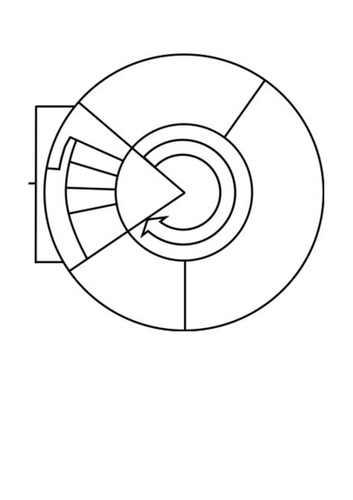
Cell Cycle Diagram
Complete Cell Cycle Diagram
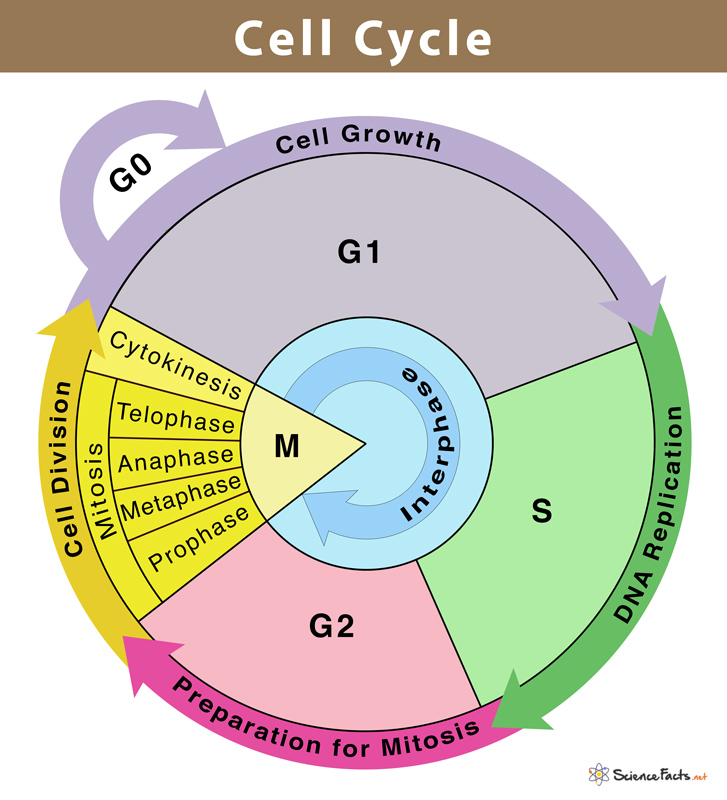
Interphase
This is when the cell performs its normal functions and prepares to divide.
G1
Cell grows and carries out normal cellular activities
S Phase
DNA is replicated. Each chromosome is copied in preparation for division.
G2
Additional growth and preparation for cell division occurs.
M Phase
Mitosis: The cell divides its genetic material/nucleus. The end result is two genetically identical diploid daughter cells.
Cytokinesis
The cytoplasm divides, physically separating the cell.
What types of things move the easiest through a cell membrane?
The membrane’s interior is largely non polar/hydrophobic, so small, non polar molecules pass through most easily. For example oxygen and carbon dioxide can diffuse directly through the membrane relatively easily. Large molecules and charged particles/ions generally have much more difficulty crossing directly and often require transport proteins.
What is the goal mitosis?
The goal is to produce two genetically identical diploid daughter cells with the same chromosome number as the original parent cell. Mitosis allows organisms to perform things such as growth, tissue repair, and replacement of old/damaged cells. It is the division of somatic (body) cells.
If you took three human blood cells out of a person’s vein and dropped it into three different solutions (hypertonic, hypotonic, and isotonic) explain what would happen to the red blood cells.
Hypertonic: Outside has more solute than inside the red blood cell, so water will move outside the cell and the red blood cell will shrink/shrivel because it loses water.
Hypotonic: Outside has less solute than inside, so water will move inside the cell and the red blood cells will swell and can eventually burst if enough water enters.
Isotonic: The solute concentrations are approximately equal, so water still moves in both directions, but there is no net movement of water because movement in and out is balanced. Therefore, the cell remains approximately the same size.
Water moves toward more solute or where there are more particles.
Explain the process of how a secreted (pushed out of a cell) protein is made.
A gene containing instructions for the protein is located in the DNA in the nucleus. The information is copied into RNA, which carries the instructions for making the protein. A ribosome, generally associated with the rough ER for a secreted protein, uses those instructions to assemble the protein from amino acids. The protein enters the rough ER, where it begins being processed. It is transported in a vesicle to the Golgi Apparatus. The Golgi Apparatus modifies, sorts, and packages the protein. Another vehicle carries the finished protein to the cell membrane. The vesicle fuses with the membrane and releases the protein outside through exocytosis.
Nucleus to Ribosome/Rough ER to Vesicle to Golgi to Vesicle to Cell Membrane to Exocytosis
Mitosis
Division of the genetic material of a somatic/body cell, ultimately allowing one parent cell to produce two genetically identical diploid daughter cells when followed by cytokinesis. Chromosome number stays the same. The end result is two genetically identical diploid daughter cells. DIVISION OF GENETIC MATERIAL/NUCLEUS
Meiosis
Meiosis is the type of cell division used to produce sex cells/gametes, such as eggs and sperm. The chromosome number is cut in half. The end result is four genetically different haploid sex cells.
Prophase
Chromatin condenses into visible chromosomes. The nuclear membrane begins breaking down. The centrosomes/centrioles move toward opposite sides of the cell and spindle fibers form. PREPARE
Metaphase
Duplicated chromosomes line up along the middle/equator of the cell. Spindle fibers attack to the chromosomes around their centromeres. MIDDLE
Anaphase
The duplicated chromosome copies separate and move toward opposite poles of the cell. APART
Telophase
Chromosomes reach opposite sides. New nuclear membranes form around each set of chromosomes, and the chromosomes begin becoming less condensed. The cell is approaching the end of nuclear division. TWO NUCLEI
Cytokinesis
The cytoplasm divides, physically separating the parent cell into two daughter cells. DIVISION OF CYTOPLASM/CELL
Interphase
It occurs before mitosis and includes G1 - growth/normal functions, S Phase - DNA replication, and G2 - additional growth/preparation.
Name all four macromolecules and give at least one example of each for its use in the human body.
Carbohydrates
Monomer - building components: Monosaccharide
Function: Energy and Structure
Examples: Glucose - provides a major source of usable energy, Fructose, Lactose, Sucrose, Starch, Glycogen - stores glucose for later use, Chitin, and Cellulose
Proteins
Monomer: Amino Acid
Function: “Workers of the body” because proteins perform many different jobs
Examples: Antibodies - fight disease, enzymes - catalyze chemical reactions, hemoglobin - transports oxygen, muscle proteins - movement, and insulin - hormone involved in regulation
Lipids
Monomer: Fatty acids
Function: Long-term energy storage and insulation, as well as important structural/signaling roles
Examples: Adipose tissue - stored energy/insulation, phospholipids - cell membranes, cholesterol - membrane component and precursor for steroid molecules
Nucleic Acids
Monomer: Nucleotide
Function: Genetic Information
Examples: DNA stores the instructions for making proteins and other cellular information. RNA helps use/carry those instructions during protein production. ATP, a nucleotide-related molecule, provides readily usable energy for cellular processes.