LING 203: Interjections, Verbs, Tense, Aspect, Modality, Phrases, and Verb Complementation
 Call Kai
 Learn
Learn Practice Test
 Spaced Repetition
 Match
Match Flashcards
 Knowt Play
1/73

There's no tags or description
Looks like no tags are added yet.
Name | Mastery | Learn | Test | Matching | Spaced | Call with Kai | Chat |
|---|
No analytics yet
Send a link to your students to track their progress
74 Terms
INTERJECTIONS
A small, fixed class of words used mainly for pragmatic purposes rather than to express semantic (literal) meaning
INTERJECTIONS examples
Hello!
Hey!
OMG!
ROFL!
Uh-huh!
Oh-oh!
INTERJECTIONS what are the formal characteristics of interjections
Have a limited, fixed form
cannot be inflected
allow little or no modification
—> unlike nouns and verbs, they do not change their form
INTERJECTIONS what are the functions of interjections
Pragmatic — they control language use in communicative situations
They can:
express emotion
control the flow of discourse
emphasise a thought
INTERJECTIONS why are interjections considered grammatically independent
They are not integrated into the grammar of larger sentences
They can stand alone as complete utterances
Wow!
Oops!
Hey!
Common in text messages and online communication because they help convey emotion
THE VERB Why are verbs described as “controlling”
Determine what follows them (the predicate)
Determine the nominal content that precedes them
Ungrammatical example:
*The concrete vanished the aardvark
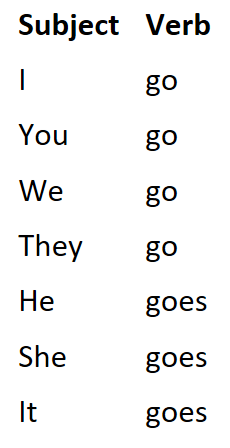
THE VERB What is verb agreement
Occurs when a verb changes its form to match a noun or pronoun
THE VERB English verb agreement
English verbs show limited agreement, mainly between singular and plural subjects
THE VERB What grammatical information do English verbs encode
Tense: when something happens
Aspect: how an action extends over time
Modality: the speaker’s attitude towards an action
TENSE
Located an action relative to the time of speaking (ToS).
Languages distinguish between events that are:
Present: happening now
Past: completed before now
Future: expected later
TENSE How many tenses are marked morphologically in English
Only two:
Non-past: I jump
Past: I jumped
→ English does not morphologically mark future tense
TENSE How does English express time
English uses a combination of:
Verb inflection: He placed it on the table
Time phrases: He put it there last week
TENSE What are the three English verb forms that indicate time
Past: walked
Non-past (3rd person singular): walks
Non-past (all other forms): walkØ
Only the first two involve inflection
TENSE Why is there no future tense in English
Because future meaning is expressed through three constructions
Will + infinitive: He will play
Present form + time adverbial: His game starts at 3pm
Going to + infinitive: He is going to play
TENSE When is the simple past used
Actions completed in the past: She finished the work before lunch
Past habits: They went there everyday
TENSE Is there a time limit on the simple past
No.
The simple past can describe events from seconds ago to millions of years ago.
Examples:
He finished the cake two seconds ago.
Trilobites lived 521 million years ago.
PRESENT TENSE What is the form of the English present tense
Only third-person singular is marked

PRESENT TENSE What are the uses of the present tense
Eternal truths: water boils at 100°C.
Habits: He goes to the gym twice a week
Future events: I leave for France in two weeks
PRESENT TENSE What is the historical (narrative) present
It uses present-tense forms to describe past events
He goes there and stays for two hours
PRESENT TENSE historical (narrative) present purpose
Creates immediacy
Increases listener involvement
PAST TENSE How is the English past tense formed
Most verbs take -ed
arrived
googled
texted
PRESENT TENSE What are irregular verbs
Verbs that do not follow the -ed pattern
Stem changes
ate
drank
brought
dreamt
Invariant forms
hit
put
bet
PRESENT TENSE Does English past tense distinguish singular and plural
No, the same form is used for every person
ASPECT
Describes how an action extends across time
unlike tense, it does not locate an event relative to the time of speaking
ASPECT How does English mark aspect
aux + lexical verb
ASPECT What are the two major aspects in English
Perfect: complete ; They have eaten
Progressive/continuous: ongoing ; They are eating
PROGRESSIVE/CONTINUOUS ASPECT What is the form of the progressive aspect
be + verb-ing
Past: they were eating
Present: he is going
Future: he will be going
Tense is marked on the aux, not the lexical verb
PROGRESSIVE/CONTINUOUS ASPECTWhat does the progressive aspect emohasise
Duration
Ongoing activity
Incompleteness
PROGRESSIVE/CONTINUOUS ASPECT What are the common uses of the progressive aspect
Unknown or unimportant completion: They were reading a book
Temporary states: We are studying aspect today
Repeated activities: He is always eating a cake
PROGRESSIVE/CONTINUOUS ASPECT How does the progressive interact with the simple past
The progressive often sets the scene, while the simple past describes an interrupting event
Example: I was reading a book when I heard a noise
PROGRESSIVE/CONTINUOUS ASPECT Which verbs resist the progressive aspect
Copulas: *The weather is seeming good
Lexical “have” (possession): *I am having two cats
Cognition and perception verbs: know, believe, think, see hear
PROGRESSIVE/CONTINUOUS ASPECT When can normally stative verbs occur in the progressive
When they describe temporary states or behaviour
You are being silly
I am thinking about it
PERFECT ASPECT What is the form of the perfect aspect
have + past participle (-en form)
Past: I had finished
Present: She has gone
Future: They will have eaten
PROGRESSIVE/CONTINUOUS ASPECT What does the perfect aspect indicate
Completion:
in the distant past
in the recent past
in the future
PROGRESSIVE/CONTINUOUS ASPECT Why is the present perfect aspect often misunderstood
Many people treat it as a past tense, but it is actually:
Present tense + perfect aspect
PROGRESSIVE/CONTINUOUS ASPECT What is the function of the present perfect
It connects a past event to the present moment
The event can have happened at any point in the past, provided it remains relevant now.
I have undertaken similar tasks before
Politicians have called for an end to…
NOTE: have is present tense!
How do tense and aspect combine? (examples)
Present + progressive: they are eating
Past + progressive: they were eating
Present + perfect: They have eaten
Past + perfect = They had eaten
Tense = a point in time
Aspect = an action across time
PROGRESSIVE/CONTINUOUS ASPECT What is the past perfect
It identifies the earlier of two past events
I had eaten dinner when Jane got home
PROGRESSIVE/CONTINUOUS ASPECT Why can’t the past perfect stand alone?
It requires another lexical verb in a more recent past tense
I had eaten when Jane arrived
*I had eaten
FINITE & NON-FINITE CLAUSES why is tense obligatory in English
A simple sentence must contain a tensed verb
The cat followed the mouse
FINITE & NON-FINITE CLAUSES must every verb in a sentence be tensed
No.
Complex sentences can contain non-finite verbs
The cat followed the mouse going to the shop
FINITE & NON-FINITE CLAUSES what is a finite clause
A clause containing
A tensed verb, or
A modal auxiliary
The cat jumped the fence
The cat might jump the fence
FINITE & NON-FINITE CLAUSES what is a non-finite clause
A clause containing a non-tensed verb:
to- or bare infinitives: I like to eat; She made them finish the work
Gerund or participle: Eating the cake, he walked home ; Written in a day, the book sold
Elided aux: The boy eating an apple is here ; The boy [who is/was eating an apple] is here
MODALITY What are modal verbs
Aux verbs that express the speaker’s judgement about an action
MODALITY What are grammatical properties of modal verbs
always finite
cannot be inflected
cannot combine with tense
are always the first auxiliary
*I might jumped
*I mights study
MODALITY What meanings do modal verbs express
possibility
probability
ability
permission
obligation
MODALITY What are semi-modals
Express the same meanings as modals but behave differently grammatically
need to
dare to
used to
have to
had better
MODALITY How do semi-modals differ from modals
inflected for tense
agree with person
Modal: he must read this
Semi-modal: he has to read this
MODALITY What is epistemic modality
The speaker’s judgment about the truth of a statement
She may leave (observation)
They must be wrong
MODALITY What is epistemic modality
Modality involving:
obligation
instructions
permission
She may leave (permission)
They must finish now (instruction)
MODALITY What is dynamic modality
The ability to perform an action
I can ride a bike
MODALITY Can one modal have multiple interpretations
Yes
“You may speak Icelandic.”
Deontic: you are permitted to speak Icelandic
Epistemic: You might know Icelandic
How can tense, aspect, and modality combine
Present perfect progressive: I have been reading for 20 minutes
Modal perfect progressive: I should have been cooking for 20 minutes
—> speakers deliberately combine auxiliaries to create precise meanings
PHRASE STRUCTURE What is a phrase
A grammatical unit that is larger than a word but smaller than a clause
contains an obligatory head word
PHRASE STRUCTURE What is a head word?
The central, obligatory element of a phrase
PHRASE STRUCTURE What is a modifier
Adds information and narrows the meaning of the head word
“cats”
happy cats
the happy cats
PHRASE STRUCTURE Why isn’t a phrase a complete thought
It provides info, but does not express a complete event
Example:
“The happy cats” tells us:
definiteness
emotional state
species
number
But not what the cats are doing
PHRASE STRUCTURE What is an NP
A phrase whose head is:
a noun
a pronoun
a name
PHRASE STRUCTURE How does modification affect noun phrases
More modification = more information
Cats = generic, plural
The cat = singular, definite
The big cats = definite, size, plural
A big cat at the zoo = indefinite, size, singular, location
PHRASE STRUCTURE What is NP co-reference
Two or more noun phrases referring to the same person, place, or thing
pronouns often create co-reference
they usually refer back to the most recent NP
PHRASE STRUCTURE What is internal modification (NPs)
Modification by closed-class words within a phrase
“The cat”
“The” modifies “cat”
PHRASE STRUCTURE What is phrasal modification (NPs)
Modification by another phrase
“The big cat by the door”
contains:
embedded AdjP
embedded PP
→ embedded phrases are always optional
PHRASE STRUCTURE Why are PPs important in English
Because English has lost many noun inflections, it relies heavily on prepositions to express relationships.
PHRASE STRUCTURE Structure of PP
PP + NP
What can prepositional phrases modify?
Noun phrases
The cat by the door
Verb phrases
Ate with a knife
Sometimes they function nominally:
After the meeting is the best time.
What is the structure of adjective phrases?
Degree adverb + adjective
Example:
Very happy
What is the structure of adverb phrases?
Degree adverb + adverb
Example:
Very quickly
What are the two major functional components of a clause?
Sentence = Subject + Predicate
Component | Phrase type |
Subject | NP |
Predicate | VP |
What is phrase constituency?
Phrases function as constituents within:
Larger phrases
OR
Entire clauses
How do you test noun phrase constituency?
1. Remove the head noun.
2. Substitution test
Replace the NP with a pronoun.
The noisy neighbours → They
3. Question test
Ask:
Who left?
The answer is the complete NP.
How do you test verb phrase constituency?
1. Remove it.
The clause becomes ungrammatical.
2. Substitute another verb.
3. Ask:
What did the NP do?
The answer is the VP.
What is complementation?
Complementation describes:
The type of noun phrase that may precede a verb.
The number and type of phrases that must or may follow it.
What are the four patterns of verb complementation?
Pattern | Example |
No complement | The aardvark disappeared. |
One obligatory complement | The chef brought cakes. |
Two obligatory complements | The zookeeper put the alligator in the cage. |
Optional complement | He has eaten (the cake). |
Which verbs allow complement deletion (elision)?
Eat
Both are grammatical:
He has eaten the cake.
He has eaten.
The complement is optional and can be omitted when understood from context.