BIOL305 - Lecture 5: Keystone Species & Trophic Cascade
 Call Kai
 Learn
Learn Practice Test
 Spaced Repetition
 Match
Match Flashcards
 Knowt Play
1/25

There's no tags or description
Looks like no tags are added yet.
Name | Mastery | Learn | Test | Matching | Spaced | Call with Kai | Chat |
|---|
No analytics yet
Send a link to your students to track their progress
26 Terms
Who coined the term keystone species?
Robert Paine (1966, 69)
Why do many describe keystone species do not fit the original definition or intent?
they often interchange inappropriately with other terms
Who coined the term trophic cascade?
Robert Paine
What did the effects of predation cause?
a series of nested strong interactions that start at upper trophic levels and cascaded downward across lower trophic levels
The concept of a trophic cascade moves beyond mere species protection to what?
focusing on the functional integrity of species interactions
What is a trophic cascade an important concept for?
conservation of community and ecosystem function
broadly used in marine protected areas
provides support for reintroduction of predator species
Trophic cascade defined:
Indirect species interactions that originate with predators and spread downward through food webs
What is top-down forcing?
indirectly effects proceed downwards across successfully lower trophic levels
What is the importance of the idea of trophic cascades?
count of the words ‘trophic cascades’ in titles, abstracts, and keywords in ecosystem types
Wolves in Yellowstone National Park
When Yellowstone was established in 1872, grey wolf was considered competition for game like elk and deer
In 1914, U.S. Congress appropriated funds to destroy wolves (and other animals) inside the park deemed "injurious to agriculture"
At that time, wolf numbers in the Yellowstone area (and more broadly) had already been decimated (hunted, trapped, poisoned)
Park rangers and government hunters eradicated the remaining population within Yellowstone by 1926
When Yellowstone was established in 1872, grey wolf was considered competition for game like elk and deer, resulting in:
In 1914, U.S. Congress appropriated funds to destroy wolves (and other animals) inside the park deemed "injurious to agriculture"
At that time, wolf numbers in the Yellowstone area (and more broadly) had already been decimated (hunted, trapped, poisoned), resulting in:
Park rangers and government hunters eradicated the remaining population within Yellowstone by 1926
For the next ~70 years in Yellowstone:
there were no resident wolves in the Yellowstone area
Wolf reintroduction to Yellowstone efforts:
In 1995-97, *41 wolves (including elements of several packs) were relocated from Canada to Yellowstone National Park
As of 2026, how many wolves and packs are within Yellowstone National Park?
84 wolves and 7-8 packs
What is the Greater Yellowstone Ecosystem?
the surrounding area of Yellowstone: national forests, parks, reservations, etc.
Why does the Greater Yellowstone Ecosystem exist?
Yellowstone (natural preserved areas) is just not big enough to support all its species
Wolf recovery and Trophic cascade in Yellowstone
Focus on woody plant structure - willows and aspen
Wolves were extirpated for ~70 years, plant growth was suppressed by elk browsing
Following wolf reintroduction, willow and aspen show growth indicative of a 'release' from browsing
Wolves lower elk numbers and appear change elk behavior
Focus on woody plant structure: what forest plants are essential?
willows and aspen
Since wolves were extirpated for ~70 years, what happened to plant growth?
suppressed by elk browsing (led efforts to reduce elk)
Following wolf reintroduction, what did willow and aspen growth show (increase in size and density)?
a 'ecological release' from browsing
What is 'ecological release’?
predators control aspects of certain organisms (elk to willows)
What do wolves do to elk?
lower their numbers and appear to change elk behavior
How did wolves appear change elk behavior?
by creating a ‘landscape of fear” where elk actively avoided areas with wolf packs, releasing willows from elk
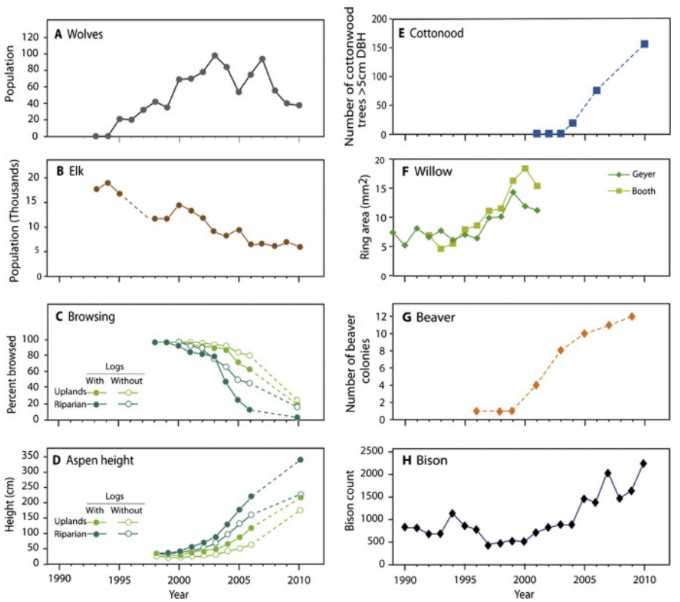
What was Wolf reintroduction was partly justified by?
the idea of reversing a Trophic Cascade
However, reintroduction of wolves to Yellowstone was an equivalent perturbation to?
removing them in the first place