L21 Evolution of development
 Studied by 0 people
 Call Kai
 Learn
Learn Practice Test
 Spaced Repetition
 Match
Match Flashcards
 Knowt Play
1/31

There's no tags or description
Looks like no tags are added yet.
Name | Mastery | Learn | Test | Matching | Spaced | Call with Kai |
|---|
No study sessions yet.
32 Terms
What is evo-devo?
way of saying "the evolution of development"
Why do we want to study evo-devo?
Darwin even noticed that changes in how organisms develop could provide a means for evolution:
- "Any change in the embryo or larva will almost certainly entail changes in the mature animal."
- "Hardly any point gave me so much satisfaction when I was at work on the Origin as the explanation of the wide difference in many classes between the embryo and the adult animal, and the close resemblance of the embryos within the same class."
How did Haeckel (1860s/70s)interpret his observations wrong?
- "Ontogeny (development) recapitulates phylogeny"
- We evolved from a fish that evolved into a reptile that evolved into us, our embryos physically echo that history, passing through a fish-like stage and then into a reptile-like stage.
- Although this isn't true (human embryology isn't just an 'extension' of reptile embryology) he did make some excellent diagrams (and he faked a few too!)
What is being studied in evo-devo?
Evo-Devo is the study of how development evolves and determines the relationships between species based on their development
What have we learnt through the study of evo-devo?
Through the study of evo-devo we have learned:
- just as evolution tends to create new genes from parts of old genes, evolution alters developmental processes to create new and novel structures
- a similar developmental program in unrelated organisms can be conserved to give rise to the same phenotype
Why can evo-devo be described as a developmental toolkit?
Just as evolution tends to create new genes from parts of old genes, evolution alters developmental processes to create new and novel structures
- Changes in developmental pathways (e.g. timing and location of gene expression) can be modified to change the resultant phenotype
What are HOX genes?
- Homeobox protein binding domain-containing genes
- Control the animal body plan
- Control the fate of the segments (but do not create the actual features of the segments)
- HOX mutants show homeotic transformations (the transformation of one organ into another)
How many HOX genes are in drosophila?
8
- they are spatially and temporally organised
What is the model species used to investigate HOX genes?
Drosophila
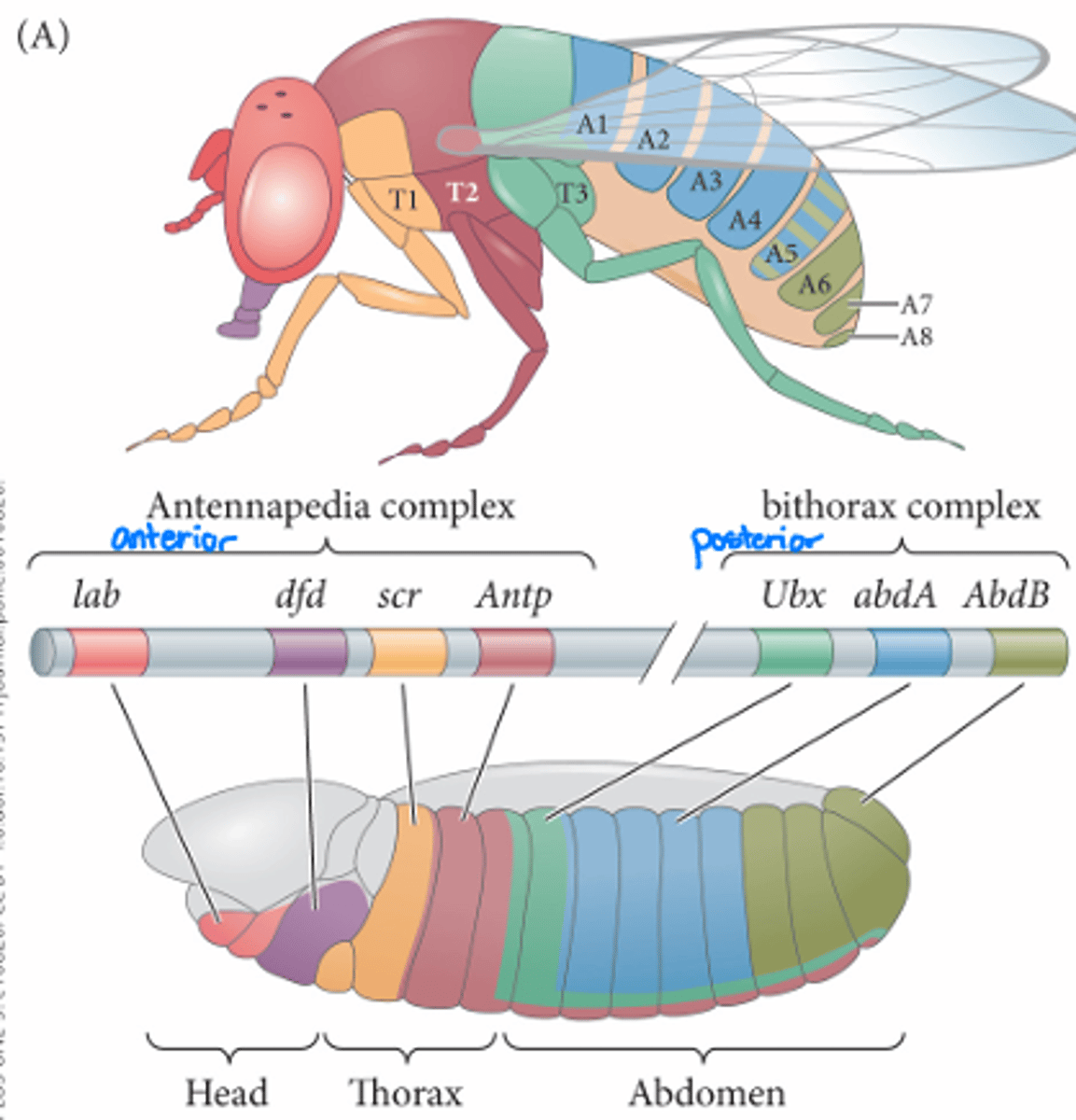
How are the hox genes often named?
After their mutants

How many copies of hox genes are in humans?
2-4 copies
What can you see if u compare the HOX genes in drosophila and humans?
• HOX genes in animals
• 2-4 copies in humans - some copies maintained and some lost
• Gene order preserved
• Expression position preserved
• Conserved pattern
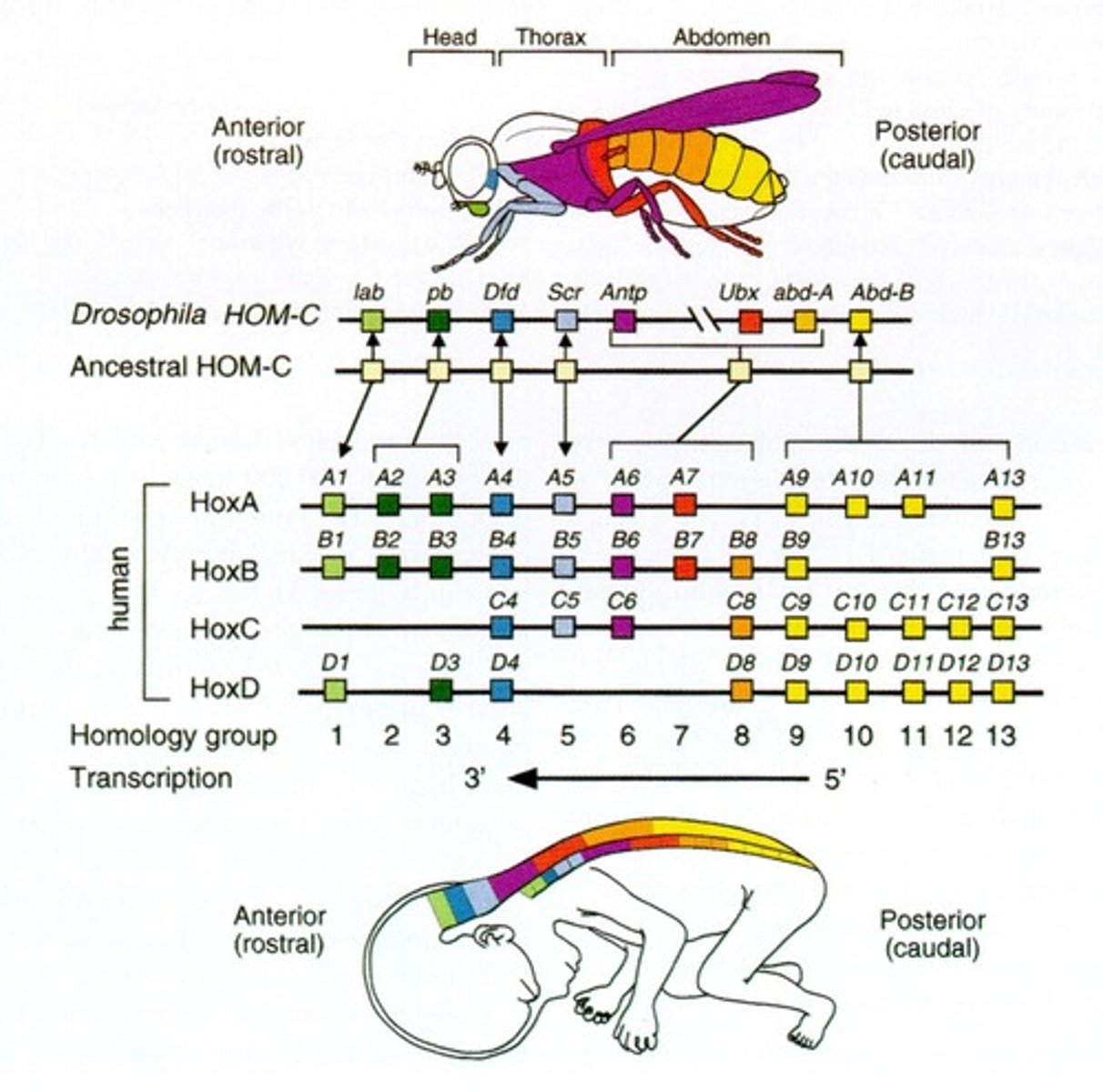
Why are their large changes in the development in flies and humans?
Changes in the development of flies vs. humans have taken place due to changes in the timing and position of HOX genes
- HOX genes still determine which segment will do what
What is the evolution of flowers?
evolved once during evolution of plants
This:
- Allowed pollination by animals
- Allowed speciation (floral incompatibilities: think back to the Mimulus example)
- Gave rise to an amazing evolutionary radiation
How is the basic plan of all flowers encoded?
The basic plan of all flowers is encoded in a very simple way (despite them being very different)
The ABC model of floral development
What is the basic structure of a flower? How do genes give rise to this?
If A expressed = sepal
If A and B = petals
if B and C = stamen
If C = carpel
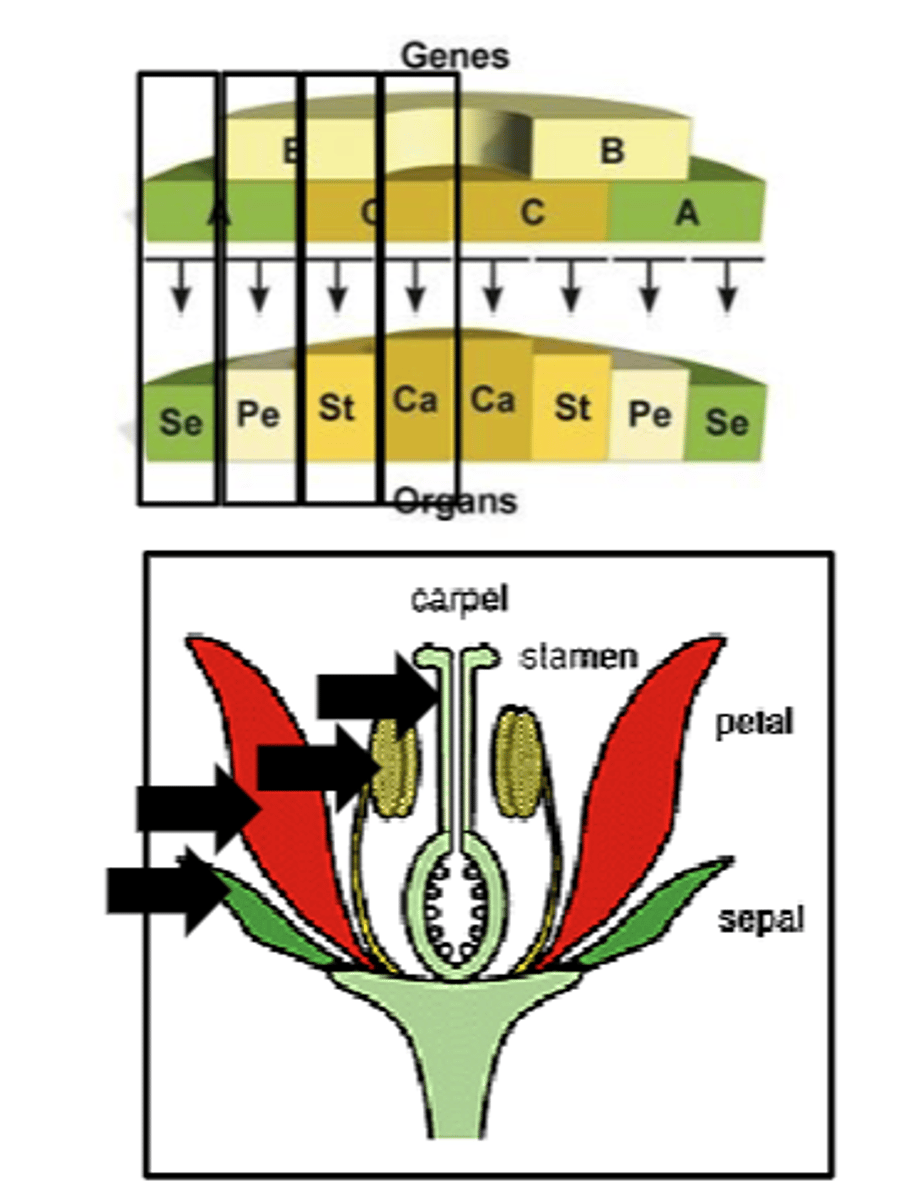
What would happen if there is no A expression?
C expressed all way across
B normal place
Just carpel and stamens (no petals)
apetela
What would happen if no B?
Only A and C next to each other
Only sepals and carpels (no petals)
Apetala or pistillata
What is no C expressed?
No carpels
agamous
What does these mutations show?
show homeotic transformations (transformation of one organ to another?
What are the MADS box genes?
MADS box genes are the HOX's of the plant world
- M = MCM1 (yeast)
- A = AGAMOUS (Arabidopsis)
- D = DEFICIENS (snapdragon)
- S = SRF (humans)
1-5 members in animals and fungi, >100 in plants
What do the MADS box genes regulate?
Regulate many aspects of plant biology
- Floral initiation
- Floral development (know your ABCs)
- Root, pollen and seed development, vernalisation, response to hormones
How can evo-devo be used in the terms of convergent evolution?
A similar developmental program in unrelated organisms can be conserved to give rise to the same phenotype
• Genes are 'recruited' more than once to give rise to the same phenotype
e.g. Pax6 and eye development
What is shown by the convergent evolution of the Pax6 gene?
Many groups evolved complex eyes independently
• Best studied comparison is eye development in arthropods and vertebrates
- Same 'master gene', Pax6, is crucial to eye formation
- Pax6 controls assembling of a photosensitive cell with a pigment cell
• Present in the ancestor of all animals and 'recruited' where eyes evolved
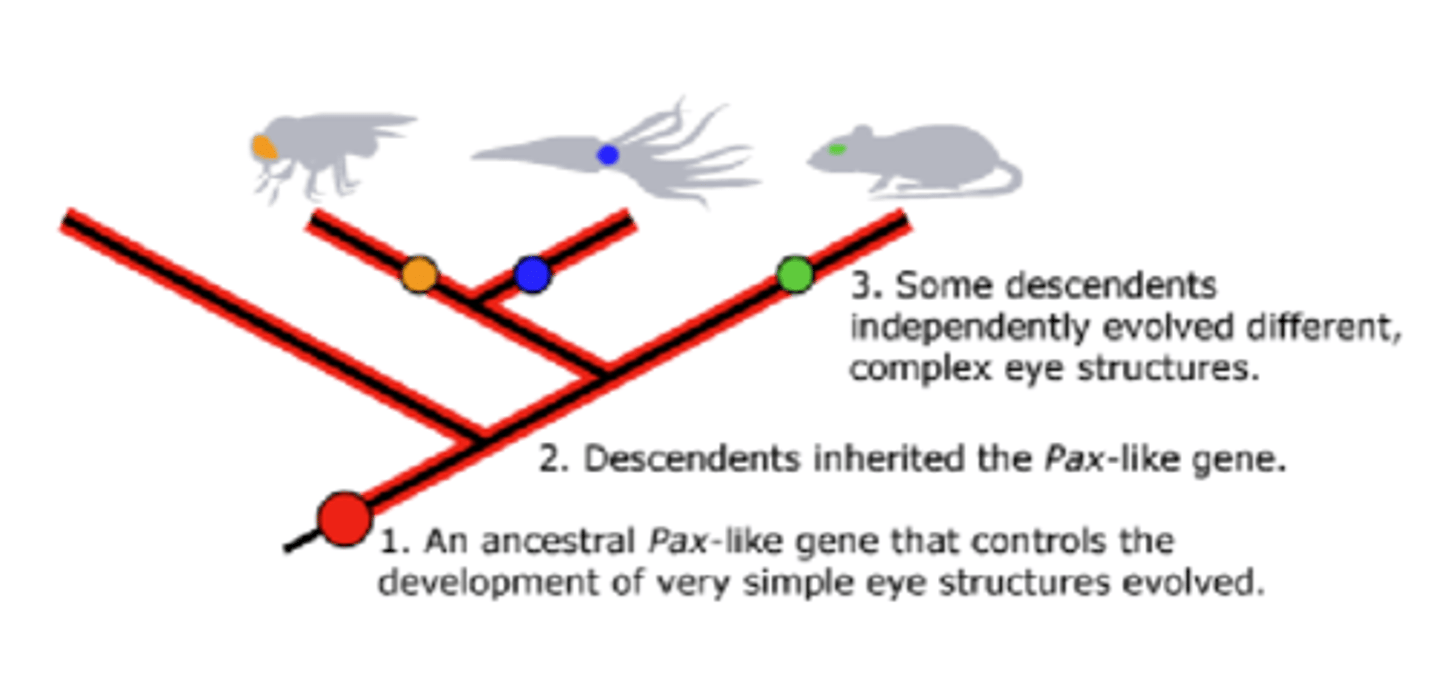
What happens if you get rid of the Pax6 gene?
will form a mutant eye so wont function
Whats an example of convergent evolution in plants?
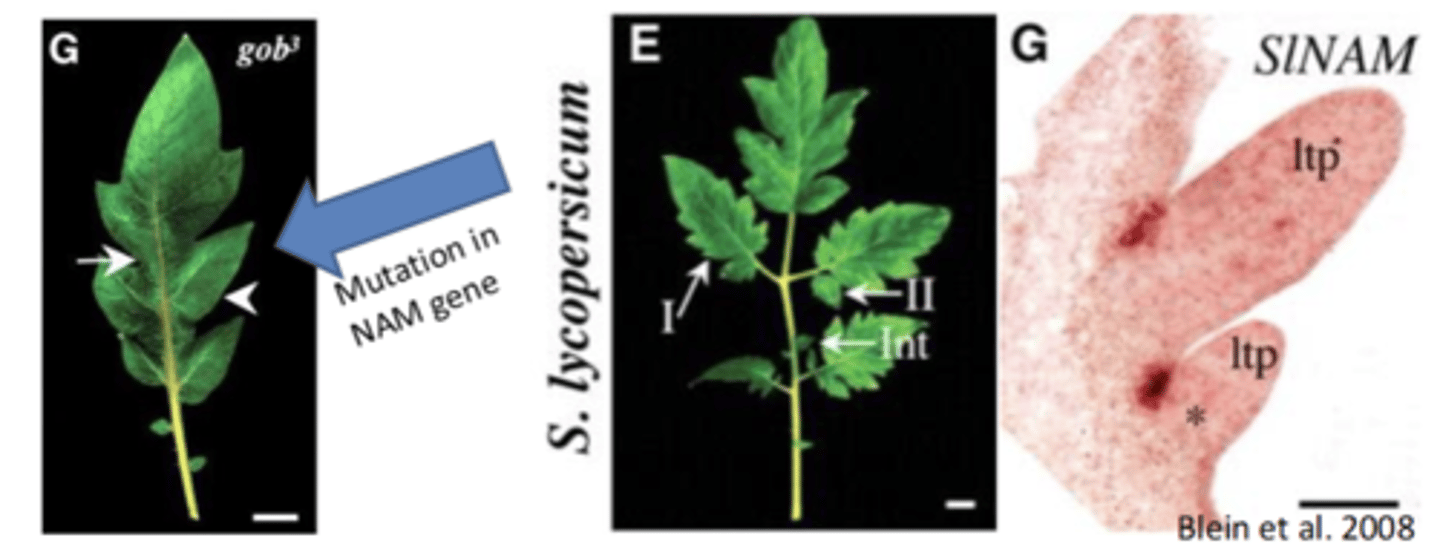
Compound leaves and floral zygomorphy (symmetry)
NAM and CUC genes in diverse plants
• These proteins repress growth, giving rise to indentations in the leaf margin
How has floral symmetry evolved?
• Floral zygomorphy (Left-Right symmetry) has evolved >38 times during angiosperm evolution (very common)
• Groups with zygomorphic flowers tend to have more species (selection on insect pollinators), e.g. Asteraceae, Orchidaceae, Fabaceae
What are the genetics of floral symmetry?
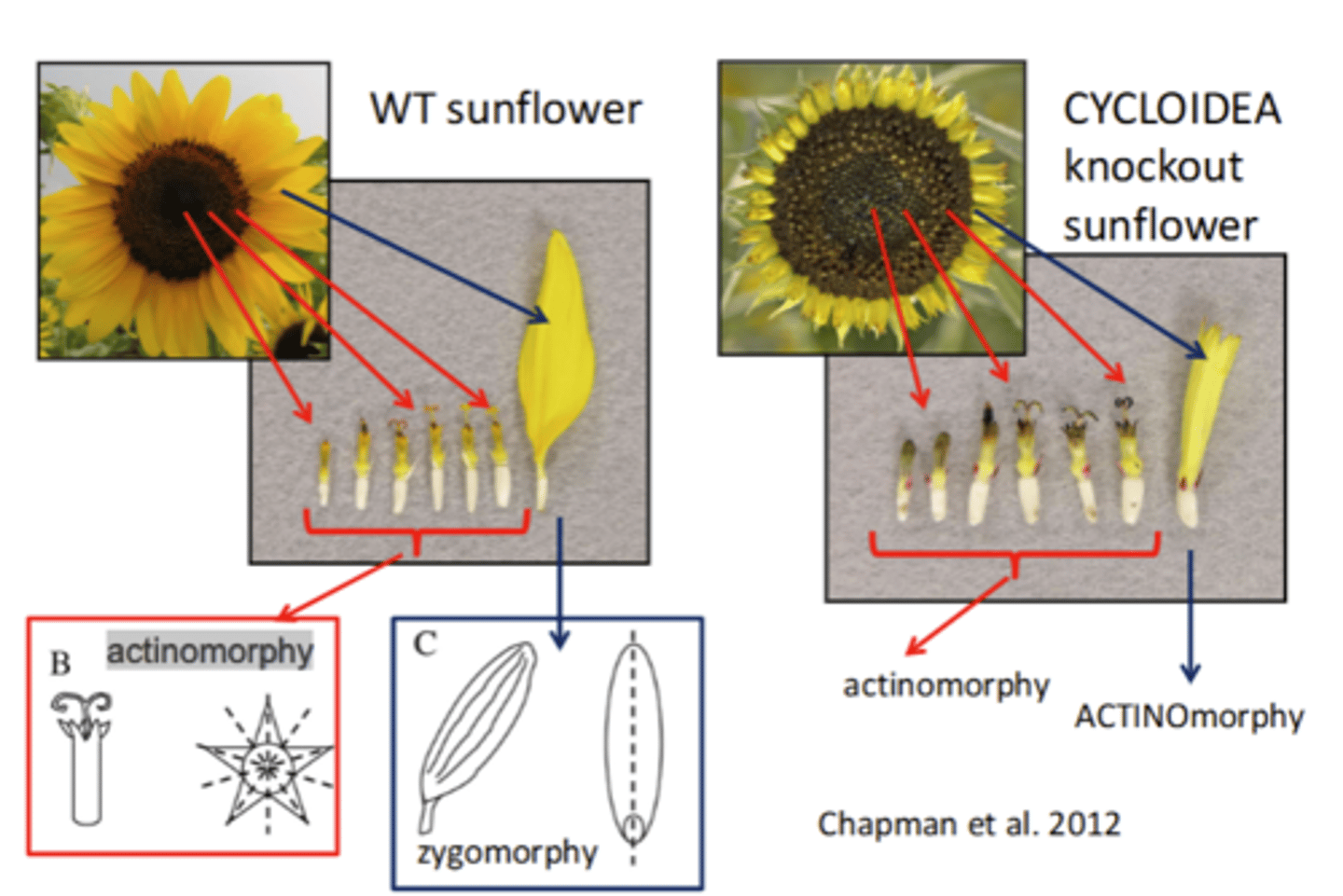
Wild Type has = Zygomorphic symmetry
Then if 2 cycloidea genes knocked out:
You get Mutant = Actinomorphic (radial symmetry)
What are the genetics of floral symmetry in a sunflower?
In Wild type: has many florets that make it up - has left right symmetry and radial symmetry (Zygomorphy and actinomorphy)
But if knockout Cycloidea
Florets are more tubule
Instead has actinomorphy and actinomorphy so loose left right symmetry
In what was the genetics of floral symmetry first discovered?
In snapdragon
What do cycloidea genes infer?
Left right symmetry
Conversion of actinomorphic to zygomorphic
What are examples of where The same gene can be recruited multiple times to confer the same phenotype in unrelated organisms?
e.g. Pax6 and CYCLOIDEA