Identity & Style
 Call Kai
 Learn
Learn Practice Test
 Spaced Repetition
 Match
Match Flashcards
 Knowt Play
1/10

There's no tags or description
Looks like no tags are added yet.
Name | Mastery | Learn | Test | Matching | Spaced | Call with Kai | Chat |
|---|
No analytics yet
Send a link to your students to track their progress
11 Terms
identity
• Each individual has multiple identities and chooses
which one to use depending on the context
• Identity might change over time, with
circumstances, situations and people
• We might have identities within us that seem
contradictory
Situational identity choice based on:
• Covert and overt prestige
• Ingroup/ outgroup
five types of identities
• Psychological Identity
• how we perceive ourselves mentally and emotionally
• Individual Identity
• who we think we are at our core
• Social Identity
• how we portray ourselves in a social situation
• Collective Identity
• groups that we feel we belong to
• Cultural Identity
• cultural groups that we feel we belong to
Internal language
Language that allows us internally to shape our identities
External language
Certain words, selected both consciously and subconsciously, to
present ourselves externally to the world around us
Style & Style-shifting
Dialect/Idiolect
- Dialect = variety of a standard language
- use dialect or standard language → be perceived as part of a group or not
part of a group
- Idiolect = individual’s own unique use of language that is developed over time
(includes favourite words or expressions)
- use idiolects consciously or sub-consciously to express identity
- Dialect levelling = consciously learning the standard language, and choosing
to use it rather than a dialect, in order to fit in with a group
- Accent reduction (pronunciation aspect of language) = speaker can choose to
learn how to use a specific language with native pronunciation in order to
change how they are perceived by those around them
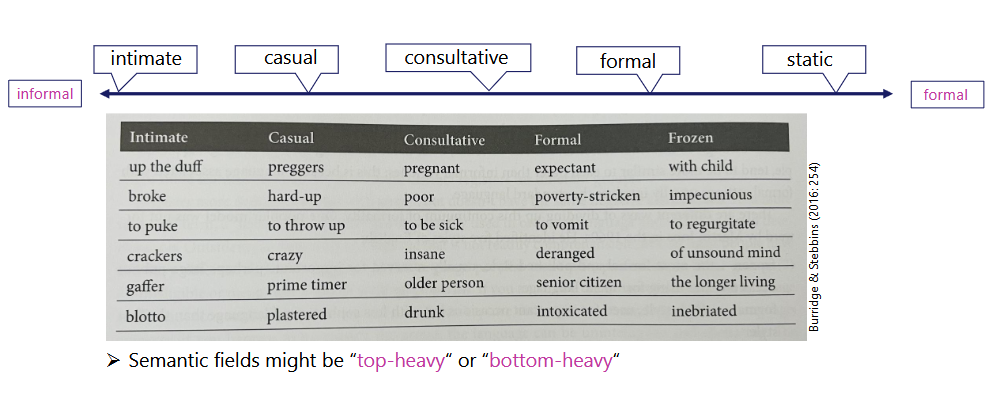
5 main categories of style
Static/Frozen: A formal set of language use that never changes or changes only marginally
➢ The Lord’s Prayer, constitutional documents, legal documents
Formal: A very formal, one-way style of communication
➢ speeches, lectures, pronouncements
Consultative: Used in groups of two or more people where one person provides information or advice
➢ doctor - patient, lawyer - client
Casual: An informal style of communication used amongst people who are socially equal (friends or peers)
➢ inside jokes, vocabulary that is unique to the group, common specific phrases
Intimate: An informal style of language used between people who are very close, such as family members or
spouses that is characterized by emotional communication
Audience design
Influence of the addressee on style
• Age of addressee
• Social background/status of addressee
• Relationship to addressee
• Language of addressee (variety, proficiency, …)
• Topic of conversation
speech convergene
consciously attuning your style of language to a group in order to fit in.
When people talk to each other, their speech often becomes more similar = one person’s speech converges
towards the speech of the other person
→ Speech accommodation
Happens
• when people like each other
• when one wants to please the other
• when one wants to put the other at ease
→ Polite speech strategy: addressee’s speech is acceptable and worth imitating
speech divergence
exaggerating your language style in order to strongly reinforce lack of membership in a
group.
Deliberately choosing a language not used by one’s addressee = speech divergence
Reasons
• Political statement (e.g. minority linguistic groups using their variety: Māori in court)
• Accent divergence: signal wish to distinguish themselves
• Not always indicator of negative attitude! If divergent forms admired, divergence used to benefit the diverger
Divergence from both styles (own and addressee’s) towards style of third party for special effect = referee design
(a third party is referred to although they are not present)
• Example: imitate teacher for amusement, imitate speech of migrant parent
speech maintenance
maintaining your language style in order to reinforce lack of membership in a group
stylisation
going beyond the usual ways of speaking/ behaving and engaging in a ‘high‘ or ‘strong‘ performance
→ Comedians and singers (New Zealand singer using US accent; Drag queens using features of stereotypically
feminine speech to perform a differently gendered identity)