CHAPTER 6
0.0(0)
Studied by 2 people Call Kai
 Learn
Learn Practice Test
 Spaced Repetition
 Match
Match Flashcards
 Knowt Play
Card Sorting
1/32

Earn XP
Description and Tags
Last updated 9:46 PM on 3/8/23
Name | Mastery | Learn | Test | Matching | Spaced | Call with Kai |
|---|
No analytics yet
Send a link to your students to track their progress
33 Terms
1
New cards
Is an exergonic reaction spontaneous or non-spontaneous?
Spontaneous
2
New cards
In an exergonic reaction, are the reactants favored or are the products favored to form?
Products
3
New cards
In an exergonic reaction, will heat energy be absorbed or released into the environment?
release heat
4
New cards
In an exergonic reaction, will the ΔG be positive or negative?
negative
5
New cards
How would an enzyme affect the rate of an exergonic reaction; (increase or decrease) the rate?
increase
6
New cards
A reaction has a ΔG = +3.3 kcal/mol; what can you predict about this reaction?
Endergonic
non-spontaneous
reactants favored
all energy absorbed
non-spontaneous
reactants favored
all energy absorbed
7
New cards
When chemical bonds between atoms are formed, will energy need to be added or released?
released
8
New cards
How are chemical bonds between atoms broken; will energy need to be added or released to break a bond?
added
9
New cards
The strength at which a chemical bond holds two atoms together is referred to as
bond strength
10
New cards
The energy required to break a bond is referred to as
bond energy
11
New cards
What type of energy is stored between the atoms of covalent bonds?
chemical potential energy
12
New cards
Name two forms of energy that are important to Biology?
light and heat energy
13
New cards
What does it mean when a reaction has met chemical equilibrium?
when the rate of the formation of the products is the same as the rate of the formation of the reactants
14
New cards
What is an oxidation reaction between atoms?
redox reaction:
when one atom loses an electron
when one atom loses an electron
15
New cards
What is a reduction reaction between atoms?
redox reaction:
when one atom gains an electron
when one atom gains an electron
16
New cards
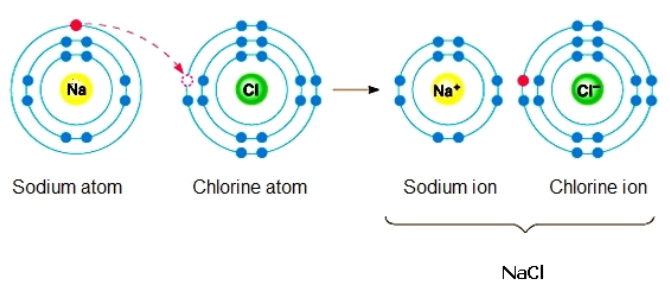
In the following reaction, has Sodium been oxidized or reduced? Has Chlorine been oxidized or reduced?
NA: oxidizes
CL: reduced
CL: reduced
17
New cards
Organic molecules are broken down when they are no longer needed, what is this process called?
Catabolism
18
New cards
Organic molecules are only synthesized from smaller precursor molecule when they are needed, what is this process called?
Anabolism
19
New cards
Competitive Enzyme Inhibitor
will mimic a substrate and will “race” for the active site of an enzyme. If the competitive inhibitor gets to the active site of the enzyme first, then the substrate cannot bind. The competitive inhibitor will “fit” into the active site of the enzyme, but no product will be produced.
20
New cards
Non-Competitive Enzyme Inhibitor
will bind to an allosteric site on the enzyme, and once it binds, the active site of the enzyme will be changed, and the substrate will not fit into the active site.
21
New cards
What are the characteristics of an enzyme?
Catalyst Protein that speeds up chemical reactions
22
New cards
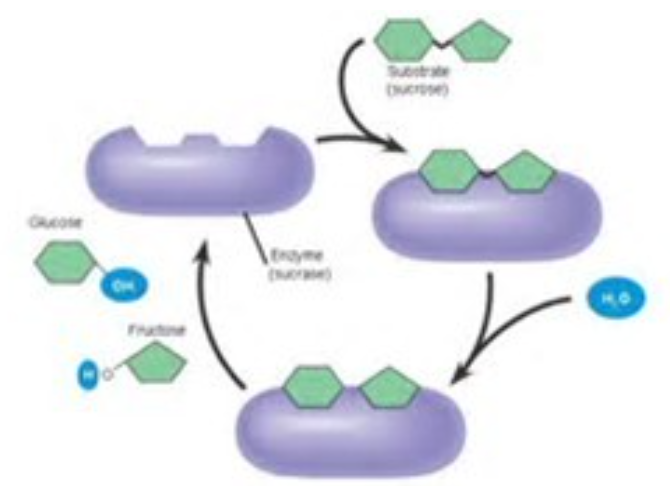
What are the steps of the catalytic cycle of an enzyme?
1. Active Site Empty
2. Active Site
3. Induce Fit
4. Reaction with product formation
5. Release of products
6. Active site empty again
23
New cards
In a catalytic reaction: Is the enzyme used up in the reaction?
NO
24
New cards
In a catalytic reaction: Does the enzyme become part of the reaction?
NO
25
New cards
In a catalytic reaction: Does the enzyme become part of the products?
NO
26
New cards
In a catalytic reaction: Does the enzyme add energy to the reaction?
NO
27
New cards
In a catalytic reaction: Can an enzyme react with many different substrates?
??????yes
28
New cards
In a catalytic reaction: Can an enzyme be denatured? If so, what type of factors will denature them?
Yes! Temperature and pH
29
New cards
Some enzymes work optimally with a cofactor; give an example of a cofactor.
Zinc, Iron, Vitamin B12, Vitamin B6
30
New cards
In a catalytic reaction: Some enzymes work better if they have a “side kick” such as B12 or Zinc; what are these called?
??????Cofactors
31
New cards
What does the First Law of Thermodynamics state about energy?
energy cannot be created or destroyed it can only be converted from one form to another
32
New cards
What does the Second Law of Thermodynamics state about the entropy (disorder) of a system as a result of an energy conversion; is entropy increased or decreased?
in an energy conversion entropy will always be increased
33
New cards
What is a coupled reaction?
when an endergonic reaction combines with an exergonic reaction (or uses the energy from an exergonic reaction) to drive both reactions forward to spontaneously produce product