Drug Induced AW
 Call Kai
 Learn
Learn Practice Test
 Spaced Repetition
 Match
Match Flashcards
 Knowt Play
1/28

There's no tags or description
Looks like no tags are added yet.
Name | Mastery | Learn | Test | Matching | Spaced | Call with Kai | Chat |
|---|
No analytics yet
Send a link to your students to track their progress
29 Terms
Examples of drug induced diseases
-HIT: heparin induced thrombocytopenia
-TdP: Torsades de Pointes
-ILD: interstitial lung disease
HIT pathophys
-Heparin induced thrombocytopenia
-Immune complication of heparin therapy caused by antibodies to complexes of platelet factor 4 (PF4) and heparin
-Antibodies cause the platelet complexes to clump together and form thrombi
Risks of HIT
-Thrombosis: usually venous thrombi
-Atypical presentations: bilateral adrenal hemorrhage, venous limb gangrene, skin necrosis
Diagnosing HIT
-Occurs ~5-14 days from start of heparin therapy (within 1 day if heparin reexposure occurring
4T scoring system calculation
-Timing of heparin therapy
-Complications of thrombocytopenia and thrombosis
-Exclusion of other causes
-Categorizes HIT likelihood based on cumulative score
-0-3: low risk
-4-5: intermediate risk
-6-8: high risk
4T scoring system accuracy
-Low risk outcome is usually accurate
-Intermediate to high risk outcome may be less accurate at predicting disease
HIT expert probability score
-Developed by Cuker and colleagues
-Utilizes 8 clinical features and broad expert opinion to assign clinical significance
HIT expert probability score accuracy
-Still undergoing prospective validation
-Tentative improved correlation with serologic HIT testing and improved inter-observer agreement compared to 4Ts score
Lab diagnostics of HIT
-Necessary for diagnosis
-Platelet activation assays
-Immunoassays
Platelet activation assays
-AKA functional assays
-C-SRA, platelet aggregation
-High specificity >95% (correctly rules out people who don't have HIT)
-Lower sensitivity 56-100% (low ability to identify people who have HIT)
Immunoassays
-Measure presence of anti-PF4/heparin antibodies
-Use enzyme-linked immunosorbent assays, particle gel, immunoturbidimetric, etc.
-High sensitivity >99% (correctly identifies those with HIT)
-Low specificity 30-70% (low ability to rule out those without HIT)
Treating acute HIT
-D/C heparin
-IV direct thrombin inhibitors are preferred agents in critically ill
-Overlap with vitamin K antagonist only after platelets recover to stable baseline or > 150x10^9 (heightened risk of gangrene if given too early)
-Long term therapy: anticoagulation for 4 weeks if isolated HIT, and 3 months for HIT with thrombosis
Aragatroban
-Direct thrombin inhibitor for the treatment of HIT
-Hepatically cleared, need dose adjustment in liver impairment
Monitoring argatroban
-Monitor aPPT to decide dose adjustments
-Hemoglobin, hematocrit, s/s of bleeding
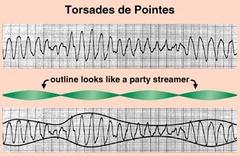
Torsades de Pointes
-Twisting of the Points
-Life threatening rapid heart rhythm in the lower chambers of the heart that create a twisting pattern in an ECG
-Caused by excessive QT prolongation
TdP ECG
Risk factors for TdP
-Electrolyte imbalances (hypokalemia, hyponatremia, hypocalcemia, hypomagnesaemia)
-Female
-Increasing age
-Time of day (diurnal variation)
-Myocardial ischemia, cardiomyopathies
-Hypothyroidism
-Obseity
-HTN
Drugs affecting QT interval
-Haloperidol
-Phenothiazines (chlorpromazine, promazine, fluphenazine, etc.)
-Azole antifungals
-Amiodarone (rarely causes TdP)
-And many more
Normal vs abnormal QTc
-Abnormal in men: QTc >450 ms
-Abnormal in women: QTC > 470 ms
-QTc >5000 is significant risk of TdP
Correction of the QT interval
-IV mag sulfate
-Electrical cardioversion
-D/C medications that prolong QT interval
DIILD
-Drug induced interstitial lung disease
-Exposure to a drug causes inflammation and eventually fibrosis of the lung interstitium
Drugs likely to cause ILD
-Amiodarone
-Nitrofurantoin
-Bleomycin
-Methotrexate
Bleomycin
-Treats Hodgkin's lymphoma
-6.8-21% risk, 48% mortality rate
-May be asymptomatic
MTX
-0.3-2.1% risk
Nitrofurantoin
-Accounts for 16-48% of the adverse events
-Reaction can occur within days to hours of nitrofurantoin exposure
Amiodarone
-One of the most common causes of DIILD
-1.2-8.8% incidence
-Especially with high doses of over longer periods of time
Types of ILD amiodarone can cause
-Subacute DIILD is most common
-Acute frequently fatal form can occur
-37% mortality rate
ILD treatment
-Remove offending agent
-Corticosteroids: limited data
-Wide variety of efficacy with GC
Glucocorticoids in treatment of amiodarone induced ILD
-1 mg/kg
-76% response but no obvious difference in survival outcomes