ib 204 - exam 1
 Call Kai
 Learn
Learn Practice Test
 Spaced Repetition
 Match
Match Flashcards
 Knowt Play
1/68

There's no tags or description
Looks like no tags are added yet.
Name | Mastery | Learn | Test | Matching | Spaced | Call with Kai | Chat |
|---|
No analytics yet
Send a link to your students to track their progress
69 Terms
Origin - we don’t know how this melts in eukaryotes
what is labeled at A?
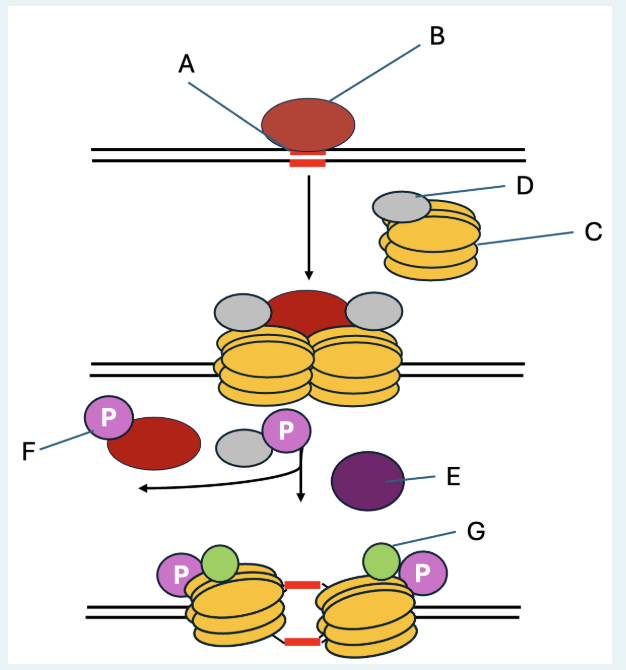
what is labeled at B?origin
what is labeled at B?

what
what is labeled at G?
Eukaryotic chromosomes have….
Multiple origins of replication, distributed across the length of a chromosome; end replication bc of losing small piece of dna every round of replication (primer)
Which of the following statements are true in relation to prokaryotic DNA replication:
I. DNA is melted by an initiator protein.
II. Helicase needs to be activated after binding to exposed DNA.
III. Occurs during S-phase of the cell cycle
I is true
Sustained cell division is one of the six hallmarks of cancer, given your understanding predict which of the following contribute to this by stimulating DNA replication:
I. A mutation which impairs binding of ORC to origins.
II. A mutation which increases the amount of MCM2-7 in cells.
III. A mutation which increases phosphorylation of ORC.
II
Apply your understanding of prokaryotic DNA replication to determine which of the following genetic regulatory mechanisms is primarily used by the initiator protein during replication?
protein + DNA interaction
What is the impact of phosphorylation on the ORC?
It releases ORC from the origin and prevents it binding again
Apply your knowledge of eukaryotic DNA replication to state at which stage of the cell cycle MCM2-7 helicase will be unphosphorylated?
G1 phase — when its phosphorylated, that means synthesis phase
Which of the following is true of melting of the DNA (formation of a replicative bubble that separates the two strands of the helix) in eukaryotes?
It's precise mechanism is unclear
What is the impact of phosphorylation on the ORC?
It releases ORC from the origin and prevents it binding again
The end replication problem refers to difficulties in copying linear chromosomes, this is overcome by the activity of telomerase, which:
Elongates the parental strand at the 3’ end using an RNA template
what do telomeres do?
they act as sacrificial buffers
The need for a 3' hydroxyl group to catalyze DNA synthesis is problematic because RNA primer removal leaves a gap at the end of chromosomes, this occurs on which strand, or strands:
I. leading strand
II. lagging strand
II
The Hayflick limit states that cells stop dividing after
60 divisions
Overexpression of telomerase can increase the longevity of mice. However, there is concern over replicating this approach in humans, apply your knowledge of telomere biology to indicate why there is concern:
Overexpression of telomerase could lead to lengthening of DNA ends and uncontrolled cell division
what types of cells have a lot of telomerase?
cancer cells and infant cells
what is the function of hTERT and hTERC?
TERT is the protein engine of the enzyme; TERC is the RNA template TERT uses to correctly build DNA repeats
telomere
structure that protects loss of coding information during DNA replication
telomeric repeats
non-coding dna — influences how many times a cell can divide
telomerase reverse transcriptase
protein with RT activity required to elongate template (G) strand
what is pol-a primase?
it is an enzyme complex that synthesizes DNA on C-strand


RNA primer
provides 3’OH group for DNA synthesis on lagging strand
embryonic cells
differentiating cells that multiply to produce a fetus
heart muscle cells
specialized cells that contain lots of mitochondria to prevent fatigue
do RBCs have a nucleus?
no they are anucleate
what should you do if given coding dna strand?
just switch the T to U then use codon chart
what are causes of mutations
errors in DNA replication, damage, imperfect DNA repair
origin of repetitive sequences
copied from a short RNA template during development
how much exposure to chemical is required to guarantee development of cancer?
5 years
first experiment of toxins and cancer
Repeated application of coal tar onto the ears of rabbits
The mutagenic potential of a compound can be quickly screened using the Ames test, from the text, which of the following statements describe the outcome of the test.
In a positive result, bacterial mutants gain the ability to GROW in the ABSENCE of histidine confirming a compound is MUTAGENIC and therefore potentially carcinogenic
what three pieces of evidence are required to define a carcinogen?
short-term cell assays (ex: Ames test —> positive), long term animal tests, epidemiology
potential outcomes of DNA damage
damage gets repaired, mutation is introduced, cell death (apoptosis)

mismatch repair
DNA polymerase (3’ to 5’ exonuclease activity), matching incorrectly inserted bases
nucleotide repair
a vital cellular pathway that fixes bulky, helix-distorting DNA damage caused by ultraviolet (UV) light and chemical carcinogens
base excision repair
remove damaged base and repair nucleotides

DNA glycosylase
does first 3 steps of BER, scans for damaged bases, recognizes specific wrong base (G* for exampe), cuts glycosidic bond between base and phosphate backbone, leaves AP site (empty)
AP endonuclease
removes sugar phosphate backbone
DNA Pol 1
remove primers and add individual nucleotides — BER: synthesize new DNA by adding the correct nucleotide(s) in the gap, using the undamaged complementary strand as a template

DNA ligase
seal the gap; forms new bond at 3’-OH
deamination
spontaneous loss of amino group — cytosine becomes uracil

reactive oxygen species
they can react/attack guanine to make 8-oxoguanine to pair with adenine, transversion mutations opor (high oxidation stress)

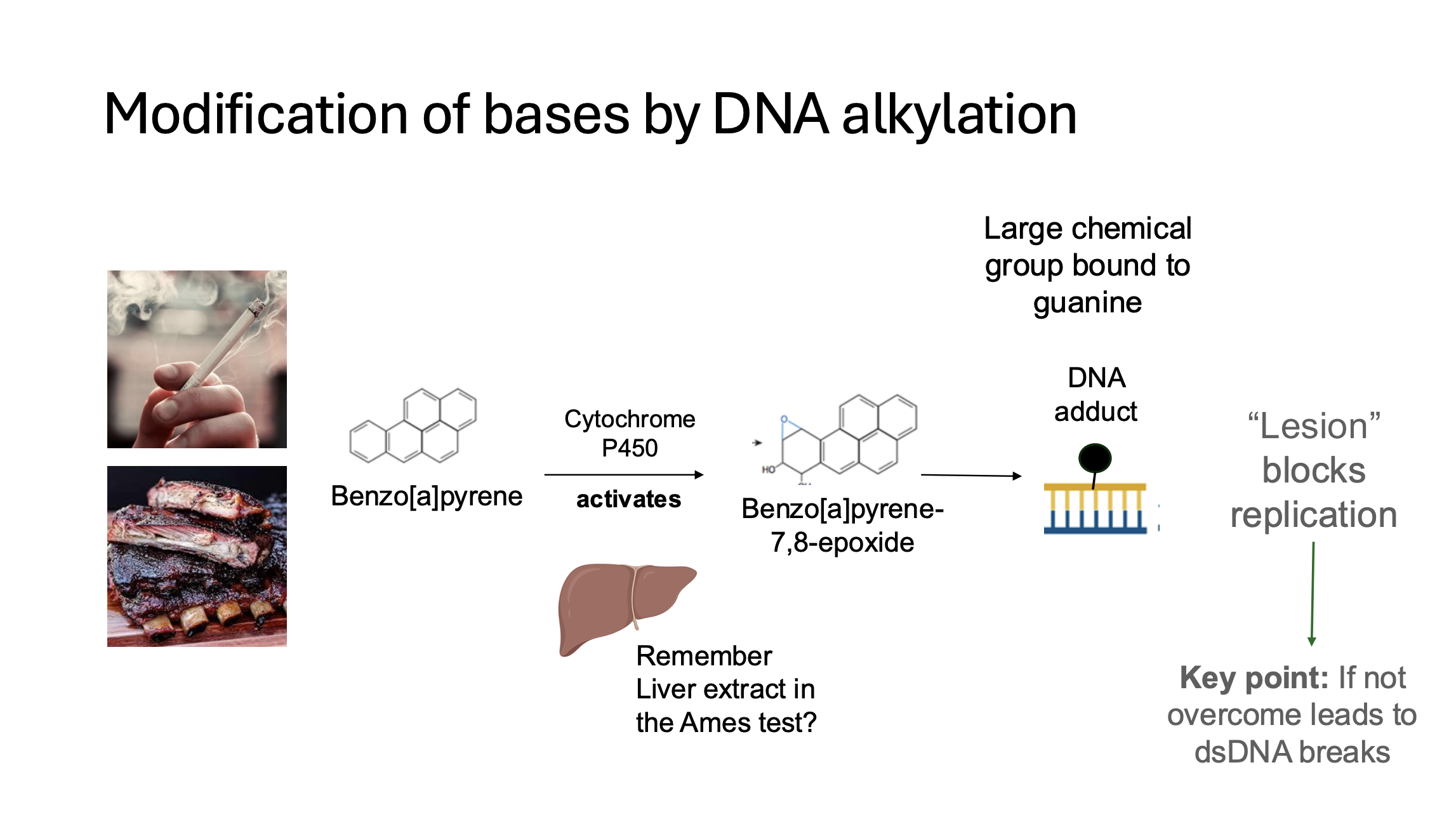
dna alkylation
addition of large chemical compounds to the DNA backbone that frequently cause replication fork stalling and double stranded DNA breaks
benzo[a]pyrene
its the one found in grilled/charred meats, leads to mutations, can lead to G —> T mutational signature
UV damage
leads to creation of pyrimidine dimers —> replication stalling forms lesion that blocks replication —> will lead to dsDNA breaks
PCNA
sliding clamp that holds DNA polymerase onto DNA strand itself, helps regulate which DNA polymerase is associated; gets ubiquitinated with DNA stress/damaged + TLS pol becomes attached
RFC (replication factor c)
used ATP to pry the PCNA ring open, place it around the DNA at the primer-template junction, and then close it around the strand
translesion dna polymerase
-able to bypass blockage, involved in DNA replication
-error prone, attaches to PCNA, can throw extra adenines to help with thymine dimers w/ mutations
ubiquitin
acts of a signal to regulate protein-protein interactions (switch out DNA epsilon)
non-homologous end joining
repairs double stranded breaks without a template, fast, can introduce mutations
somatic mutation theory of cancer
process of tumor development do mutations in DNA repair genes occur in the beginning or early stages of formation of a tumor; cancer requires 4 or more genes
how does air pollution cancer?
by stimulating an inflammatory response that activates cells with pre-existing mutations
retinoblastoma
inherited recessively and tumor suppressor gene
cell cycle checkpoint
decision point in cell cycle where favorable conditions must be met to continue —> progression or termination
E2F
activates transcripton of genes involved in DNA replication

CDK (cyclin-dependent kinase)
always present throughout the cell cycle requires cyclin for activity

cdk-cyclin complex (active)
phosphorylates proteins to overcome cell cycle checkpoints
RB gene
inhibits cell cycle progression
G1
time when cell is preparing for DNA synthesis

synthesis phase
DNAis being replicated
what does rb do for cell cycle?
it regulates it and inactivates it

viral-induced tumors
Retroviruses can pick up fragments of proto-oncogenes from host genomes and cause cancer during subsequent infections
mutations leading to formation of oncogenes
gain of function
which repairs are imperfect vs perfect?
nucleotide exicison repair (NER) and homologous recombination are PERFECT; TLS and non-homologous end joining are IMPERFECT