Electrical Properties
 Call Kai
 Learn
Learn Practice Test
 Spaced Repetition
 Match
Match Flashcards
 Knowt Play
1/53

There's no tags or description
Looks like no tags are added yet.
Name | Mastery | Learn | Test | Matching | Spaced | Call with Kai | Chat |
|---|
No analytics yet
Send a link to your students to track their progress
54 Terms
The cells in the myocardium are interwoven, may branch at either end, are joined at their boundaries by structures called __________ which contain ________
The cells in the myocardium are interwoven, may branch at either end, are joined at their boundaries by structures called intercalated disks which contain gap-junctions
Function of gap junctions
permit cell-to-cell conduction of excitation through intercalated discs
Explain the all or none rule in cardiac muscle
A stimulus arising at any point in the ventricle leads to the complete contraction of both chambers
Membrane permeability to Ca2+ is ______ (descriptor)
Very low
Membrane permeability to K+ is ______ (descriptor)
High
Membrane permeability to Na+ is ______ (compared to K+)
10% that for K + (small “inward background” current)
When K+ ions exit the cell, what is inside a cardiac myocyte that leaves behind a negative charge
cardiac myocyte contains negatively charged species (mostly organic phosphates and charged proteins), that cannot pass through the cell membrane
How do ions pass through cell membranes
Membrane channel
conductance (G)
The ease with which the ion passes through the membrane
How is ion conductance defined using R
1/R
R = resistance
GK
GNa
GCa
potassium conductance
sodium conductance
calcium conductance
iK
iNa
iCa
potassium current
sodium current
calcium current
What is required to happen for current to flow
If the conductance for an ion increases, the ion will pass through the membrane and a current will flow
resting membrane potential in contractile cells of the atria and ventricles is (in mV)
-90mV
what 2 things control resting membrane potential
the high concentration of potassium ions in the intracellular fluid
the high permeability of the cell membrane K + ions as compared to other ions
Equilibrium Potential for potassium (EK+) in mV
-94mV
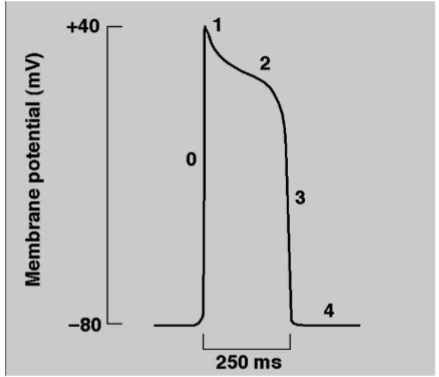
5 phases of cardiac action potential
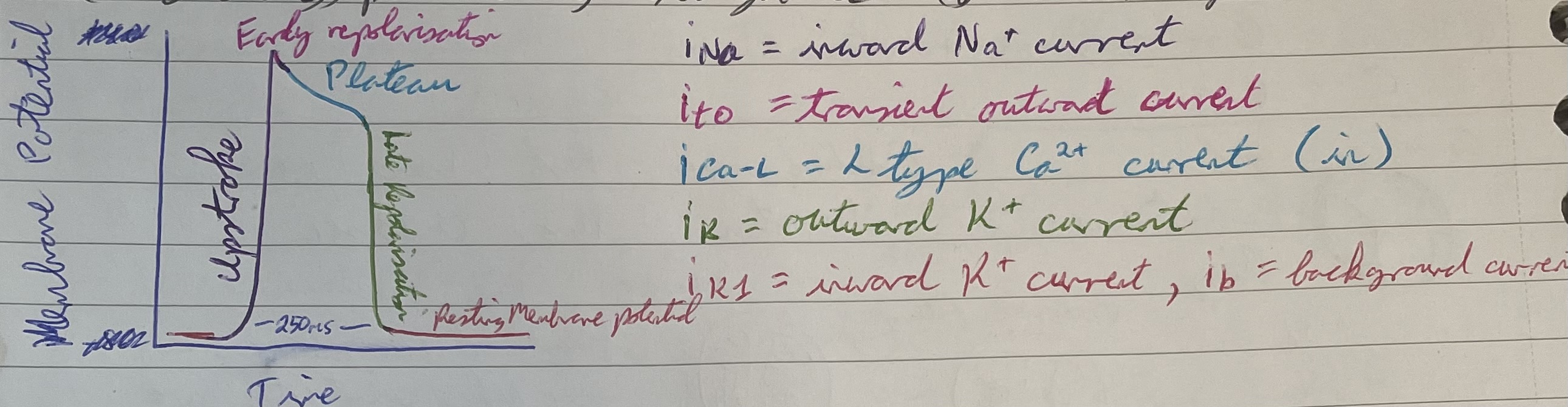
Phase 0 Upstroke
Phase 1 Early repolarisation
Phase 2 Plateau phase
Phase 3 Late repolarisation
Phase 4 Resting membrane potential
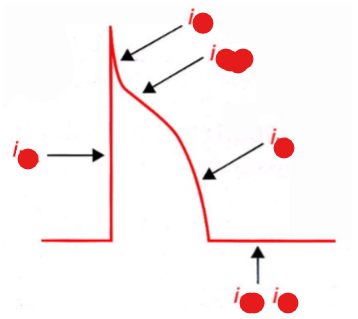
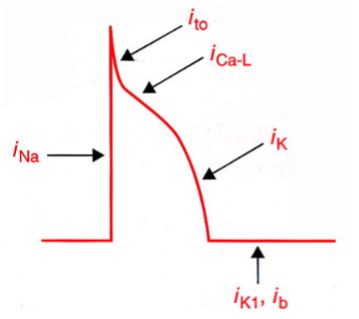
Which ionic currents are at each place
The currents go in, out, in, out, in
ito is K+ out
(NATO CAL(LED)! KK)
Phase 0 potential
-65mV
What happens in Phase 0
Membrane reaches threshold potential
Rapid flux of Na+ ions into the cell
Cell rapidly depolarises (1-2 ms)
Reaches a positive potential of +40mV
In phase 0 why doesn’t membrane potential reach ENa
The outward potassium current is still flowing
(ENa= equilibrium potential for sodium = 60mV)
Explain Phase 1 (why is the overshoot brief)
The overshoot is brief because the fast Na + channels are self- inactivating a decrease in GNa
Within a couple of milliseconds the membrane voltage repolarises a few mV, owing to an outward current of K + ions (ito)
What does the plateau in phase 2 represent
sustained depolarisation at a level slightly lower than peak depolarisation
What produces the plateau
a small sustained inward current of Ca2+ due to the opening of calcium channels (rise in Gca)
Talk about the flow of calcium in and out during the plateau
The calcium channels are voltage- operated channels, which begin to
activate slowly when the cells depolarises to reach their threshold of -30 mV to -35 mV (during rapid depolarization)
In the latter part of the plateau phase, calcium channels are beginning to inactivate
The inward current during this stage is due partly to sodium ions passing in through the sodium- calcium exchanger (Na-Ca exchanger)
What’s the significance of the long duration of the plateau phase (2 points)
1. The cell is electrically unexcitable / refractory for 200-400ms since active contraction of the cardiac muscle lasts only 200-250ms - a fused series of contractions is not possible in cardiac muscle (which would be fatal!)
2. The plateau phase not only initiates contraction but also directly influences the strength of contraction (greater Ca 2+ entry will give rise to stronger force of contraction)
At what mV does excitability return after the refractory period
Returns gradually when membrane potential is about -40mV
2 periods of refraction & duration of each
Absolute refractory period = 200 ms
Relative refractory period = 50 ms
What causes cardiac cells to be unexcitable during the refractory phase
the changes that occur to the fast Na + channel
The fast Na+ channel has 2 gates. What are they
the “m” gate – activation gate
the “h” gate – inactivation gate
(m = move gate. h = hold gate)
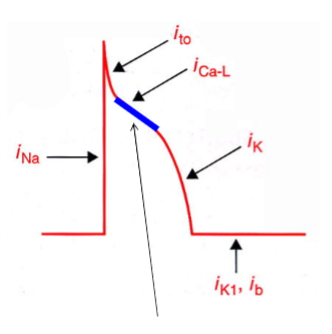
How does iCa almost stabilise the potential at 0mV to -20mV
The inward Ca+ current is almost sufficient to counterbalance the outward K+ current
Role of potassium in phase 3
The potassium conductance (GK) increases towards the end of the plateau phase as the calcium channels inactivate
Potassium leaves the cell generating a potassium current (iK)
This produces a repolarisation towards resting potential
What is phase 4
Resting membrane potential
(remember the phases are 0, 1, 2, 3, 4)
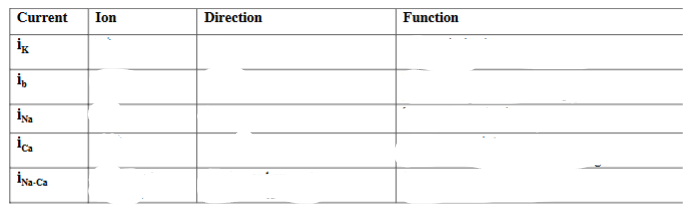
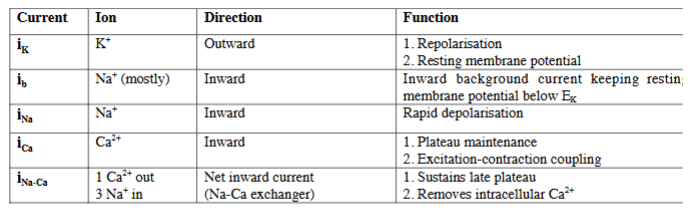
What does the excitation-conduction system consist of
Sinoatrial (SA) node
Atrioventricular (AV) node
Bundle of His
Left and right bundle branches
Purkinje fibres
Of the pacemakers which is dominant
SA node
How does generation of the action potential in the SA node differ from that of excitation of normal cardiac cells
It occurs spontaneously
Pacemaker cells have _____ resting potentials
unstable
The SA node action potential has only 3 phases.
What are they
Phase 4: Pre-potential or pacemaker potential
Phase 0: Upstroke
Phase 3: Repolarisation
initial potential of an SA node cell is about _______ and it _______ spontaneously
–60 mV to –70mV
declines (becomes more positive)
What is pacemaker potential (or pre-potential) - not a number - explain
slowly declining potential (becoming more positive)
What causes the decay of the pacemaker potential over time (2 causes)
An inward Na+ current - if (f is for funny)
The membrane becomes gradually less permeable to K+ (GK) as the membrane depolarises.
The outward current iK falls progressively allowing inward Na+ current (if)
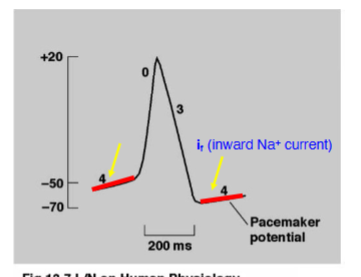
The upstroke in the cells of the SA node is fast/slow in rising and big/small in amplitude
The upstroke in the cells of the SA node is slow in rising and small in amplitude
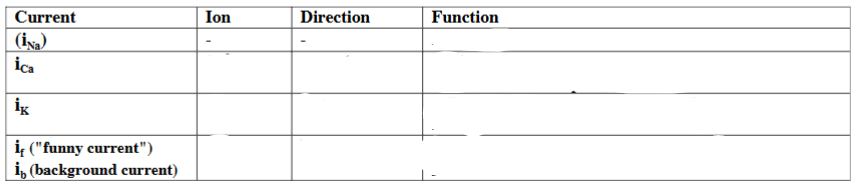
Main ionic currents in nodal pacemaker cells
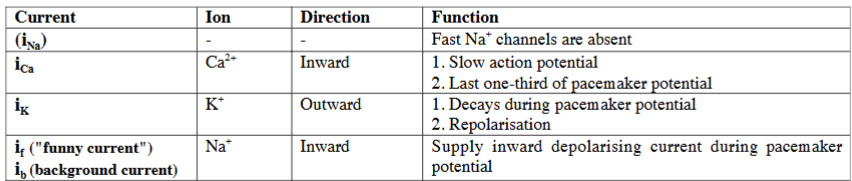
_________ nervous system activity is generally responsible for changes in the rates of SA node discharge
Autonomic nervous system
The SA node is innervated with parasympathetic fibres & sympathetic fibres. What nerves correlate to each of these in relation to cardiac muscle
parasympathetic fibres = vagus nerve
sympathetic nerve fibres = cardiac nerves
Effect of parasympathetic stimulation on heart (2 points)
Reduces heart rate
Hyperpolarises the SA node - threshold is reached later - HR slows
How does hyperpolarisation occur
ACh binds to its receptor (muscarinic, M2)
Activation of ACh - sensitive potassium channel (KACh) occurs
Potassium conductance (GK ) is increased
When ACh binds to its receptor (muscarinic, M2) it also has an effect on sympathetic stimulation. What is this effect
Binding of ACh leads to a fall in the intracellular concentration of cyclic AMP
This reduces the effects of sympathetic stimulation
Reduced if and iCa
Reduced slope of the pacemaker potential
Effect of sympathetic stimulation on heart rate
Increases HR
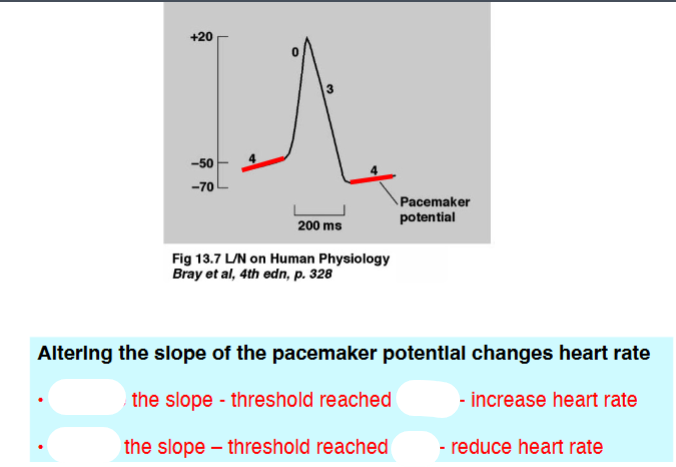
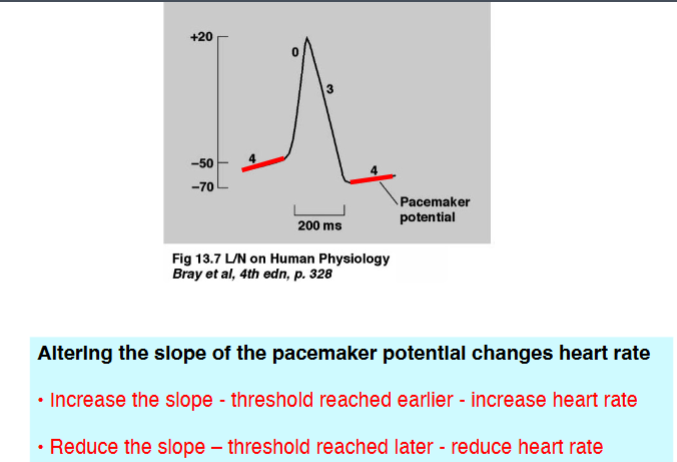
What does the release of noradrenaline (NA) indicate
Sympathetic stimulation
How does NA increase heart rate
Noradrenaline (NA) is released from sympathetic nerve endings
NA binds to β1 adrenergic receptor - leads to a rise in intracellular conc. of cyclic AMP.
Increased intracellular conc. of cyclic AMP increases the if (inward Na+ current) & activates protein kinase A which phosphorylates the Ca channel & increases iCa (inward Ca2+ current)
Sodium (GNa) and calcium conductance (GCa) are increased and inward calcium (iCa) and sodium currents (if) are increased
The slope of the pacemaker potential is increased
Role of protein kinase A in cardiac muscle cells
phosphorylates the Ca channel & increases iCa (inward Ca2+ current) - increases heart rate
phosphorylates the K channel involved in repolarisation
increases the repolarising K+ current (iK)
Shortens the duration of the action potential
Without this effect, the long duration of the cardiac action potential would begin to limit heart rate