Respiratory System
 Call Kai
 Learn
Learn Practice Test
 Spaced Repetition
 Match
Match Flashcards
 Knowt Play
1/34

There's no tags or description
Looks like no tags are added yet.
Name | Mastery | Learn | Test | Matching | Spaced | Call with Kai | Chat |
|---|
No analytics yet
Send a link to your students to track their progress
35 Terms
Which respiratory center in the medulla sets the basic rhythm of breathing?
Ventral respiratory group (VRG)
Which statement about alveolar surface tension is correct?
Pulmonary surfactant reduces tension to prevent collapse
Vital capacity (VC) measures [what].
total air you can move in and out, excluding residual volume
What is the name of the area on each lung where the bronchi, arteries, veins, and nerves enter?
Hilum
The tertiary bronchi continue branching inside the lungs to form [what].
Bronchioles
Why is the first breath after birth possible?
Pulmonary surfactant lowers alveolar surface tension, and chest compression during birth expels fluid
What is perfusion in the lungs?
Blood flow through pulmonary capillaries
Which do NOT have cartilage and have muscular walls to control airflow?
Bronchioles
What type of epithelium lines most of the nasal cavity and trachea?
Pseudostratified ciliated columnar epithelium
How does the body increase oxygen delivery at high altitude while at rest?
By releasing more oxygen from hemoglobin and producing more BPG
What is acclimatization?
Long-term adjustment to high altitude with increased red blood cells
Carbon dioxide diffuses out of the blood into the alveoli mainly because [why].
it has a higher partial pressure in the blood than in the alveoli
How many terminal bronchioles are found in each lung?
More than 1,000
The branching of the bronchial tree is important because [why].
it warms and filters air before reaching the alveoli
A patient has a broken rib preventing expansion of the chest wall. Which lung characteristic is directly affected?
Thoracic wall compliance
A nurse notices a patient’s breathing is rapid and deep after heavy exercise. What is the main reason?
High CO2 levels and low pH stimulate medulla
A patient’s arterial CO2 rises due to hypoventilation. Which reflex increases their breathing rate?
Central chemoreceptors sensing low pH from high CO2
A patient has excessive dead space due to non-functional alveoli. What is the effect?
Less oxygen reaches blood despite normal ventilation
A patient has low blood pH due to metabolic acidosis. How does the respiratory system compensate?
Breathing speeds up & breathing deepens
What is acclimatization?
Long-term adjustment to high altitude with increased red blood cells
Which part of the bronchial tree is responsible for trapping debris and pathogens in mucus?
Bronchi and bronchioles
What is the effect of parasympathetic stimulation on the airways?
Causes bronchoconstriction, narrows airways, decreases airflow
Which of these represent symptoms or effects of hyperventilation?
Low blood CO2 levels, high blood pH (alkalosis)
What keeps the lungs from collapsing?
Slightly negative intrapleural pressure
How is most oxygen in the blood transported?
Bound to hemoglobin in red blood cells
Which brain region influences breathing in response to emotions, pain, or temperature?
Hypothalamus and limbic system
Why is the carina important?
It contains nervous tissue that triggers coughing if a foreign body is present
What is the main way carbon dioxide is carried in the blood?
As bicarbonate (HCO3-)
During normal inspiration, which of the following occurs?
Diaphragm moves downward, chest volume increases
Which cells in the alveoli secrete surfactant?
Type II cells
Tidal volume (TV) is [what].
normal breath volume (around 500 mL)
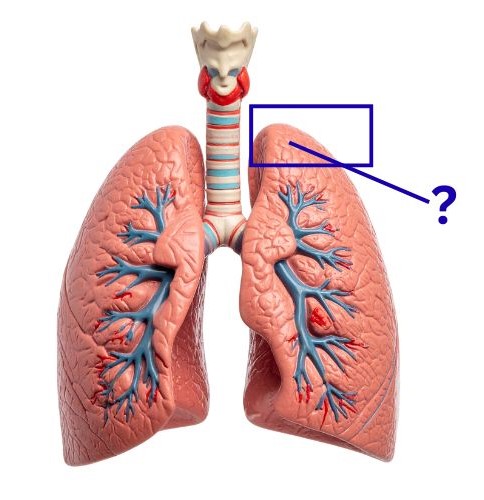
Identify the part of the lung highlighted below.
apex of lung
A patient inhales a toxin that destroys type II pneumocytes. What problem will occur first?
Decreased surfactant leading to alveoli collapse
During deep breathing exercises, which pressure changes allow air to flow into the lungs?
Intra-alveolar pressure drops below atmospheric pressure