ruminant nutrition
 Call Kai
 Learn
Learn Practice Test
 Spaced Repetition
 Match
Match Flashcards
 Knowt Play
1/31

There's no tags or description
Looks like no tags are added yet.
Name | Mastery | Learn | Test | Matching | Spaced | Call with Kai | Chat |
|---|
No analytics yet
Send a link to your students to track their progress
32 Terms
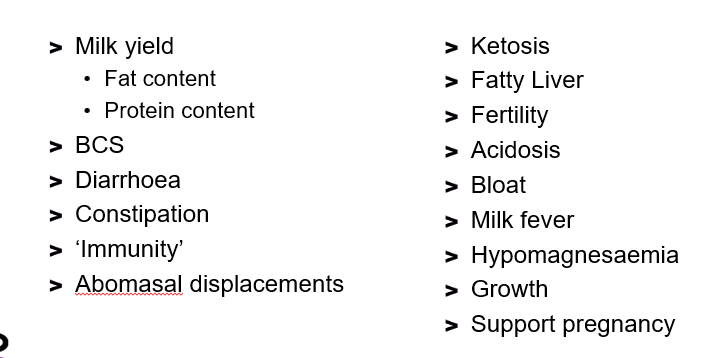
what does nutrition affect
concentrate examples
40 percent
cereals
cake
soya
rapeseed
molasses
forgage 60
grass
brassicas
roots
straw
maize
relative neonate stomach volumes
rumen 25
reticulum 8
omasum 8
abomasum 60
adult
rumen 62
reticulum 11
omasum 5
abomasum 22
normal condition
temperature
aerobic or anaerobic
pH range
how much saliva per day
how much bacteria per ml
how much protozoa per ml
38-40 degrees
anaerobic
ph 6.0-6.5
buffering capacity- salivation (150l/day cows)
prouces gas co2 and ch4
10^9-10^10 per ml of bacteria
10^6 per ml of protozoa
normal rumen including
what do large particles form
what is this important for
innervation
size of particle required to leave the rumen
aim
as food enters same vol leaves
soluble components ie sugars soon fermented
insoluble gradually broken down by microbes
large particles form a fibrous mat until broken down
the fibre mat is important for rumen movements and saliva flow
via cnx
particles need to be about 3-4mm to leave rumen
high oughage diets increase transit time due to salivation but this decreases digestion
aim to have quickly digestible small sized conc that tprovide max energy quickly w/o rumen acidosis
reticulum
no absorptove capactuy
cnx
mechanical
rumen contraction start
microbial
larger proportionally in small ruminatns
omasum
biphasic
first contraction removes fluid
fluid with vfa and nacho3
ths is then absorbed
second cotnraction expel solids into abomasum
cnx
abomasum
proteins broken down to absorb in si
intrinsic motility
weak contracton strenghten as they reach the pylorus to aid expulsion of contents
larger proportionally in small ruminant
small intestine
where does neutralisation of stomach acid take place
where is the site for absorption
what does the ileum absorb and what else does it contain
what prevents backflow
duodenum neutralise stomach acid
pancreas and bile duct secrete here
jejunum site for absorption
ileum absorb remaining nutrient and b12, contain lymphoid tissue
ileocaecal valve prevent backflow
large intestine
where is the caecum blind ended sac
what is absorbed in the colon
what do bacteria produce
smaller than si
caecum blind ended sac in right sub lumbar fossa
storage and breakdown
colon primary site for water and na absorption
bacteria in colon produce necessary vit k and thiamine
used as channel for removal of waste
microbes
bacteria protozoa and fungi
feed on forages
via anaerobic fermentation they produce end products that can be utlised by the cow as well as the microbes themselves
digest up to 70 percent dry matter but microbes have differing fnction
essentail diet contains sufficient energy and protein for the growht and mutiplication of microbes so that rate of digestion is maximised
end product of microbes
VFAs- main energy source
ammnia- used to form micorbial protein, microbial bacteria are digested and are cows main source of protein
gases co2 and methane
fibre analysis
Crude Fibre (CF): Crude fibre is a traditional measure of fibre content in feeds.
Neutral detergent fibre (NDF) and acid detergent fibre (ADF) are more useful measures of feeding value, and should be used to evaluate forages and formulate rations.
Neutral Detergent Fibre (NDF): Structural components of the plant, specifically cell wall. These are slowly digested. An increased NDF → decreased intake
Acid Detergent Fibre (ADF): The least digestible plant components, including cellulose and lignin. This often has a poor energy content and is excreted in the faeces
fermentation of carb such as straw and fibrous hay
which fatty acid
what are bacteria sensitive to and why is this an issue
straw, fibrous hay:
large proportion of acetate
bacteria that do this are sensitive to fat and high acifity
so cows with high fat diets or have acidosis are unable to break down celluloses
carbs consist of…
cellulose
hemicelluloses
starch
water soluble sugars- fructans mainly
lush pasture
fermentation of potatoes/beet
which volatile fatty acid
what does this bacteria supress
rapidly digeted
starch
incresae level of propionate rapidly
bacteiria not affected by acidity but supress acetate forming cellulose diesting bactera
fermentation of molasses, glucose, dissolved sugar
similar bacteria to thse that break down potatoes and beet
do not have a profound effect on reducing rumen pH
vfa
what are they used for
percent of energy that they provide
what do they help promote the growth of
are major end products of fermentation because c skeletons cannot be completely oxidised to co2 in the absence of o2
readily absorbed into the blood stream and transported to the liver where they are covnerted to other energy sources
used for hepatic gluconeogenesis, lipogenesis in peripheral tissues and milk synthesis
Rapidly absorbed to minimise acidosis
This is why try to dissuade farmers from feeding in parlour
Determine milk fat and protein content
Provide 70% cows energy
Help promote growth of rumen papillae
Absorbed through rumen wall and go to liver
Used as an energy source by the liver
acetate
what percent of vfas produced does it make up
what kind of diet does it predominate in
function
what is it a precursor for
how many moles atp per mole cetate via acetyl coa?
55-65% of VFAs produced is acetic acid
It predominates on a high roughage diet
Synthesis of fatty acids in adipose
•Is a precursor for mammalian milk fat
•Found in peripheral circulation
•Some is also used for muscle metabolism and body fat
•
Net gain of 10 (moles) ATP per mole acetate via acetyl CoA entering Krebs (TCA) cycle
butyrate
percentage
function
what kind of food is it found in
what does the liver turn it into
net gain of how much ATP per mole butyrate
10-15% of VFAs produced is butyric acid
Provides energy to the rumen wall
It doesn't vary in proportion to other volatile fatty acids
Found in poorly fermented silage
Liver turns into betahydroxy-butyrate (BHBs), used by muscle, milk gland
Net gain of 25 ATP per mole butyrate (via acetyl CoA entering Krebs)
propionate
percentage
what kind of diet
what is it a precursor for
how does it provide energy
what is it used for
net gain how much atp per mole
18-21% of VFAs produced is propionic acid
Predominates in a high concentrate diet
Precursor of glucose
Provides energy via the conversion of blood glucose in the liver
Used in lactose (milk sugar) synthesis
Net gain of 18 ATP per mole propionic acid via Krebs cycle
proteins which do not get broken down in the rumen
undegraded dietary protein- UDP
rumen degradable protein
rumen microbe
nitrogen and amino acid used by the rumen microbes to grow
as microbes can use any source of nitrogen little is needed
must be sufficient as if insufficientthen not enough microbes and carb breakdown slow
microbial crude protein
what is it
composition
or BCP- bacterial crude protein
flow of protein contained in rumen bacteria which is produced in the rumen and is passed into the intestine for digestion
80 true and 80 digestible
protein that reaches abomasum and si is euther mcp or udp
non protien nitrogen- how can more protein reach the small intetine than actually consumed
If excessive RDP then the excessive ammonia is absorbed into the blood and carried to the liver
Liver turns NH4 into urea, then excreted in urine
If insufficient protein in diet then more ammonia returned to rumen
This ammonia is then turned into MCP
In this way, more protein may reach the SI then is actually consumed
non protein nitrogen compoud
This is why urea added to the diet
Rumen acts as a leveller so constant stream of protein passing to SI
Must ensure enough energy in the diet for protein synthesis
If ammonia too high can overload liver capacity and cause toxic levels of NH4 in the blood.
lipid
ideal amounts
what amount inhibits microbe action
what type is not absorbed by the rumen
Minimal digestion in rumen (ideally <50g/kg)
>100g/kg inhibits microbe action
LCFAs not absorbed by rumen
Most fats consumed are triacylglycerides (TAGs) which are hydrolysed by lipases
Fats are then saturated in the rumen
Pass to SI for digestion
If treated, dietary fats can remain unsaturated when get to SI and these alter milk fat content
what happens to unsaturated fat
become saturaed in the rumen
why is lignin not digested
low o2 content and condensed structure which prevents hydrolysis
it hinders the breakdown of associated cellulose so lower the liginin more is digested