Langchain
 Call Kai
 Learn
Learn Practice Test
 Spaced Repetition
 Match
Match Flashcards
 Knowt Play
1/95

Earn XP
Description and Tags
intro
Name | Mastery | Learn | Test | Matching | Spaced | Call with Kai | Chat |
|---|
No analytics yet
Send a link to your students to track their progress
96 Terms
What are the uses of lang chain framework
Build
Run
Deploy
Maintain
Monitour
What are some popular LLM architectures?
Examples include GPT (Generative Pre-trained Transformer), BERT (Bidirectional Encoder Representations from Transformers), and T5 (Text-to-Text Transfer Transformer).
LLM Task As per use case
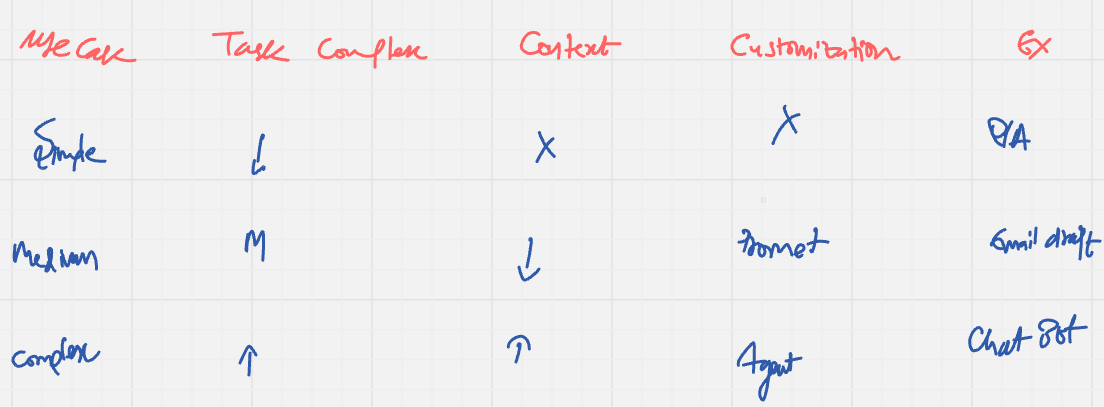
Data Loader
This is done using the source File.
Main purpose is to load the file to the model
what is the purpose of env file
in that we have secreat keys like open api key & lot more.
for text file we use ______ loader
Document Loader
for Single pdf file we use ______ loader
pdf loaders or pypdf
for Multiple pdf file we use ______ loader
Directory Loader
for Reasearch Paper (arvix) file we use ______ loader
Document Loader
how do we verify the loader ?
we can verify the loader using refrence Object
Text Splitter
Spliting text as per the token limit.
Types of text splitters
character Splitter
Recursive Character Splitter
Recursive Json Splitter
Character Splitter
/n ← split by next line
/n /n ← Split by paragraph
Chunks
Smallest part of main data for token limit
Chunk Overlap
This will help in maintaining the context of the Info.
Cosine similarity used to determine the result by
Cosine Similarity=A⋅B/∥A∥∥B∥
The result ranges between −1-1 and 11, where:
11 means the vectors are identical.
00 means they are orthogonal (completely different).
−1-1 means they are opposite
Indexing
Once Chunk is Created that is converted to vector with meaning.
if Chunk Capacity is 4k Tokens can we send 2k tokens
Yes
Recursive Character Splitter
This will split as per the sentance. This has the context of the words
Recursive Json Splitter
we will load the data from json link and we will use context manager to store File here.
do we send full Token
we only send 75 % of the token info
if your model token limit is 4k and you send documnet with 5k what happens to last1k data ?
That wont even read.
What is the challenge of handling token limits in LLMs?
LLMs have maximum token limits for input and output, which can make it challenging to process or generate long-form text efficiently.
How do LLMs handle context in a sentence or passage?
LLMs use attention mechanisms, such as in the Transformer architecture, to focus on relevant parts of the input sequence and understand context.
How would you choose between PyTorch and TensorFlow for training LLMs?
PyTorch is more flexible and widely used in research, while TensorFlow is production-friendly and integrates well with deployment tools.
what is a prompt types
system and custom prompt
how do you code Prmpt ?
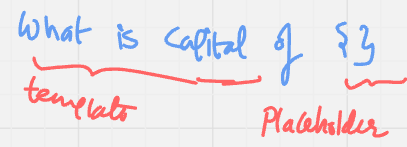
prompt = PromptTemplate(
    input_variables=["product"],
    template="What is a good name for a company that makes {product}"
)what is template and place hodler in prompt
parameters that control the performance and behavior of models
Learning Rate (for training or fine-tuning)
Context Window (Token Limit)
Batch Size
Stop Sequences
Frequency Penalty
Presence Penalty
Max Tokens
Top-k
Top-p (Nucleus Sampling)
Temperature
Explain the parameters :
Temperature:
This parameter controls the randomness of the model's responses.
Low values (e.g., 0.2) make the output more focused and deterministic. The model tends to pick the highest probability answer every time.
High values (e.g., 0.8) make the output more diverse and creative, as it allows the model to explore less probable options.
Top-p (Nucleus Sampling):
It controls how many probabilities the model considers when generating each word or token.
For example:
Top-p = 1.0: The model considers all probabilities (like traditional sampling).
Top-p = 0.9: The model only considers the top 90% of probable choices and ignores the rest, leading to more focused yet flexible output.
Top-k:
This limits the number of top choices for each word the model considers.
Low values (e.g., k = 10) constrain the model to select from only the top 10 options, making the responses more predictable.
High values allow greater exploration but can lead to randomness.
Max Tokens:
This parameter sets the maximum length of the output generated.
Increasing this parameter allows the model to generate longer responses.
Reducing it limits the output length for shorter answers.
Presence Penalty:
Controls how much the model discourages repeating words or ideas it has already generated.
High penalty results in more diverse responses by avoiding repetitions.
Low penalty allows frequent repetition if required.
Frequency Penalty:
Similar to presence penalty but specifically discourages generating frequent words (e.g., common verbs).
Encourages more creative or novel responses.
Stop Sequences:
Specific sequences of words can be defined to stop the model's output generation.
For example, you might set a stop sequence like "End of conversation," and the model will cease generating text after encountering it.
Batch Size:
Controls how many predictions the model processes at once during training or inference. Larger batch sizes can speed up processing but require more memory.
Learning Rate (for training or fine-tuning):
Determines how much the model adjusts its weights during each iteration of training. A higher learning rate speeds up training but risks overshooting optimal values, while a lower rate provides stability but slows down the process.
Context Window (Token Limit):
Defines the maximum number of tokens the model can process in a single prompt. Larger context windows allow the model to understand longer inputs or conversations.
Chain
This will tell you order of Execution
if we have Multiple chains we use
Chain Channel
Chain Types
Simple Sequential Chain
Sequential chain
Simple Sequential chain
we want output of last chain
Sequential chain
This will give Output of all chain.
how do we see how chain is performing
Verbose is True
Agents in LLM
This will intract with LLM using
Prompt, task automation & Context handling
Tools in LLM
Run the query ex : external apis are used to perform external tasks.
memory in LLM
Help model to remember the previous chat (Conversation)
Conversation Memory in memory
This remember all the conversation and print only place holders values.
Conversation chain in memory
You get both Q& A
Conversation Buffer window Memory in memory
This will remember to certain number of conversation as per specified k (Context Window).
Embedding
This help converting text to number as model cannot understand other than number
Types of Embedding
Open Ai , Hugging Face , Ollama , BERT, TF IDF
Vector Index
This will store the embedding in your own system.
only for simple task not Company Related, only used for testing
ex FAISS
Vector DB
The embedding are stored in cloud
We mostly use them for Company
Ex Chroma ,Weaviate & pinecone
Meta data in Vector Data
This is Key Value Pair of vector.
we use this for storage limit, Character limitation & set max 50 per index.
How do we know a particular chunk has our related info
similarity Search (Cosine similarity , Man hat , Euclidean distance & Approximate nearest nebhour)
why we don’t use the SQL as vector db. ?
A custom text file has millions of texts; when we convert it, the latency will be low.
Retrieving using sql will have very bad latency as it’s not a vector db
Faiss full form
Facebook AI Similarity Search
FAISS
FAISS is widely used in applications like recommendation systems, search engines, and Large Language Model (LLM) indexing due to its ability to handle large-scale datasets with high performance.
Vector Index
No scalability
We need backup
what is dangerous serialization = true
you trust the dock you send to model.
earlier we used to not use this. but now this has become manditory.
Vector Db Types
Chroma , Weaviate & pine cone
Chroma
This is self hosted db. ITs from Apache.
Used for long term Retention.
Weaviate
Open source with Plugin and extensibility
self Hosted or Cloud
PineCone
This is used for cloud only.
Used mostly for scaling data sets.
Rag Full form
Retrieval augmented Generation
RAG work
retriever : this will find relevant info from query (input)
Augmentation : This takes relevant info from input to llm
Generate : Takes input of retriver & augmented to generate the output
Why we use a rag
As LLM cannot correctly predict from external data, we use rag.
This will remove Hallucination as this provides info that is not available to the model.
Finetuning Vs rag
Aspect | Fine-tuning | RAG (Retrieval-Augmented Generation) |
|---|---|---|
Definition | Updates model with domain-specific data. | Combines model with external data retrieval. |
Training Required | Requires retraining for new tasks. | No retraining needed; uses external sources. |
Real-time Updates | Difficult to incorporate. | Easily integrates updated or live information. |
Inference Speed | Faster, no external dependencies. | Slower, involves retrieving external data. |
FineTunning
We can train a pre existing model and make that as per our requirements.
You should have Good GPU to use Fine Tuning.
FineTunning
LORA ,Qlora , Quantization
Model Compression
This will reduce the size of the model & technically complexity of model
drawback in model compression
Loss of accuracy
Types of model compression
quantization
pruning
weight sharing
knowledge distillation
Knowledge distillation
Train small model to mimic the behaviour of big model
Pruning
removing unnesary model parameters like weights so size of model is reduced
weight sharing
Layer of neuro share the weight thus reducing the size of model
Quantization
Quantization in LLMs (Large Language Models) is a technique used to make models smaller and faster by reducing the precision of the numbers they use to perform calculations.
Example of quantization
32 Bit FP → 8 bit FP
FP : Full Precision
Ex 1.1311341 → 1.1 FP
LORA vs QLORA
Aspect | LoRA (Low-Rank Adaptation) | QLoRA (Quantized LoRA) |
|---|---|---|
Purpose | Efficient fine-tuning of pre-trained models. | Efficient fine-tuning combined with quantization to further reduce memory usage. |
Technique | Injects low-rank matrices into model weights during training without updating the full model. | Applies LoRA fine-tuning on models quantized to 4-bit precision for extreme resource efficiency. |
Memory Usage | Low memory requirements compared to full fine-tuning. | Significantly lower memory usage due to quantization (ideal for large-scale models). |
Precision | Retains floating-point precision (e.g., FP32/FP16) during fine-tuning. | Reduces precision to 4-bit quantization while maintaining performance with minimal accuracy loss. |
Performance | High fine-tuning efficiency, with minimal accuracy trade-off. | Comparable performance to full-precision models, despite quantization. |
Computational Cost | Reduces cost by avoiding the need to train full model weights. | Further reduces computational cost by leveraging quantized models |
Rag Types
Dense retriver : used for vector retriver Ex BERT
Sparse Retriver : Utilization like TFIDF
Hybrid : dense + Sparse
Multihop : Retriver From Multiple Steps
Personalized Retriver : Retries Based on History
How do we version Controll
We will use GIT
RAGAS
This is used to evaluate the accuracy of RAG
faithfulness
Precision
Recall
Correctness
Model scaling law
Model perfomance will depends on GPU
Model perfomance will decrease when the size of model increase
Halucination
Incorrect answer is given by model that is grammatically correct but not actually correct.
how do we reduce the halucination
Rag , reinforment learning , prompting , model calibraion ,Fact Verification and ensambling techniques
RAG in halusination
this depends on external data apart from internal data
Prompting in hallucination
Good prompts also reduce the hallucination
model calibraion
Fact verification
Help model to verify the facts in online
ensambling techniques
Combine output of multiple models to reduce hallucination
LLm evaluation
To Check the perfomance of LLM
Perplexity , ragas , BELU , Human , meteor
Perplexity:
Think of it as how "confused" a language model is when predicting the next word in a sentence.
Lower perplexity means the model is better at guessing correctly and is more confident.
ROUGE (Recall-Oriented Understudy for Gisting Evaluation):
It's a way of comparing text generated by the model with reference text.
It checks for overlapping words and phrases between them to measure how close they are.
Widely used in summarization tasks.
BLEU (Bilingual Evaluation Understudy):
A metric to evaluate how well machine-generated text matches human-written text.
It looks at word sequences (like pairs or triples) and rewards similarity to the reference text.
Commonly used in translation tasks.
Human Evaluation:
Sometimes, machines just can't do justice! Humans read the model's outputs and judge them based on quality, fluency, and relevance.
It's subjective but gives insight into how "natural" the model's responses are.
METEOR (Metric for Evaluation of Translation with Explicit Ordering):
Similar to BLEU, but smarter about matching synonyms and different word orders.
It's designed to capture the meaning better than just exact word matches.
How do you choose The LLm Model
its said by client as per budget or some time we suggest him better option if available
using llm evalutaion we check which model is performing good and later decide to select that model
for open source GPU and storage must be good
which is costly open source or non open source
non open source (GPT) but open source (LLama)has storage cost
which model have privacy concerns
Open source
Easy to change Things is model
non open source is easy to change the model as we only change the model name buy in open source we need to make a lot of changes
Multi stage environment
Data ingestion , Chunking , embedding , Retrieval , Generation of summary
Context Learning
The model is learned by based on the context provided by the model.
we provide example for what type of answer we want.
security Features in Azure Open Ai
Content filter (remove Hateful media), data encryption & windows defender for cloud.
PII management without exposing to end user :
Encryption data is stored
Role based access
Strong Authentication
monitor unauthorised acess