ENVE3160 Biology
 Call Kai
 Learn
Learn Practice Test
 Spaced Repetition
 Match
Match Flashcards
 Knowt Play
1/13

There's no tags or description
Looks like no tags are added yet.
Name | Mastery | Learn | Test | Matching | Spaced | Call with Kai |
|---|
No analytics yet
Send a link to your students to track their progress
14 Terms
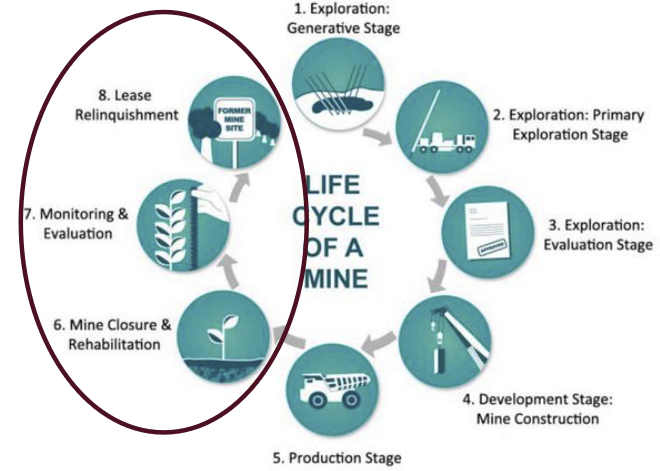
What is the longest phase of a mine’s lifecycle?
20-25% of closure costs are related to water treatment
Urease pathway (Biocementation)
Converts urea to calcium carbonate.
Requires:
- Microbes
- Urea (produces ammonia)
- Source of calcium
Carbonic Anhydrase Pathway (Biocementation)
Mineralises CO2 as carbonate.
Requires:
- Enzymes (with or without microbes)
- CO2 from atmosphere or conc.
- Source of calcium
Sulfate Reducing Bacteria Pathway (Biocementation)
Sulfate reduction produces alkalinity.
If this is captured as a carbonate, it can drive MICP.
SRBs are also found to contain both urease and carbonic anhydrase genes.
Function anaerobically with fewer inputs required
Difference between linear economy and circular economy
Linear:
Natural resources → Take → Make → Dispose →Waste
Technical & Biological materials mixed up
Energy from finite sources
Circular:
Biological: → Make→ Consume → Enrich→
Technical: → Make → Use → Return →
Energy from renewable sources
Circularity can be measured by the amount of ______ resource that is used to sustain _______ activity.
Circularity can be measured by the amount of non-renewable resource that is
used to sustain economic activity.
Circular economy
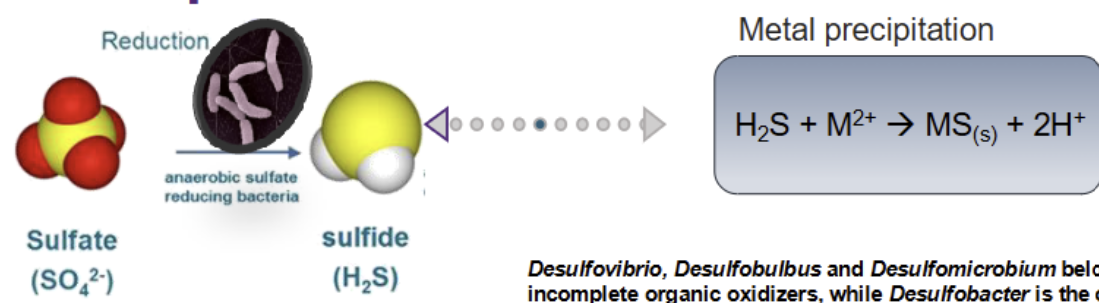
What are the advantages of biological Sulphate reduction, and some examples of sulfate reducing bacteria?
Sulfate reducing bacteria:
Autotrophs: Hydrogen and CO2/CO
Heterotrophs: Organic compounds
Advantages:
1. Low solubility of precipitates
2. Precipitant produced on site
3. Sulphate already present in most mine-impacted waters
4. Low sludge volume
What is the main trade‑off between expanding clean energy technologies and the
environmental impacts of extracting minerals?
clean energy technologies reduce greenhouse gas emissions and help fight climate change, but they require increased mining and processing of critical metals
causes environmental impacts such as land disturbance, waste generation, pollution, and greenhouse gas emissions
we must balance the benefits of clean energy with the environmental costs of obtaining the necessary materials.
Explain two circular economy strategies that can reduce this trade‑off.
Strategy 1: Design products to last longer
Design EVs, batteries, and wind turbines for long life, repair, and modular upgrades so they remain in use for longer and require fewer newly mined critical metals.
Strategy 2: Recycle and recover critical metals
Develop efficient recycling systems to recover critical metals from old products and industrial residues, allowing recycled materials to replace some newly mined metals.
Why is mine closure, and especially long‑term water treatment, such a critical
sustainability challenge for companies like Rio Tinto?
Mine closure is a major sustainability challenge because contaminated mine water can continue polluting the environment for decades after mining ends. Companies must often provide long-term water treatment to protect ecosystems and downstream communities and to comply with environmental regulations. These ongoing treatment costs become significant financial liabilities, making mine closure both an environmental and economic challenge.
Describe two ways that emerging technologies or approaches presented in the
lecture (for example selective metal recovery, bio‑based treatment, or site‑scale
testbeds) can improve sustainability outcomes at closure.
Selective metal recovery can turn MIW from a pure waste into a resource by recovering valuable metals, which reduces the mass of contaminants requiring treatment and creates a revenue stream that can help finance long‑term closure obligations.
Bio‑based treatment systems (for example, microbial reactors, biobeads, or
engineered living materials) can immobilise or remove metals with lower energy and chemical inputs, providing more passive, robust, and nature‑based options that reduce operational costs and environmental footprints over time.
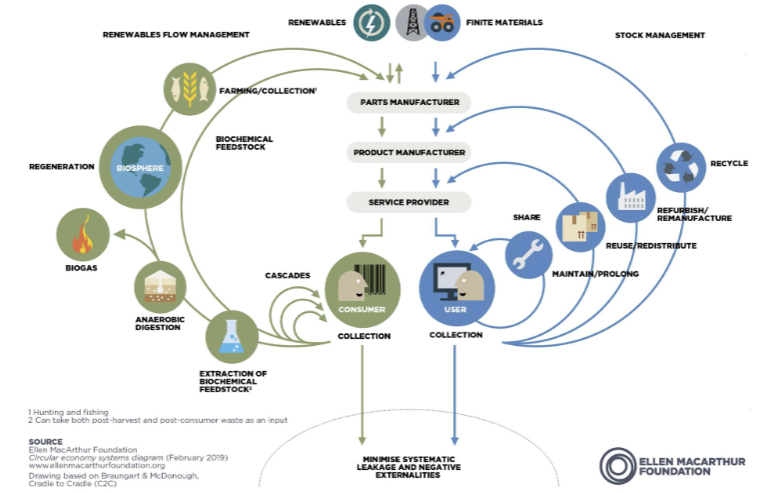
What is one of the main purposes of the butterfly diagram under the circular
economy concept?
To distinguish between technical and biological material cycles in a circular economy
The UN has labelled acid mine drainage (AMD) as the second biggest problem
facing the world after global warming. But tackling the problem is very difficult as discussed
during the industry guest lecture. At present, the use of lime as a precipitation aid remains
widespread. On the other hand, biological sulphate reduction can be a more sustainable
alternative as the sulphide produced can be used to precipitate metals from AMD.
a. Discuss why biological sulfate reduction is a better alternative for the treatment
of AMD as compared with lime treatment (explain the environmental phenomena behind
each alternative)
Lime addition causes the precipitation of metal hydroxides. This process generates a
large volume of metal-containing sludge that requires disposal, creating a secondary
pollution problem. In contrast, biological sulfate reduction uses sulfate-reducing
bacteria (SRB) to convert sulfate in AMD to sulfide. The sulfide then reacts with
dissolved metals to form insoluble metal sulfides, which can be easily removed. This
process is more environmentally friendly as it avoids the generation of large volumes of
sludge and can recover valuable metals.