Exam 1
 Call Kai
 Learn
Learn Practice Test
 Spaced Repetition
 Match
Match Flashcards
 Knowt Play
1/290

There's no tags or description
Looks like no tags are added yet.
Name | Mastery | Learn | Test | Matching | Spaced | Call with Kai | Chat |
|---|
No analytics yet
Send a link to your students to track their progress
291 Terms
What experiment lead to the idea that organic molecules can be generated through electricity in the earth’s atmosphere?
Miller-Urey Experiment
When was the earth formed?
4.5 BYA
When did the earth become habitable for life?
3.8-3.9 BYA
When did first life evolve on earth according to the fossil record?
3.5 BYA
When did oxygenic photosynthesis first evolve?
3 BYA
When did eukaryotes first evolve?
2 BYA
When did eukaryotes acquire mitochondria through endosymbiosis?
1.6 BYA
When did eukaryotes acquire chloroplasts through endosymbiosis?
1.5 BYA
When was The Big Bang?
14 BYA
When was the end of heavy bombardment on earth?
4 BYA
What three things were important about the end of heavy bombardment?
The earth cooled, thousands of years of rain, earliest time life could exist
When was the primordial soup theory supposed to take place?
3.8 BYA
What three locations are involved in the primordial soup theory?
Tide pools, ocean, atmosphere
What was the 4 vessels setup for the Miller-Urey experiment to prove the primordial soup theory was plausible?
Water and heat, gas chamber for steam with electrodes, condenser, and water analysis
What was first found after the Miller-Urey experiment?
Amino acids
What changed in order to find nucleic acids and lipids and carbs in the Miller-Urey experiment?
Different atmosphere
For both the PST and DOT: Inorganic compounds to what?
Organic compounds
For both the PST and DOT: Organic compounds to what?
Polymers
For both the PST and DOT: Polymers to what?
Enzymatic molecules and self replication
For both the PST and DOT: Enzymatic proteins and self replication to what?
Enzymatic molecule networks
For both the PST and DOT: Enzymatic molecule networks to what?
Enzymatic molecule networks within lipid membranes
What was the two problems with the PST?
Temperature was too high and UVR was too high (no ozone layer)
Where does the Dark Origin Theory take place?
In the ocean within rifts created by tectonic plates
Within the black clouds expunged from these rifts created by the tectonic plates bringing magma close to the surface, what compounds are found?
Hydrogen sulfide, carbon dioxide, iron, infrared light, hydrogen and carbon monoxide
In the dark origins theory, instead of tide pools where did the organic material gather?
In porous chambers within the rocks of the rifts (they survived because of the heat capacity of water creating a temperature gradient)
What was the first organisms found in the fossil record?
Stromatolites
Why were stromatolites able to be discovered even though they existed 3.5 billion years ago?
They form rock on top of themselves as they grow
Did stromatolite have community?
Yes
What is one way to tell there is life on a planet?
Oxygen in the atmosphere
3 billion years ago, what helped life diversify?
Production of oxygen in the air
Do bacteria have organelles?
Yes, but they are small
What are the three non-cellular life examples?
Viruses, viroids, and prions

What shape is this?
Coccus

What shape is this?
Bacillus

What shape is this?
Vibrio

What shape is this?
Spirillum

What shape is this?
Pleomorphic

What shape is this?
Coccobacillus (mix of coccus and bacillus)
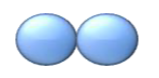
What shape is this?
Diplococci

What shape is this?
Chain
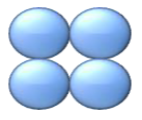
What shape is this?
Sheets
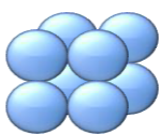
What shape is this?
Packets
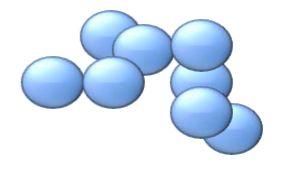
What shape is this?
Clusters

What bacteria stick together as a swarm, kill and eat other bacteria, and when dried or starved clump together to form a fruiting body with spores as the fruit (showing specialization)
Myxobacteria

What cells are specialized in some filamentous cyanobacteria to form a nutrient factory for the other cells, producing nitrogen in nitrogen-scarce environments?
Heterocytes
What are some macromolecules within the phospholipid bilayer?
Proteins, glycolipids, glycoproteins, etc.
What are four purposes of the cell membrane?
Regulate movement in and out, generate energy, uptake nutrients, and interact with environment
How many membranes can prokaryotes have?
3
Can Ions and charged particles diffuse through the cell membrane?
No
Can large molecules diffuse through the cell membrane?
No
Can water diffuse through the cell membrane?
Yes
Can gases diffuse through the cell membrane?
Yes
Can urea diffuse through the cell membrane
Yes
Can small hydrophobic molecules diffuse through the cell membrane?
Yes
Can ethanol diffuse through the cell membrane?
Yes
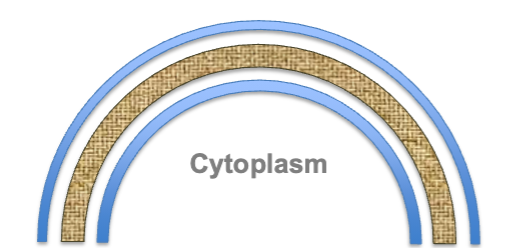
What membrane?
Gram negative
What is the word for 2 and/or 3 membranes?
Gram negative
What bacteria have 3 membranes?
Cyanobacteria
When ions and water are not allowed to diffuse this is known as?
Disequilibrium

What membrane?
Gram positive
What is osmosis in this class?
Water moving across the membrane toward ions

Hypertonic, hypotonic, or isotonic?
Hypertonic

Hypertonic, hypotonic, or isotonic?
Hypotonic

Hypertonic, hypotonic, or isotonic?
Isotonic

What type of cell membrane transport requires no work and releases a proton gradient?
Passive transport
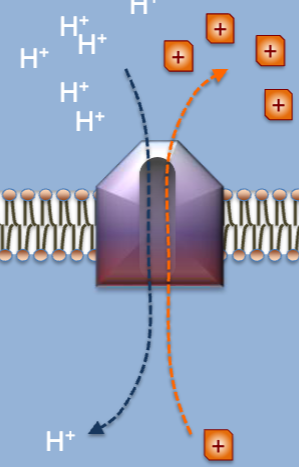
What type of cell membrane transport requires work and moves ions against the gradient?
Active transport

What type of cell membrane transport requires a protein to bring the molecule through the membrane?
Active transport
What is an example of passive transport?
Ion channels
What is an example of active transport
Proton motive force
What is an example of the active transport that gets proteins to bring molecules across the memebrane?
ATP binding cassette
What is an example of group transport across the plasma membrane?
Glycolysis attaching a phosphate to glucose to get it across the membrane
What is another example of active transport that requires atp?
Protein secretion
What is the cell wall made of?
Peptidoglycan
The alternating NAG and NAM “bricks” of the cell wall are made of what?
Sugars
The “glue” between the “bricks” of NAG and NAM are made of what?
Amino acids
The “glue” that is between the “bricks” of NAG and NAM attach where?
NAM
In gram positive cells, the “glue” between the “bricks” of NAG and NAM include what alteration?
A glycine linker
If you are staining cell walls, which will remain violet after washing?
Gram positive
What type of cell wall can be counter-stained for further identification?
Gram negative
What medicine affects cell walls and inhibits the enzyme that connects two NAMs?
Penicillin
Can penicillin affect current cells or does it only affect newly formed cells?
Newly formed cells
When does transpeptidation occur?
Cell division
What enzyme can break the bonds of NAG and NAM, that is also produced in our tears?
Lysozyme
What polysaccharide structure is very important for connecting biofilms?
Capsules/Extracellular polymeric structures (EPS)
Biofilms provide protection from what three hazards?
Viruses, antibacterial agents, and desiccation
Biofilms and, more specifically, EPS help attach to what two things?
Surfaces and other microbes
Why are biofilms so resilient?
Most antimicrobials can only penetrate the first layer which can be regrown
What are extreme versions of biofilms that exist in hot springs, lakes, and coastal intertidal zones?
Microbial Mats
What is the filament called that makes up the flagella?
Flagelin
How is a prokaryotic flagella powered?
Proton motive force to spin 360o
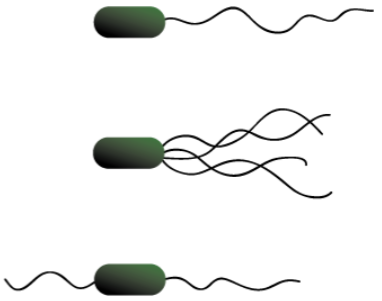
What type of flagella?
Polar

What type of flagella?
Peritrichous
When bacteria want to move forward with their flagella, which way does it rotate?
Counter-clockwise
When bacteria want to tumble, which way does their flagella rotate?
Clockwise
Why can’t bacteria steer their flagella?
They are too small
Why can’t bacteria sense where something is coming from?
They are too small, one side of the bacteria feels what the other side is feeling
How do bacteria move toward a food source?
They can sense concentrations over time and judge if they are going toward or away from something
Bacteria who are attracted to chemicals are known as?
Chemotaxis
Bacteria who are attracted to light are known as?
Phototaxis
Bacteria who rely and magnets to orient themselves are known as?
Magnetotactic