Chapter 21: Carboxylic Acid Derivatives: Nucleophilic Acyl Substitution Reactions
 Call Kai
 Learn
Learn Practice Test
 Spaced Repetition
 Match
Match Flashcards
 Knowt Play
1/24

There's no tags or description
Looks like no tags are added yet.
Name | Mastery | Learn | Test | Matching | Spaced | Call with Kai | Chat |
|---|
No analytics yet
Send a link to your students to track their progress
25 Terms
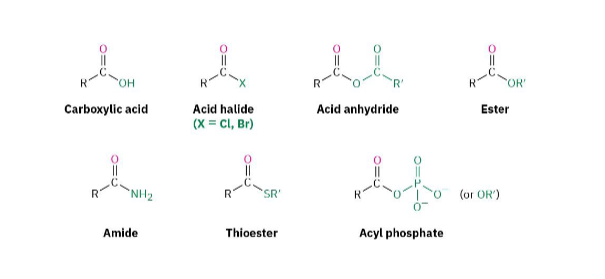
Carboxylic Acid Derivatives
Z can be:
Cl → acid chloride
OCOR → acid anhydride
OR → ester
NH₂/NHR/NR₂ → amide
SR → thioester
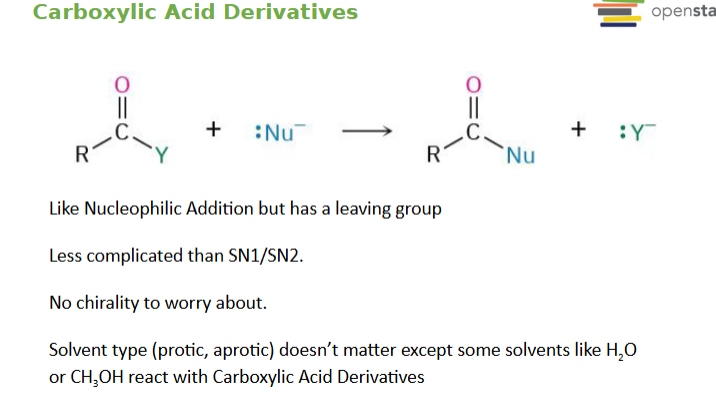
5 important Derivatives
Acid Halide: Most reactive
Acid Anhydride: Two acyl groups connected by oxygen
Ester
Amide
Thioester: Ester with S instead of O
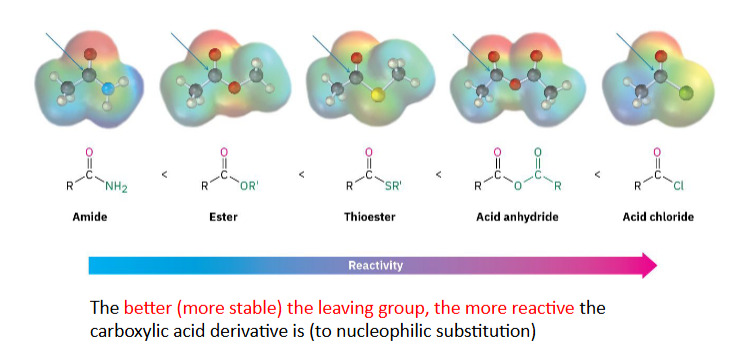
Reactivity Order:
ACID CHLORIDE > ANHYDRIDE > ESTER ≈ THIOESTER > AMIDE
Better leaving group = more reactive derivative
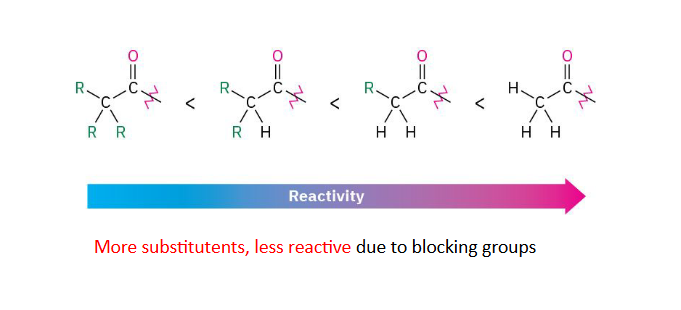
Steric Effect
More groups surrounding the carbonyl —> harder for nucleophile to attack —> less reactive
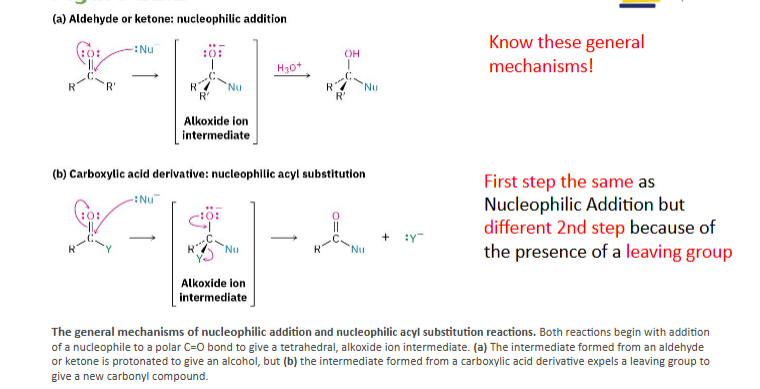
Nucleophilic Acyl Substitution
Nucleophile attacks the carbonyl carbon, the C=O pi electrons move onto oxygen, now you have a tetrahedral intermediate.
Carbonyl reforms: The oxygen lone pair moves back down to form C=O, at the same time, leaving group leaves.
General Rule for predicting products: Ask, what nucleophile am i adding? Then replace the leaving group with the Nucleophile
Interconversion rule
A more reactive derivative can be converted into a less reactive derivative, but not the other way around
Acid chlorides
the most reactive. why? Cl⁻ is an excellent leaving group.
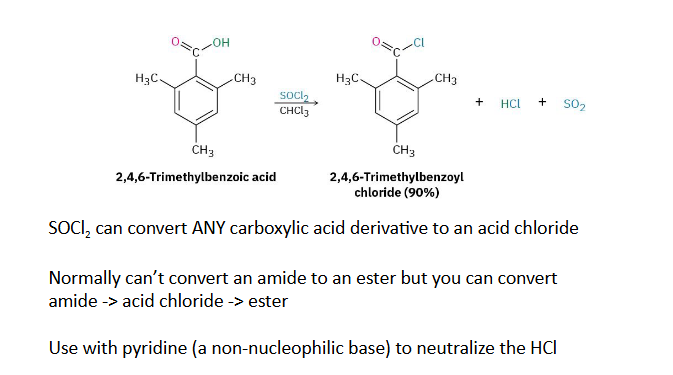
Make acid chloride:
RCOOH → RCOCl
Reagent:
SOCl₂
Acid chloride reactions:
RCOCl + H₂O → RCOOH
→ hydrolysis
RCOCl + ROH → RCOOR
→ ester
RCOCl + RNH₂ → RCONHR
→ amide
RCOCl + R₂CuLi → RCOR
→ ketone
RCOCl + LiAlH₄ → RCH₂OH
→ primary alcohol
Acid chloride + amine:
Usually use 2 equivalents amine:
one attacks
one neutralizes HCl
Acid Anhydrides
Structure:
RCO–O–COR
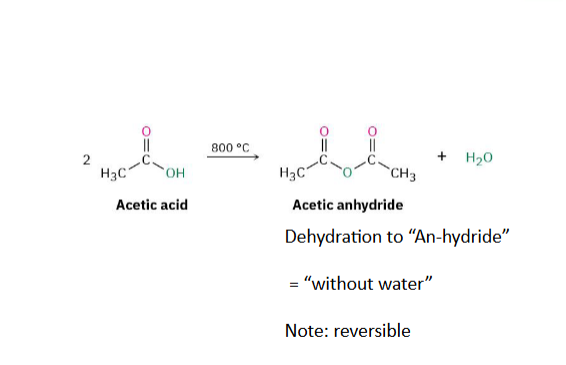
Formation:
2 RCOOH → anhydride + H₂O
(dehydration)
Reactions:
Anhydride + ROH → ester
Anhydride + RNH₂ → amide
Ac₂O/pyridine:
Used to acetylate alcohols.
Esters
Structure:
RCOOR′
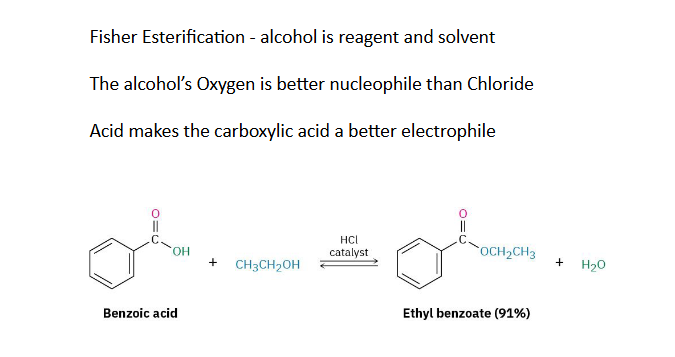
A. Fischer esterification
RCOOH + R′OH ⇌ RCOOR′ + H₂O
Reagents:
H⁺, heat
Important:
acid-catalyzed
reversible
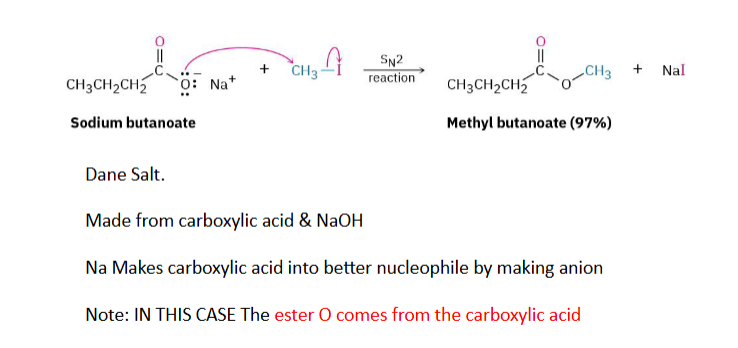
alcohol oxygen becomes the ester OR oxygen
Ester Hydrolysis
Acidic:
RCOOR′ + H₂O/H⁺ ⇌ RCOOH + R′OH
Reversible.
Basic = SAPONIFICATION ⭐
RCOOR′ + OH⁻ → RCOO⁻ + R′OH
Produces a carboxylate salt + alcohol.
Ester Reduction
RCOOR′ + LiAlH₄ → alcohols
Ester + Grignard
Ester + 2 RMgX → tertiary alcohol
Why 2 equivalents?
1st Grignard → ketone
2nd Grignard → tertiary alkoxide
acid workup → tertiary alcohol
Ester + amine
Ester + RNH₂ → amide
= aminolysis
Amides
Structure:
RCONH₂
or
RCONHR / RCONR₂
Why least reactive?
Nitrogen lone pair → resonance with C=O
↓
carbonyl becomes less electrophilic
↓
N is a poor leaving group
Making amides
Acid chloride + amine:
RCOCl + RNH₂ → RCONHR
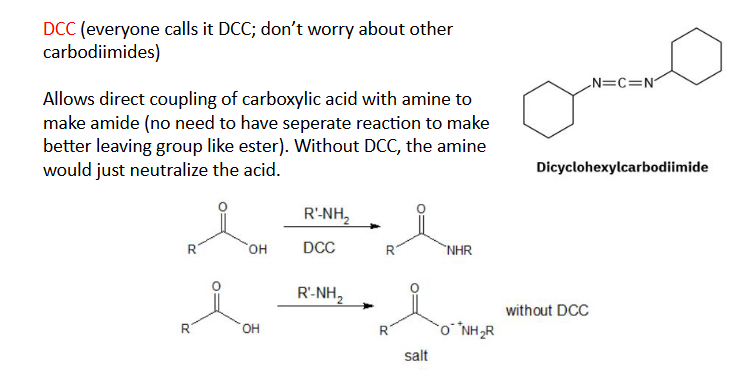
Carboxylic acid + amine:
Use:
DCC
RCOOH + RNH₂ + DCC → amide
DCC activates the carboxylic acid.
Important for peptide synthesis.
Amide Hydrolysis
Amide + H₂O → carboxylic acid/carboxylate
Amide reduction
Amide + LiAlH₄ → amine
Ester + LiAlH₄ → alcohol
Amide + LiAlH₄ → amine
thioesters
Structure:
RCOSR′
Think:
ESTER with S instead of O
polymers
Polyamide
Contains repeated:
AMIDE linkages
Example:
Nylon
Polyester
Contains repeated:
ESTER linkages
spectroscopy
IR
C=O: ~1650–1750 cm⁻¹
Ester:
C=O ~1735–1750 cm⁻¹
C–O ~1000–1300 cm⁻¹
Amide:
C=O ~1650–1700 cm⁻¹
N–H present if N–H bonds exist
Acid chloride:
C=O around ~1800 cm⁻¹
Anhydride:
TWO C=O peaks
1 H NMR of Esters
Use:
chemical shift + integration + splitting
Typical ester environments:
CH₃CO–: ~2 ppm
OCH₂–: ~4 ppm
terminal CH₃: ~1 ppm
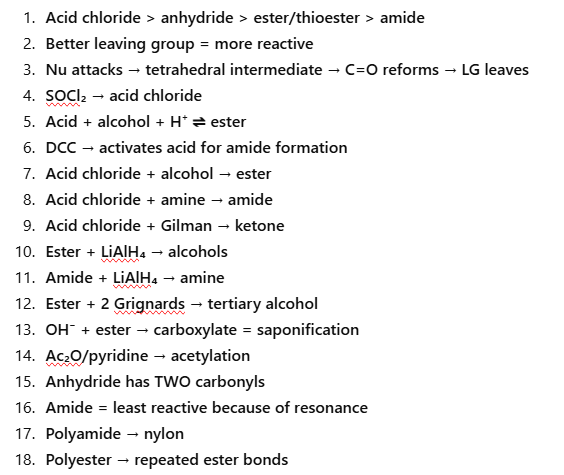
summary part 1
see image
summary part 2
see image
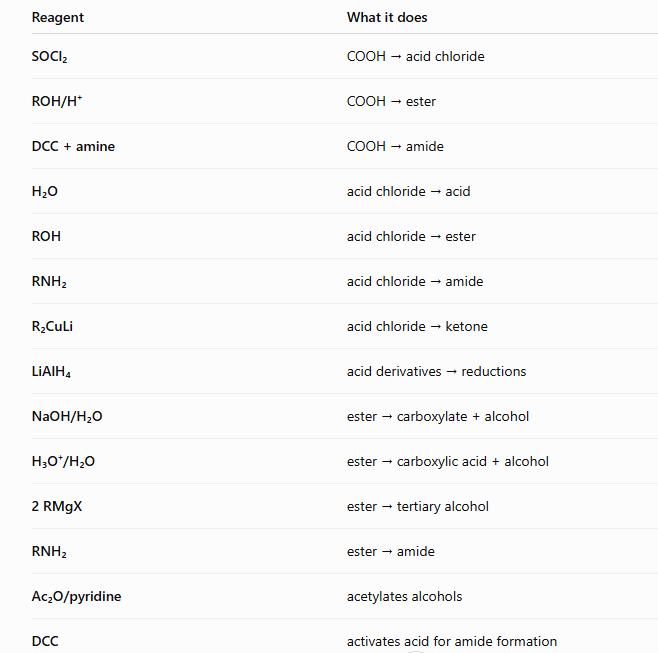
summary part 3
Carboxylic acid derivatives all contain an acyl group, R–C(=O)–, attached to a leaving group. Their main reaction is nucleophilic acyl substitution: nucleophile attacks the carbonyl → tetrahedral intermediate → carbonyl reforms → leaving group leaves.
Reactivity: acid chloride > anhydride > ester/thioester > amide. Better leaving group and less steric hindrance = greater reactivity.
Acid chloride: RCOCl. Made with SOCl₂. It can become an acid, ester, amide, ketone, or alcohol.
Anhydride: RCO–O–COR. Made by dehydration of acids. Can make esters and amides.
Ester: RCOOR. Made by Fischer esterification or from acid chlorides/anhydrides. Hydrolysis gives acid + alcohol. Base hydrolysis is saponification. LiAlH₄ gives alcohols. Two Grignards give a tertiary alcohol.
Amide: RCONH₂/RCONHR/RCONR₂. Least reactive because nitrogen resonance-stabilizes the carbonyl and is a poor leaving group. Made using acid chlorides + amines or carboxylic acids + DCC. Hydrolysis gives carboxylic acid; LiAlH₄ gives amine.
Thioester: ester with S instead of O; important biologically.
Polymers: polyamide = nylon; polyester = repeated ester units. Step-growth polymerization uses molecules with multiple nucleophilic/electrophilic functional groups.
Spectroscopy: look for the carbonyl C=O in IR, and use ¹H NMR chemical shifts + splitting + integration to identify ester environments.
summary part 4
Acid chloride > anhydride > ester > amide
Better leaving group = more reactive
Nu attacks → tetrahedral intermediate → C=O reforms → LG leaves
SOCl₂ → acid chloride
Acid + alcohol + H⁺ ⇌ ester + water
DCC + acid + amine → amide
Acid chloride + alcohol → ester
Acid chloride + amine → amide
Acid chloride + R₂CuLi → ketone
Ester + LiAlH₄ → alcohols
Amide + LiAlH₄ → amine
Ester + 2 RMgX → tertiary alcohol
final summary
CHAPTER 19
Aldehydes + ketones
Nu attacks C=O
↓
addition
↓
alcohol-type product
CHAPTER 20
Carboxylic acids + nitriles
Focus on:
acidity
pKa
synthesis
nitrile chemistry
CHAPTER 21
Carboxylic acid derivatives
Nu attacks C=O
↓
tetrahedral intermediate
↓
leaving group leaves
↓
NEW CARBOXYLIC ACID DERIVATIVE