Interdependencies and Keystone Species in Ecosystems: Biology and Ecological Roles
 Call Kai
 Learn
Learn Practice Test
 Spaced Repetition
 Match
Match Flashcards
 Knowt Play
1/27

There's no tags or description
Looks like no tags are added yet.
Name | Mastery | Learn | Test | Matching | Spaced | Call with Kai | Chat |
|---|
No analytics yet
Send a link to your students to track their progress
28 Terms
What is an ecosystem composed of?
A complex network of interactions and interdependencies between species.
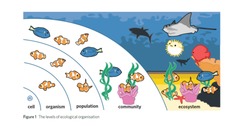
What are the five main levels of ecological organization?
Cell, Organism, Population, Community, Ecosystem.
What does population size refer to?
The total number of members within a given population.
What is carrying capacity?
The maximum number of individuals an environment can support and sustain.
What factors can alter a population's size?
Total births, deaths, immigration, and emigration.
How is population distribution defined?
The geographical spread of a species across different areas.
What are the three types of population distribution?
Uniform, random, and clumped.
What does population density refer to?
The number of individuals found in a given area, such as individuals per square kilometer.
What are density-independent factors?
Factors that affect populations regardless of their density, such as rainfall.
What are density-dependent factors?
Factors that have a more intense influence as population density increases, such as disease.
What is the role of keystone species in an ecosystem?
They play a disproportionately large role in maintaining ecosystem structure and composition.
What happens when a keystone species is removed?
It typically has a larger effect on the ecosystem than the removal of other species.
What are two common roles that keystone species fulfill?
Apex predators and ecosystem engineers.
What is mutualism?
A type of interaction where both species benefit.
What is parasitism?
A type of interaction where one species benefits at the expense of another.
What is predation?
An interaction where one species (predator) hunts and consumes another (prey).
What is competition in ecological terms?
An interaction where two species compete for the same resources.
What is biodiversity?
The variety of life in a particular habitat or ecosystem.
What influences the births and deaths in a population?
Biotic and abiotic factors within the ecosystem.
How can population change be predicted?
Using the population growth model.
What is the significance of understanding population distribution?
It helps in understanding how species interact with their environment and each other.
What can cause changes in population distributions over time?
Environmental factors such as temperature, rainfall, invasive species, and habitat loss.
What is the impact of resource availability on population distribution?
It can lead to clumped distributions around resources.
What is the relationship between population density and resource competition?
Higher population density can lead to increased competition for limited resources.
Why is calculating the true size of a population difficult?
Due to the influence of various biotic and abiotic factors.
What is the ecological role of apex predators?
They help regulate the population sizes of other species in the ecosystem.
What is the role of ecosystem engineers?
They modify the environment, creating habitats for other species.
What does the term 'interdependencies' refer to in ecology?
The reliance of species on each other for survival and ecosystem stability.