Chapter 9 Plant Transport
 Call Kai
 Learn
Learn Practice Test
 Spaced Repetition
 Match
Match Flashcards
 Knowt Play
1/134

Earn XP
Description and Tags
Name | Mastery | Learn | Test | Matching | Spaced | Call with Kai | Chat |
|---|
No analytics yet
Send a link to your students to track their progress
135 Terms
What is a low power plan?
a scientific drawing that shows structures in proportion but with no cellular detail
How are the xylem vessels and phloem tissues arranged in the root of a dicot plant?
there is a central core of xylem vessel in an X-shape, with phloem tissue between the arms of the X-shape
Describe the cells surrounding the vascular bundle in a root and their function
There are meristem cells (that differentiate to xylem and phloem) called the pericycle, and surrounding this is the endodermis, which regulates water movement into the xylem vessels
How is the arrangement of vascular bundles in roots structurally advantageous?
it provides strength to withstand the pulling forces to which the roots are exposed when the stem is blown in the wind
Where are vascular bundles found in stems of dicot plants and why?
on the outer edge of the stem for structural support
Describe the arrangement of cells and tissue in vascular bundles in stems
xylem vessel - inside of vascular bundle
phloem tissue - outside of vascular bundle
cambium - in between xylem and phloem
fibrous cap - on outside
What is cambium?
meristem cells found in vascular bundles in stems
What is the purpose of vascular bundles in the stem having a fibrous cap?
protection
True or false? xylem vessels in roots have larger lumens than xylem vessels in stems
false - the lumen is wider in stems
Fill in the blanks: In dicot leaves, vascular bundles from the ___ and ___ of a leaf, which branch and get smaller as they spread away. The ___ is located on top of the ___.
midrib, veins, xylem, phloem
Why is the position of vascular bundles in the leaf structurally beneficial?
The veins provide structural support so that the leaf can remain flat and open to absorb maximum sunlight for photosynthesis
When viewing vascular bundles, which differential stain can be used?
Toluidine blue
Correct the statement: the stain Toluidine blue stains the cytoplasm of xylem vessels blue
cytoplasm → lignin
blue → red
True or false? Plants have higher metabolic demands than animals due to photosynthesis
false - plants metabolic demands are lower
What is mass flow?
the bulk movement of materials directed by a force
What is a dicotyledonous (dicot) plant?
a plant that has 2 seeds leaves, and makes seeds that contain 2 cotyledons (organs that act as food stores)
Why do plants need a transport system?
metabolic rate - although oxygen can be transported by diffusion (as the respiration rate is low enough), water, assimilates, mineral ions and hormones need transporting
size - materials must be moved throughout the whole plant
SA:V ratio - although leaves have a large SA and can rely on diffusion the rest of the plant has a low SA:V ratio
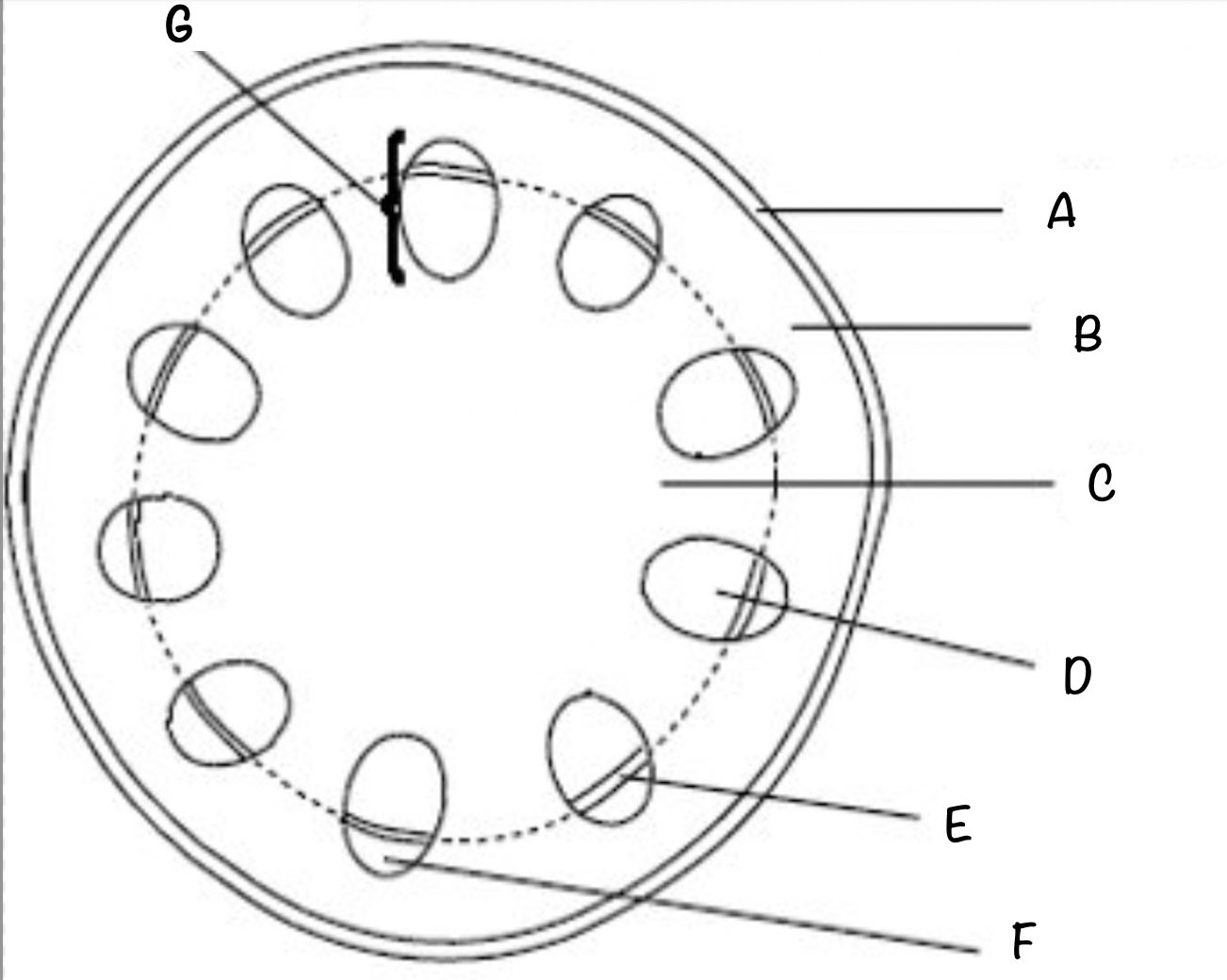
Label parts D, E and F
xylem, cambium, phloem
Label A, B and C
epidermis, cortex, pith
In what part of a plant (root, stem or leaf) would this transverse section be found?
stem
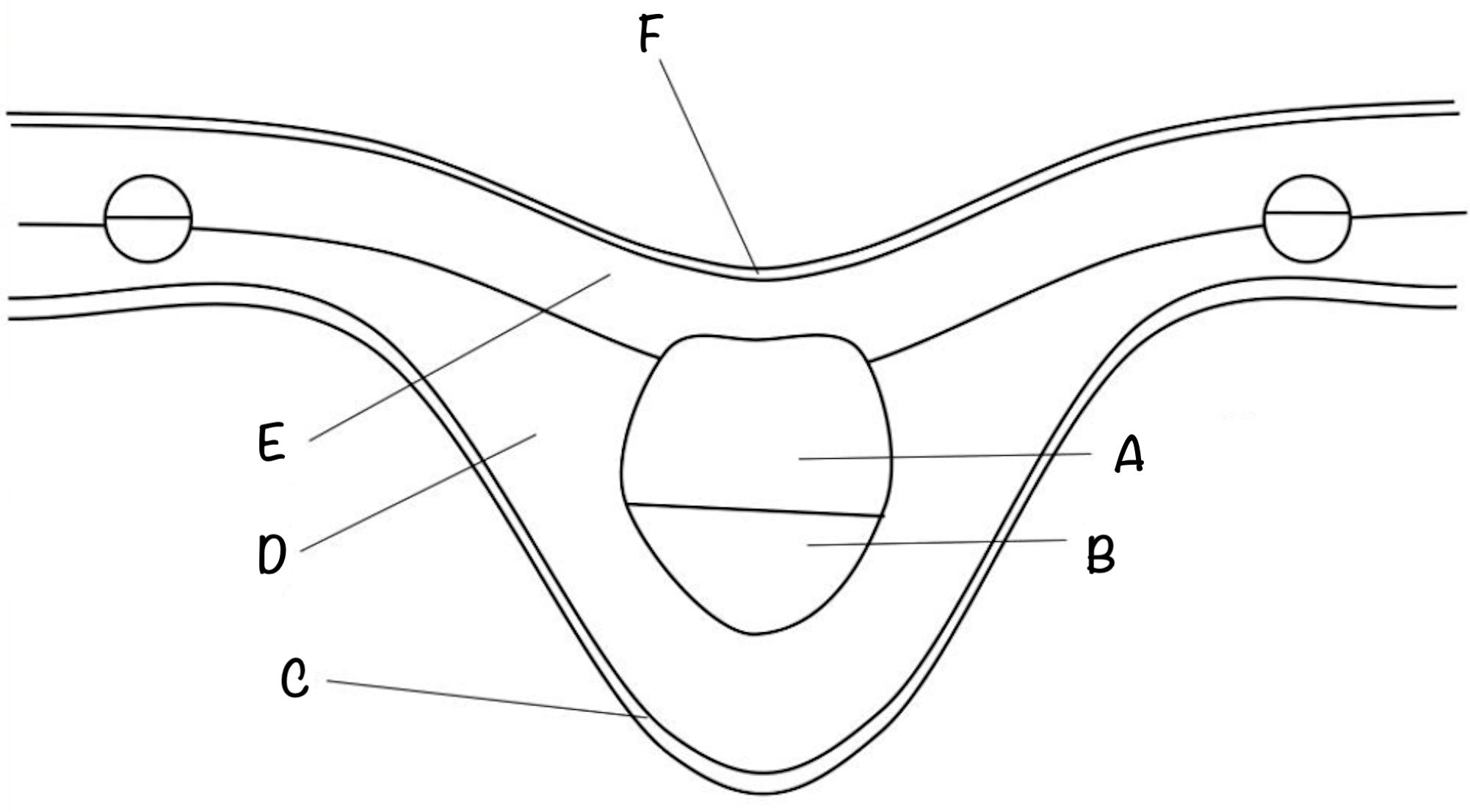
In what part of a plant (root, stem or leaf) would this transverse section be found?
leaf
Label parts A and B
A - xylem, B - phloem
Label parts C and D
C - lower epidermis, D - spongy mesophyll
Label parts E and F
E - palisade mesophyll, F - upper epidermis
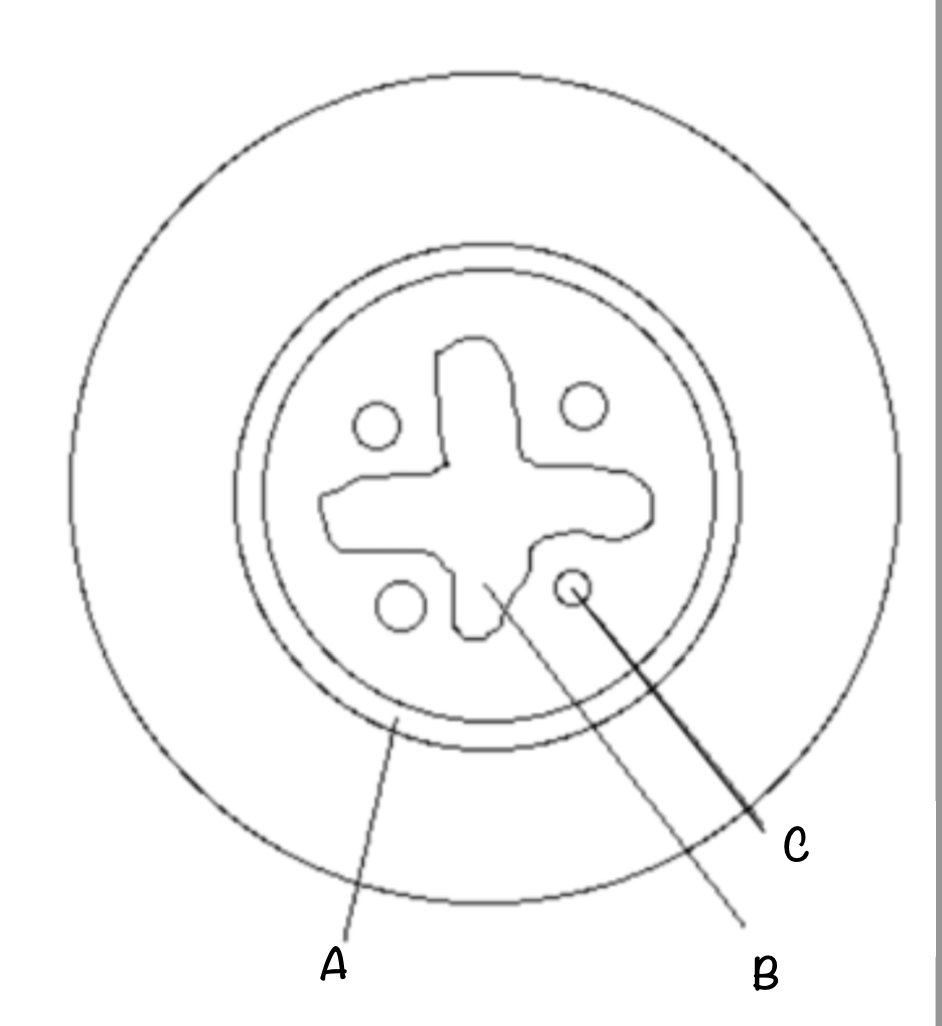
In what part of a plant (root, stem or leaf) would this transverse section be found?
root
Label part A
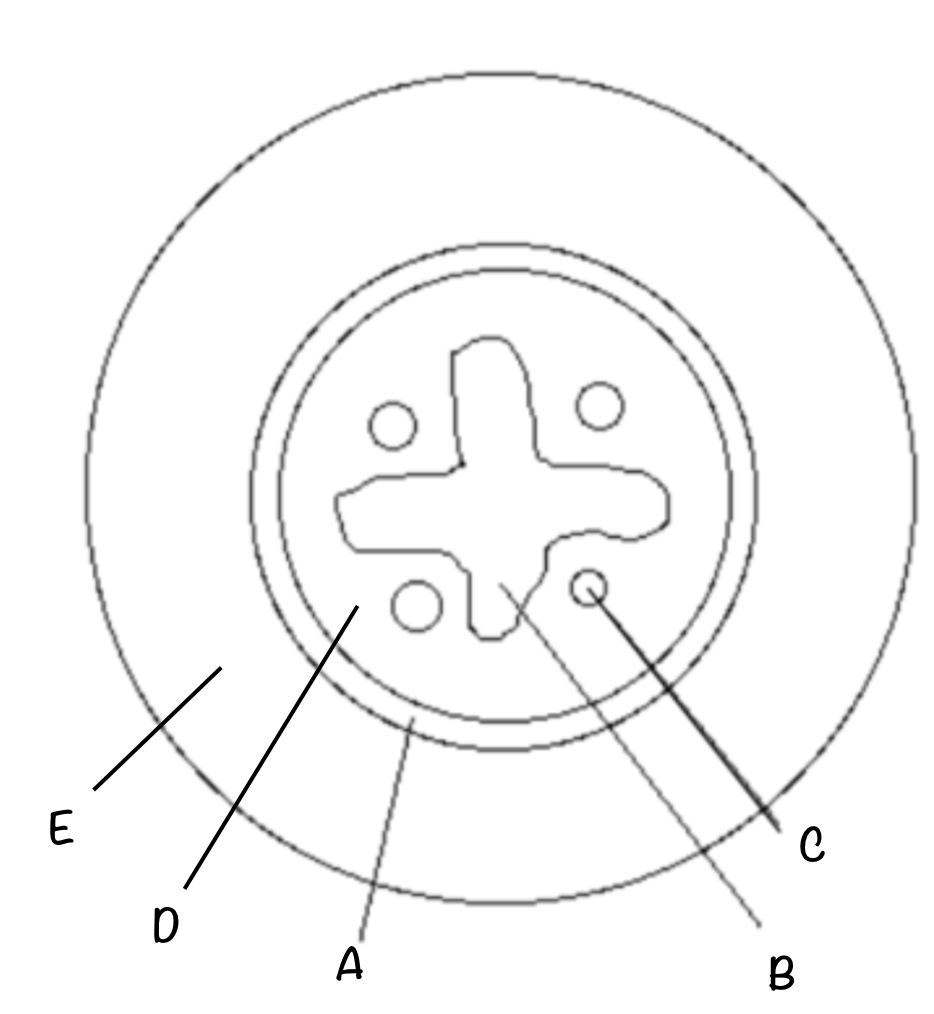
Label parts B, C and D
B - xylem, C - phloem, D - pericycle
Label parts A and E
A - endodermis, E - cortex
What are the 2 functions of xylem vessels?
transport of water and mineral ions
structural support
Why do xylem vessels give plants structural support?
the lignified cellulose cell walls have a high tensile strength
What are xylem vessels made from, and describe their basic structure?
made from dead xylem cells which are aligned end to end to form a continuous hollow column
What is the substance that is used to waterproof xylem cells?
lignin
Why is it important that the lignified cell walls have a high tensile strength?
they hold the xylem vessel open, keeping it from collapsing even when water is in short supply
Fill in the blanks: as xylem vessels develop, they are impregnated with ___ which makes their cell walls waterproof, but ___ the cells causing the end walls and contents to decay. During this process, patterns form in the cell walls which can be ____ (spiral) rings or ___ (broken network of rings). These rings prevents the vessel from being too rigid and allows some ___.
lignin, kills, anular, reticulate, flexibility
What structures form in places where lignification is incomplete?
pits / bordered pits
What is the function of pits?
allows the lateral movement of water (for maintaining turgidity in the plant)
What 3 adaptations of the xylem vessels ensure that the flow of water is not impeded?
no end walls
no cell contents
lignin to prevent collapsing
What are the 2 elements of phloem tissue?
sieve tube elements and companion cells
Describe the sub cellular structures found in sieve tube elements
there is no nucleus or sub cellular structures and very little cytoplasm
Describe the basic structure of the sieve tubes of phloem tissue
elongated sieve tube elements are lined up need to end to form the sieve tubes
Do sieve tube elements contain lingin?
no
True or false? sieve tube elements have thick walls to maintain a pressure gradient
false - they are thin so substance can diffuse/move by osmosis in/out
Describe the structure and function of the end walls of sieve tube elements
there are perforated end walls, called sieve plates, which allow the movement of sap between cells
Describe the sub cellular structure of a companion cells
large nuclei
dense cytoplasms
numerous mitochondria (for ATP for active loading of sucrose)
How are the companion cells and sieve tube elements linked together?
plasmodesmata
Give 3 reasons why water is important for both the structure and metabolism of plants
turgor/hydrostatic pressure (due to osmosis) supports stems and leaves
turgor drives cell expansion (allowing plant root to grow through hard surfaces)
loss of water by evaporation keeps plants cool
water is a reactant in photosynthesis
water is needed for the transport of mineral ions and sugars (in aqueous solution)
What is water potential?
The total potential energy of the water molecules in a system. It is a measure of the tendency for water molecules to diffuse from one place to another down a concentration gradient
What is the water potential of pure water?
0
Do solutions have a more positive or negative water potential than pure water?
more negative
Choose the correct words: water moves from a more/less negative water potential to a more/less negative water potential
less, more
How are root hair cells adapted as exchange surfaces?
microscopic size allows penetration of soil particles
large SA:V ratio due to root hairs
thin surface layer (cell wall and membrane) for rapid diffusion/osmosis
concentration of solutes in cytoplasm maintains a water potential gradient between the soil and cells
Describe how water moves into a root hair cell
Mineral ions diffuse or are actively transported into the root hair cell (RHC) using energy from ATP. This lowers the water potential of in the cytoplasm of the RHC, creating a steep water potential gradient with the soil. Water moves into the RHC by osmosis, down the water potential gradient from a higher water potential in the soil to a lower water potential in the root hair cell across a selectively/partially permeable membrane
Why may the rate of transport of water into the root hair cells decrease in waterlogged soil, even though water is more readily available?
In waterlogged soil, there is less oxygen for aerobic respiration, so less ATP is produced for the active transport of mineral ions, so the steep diffusion gradient is less well maintained
How (briefly) does water move from the root hair cells, through the cortex cells?
The water potential of the RHC is higher than that of the cortex cell, so water (and dissolved mineral ions) move across the cortex by osmosis down a series of water potential gradients
Name the 2 pathways by which water can move through cortex cells
apoplast and symplast pathway
Fill in the blanks: When water move through the apoplast, it moves between _____ strands of the ___ ___ and through ____ spaces. As it doesn’t pass through any plasma membranes, it moves by ____ due to ____ forces between the water molecules, and it can carry mineral ions and salts
cellulose, cell wall, intracellular, mass flow, cohesive
What is the symplast? How does water move through the symplast pathway?
The symplast is the continuous cytoplasm of the plant cells that are connected through the plasmodesmata. Water moves by osmosis along a series of concentration gradients.
What is the layer of cells surrounding the xylem in the root calls?
endodermis
What is found in a waxy, strip around endodermal cells?
casparian strip
What waterproof substance is the Casparian strip made of?
suberin
What is the function of the Casparian strip?
The Casparian strip blocks the apoplast pathway, forcing water into the symplast pathway before it reaches the xylem vessel
Why is the Casparian strip needed? Give 2 reasons
It moves mineral ions into the endodermal cells, which is needed to move the water into the xylem
it is a physical defence mechanism as the selectively permeable membranes of the endodermal cells block pathogen
How is water moved from the endodermis into the xylem?
Mineral ions are actively transported into the xylem, lowering the water potential. Water moves down a water potential gradient from the endodermal cells, into the xylem vessel
True or false? the Casparian strip also blocks the back flow of water out of the xylem
true
Name the 3 processes that enable water to move up the stem in the transpiration stream
root pressure, capillary action, transpiration pull
What is root pressure?
the pressure of water being forced into the xylem at the roots caused by the active transport of mineral ions into the xylem from the endodermal cells
True or false? root pressure is the main factor that drives water up the stem
false - it is the least significant factor
Fill in the blanks: Capillary action is caused by the water molecules being ___ (property of water), so they form _____ ___ with the walls of the ____ (narrow/wide) xylem vessels, becoming attracted to them by ____. This pulls water up the sides of the vessels.
charged/polar, hydrogen bonds, narrow, adhesion
Fill in the blanks: Transpiration pull - As water molecules are ___ (property of water), they are attracted to each other by forces of ___, which hold the water molecules together in a ___ ____.
charged/polar, cohesion, continuous column
By what process of movement is water moved up the stem?
mass flow
What is transpiration?
the evaporative loss of water vapour from the aerial parts of a plant
What 3 processes does transpiration involve?
osmosis of water from the xylem vessels into mesophyll cells
evaporation from the surface of the spongy mesophyll cells into intracellular (air) spaces
diffusion of water molecules out of the intracellular spaces through the stomata
What is the transpiration stream?
the effect of water being pulled up the plant in a continuous column to replace water lost by evaporation from the leaves
What is the cohesion-tension theory?
the ‘pull from above’ in transpiration creates tension in the column of water (lignification prevents the vessel from collapsing under this pressure), and this relies on a continuous cohesive column of water to be maintained
If a xylem vessel is damaged, how can the cohesion-tension theory still be maintained?
water moves into adjacent xylem vessels through pits
What can the intracellular spaces between the spongy mesophyll cells and stomata also be called?
substomatal cavity
How do guard cells increase turgor?
guard cells passively become turgid when there is adequate water in the plant. This can be increased further by the guard cells actively transporting potassium (K+) ions into the cells, lowering the water potential, so more water moves in by osmosis
How does the structure of the guard cells allow to swell into ‘bean-shapes’?
cellulose hoops prevent the cells swelling in width
inner cell walls are less flexible than the outer walls
What happens to guard cells during a water deficiency?
A plant hormone (abscisic acid) is produced in the root, which travels up the transpiration stream, and causes the potassium ions to move out of the guard cells, increasing the water potential, so water moves out by osmosis and the guard cells become flaccid, closing the stomata
How does increasing light intensity affect the rate of transpiration?
it increases the number of stomata open for gas exchange, so increases rate of water vapour diffusing out, so increases transpiration rate
How does increasing relative humidity affect the rate of transpiration?
decreases rate of transpiration and it lowers the steepness of the water potential gradient between the inside and outside of leaf
What is relative humidity a measure of?
the amount of water vapour in the air (humidity) compared to the total concentration of water the air can hold
How does increasing temperature affect the rate of transpiration?
increases transpiration rate as
increases kinetic energy of water molecules, so they evaporate faster
increases the concentration of water vapour the external air can hold before it becomes saturates (so decreases relative humidity)
which both increase the diffusion gradient
How does increasing air movement affect the rate of transpiration?
higher air movement outside the leaf carries away water vapour maintaining a high water vapour potential gradient, increasing the rate of transpiration
How does a low soil water availability affect the rate of transpiration?
the plant can’t replace the water lost, so the stomata close and leaves wilt, reducing the rate of transpiration
How does the presence of a cuticle affect the rate of transpiration?
the waxy coating is hydrophobic so water cannot move through it, decreasing transpiration rate
Which of these factors can also affect the rate of transpiration?
A - turgidity of plant
B - number of leaves
C - density of plant cells
D - number, size and position of stomata
B and D
True or false? you can directly measure transpiration
false
What assumption has to be made when using a potometer?
The rate of water uptake (measured by the potometer) is equal to the rate of water lost through transpiration
Is measuring transpiration with a potometer 100% accurate?
no as some water is in photosynthesis and used/produced in other reactions, and it assumes the cells are turgid
Describe how to set up the shoot cutting in the potometer
cut the shoot underwater and at an angle (to provide large SA)
seal the stem in the potometer using waterproof gel such as vaseline (removes air bubbles and makes air tight)
dry the leaves
How do you calculate the rate of transpiration?
volume of water uptake (pi x r2h) / time
How can you investigate how the rate of airflow affects the rate of transpiration?
use a fan or hairdryer (but hairdryer may add heat)
How can you investigate how the humidity affects the rate of transpiration?
spray water in a plastic bag and wrap it around the plant
How can you investigate how the light intensity affects the rate of transpiration?
change distance of plant from a lamp (use a glass screen to remove heat)
How can you investigate how the temperature affects the rate of transpiration?
change the temperature of the room
Why might some potometers have a reservoir?
water can be let back into the capillary tube, pushing the air bubble back to the start of the scale, so multiple readings can be done
How can you make the air bubble more visible in the potometer?
place the end of the capillary tube in coloured dye
What is translocation?
the movement of assimilates through the phloem tissue
What are assimilates?
substances made by the plant such as sugars