ChE design Part A
 Call Kai
 Learn
Learn Practice Test
 Spaced Repetition
 Match
Match Flashcards
 Knowt Play
1/38

There's no tags or description
Looks like no tags are added yet.
Name | Mastery | Learn | Test | Matching | Spaced | Call with Kai | Chat |
|---|
No analytics yet
Send a link to your students to track their progress
39 Terms
ChE design activities
create a plan of action and set of detailed specifications, which, if implemented, will lead to a predicted financial outcome.
DESIGN
a creative activity • one of the most rewarding and satisfying activities by an engineer • does not exist at the start of the project
DESIGN
begins with a specific objective or customer need in mind, and by developing and evaluating possible designs, arrives at the best way of achieving that objective (ex. a better chair, a new bridge, a new chemical product or production process)
Design Alternatives
When considering possible ways of achieving the objective, the designer will be constrained by many factors, which will narrow down the number of possible designs.
• There will rarely be just one possible [design] solution to the problem.
• Several alternative ways of meeting the objective will normally be possible, even several best designs, depending on the nature of the constraints.
Design Constraints
Fixed and invariable constraints,
Less rigid constraints
Fixed and invariable constraints,
constraints that arise from physical laws, government regulations, and standards.
Less rigid constraints
constraints that can be relaxed by the designer as part of the general strategy for seeking the best design.
External constraints
constraints outside the designer’s influence; set the outer boundary of possible designs
Internal constraints
constraints within the designer’s control, e. g. choice of process, choice of process conditions, materials, and equipment
Major Design Constraints
Economic considerations
Time
iterative
Design is an _____ procedure
as the design develops the designer will be aware of more possibilities and more constraints, and will be constantly seeking new data and ideas, and evaluating possible design solution
Nature of Design: The Design Process
1 The Design Objective (Determine Customer Needs)
2 Setting the Design Basis (Set Design Specifications
3 Generation of Possible Design Concepts
4 Fitness Testing
5 Economic Evaluation, Optimization and Selection
6 Detailed Design and Equipment Selection
7 Procurement and Construction
sub-objectives
the requirements of the various units that make up the overall
Should haves
are parts of the initial specification that may be thought desirable, but that can be relaxed if required as the design develops
statement of the requirements.
Before starting work, the designer should obtain a complete and unambiguous ________
translating the customer need into a design basis
The most important step in starting a process design is _________
Design Basis
a more precise statement of the problem that is to be solved
me third” syndrome
technology that is not well proven
not invented here” syndrome
innovation is wanted, previous experience, through prejudice, can inhibit the generation and acceptance of new ideas
sketch out a rough block diagram and to list the primary function (objective) and the major constraints
first step in devising a new process design
The Anatomy of a Chemical Manufacturing Process
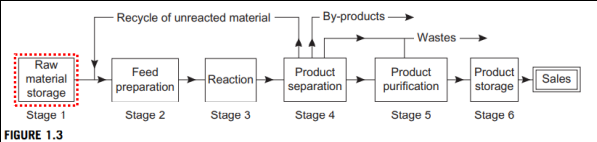
Raw material storage
Anatomy of a Chemical Manufacturing Process stage 1
Feed preparation
Anatomy of a Chemical Manufacturing Process stage 2
Reaction ( hear of chemical manufacturing process)
Anatomy of a Chemical Manufacturing Process stage 3
Product separation
Anatomy of a Chemical Manufacturing Process stage 4
Product purification
Anatomy of a Chemical Manufacturing Process stage 5
Product storage
Anatomy of a Chemical Manufacturing Process stage 6
Ancillary Processes
provision must be made for the supply of the services (utilities) needed
Continuous processes
are designed to operate 24 hours a day, 7 days a week, throughout the year. • Some down time will be allowed for maintenance and, for some processes, catalyst regeneration.
plant attainment or operating rate
the percentage of the available hours in a year that the plant operates (usually 90-95%).
Attainment%

Batch processes
are designed to operate intermittently, with some, or all, of the process units being frequently shut down and started up.
Phase 1: Process design
Phase 2: Plant design
The Organization of a Chemical Engineering Project phases
Phase 1: Process Design
Covers the steps from the initial selection of the process to be used, through to the issuing of the process flow-sheets
Includes the selection, specification and chemical engineering design of equipment.
Phase 2: Plant Design
Includes the detailed mechanical design of equipment, the structural, civil and electrical design, and the specification and design of the ancillary services
project design
The ________ should start with a clear specification defining the product, capacity, raw materials, process and site location.
project manager
the ______ will ensure that intermediate deliverables identified in the project plan are completed on time and that the project is kept close to the planned budget.
operating company
The technical “know-how” for the process could come from the ________ or could be licensed from the contractor or a technology vendor.
teamwork
communications
project management
Good ________, ____________ and ________ are critically important in ensuring that the project is executed successfully.